Article rewriting means reshaping an existing article into new wording and structure while keeping its central ideas, facts and intent, and giving credit where the ideas come from another author.
You might have an old blog post that needs refreshing, a source you need to explain in an essay, or a draft that doesn't suit its readers. The difficult part isn't finding different words. It's deciding what you can change without altering the article's original meaning.
What Article Rewriting Means in Practice
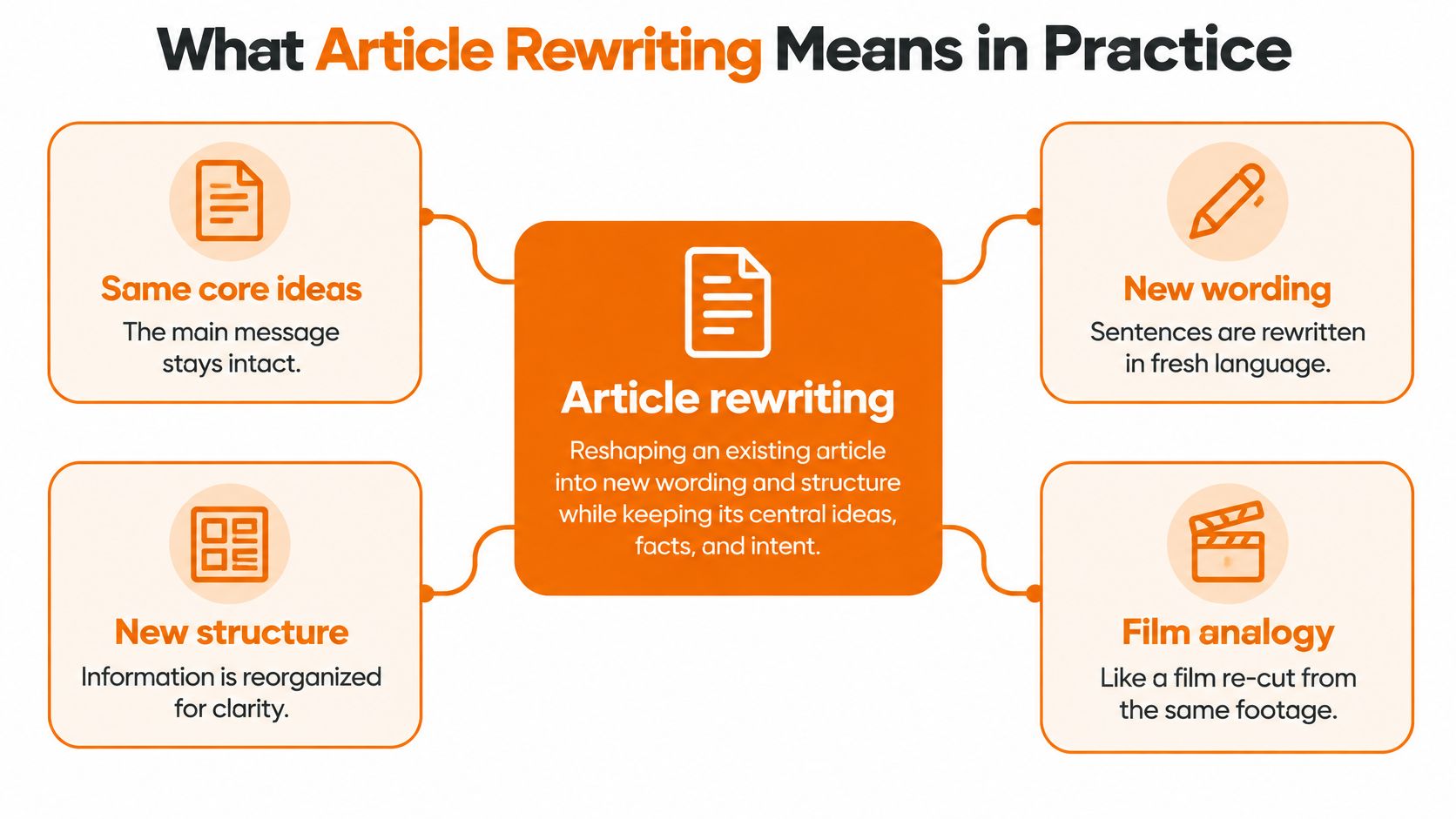
Think of rewriting as a film re-cut from the same footage. The scenes remain, but an editor changes their order, pacing and transitions for a different audience. A rewrite works similarly, provided the new arrangement doesn't suggest a different story.
Sentence structure, word choice, paragraph order and emphasis can change. The main claims, relevant numbers and dates, cause-and-effect relationships, and author's purpose must remain accurate.
The distinction is easier to see as a map of what changes and what stays.
Change the expression, not the evidence
In academic writing, this practice is commonly called paraphrasing. A 2019 study in the Getsempena English Education Journal found that more than 70% of sampled students understood the distinction between paraphrasing and plagiarism.
Knowing the distinction doesn't make execution automatic. Replacing words individually can leave the source's sentence pattern intact, introduce awkward phrasing, or substitute a term with a different technical meaning.
Common reasons to rewrite include:
- Refreshing a post: Replace outdated information with verified updates while preserving what remains valid.
- Adapting a guide: Explain specialist material to beginners without removing necessary qualifications.
- Discussing a source: Express another author's idea independently and provide credit.
Rewriting also isn't identical to humanizing. Making AI-assisted prose sound more natural, the purpose of an AI humanizer, concerns voice and rhythm; restating an article concerns the relationship between the source and the new version.
A natural-sounding passage can still misrepresent its source. Conversely, a faithful paraphrase can still need stylistic editing.
Practical rule: A reader should be able to match each retained claim to the original without discovering an unexplained omission, addition or change.
Rewriting, Paraphrasing and Summarizing Compared
| Factor | Rewriting | Paraphrasing | Summarizing |
|---|---|---|---|
| Main goal | Reshape an article for a new purpose, audience or freshness | Restate one passage in new words | Reduce a source to its main points |
| Length compared with source | Often similar, sometimes shorter or longer | About the same length | Much shorter |
| Detail kept | Key claims and facts, plus new framing and examples | Nearly every idea in the passage | Only the central ideas |
| Typical use | Updating a blog post or adapting a guide for a new audience | Using a source's idea in an essay | Writing an abstract or executive brief |
| Credit needed | Yes, for ideas and facts taken from another author | Yes | Yes |
The terms overlap, but they don't describe exactly the same job. A writer can paraphrase individual passages and summarize background material while rewriting an entire article.
Purdue OWL's guidance for multilingual writers explains that a full paraphrase generally stays about the same length as, or slightly shorter than, its source. A summary deliberately removes secondary details.
The same passage, different jobs
Consider this illustrative passage:
Regular exercise supports cardiovascular health because it strengthens the heart and helps circulation. A beginner's guide should explain both the benefit and the reason behind it.
A paraphrase might read:
By strengthening the heart and supporting circulation, regular exercise benefits cardiovascular health. Guidance for beginners should connect that benefit with its explanation.
The wording and sentence arrangement change, but the supporting explanation remains.
A summary might read:
The passage explains the cardiovascular benefits of regular exercise.
That version identifies the topic and central point. It doesn't preserve the explanation or the recommendation for beginner guidance, so it shouldn't substitute for a full paraphrase when those details matter.
A whole-article rewrite could use the paraphrased explanation, introduce a beginner's question, and add a clearly sourced update or practical example. The added material must be distinguishable from what the original author established.
Use paraphrasing when you need a source's specific idea, summarizing when readers need an overview, and rewriting when the article itself needs a different presentation. For more examples of that boundary, use this guide to distinguishing summarizing from paraphrasing.
How to Rewrite an Article Step by Step
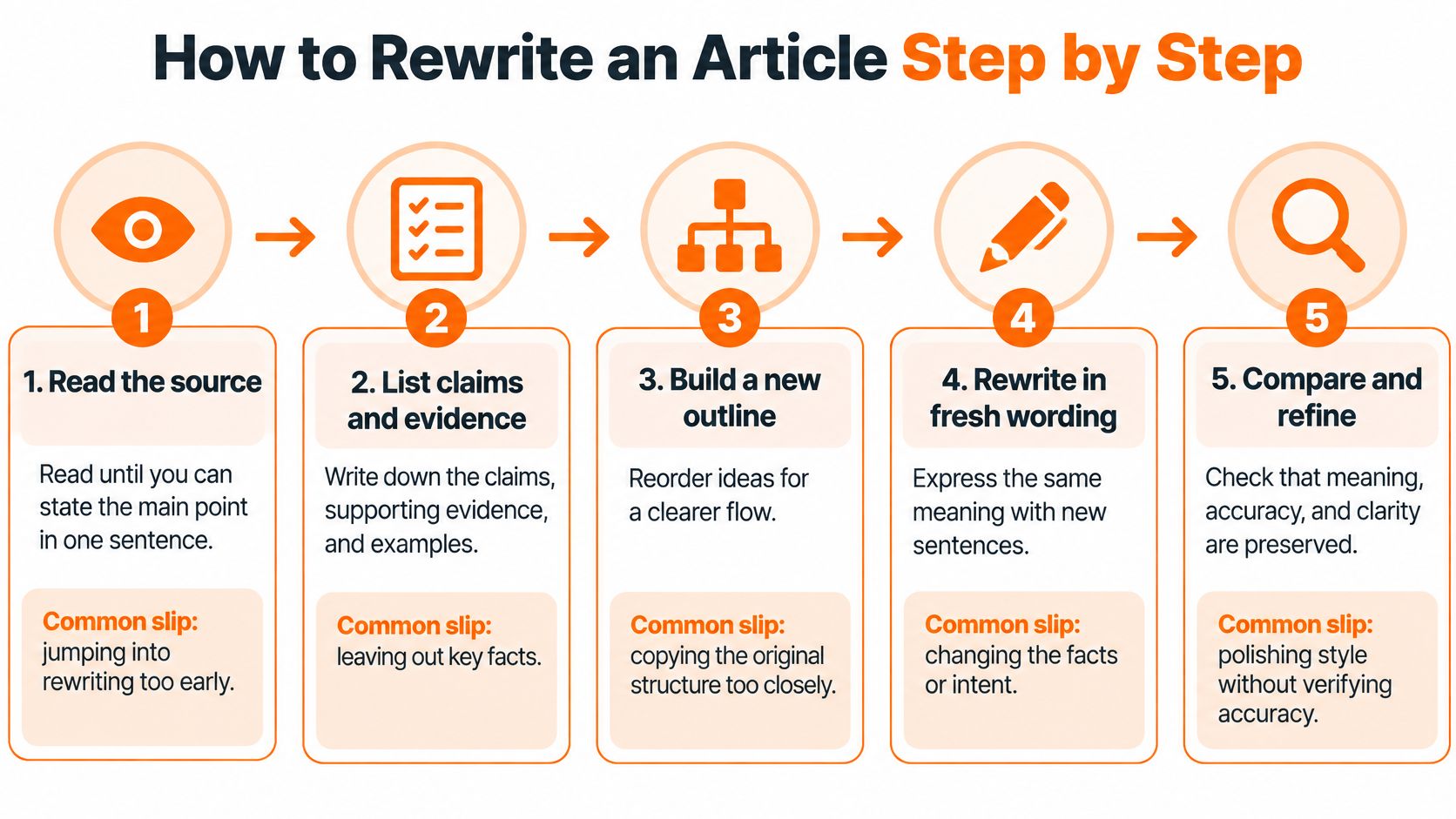
A reliable method separates understanding, drafting and verification. Purdue OWL's paraphrasing guidance recommends reading until the meaning is clear, setting the source aside, drafting independently, and comparing the result with the original.
This visual groups the work into a practical editing sequence.
-
Understand before drafting. Read until you can state the article's main point in a sentence, including its important qualification. The common slip is beginning with the opening paragraph before understanding the overall argument.
-
Make a claim inventory. To prevent omissions, list the claims, supporting evidence and examples, then record every relevant number, name and date. Mark essential details so an interesting anecdote doesn't displace the evidence readers need.
-
Draft from notes, not visible sentences. Independent wording is easier when you close the source and explain the material from your notes. Don't substitute vague language for a technical term you haven't understood.
-
Organize around the new reader. A beginner may need an example before the general principle, while a specialist may need the conclusion first. Reorder the material without separating a claim from the qualification that limits it.
-
Compare claims against the source. Accuracy requires a deliberate check of names, dates, quantities, negations and words such as may, must and will. Reading only for smoothness won't reveal whether you've strengthened a tentative conclusion.
-
Add a useful contribution. When the assignment permits it, provide a verified update, a relevant local example or clearly identified analysis. Don't present your addition as something the source author said.
-
Attach credit to borrowed material. Readers need to know which source supports which idea, so place citations beside the relevant claims. A link at the end of an article isn't a substitute for clear attribution throughout.
Polish after verifying
The Lumi paraphrase tool can provide a first pass for clarity and variation, but its output still needs the comparison in step five.
After substantive edits, run a grammar check for spelling, agreement and awkward constructions. Review any suggested change that touches a technical term or qualification.
Give particular attention to initial comprehension and final comparison. If either fails, polished wording can conceal a misunderstanding rather than fix it.
For a demonstration alongside the written workflow, use this video.
A Before-and-After Rewrite That Keeps the Facts
Say you're editing a hypothetical blog post about page performance. The following figures are invented for the editing exercise, not evidence of an actual performance result.
Original
In our 2024 test, pages that loaded in under two seconds kept about 30% more visitors through the first session.
Weak rewrite
Fast pages keep more visitors around.
The weak version sounds simple, but it drops the year, loading threshold, approximate result and test scope. It also turns a bounded observation into a general claim.
Proposed stronger rewrite
Across our 2024 tests, pages that loaded in under two seconds held roughly 30% more visitors through the first session.
This version preserves much more information, but a careful editor should still reject tests. The original describes a single test, not several. Even a rewrite that looks faithful can expand the evidence.
A version that passes the comparison
A safer version is:
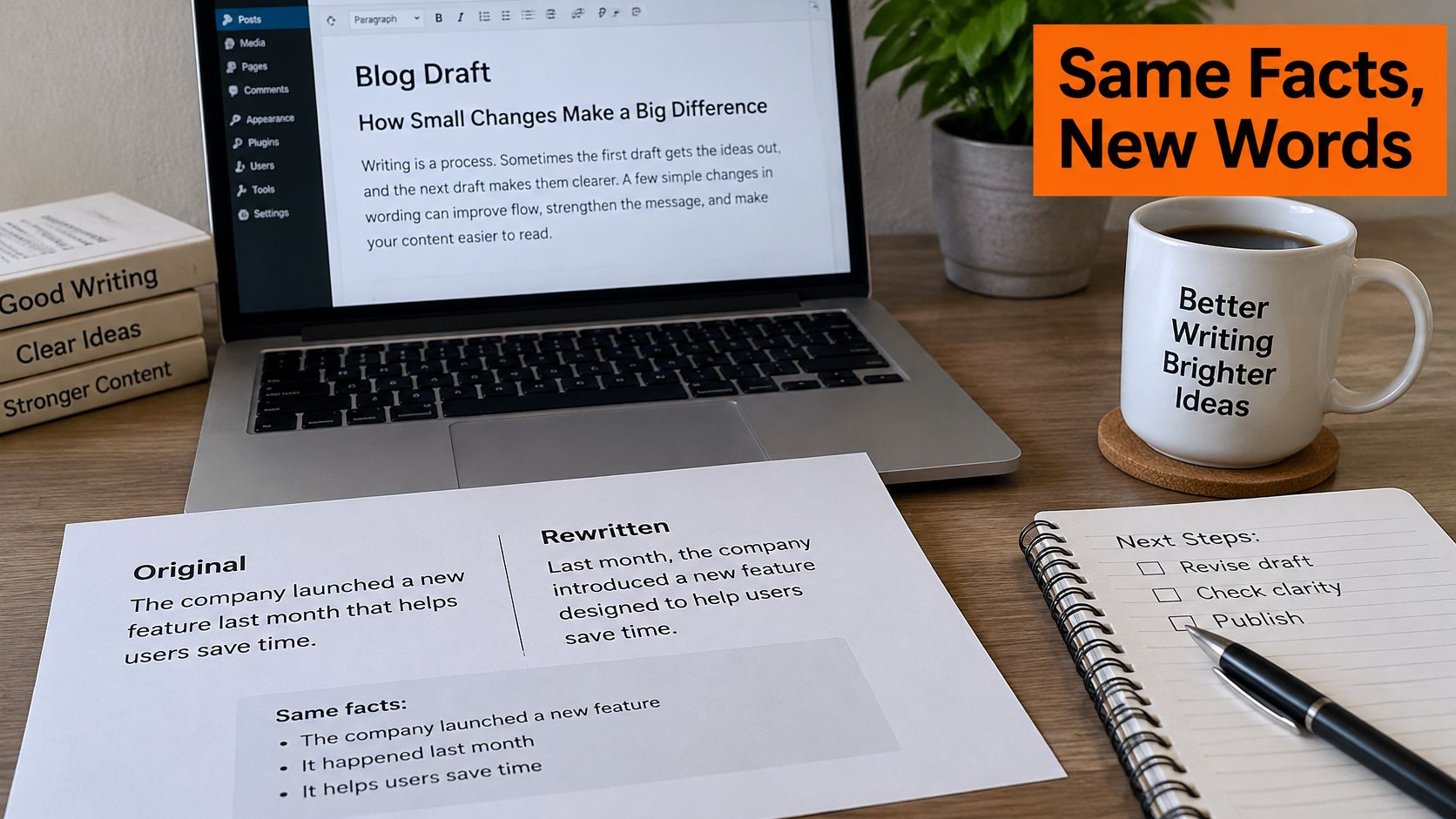
Pages loading in under two seconds retained roughly 30% more visitors through the first session in our 2024 test.
Here, the order and phrasing change while the year, threshold, approximate figure and singular test remain. Roughly matches the original's about; it isn't decorative hedging.
The workspace may look ordinary, but the important work happens in the comparison between drafts.
For a developer audience, add a separate explanation of the test setup, but only after obtaining the actual method. Don't invent device conditions, connection speeds or a measurement tool to make the passage sound technical.
For a marketing audience, lead with the result: Roughly 30% more visitors stayed through the first session on pages loading in under two seconds in our 2024 test. Keep the test limitation close to the result, even if it makes the sentence less punchy.
A further issue remains: more visitors compared with what? The original doesn't specify the comparison group. A responsible editor asks the author rather than supplying a plausible answer.
The lesson is more demanding than keeping every number. A good rewrite preserves what the evidence establishes and makes unresolved gaps visible.
Where Rewrites Quietly Change the Meaning
A rewrite can keep the topic and still change the claim. Editors call this semantic drift, and a single word can cause it. The effect works like a redrawn map: the coastline looks identical while one border moves. Drift usually arrives innocently, during compression, when a qualifier is trimmed to meet a word count and the sentence graduates from possibility to certainty.
Certain edit types break claims more often than others.
| Edit type | Original wording | Rewritten wording | What breaks |
|---|---|---|---|
| Modal verb | Remote work may reduce turnover | Remote work will reduce turnover | Possibility becomes certainty |
| Number | Survey of 40 managers in 2023 | Survey of hundreds of managers | Precision and sample size disappear |
| Negation | The method is not approved for children | The method is approved for children | The claim is reversed |
| Attribution | According to a 2023 audit | Research shows | The source can no longer be traced or judged |
| Scope | Results in the EU | Results worldwide | The claim reaches beyond the evidence |
| Causality | Sales rose because prices fell | Sales rose as prices fell | A causal assertion becomes a statement of timing |
The negation row looks too obvious to miss, yet it survives real editing. Compress "not approved for children" for length and the "not" can vanish along with the padding. The same pressure turns a dated, countable sample into a vague crowd.
Check claims, not just similarity
Paraphrase robustness research examines how changed wording can affect meaning and downstream system behavior. Semantic similarity alone isn't a reliable guarantee that an output preserves factual details, because a similarity score measures how alike two passages look, which is a different question from whether they assert the same thing.
That distinction matters most in technical, academic, legal and news writing. Two passages can discuss the same treatment, court decision or engineering process while disagreeing about who qualifies, what happened or how certain a conclusion is.
A claim-level review treats the draft as a set of assertions to verify rather than a surface to polish:
- Separate compound claims. Break a sentence into the individual assertions it contains, including exceptions and conditions.
- Protect sensitive details. Keep quantities, names, domain terminology and qualifications fixed while changing the surrounding expression.
- Compare and investigate. Check each rewritten assertion against its source, then personally review anything a contradiction or entailment check flags.
An automated check can help prioritize review. Deciding whether an attribution is sufficient or whether a technical qualification can be removed stays with the editor.
Run this comparison before publication and again after later edits that affect substance. A headline change, a shortened introduction or a last-minute cut can introduce a mismatch after the main draft has passed review.
If changing a sentence could change what a reader believes or decides, compare its wording with the original carefully enough to explain every difference.
Academic Honesty and Credit When Rewriting
Rewriting doesn't cancel the duty to credit. Purdue OWL's comparison of plagiarism policies states that borrowed information needs citation whether it's quoted, paraphrased or summarized, and warns that superficial changes can remain plagiarism even when a citation appears.
Two common shortcuts therefore fail: changing a few words doesn't establish independent expression, and adding a citation doesn't authorize copying recognizable phrasing without quotation marks.
Separate language help from authorship
A legitimate language edit helps you express an argument you understand. It becomes a different academic issue when someone or something supplies the interpretation, reasoning or analysis that the assignment asks you to produce.
Before submitting, check:
- Course rules: Confirm whether rewriting assistance is allowed for this assessment, not merely available at your institution.
- Disclosure requirements: State the nature and extent of assistance wherever your course requires it.
- Evidence of authorship: Keep notes, drafts and revision history that show how your argument developed.
- Retained wording: Put exact borrowed phrases in quotation marks and provide the required reference.
Use the drafting-and-comparison workflow with source and page details recorded in your notes, rather than editing directly over the original wording. If your draft still follows the source sentence by sentence, this guide to avoiding patchwriting can help you identify the problem.
Treat originality checks as screening
A plagiarism checker can flag passages that closely resemble a source. A clean result doesn't establish that every borrowed idea is credited, that assistance was permitted, or that the underlying thinking is yours.
The practical question isn't whether you can make a passage look different enough. It's whether your work meets the assignment's expectations for understanding, evidence and authorship.
Before submitting, close the draft and explain the argument aloud. Can you describe its reasoning, defend its evidence and answer a question about its limitations in your own words?
Publishing Safely Without Search or Rights Risk
Rewriting becomes a search problem when a publisher uses it to produce low-value duplicates. Google's spam policies identify automated transformations such as synonymizing, translating or obfuscating existing material as potential scaled content abuse when they generate large amounts of unoriginal content with little value.
The distinction isn't whether a person or an automated tool helped write the page. It's whether the publisher is serving readers or manufacturing pages primarily to manipulate rankings.
A competitor's guide with swapped synonyms and the same headings offers little independent reason to exist. An article with verified current information, tested examples, questions from a distinctly different audience and original analysis has a clearer editorial purpose.
Check whether the page should exist
Before commissioning a separate article, check whether an existing page already targets the same primary query, modifier and intent. If it does, improve that page rather than publishing another answer for the same reader need.
Then ask: Could someone who never saw the original learn something complete, accurate and useful from this rewrite?
Promotion comes later. Keyword Kick's guide to link building sites is a resource for evaluating outreach options, but distribution can't substitute for a worthwhile page.
Clear the rights and editorial checks
Copyright and attribution are separate questions. Ohio State University's explanation of derivative works describes how protection for new original additions doesn't transfer ownership of the preexisting work.
Giving credit therefore doesn't automatically grant permission to adapt protected expression. Likewise, receiving permission doesn't excuse factual errors.
Use these checks before release:
- Rights: Establish that you own the source, have appropriate permission, can use public-domain material, or have another valid legal basis. Don't assume new wording resolves rights questions.
- Value: Identify the new analysis, verified information, practical example or audience adaptation the reader gains.
- Facts: Check every material number, name, date and claim against an appropriate current source. Preserve historical context when an older figure remains relevant.
- Credit: Make the origin of borrowed ideas and information clear beside the relevant material.
There's no universal percentage of changed words that establishes enough new value. Judge the page by usefulness, accuracy and independent contribution, not a uniqueness score.
Our tools include AI Humanizer, AI Detector, Grammar, Paraphrase and Plagiarism, plus a free AI Text Cleaner. Use grammar and plagiarism checks for distinct polishing and originality tasks; this explanation of how a plagiarism checker fits into review can help define that second pass.
Always read the final output before publishing or submitting it. Tools can support review, but the person releasing the article remains responsible for its claims.
Common Questions About Article Rewriting
What is article spinning, and is it the same as rewriting?
Article spinning usually means automatically substituting words or phrases to create another version. It differs from careful rewriting because the substitution process doesn't itself establish that the claims, logic and source context survived.
A spun article may look different while preserving the original's weaknesses or introducing new errors.
How do I rewrite a long article without losing track?
Work section by section with a claim inventory beside your draft. Mark each essential claim as retained, deliberately summarized, replaced with a verified update or removed for a stated editorial reason.
Check each section before moving on, then review the complete article for contradictions introduced by reordering.
Does rewriting improve rankings by itself?
No. Different wording alone doesn't give readers a better answer, and it doesn't guarantee better search performance.
Verified updates, useful examples and independent analysis provide a stronger reason to publish than surface-level variation.
If you're asking what is article rewriting in practical terms, start with a single section in the Lumi paraphrase tool and compare its output with the source before accepting any change.
Lumi Humanizer offers tools for rewriting, grammar review, originality checks and making AI-assisted prose sound more natural. Visit Lumi Humanizer, try a section you understand well, and review the result claim by claim before using it in your final article.