A credibility checklist isn't enough to tell you whether a source belongs in your essay. To learn how to evaluate sources for an essay, check who produced the information, trace the claim to its original evidence, and compare it with independent sources. A polished page or scholarly label is a starting point, not proof that the sentence you want to cite is supported.
Screen Every Source in Five Minutes
A beautiful website can be wrong, and a plain one can be careful. Before you read closely, spend about five minutes on six checks: author, date, evidence, purpose, audience, and references. The key question is narrow: can the exact sentence you want to cite survive a trip back to its evidence and a comparison with independent coverage?
Purdue OWL's source-evaluation guidance recommends checking expertise, audience, evidence, dates, references, and independent confirmation. The screen below turns those checks into a repeatable sorting habit, so a weak page fails early instead of consuming your research time.
Six-check quick screen
| Check | Where to find it | Red flag |
|---|---|---|
| Author | Byline, about page, contributor list | No name, no credentials, or a generic team account |
| Date | Publication line and last-updated note | Undated, or too old for a claim about current conditions |
| Evidence | Links, data sources, methods section | Claims with no source, or sourced only to other articles |
| Purpose | About page, funding note, ads or sales pitch | Hidden sponsor or a product being sold |
| Audience | Introduction, tone, intended readers | Written mainly to provoke rather than inform |
| References | Bibliography or in-text citations | Citations that go nowhere or loop back to the same site |
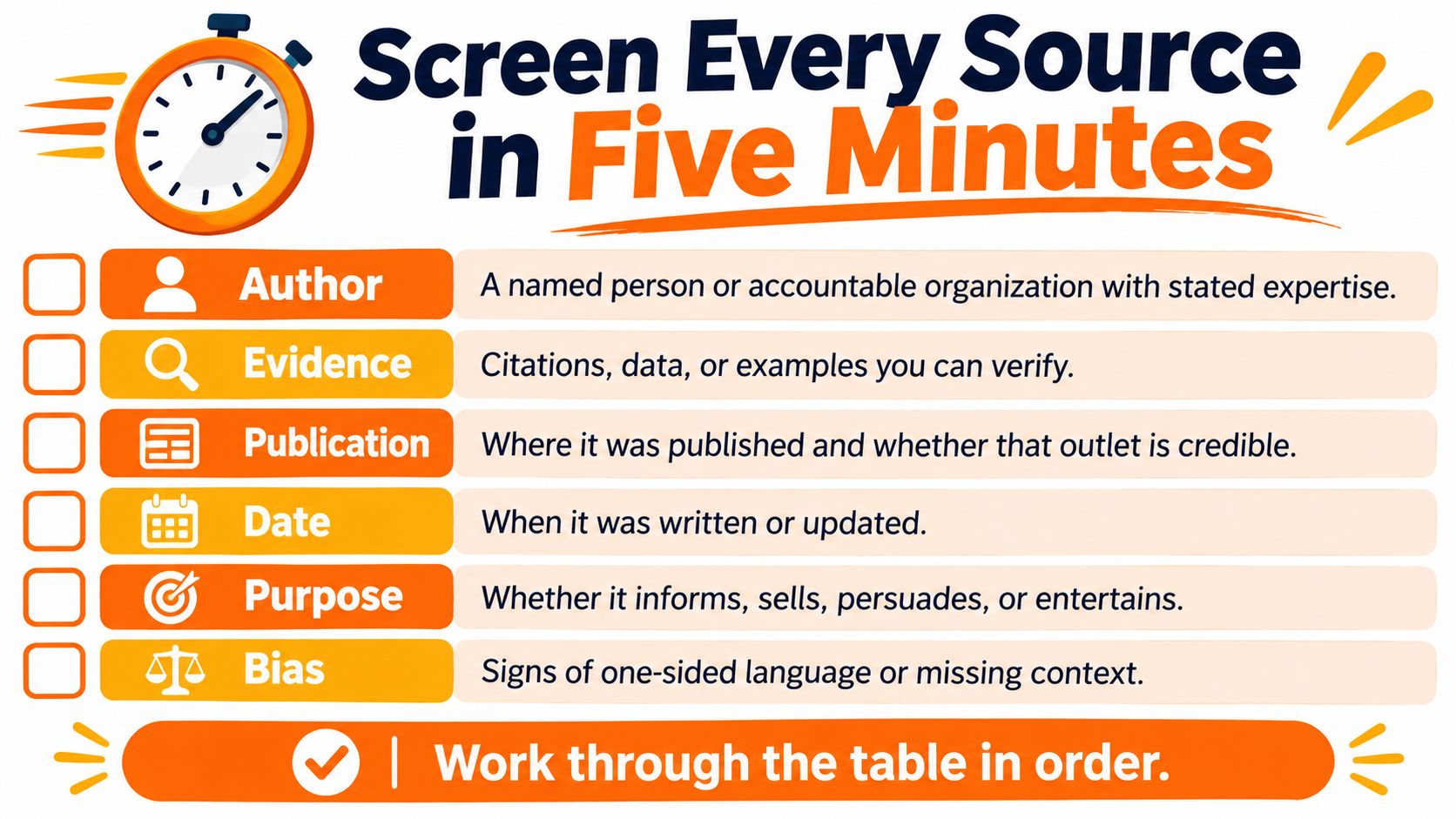
Work through the table in order. Look for an accountable person or organization first, then judge whether the date suits your question. An older historical document may be exactly what you need, while an undated page is a poor choice for a claim about current conditions.
At the evidence row, open one or two links rather than admiring the citation count. The screen works like a ticket check: it decides what gets into the deeper reading stage, where the claim still has to match its original evidence. A sales pitch does not make information false, but it gives you a reason to examine which findings the author includes or leaves out. Accessible language is fine; language designed mainly to provoke deserves closer scrutiny.
Use this visual checklist as a reminder while screening.
Recognize when to move on
An undated blog post with a generic Research Team byline, no outbound links, and citations pointing only to its own pages fails the author, date, and references checks before you examine its argument. The same test applies to a human page, a dataset, or an AI summary.
For a biology essay, you might encounter VirusFAQ.com's explanation of how viruses hijack host cells. Run it through the same screen before deciding whether it is useful background or suitable evidence for your particular claim.
A page that passes earns closer reading, tracing, and comparison. A page that fails gets left behind before it shapes your thesis.
Check the Author and Funding Outside the Page
Lateral reading means leaving a page to investigate it elsewhere. Instead of trusting an author's biography on the publisher's website, open another tab and look for independent confirmation of their expertise and affiliations.
A Stanford-led study of online credibility judgments compared 45 internet users, including 10 professional fact-checkers, 10 Ph.D. historians, and 25 Stanford undergraduates. Fact-checkers used lateral reading and reached more warranted judgments in a fraction of the time, while historians and students commonly stayed within the original website.
The practical lesson isn't that students need to become professional investigators. It's that reading a questionable page more carefully won't necessarily reveal what its publisher has omitted about itself.
Check expertise that fits the subject
For an essay on climate policy, a named university researcher or public-agency specialist gives you an identifiable person to investigate. An anonymous advocacy page gives you much less to work with.
Check whether the researcher studies the question your essay addresses. Expertise in atmospheric measurement, for example, doesn't by itself establish expertise in the economic effects of a particular tax.
The University of New England's evaluation guidance recommends checking authors' backgrounds, other publications, qualifications, subject expertise, and institutional affiliations. It also advises caution when author credits are missing.
Use this short investigation:
- Search the author outside the site. Combine their name with their institution and subject. Look for an institutional profile and relevant publications.
- Search the publisher's funding. Find ownership details, sponsorship disclosures, or an explanation of the organization's mission.
- Compare independent descriptions. Check how two reputable outlets or institutions describe the publisher. Make sure they aren't copying the same biography or press release.
- Record what you found. Write a line identifying the author's relevant expertise, funding relationships, and any unresolved concern.
Interpret funding without jumping to conclusions
A disclosed sponsor isn't proof that a finding is wrong. It tells you which relationships deserve attention when you examine the methods, framing, and conclusions.
Suppose a transport-policy report receives funding from a vehicle manufacturer. Ask whether the report considers alternatives fairly, explains its assumptions, and makes its underlying evidence available. Don't replace evaluation with either automatic trust or automatic rejection.
Practical rule: Verify the expertise and relationships that matter to the claim, not just the credentials that look impressive.
If your assignment requires source annotations, use the verification note when writing an annotated bibliography. Record the reason for your judgment, not merely that the page looks professional.
Match the Source Type to Your Essay Question
Match the source to the claim you need to support. Peer review is a useful credibility signal, but it can't make an irrelevant study answer your essay question.
Source types and what each is good for
| Source type | Best use in an essay | Check before citing |
|---|---|---|
| Primary source | Original evidence such as laws, letters, datasets, or eyewitness accounts | Confirm the document is authentic and dated |
| Peer-reviewed study | Current research findings and their methods | Check sample, methods, limitations, and funding |
| Systematic review or meta-analysis | Summary of many studies on one question | Check inclusion criteria and date range |
| Official statistics | Government or agency figures | Check definitions, year, and geographic scope |
| Secondary analysis | Interpretation of events or data | Trace the key numbers back to the primary evidence |
| Journalism | Recent events and reporting | Check how close the reporter was to the event |
| Opinion or advocacy | Arguments and perspectives to test | Treat as a claim to evaluate, not as evidence |
Purdue OWL distinguishes primary and secondary sources by their proximity to the original event or information. That distinction is about the source's relationship to your question, not a simple ranking of quality.
A government's published law is primary evidence of what the law says. A scholarly article explaining its effects is secondary analysis. You may need both, but they support different sentences.
Look beyond the journal label
Research on the development of refereeing in Royal Society journals helps place peer review in context as a scholarly checking process. It shouldn't be treated as a guarantee that every conclusion is correct.
Before relying on a journal article, examine its research question, sample, methods, data, limitations, funding, and references. Check the full article rather than assuming the abstract contains every qualification you need.
For current medical or economic findings, a recent, relevant peer-reviewed article may suit your purpose. For an essay about what people believed during a historical period, a contemporary letter or set of meeting minutes may be more appropriate.
The best source isn't simply the most prestigious one. It's the one whose evidence answers your question.
Choose sources that are authoritative, transparent, current enough for the topic, and directly relevant. Then test whether their conclusions remain convincing alongside other credible evidence.
Trace Each Claim Back to Its Evidence
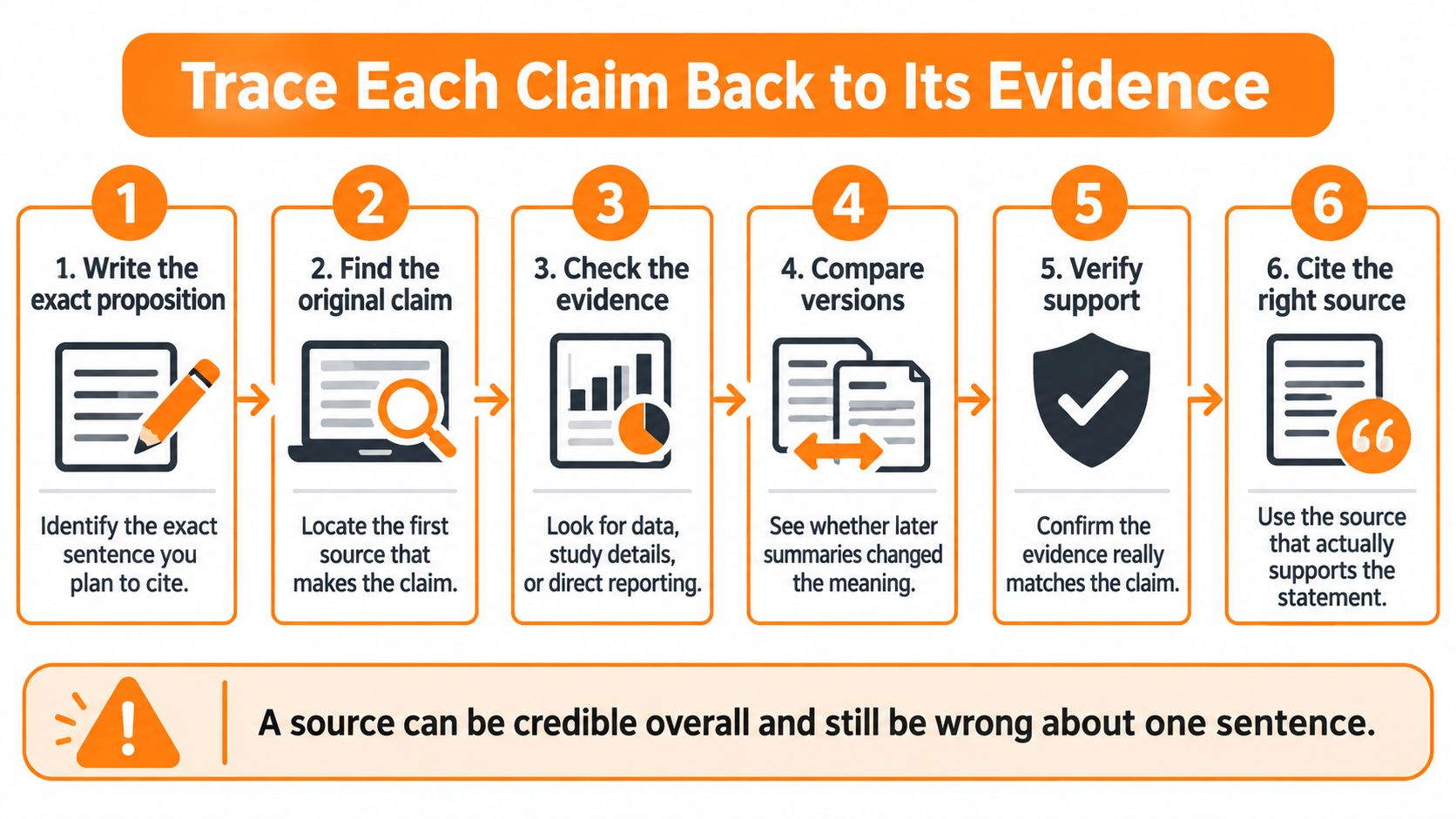
A source can be credible overall and still fail to support the sentence you want to cite. Evaluate the claim itself, including its wording, scope, and level of certainty.
The University of Kansas guide to cues and evidence describes investigating credibility signals externally and explaining how the resulting evidence changes your judgment. For essay research, turn that approach into a repeatable procedure.
- Write the exact proposition. Identify the sentence you intend to support, not just the general topic.
- Classify the source. Is it primary research, a systematic review, official statistics, expert synthesis, journalism, or commentary?
- Find the underlying evidence. Follow the claim to its original dataset, methods section, table, or document.
- Check the match. Compare the population, date, place, and measured outcome with your proposed sentence.
- Seek independent corroboration. Compare the result with at least two high-quality sources that don't repeat the same underlying account.
- State the uncertainty. Qualify conflicting findings and distinguish association from causation.
Keep the evidence trail visible as you work.
Narrow the sentence to what was measured
Consider a hypothetical blog claiming that remote work boosted output by 40 percent. Its link leads to a company press release, and the underlying hypothetical study followed one firm for one quarter, finding only a correlation based on workers' reported output.
The original wording overstates both the scope and the causal conclusion. A defensible revision would be:
In a one-quarter study of one firm, remote workers reported higher output, though the study did not establish that remote work caused the change.
That sentence is narrower because the evidence is narrower. It doesn't turn workers' reports into an independently measured productivity gain or generalize a company-specific result to every workplace.
Purdue OWL defines cross-checking as verifying information in one source against information in another. Collecting several articles that repeat a press release doesn't meet that standard.
Catch errors before they reach the draft
Watch for these common mismatches:
- Wrong document: You cite publicity material instead of the underlying study.
- Wrong scope: You generalize from a small or unrepresentative sample.
- Wrong inference: You describe an association as a cause.
- Wrong timeframe: You use older figures to describe current conditions.
- Missing limitations: You rely on a summary that leaves out qualifications.
For a source-heavy assignment, a literature review matrix can help you compare populations, methods, findings, and limitations without confusing which study supports which claim.
Handle AI Output and Conflicting Evidence
Treat an AI response as a research aid rather than evidence, unless your instructor explicitly permits citing it. Find the underlying publication behind a factual claim and cite that publication when it supports your sentence.
Keep the original material open while checking an AI-assisted summary.
Say an AI summary describes three studies, but one reference title matches nothing in your library database. Remove that reference from your working bibliography, search for the claim independently, and use only publications you can open and confirm.
The St. John's University student guide to AI recommends verifying AI-generated facts with multiple reputable sources, checking cited materials directly, rejecting uncited claims, and confirming publication dates. A plausible title and confident explanation don't establish that a publication exists or says what the summary claims.
Weigh disagreement rather than counting sources
When sources disagree, ask whether they studied the same question. Different populations, outcome measures, locations, or periods can produce different findings without either source being dishonest.
Compare the quality of the methods and how closely the evidence fits your claim. A larger sample may help, but size alone doesn't fix an unsuitable design or irrelevant measurement.
- Stronger support: Favor transparent methods and evidence directly relevant to your question.
- Genuine uncertainty: Describe the disagreement when credible findings remain in conflict.
- Unequal evidence: Don't give unsupported commentary the same weight as well-supported findings.
Information-literacy scholarship on checklist limitations emphasizes calibrated trust rather than reducing evaluation to a yes-or-no judgment. Your essay can explain what the evidence supports while acknowledging what remains unresolved.
Keep the same evidence-first approach when considering advice in video form.
For a rough assessment of your draft's writing patterns, an AI-signal detector provides an estimate, not a verdict. Review the draft manually and treat detector results as one editing signal. They can't establish whether your citations are accurate.
How to Evaluate Sources for an Essay and Decide What to Cite
Cite a source when your verification note answers these questions: Who made it? What evidence supports the claim? Do independent sources agree? Keep the decision attached to the particular claim, because the same publication may support one sentence but not another.
Use a log to separate sources you've opened from sources you've checked. The entries below are hypothetical examples, not descriptions of published studies.
Verification log for each source
| Source | Author check | Evidence check | Corroboration | Decision |
|---|---|---|---|---|
| Climate policy report | Named researcher at a university, credentials listed | Methods and funding disclosed | Matches two agency datasets | Cite, note regional scope |
| Advocacy blog post | No author listed | Claim links only to a press release | Not found in independent sources | Drop, or trace to original study |
| Journal article on remote work | Named authors, institutional affiliation | Sample of one firm, correlational design | Two later studies report similar direction | Cite, state the causal limit |
Make the citation decision explicit
The hypothetical climate report is usable for a claim about the region it studied. It doesn't justify a worldwide conclusion merely because its author has strong credentials.
The advocacy post hasn't supplied an adequate evidence trail. If its central claim matters to your argument, investigate the original study rather than citing the post as a substitute.
The remote-work article can support a carefully limited statement about an association. Similar findings elsewhere may strengthen confidence in that pattern, but they don't automatically establish causation.
For each source you retain, save practical details:
- Claim supported: Write the sentence or proposition the source justifies.
- Evidence location: Record the page, table, section, or dataset field.
- Necessary qualification: Note the regional, methodological, or causal limitation.
- Citation details: Save the information your required citation style needs.
Resolve gaps before submitting
Remove a factual claim if you can't verify its supporting source. If a limited source is essential to the assignment, use it only with an explicit limitation and only when your instructor permits that approach. A disclaimer can't turn a nonexistent reference into usable evidence.
Check your course's rules on AI assistance, citation, and acceptable source types before submitting. In academic settings, you must comply with your institution's academic integrity policies, including when using editing tools.
Finish with a separate originality review. An originality and plagiarism-risk check can help you review overlap, but it doesn't confirm source accuracy. Your verification log still needs to show why each important claim belongs in the essay.
Knowing how to evaluate sources for an essay means being able to explain your citation decisions. Keep a source because its evidence supports your wording, not because you've already spent time reading it.
Frequently Asked Questions About Evaluating Sources
Is a .edu or .gov site automatically reliable?
No. A domain identifies where a page is hosted, not whether a particular claim is adequately supported. Check the named creator, document purpose, date, and underlying evidence.
Can I cite Wikipedia?
Use it to identify useful terminology and potentially relevant references. Open those references and evaluate them directly before citing them. Follow your instructor's policy if the assignment specifically concerns Wikipedia itself.
Does peer review mean a study is correct?
No. It indicates scholarly checking, not certainty. Read the methods and limitations, and make sure the findings support the precise conclusion you intend to draw.
How many sources should confirm a claim?
For an important claim, compare at least two independent, high-quality sources. Independence matters more than collecting repeated versions of the same announcement. If credible sources conflict, explain the disagreement.
What if the only source I can find is weak?
Search for the original document or evidence using distinctive terms from the claim. If you still can't verify it, narrow or remove the claim. State a limitation only when using that source is appropriate for the assignment.
Should I use AI to find sources?
Check your instructor's rules first. If AI assistance is allowed, verify each suggested reference yourself and read the publication before citing it. Don't rely on an AI summary as proof of what an author found.
Lumi Humanizer helps refine AI-assisted prose for more natural flow while preserving its original meaning and intent. Once you've verified your evidence, visit Lumi Humanizer to polish wording where your institution permits it, then review the final output to ensure every citation and qualification remains intact.