Changing words isn't enough to avoid patchwriting. To learn how to avoid patchwriting, separate reading from drafting, rebuild the explanation around your own purpose, and check both its meaning and its structure against the source. A citation still matters, but it doesn't turn a closely imitated sentence into an independent paraphrase.
Spot Patchwriting in Your Own Draft
Patchwriting happens when a paraphrase retains recognizable source wording or sentence structure, even after the writer substitutes synonyms. The Purdue Fort Wayne library guide describes it as borrowing source language to discuss that source, a form of imitation rather than independent explanation.
It can slip past careful writers because the vocabulary looks different. The resemblance becomes clearer when you compare clauses: who performs the action, where the explanation begins, and how the writer connects cause and result.
Compare the structure, not just the vocabulary
Consider this hypothetical city-policy example:
- Source sentence: A city cut emissions by changing commuting habits.
- Close draft: The city lowered emissions by altering how people commuted.
- Rebuilt explanation: Changes in residents' journeys to work helped the city achieve its emissions reduction.
The close draft follows the same route: city, reduction, mechanism. The rebuilt explanation starts with the mechanism instead. It still needs attribution, and a longer paragraph would need its own organizing purpose rather than a series of similarly rearranged sentences.
Patchwriting signs compared with an independent paraphrase
| Check | Patchwriting sign | Independent paraphrase | Fix |
|---|---|---|---|
| Word order | Same clause sequence as the source | Ideas reordered around your own point | Rebuild the paragraph's sequence |
| Sentence pattern | Same grammar with synonyms swapped | New sentence shape with your own subject | Redraft from memory |
| Distinctive terms | Unusual source terminology reused without marks | Essential terms kept and marked when distinctive | Quote the term or define it in your own words |
| Example order | Same examples in the same order | Examples chosen to fit your argument | Replace or reorder the examples |
| Phrase matches | Several phrases match the source | Matches limited to necessary technical terms | Set the source aside and redraft |
| Citation | Citation present but structure unchanged | Citation plus a rebuilt idea | Restructure, don't just add a citation |
Place your paragraph beside the source. Highlight matching phrases and unusual terminology, then compare the order of claims and examples.
Purdue OWL's guidance on paraphrasing and summary emphasizes checking meaning while changing sentence structure and the order of major ideas. A similarity score isn't a substitute for that comparison: it can flag necessary terminology while missing inherited structure.
Practical rule: Use overlap as a reason to inspect a passage, not as an automatic verdict.
Run the table's checks on a paragraph today. As an editing triage rule, mark any paragraph that fails multiple checks for a fresh draft, not another round of synonym replacement.
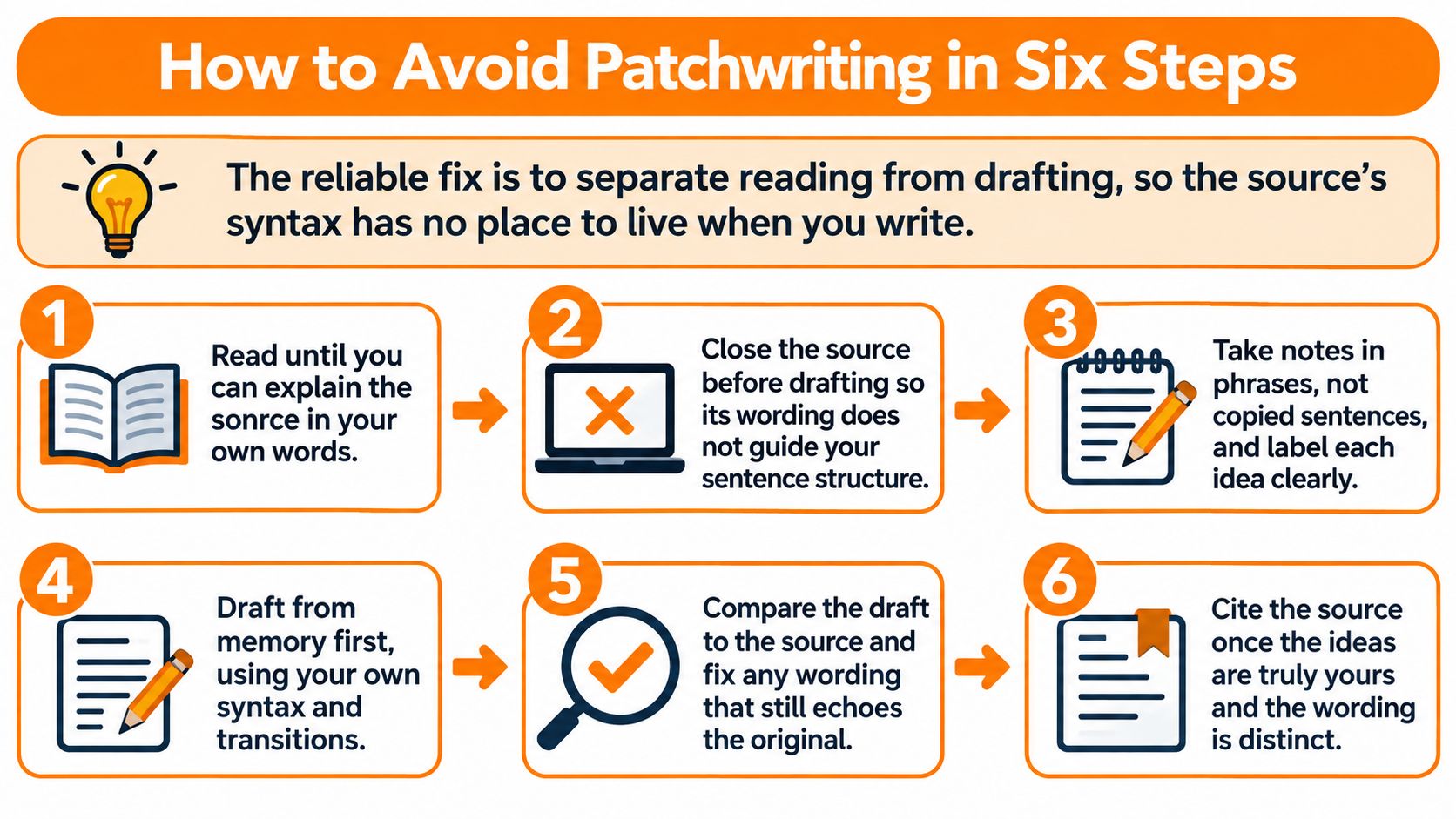
How to Avoid Patchwriting in Six Steps
The reliable fix is to separate reading from drafting. When you stop looking at the original sentences, you have to explain the idea rather than edit the author's language.
Purdue OWL's paraphrase exercises recommend setting the original aside, writing separately, comparing for accuracy, identifying borrowed unique phrases, and recording source information. The workflow below turns those habits into a repeatable drafting routine.
Keep this process beside your notes while you work.
Read and record before drafting
-
Understand the claim and its support. Read until you can explain what the author argues and what evidence supports it in a plain sentence. If you can name the topic but not explain the reasoning, reread. The common slip is mistaking familiar vocabulary for understanding.
-
Make a compact source note. Record the author, title, relevant page or stable location, and a short concept label rather than a copied sentence. For a hypothetical sleep-and-memory paper, your label might be sleep and memory consolidation, followed by the actual page reference. Don't let polished source prose become your drafting notes.
-
Close or set aside the source. Minimize the browser tab, put the book away, or move your notes out of view. The University of Wisconsin–Madison Writing Center also suggests abbreviated notes and, when practical, returning to paraphrase later, potentially a day afterward. Keeping the source open makes it easy to borrow its syntax without noticing.
Draft, verify and control quotations
-
Write from memory around your purpose. Ask what your reader needs from this source. In the hypothetical sleep example, a student might begin with the finding, explain its relevance to studying, and finish with a clearly identified interpretation about revision habits. The slip to avoid is reconstructing the author's paragraph sentence by sentence.
-
Reopen the source and check accuracy. Compare every claim, number, qualification, and relationship. Did the author report an association, while your draft claims causation? Did you remove a limitation? Independent language is no improvement if you change the finding.
-
Mark distinctive wording that remains. If the exact language matters, reproduce it accurately with quotation marks and a citation. If it doesn't matter, rebuild that part instead of disguising it. Don't force a paraphrase of language your argument needs to examine directly.
A successful paraphrase can be checked against the source for accuracy without reading like a reconstruction of its sentences.
Before continuing with your paper, redo a troublesome paragraph using this routine. Keep the old version temporarily so you can compare the organizing choices, not just the vocabulary.
Handle Dense Sources, Technical Terms and Second-Language Writing
When a source is difficult, the immediate problem may be comprehension, not a missing plagiarism rule. You can't reliably rebuild an explanation you don't yet understand.
Start with an outline rather than a polished sentence.

A university study published in the International Journal for Educational Integrity found that 70% of participants correctly judged a patchwriting example unacceptable, while 19% considered it acceptable. That finding supports teaching writers to recognize the boundary, rather than assuming a warning will be enough.
Build a claim map
Before drafting, write a short map:
- Claim: What does the author argue or report?
- Evidence: What observation, comparison, or reasoning supports it?
- Limits: Under what conditions does the claim apply?
If you can't complete the map, return to the difficult passage or ask an instructor about the concept. Guessing at meaning and then polishing the guess produces fluent inaccuracy.
Keep established technical terms such as working memory, effect size, or cognitive load when they're necessary. An ordinary disciplinary term doesn't automatically require quotation marks; distinctive wording borrowed from a particular author does. Explain the concept in your own surrounding language instead of replacing precise terminology with a vague synonym.
Separate fluency from independence
Consider a hypothetical source reporting that participants with greater working-memory capacity performed better on a task under distraction. A multilingual student changes the grammar but preserves that exact sentence architecture.
A rebuilt version could begin with the task: Under distracting conditions, task performance was better among participants with greater working-memory capacity. That's an illustrative sentence, not a research finding, and the student would still need to cite and verify the actual source.
For a longer passage, make a reverse outline by labeling each paragraph's main point in your own words. If your draft repeats the source's sequence without a reason tied to your argument, reorganize it.
Use the following video as an additional learning resource.
A paraphrase tool can serve as a clarity pass after you've written an independent draft, not as a replacement for understanding. Pick a dense paragraph and make its claim map before opening your draft.
Decide When to Quote, Paraphrase or Restructure
Quote when the exact words matter; paraphrase when you can independently explain the idea. Sometimes the best repair is neither, but a shorter summary followed by your own analysis.
Purdue OWL's paraphrasing guide recommends checking accuracy and marking unique borrowed wording. Use these decisions when a passage feels borderline.
-
Exact wording matters. Quote a definition, memorable formulation, or language you're analyzing. Include quotation marks and a page-level citation, or the stable locator required by your citation style.
-
The idea matters, but the wording doesn't. Paraphrase after understanding and rebuilding it. For example, explain why an experiment supports your argument instead of reproducing the author's description sentence by sentence.
-
A technical term has no useful substitute. Keep cognitive load if that's the concept you mean. Change the surrounding explanation, not the terminology needed for accuracy.
-
A distinctive phrase isn't essential. Remove it and explain the point differently. Replacing each word with a near-synonym preserves too much of the original formulation.
-
You're combining sources. Organize the paragraph around a comparison you want to make, and attribute each contribution. Don't assemble sentence fragments from different authors into a patchwork.
-
Your paragraph follows the source's progression. Summarize at a higher level, then add a relevant interpretation, qualification, or comparison. Don't reorder evidence in ways that distort the author's logic.
Make the choice visible
Say a student needs an author's exact definition of cognitive load. She quotes that definition, then paraphrases the explanation of an experiment because her essay needs its reasoning, not its wording.
She also distinguishes the author's conclusion from her own interpretation. That boundary matters just as much as the choice between quotation and paraphrase.
Margin check: Label borderline passages quote, paraphrase, or restructure before editing them.
For further discussion of rewriting support, consult this guide to paraphrase tools for students. Apply the decision list to a few passages in your current draft before choosing any wording assistance.
Patchwriting, Plagiarism and Your Institution's Rules
A citation doesn't settle every case. Scholarship on patchwriting identifies disagreement: some scholars classify cited patchwriting as misuse of sources rather than academic dishonesty, while others classify it as plagiarism even when the source is acknowledged.
The distinction affects the remedy, but appearance alone doesn't establish intent.
- Inexperienced close paraphrase: A first-year writer follows a source's sequence because they can't yet explain the concept independently. Guided note-taking, quotation practice, and rewriting address the immediate problem.
- Deliberate copying: A student knowingly copies paragraphs and makes token changes. Accountability and a review of the written policy are necessary alongside correction.
Teaching source use and enforcing academic integrity aren't mutually exclusive.
Check your course and institutional rules, including permitted writing assistance, and ask your instructor how they classify close paraphrase. Users in academic settings must comply with their institution's academic integrity policies.
Questions about whether Turnitin can detect paraphrasing shouldn't replace that conversation. More detector checking doesn't teach comprehension, synthesis, or attribution, and a result cannot establish a writer's intentions.
Confirm Each Paragraph Before You Submit
A clean draft requires a final manual review. The rewriting is still your responsibility, even when software helps identify passages worth inspecting.
Use the source and your draft side by side during this check.
- Verify evidence: Confirm that source-based paragraphs preserve the original qualifications and don't overstate findings.
- Inspect attribution: Check quotation marks, page references or stable locators, and matching reference-list entries.
- Read aloud: Repair awkward transitions without losing distinctions between the source's argument and your interpretation.
Say a student reviewing a literature review finds several close paragraphs. She redrafts the weakest passages, adds her own comparison, and checks citations before sending the document to her supervisor.
Treat automated results as second opinions
An AI detector estimates AI-generated signals; it doesn't determine whether you've paraphrased independently. Our recommended workflow is to review manually and treat detector results as one editing signal, not a final verdict, since results vary with draft quality and detector version.
An originality report serves a different purpose: reviewing wording overlap and potential attribution problems. This guide to using a plagiarism checker explains that review step.
Always review the final output before submitting. After reworking flagged paragraphs, check the final version rather than relying on a report from an earlier draft.
Common Questions About Avoiding Patchwriting
Is changing a few words enough?
No. If your draft retains the source's sentence pattern and claim sequence, return to your concept notes and rebuild the explanation.
Does a paraphrase still need a citation?
Yes. The University of Oklahoma writing guide emphasizes preserving meaning and citing paraphrases even when you use your own words. Add the locator your citation style requires.
Can a paraphrasing tool fix the problem?
It can help refine clarity after you've developed your own explanation. It can't replace understanding, source verification, or your judgment about borrowed language.
Is a similarity score proof of patchwriting?
No. Inspect the passage and its source before deciding what needs repair.
For readers preparing to teach these distinctions, ELTica's guidance for aspiring English teachers offers a resource for broader teaching-career questions. Learning how to avoid patchwriting requires practice explaining ideas, not just recognizing prohibited wording.
Lumi Humanizer offers rewriting support for AI-assisted text to improve clarity, voice, and flow while preserving meaning. Once you've rebuilt your source-based passages and checked your institution's rules, visit Lumi Humanizer to refine permitted AI-assisted wording, then review the result against your sources before submitting.