If you sort writing styles in literature by labels alone, you'll miss the choices that shape how a page sounds. Romantic, realist, modernist: those names help you search a syllabus, but they don't tell you which words, sentences, or viewpoints to test in the passage in front of you.
Why do two novels from the same decade feel like different languages? The usual habit is to stop at the movement name. Style isn't a costume. It's a pattern of diction, syntax, tone, and narrative habit that you can hear, count, and revise.
Start with the definition, then use the lookup of period, aim, technique, and example. After that, test a passage for diction, syntax, point of view, and rhythm, and decide what your own draft should do before you write it.
What Writing Styles in Literature Actually Are
A writing style in literature is the combination of an author's diction, syntax, tone, characterization, and other narrative techniques. Purdue OWL's glossary of literary terms treats style as that whole combination, so vocabulary or sentence length by itself doesn't make a style.
A long sentence can be plain. A short one can be ornate. Two writers can share a topic and still sound unlike each other because one favors clipped clauses and a cool tone while the other stacks modifiers and lets feeling sit in the wording.
Style works like handwriting. You can change the message and still recognize the hand. Local choices live in word selection and sentence rhythm. Larger choices live in how characters are presented and how the story is arranged.
Same narrator, different hand
Say two third-person novels both use an outside narrator. One relies on clipped syntax and restrained diction: "She shut the door. The room stayed cold." The other uses ornate language and extended description: "She drew the door closed, and the hinges seemed to remember every winter that had passed through that room." Same viewpoint. The pages don't feel alike.
A mode can carry a style too. Satire typically adopts a satirical style, while an elegy adopts an elegiac one. The label follows the habits, not the other way around.
Movements such as realism or modernism are historical clusters of shared habits, not rigid rulebooks. Writers inside one cluster still choose different sentences. Match a passage to its period and technique, then measure the diction and rhythm, and only then decide what a reader should feel.
Major Literary Styles at a Glance
A style table is a map, not the terrain. Read each row as a bundle of four coordinates: period, aim, technique, and example. Match the period to the era you are studying, then test the hallmark technique against the passage in front of you. If the technique is absent, the label may be wrong even when the date fits.
| Style | Period | Core aim | Hallmark technique | Example |
|---|---|---|---|---|
| Romanticism | about 1790-1850 | Emotion, nature and the individual | Heightened imagery and first-person feeling | Wordsworth's "Tintern Abbey" (1798) |
| Gothic | about 1764-1830 | Fear, the sublime and the uncanny | Atmospheric settings and framed narration | The Castle of Otranto (1764) |
| Realism | about 1830-1900 | Ordinary life and social accuracy | Detailed description and restrained narration | Flaubert's Madame Bovary (1857) |
| Naturalism | about 1870-1910 | Heredity and environment shaping fate | Scientific detachment and deterministic plots | The Call of the Wild (1903) |
| Modernism | about 1910-1945 | Subjectivity and the breakdown of tradition | Fragmented structure and shifting viewpoints | Mrs Dalloway |
| Stream of consciousness | technique inside modernism, not its own movement | Interior thought as it occurs | Unpunctuated interior monologue | Ulysses |
| Magical realism | about 1940-1980 | The ordinary and the fantastic coexisting | Matter-of-fact tone for impossible events | García Márquez's One Hundred Years of Solitude (1967) |
| Minimalism | about 1970-1990 | Surface detail with withheld emotion | Short sentences and sparse dialogue | Cathedral |
| Postmodernism | after 1945 | Irony, metafiction and play with form | Self-referential narration and pastiche | If on a Winter's Night a Traveler |
Several styles overlap in time, so one decade can hold more than one habit. A late Gothic tale can sit beside early realist description. A postwar novel can use minimalist dialogue inside a postmodern frame.
Stream of consciousness is a technique used within modernism, not a movement with its own dates. Treat that row as a tool you might find inside a modernist book, not as a separate era.
Once a row seems plausible, read a short passage twice. First for diction: is the vocabulary formal or plain? Then for syntax: are the sentences long and winding or clipped? Then for point of view and rhythm: who speaks, and how does the prose move? The table helps only after you can point to the diction, syntax, viewpoint, or rhythm that carries the label.
Measuring Style Through Diction, Syntax and Rhythm
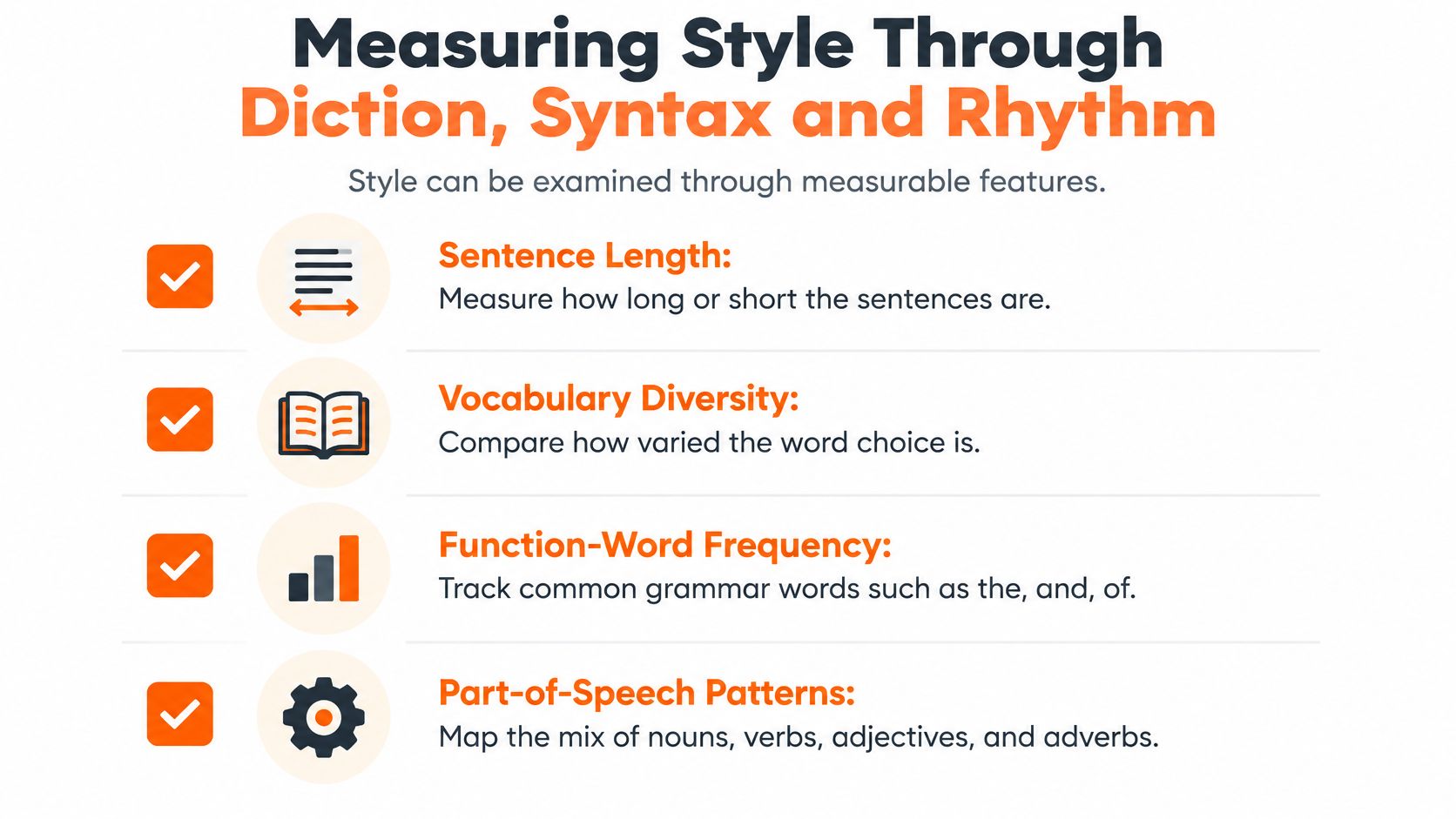
Style can be examined through measurable features, a practice often called stylometry. Useful measures include sentence length, vocabulary diversity, function-word frequency, word and character n-grams, and part-of-speech patterns.
Function words such as articles, pronouns, and prepositions are usually less consciously controlled than topic vocabulary. They tend to show syntactic habit more reliably than the nouns that name the subject. In a stylometric study of literary texts, support-vector-machine classification using the 500 most frequent words achieved 88% authorship accuracy, while a model using 2,000 frequent 3-grams achieved 79%, according to Digital Scholarship in the Humanities. High-frequency grammatical vocabulary is a practical place to start. Distinctive content words often track genre more than voice.
A check you can run on one passage
Compare passages of similar length and genre. Viewpoint, dialogue, and period can shift the counts.
- Sentence length: Find the average, then note how much it varies.
- Function words: List the five you see most often, such as the, and, of, I, or she.
- Filter: Notice whether pronouns like I or she decide what the reader is allowed to know.
- Rhythm breaks: Mark where a short sentence interrupts a long one, or the reverse.
Compare counts only across passages of similar size and genre, or the profile will describe the scene type rather than the writer.
Readability scores estimate complexity from sentence length and syllable count. They aren't a grade for literary quality. Research on modern fiction also looks at lexical diversity and compressibility, because perceived quality can come from how those traits interact. A lower readability score may be deliberate density. Judge it against audience, genre, voice, and pacing.
What a steady beat does
A passage of uniform 22-word sentences keeps a level pulse. Tension has fewer places to spike, and emotion can feel managed. Alternate a four-word sentence with a twenty-word one and the short line lands harder. The long line then gives the feeling room to spread. Tightening a muddy sentence for clarity is a different task from choosing that rhythm. If you want to hear word choice apart from plot, look at examples of diction before you revise.
Songwriters face a similar split between pattern and subject. Lyric writing advice for independent musicians is a useful side study in how repeated small choices, not the topic alone, make a line recognizable.
A 2012 analysis of English-language authors in Project Gutenberg, limited to writers after 1550 with at least five works and known birth and death dates, used "content-free" function words and found writers from similar periods resembled one another more than writers separated by larger gaps. These figures profile habit across comparable passages. They don't rank literary worth.
From Romantic Emotion to Realist Detail
What changes when the same moon stops being a feeling and becomes a piece of equipment?
Read the period, the aim, the technique, and one sample line together. A style name alone does not tell you how a sentence is built.
| Period | Aim | Technique | Example |
|---|---|---|---|
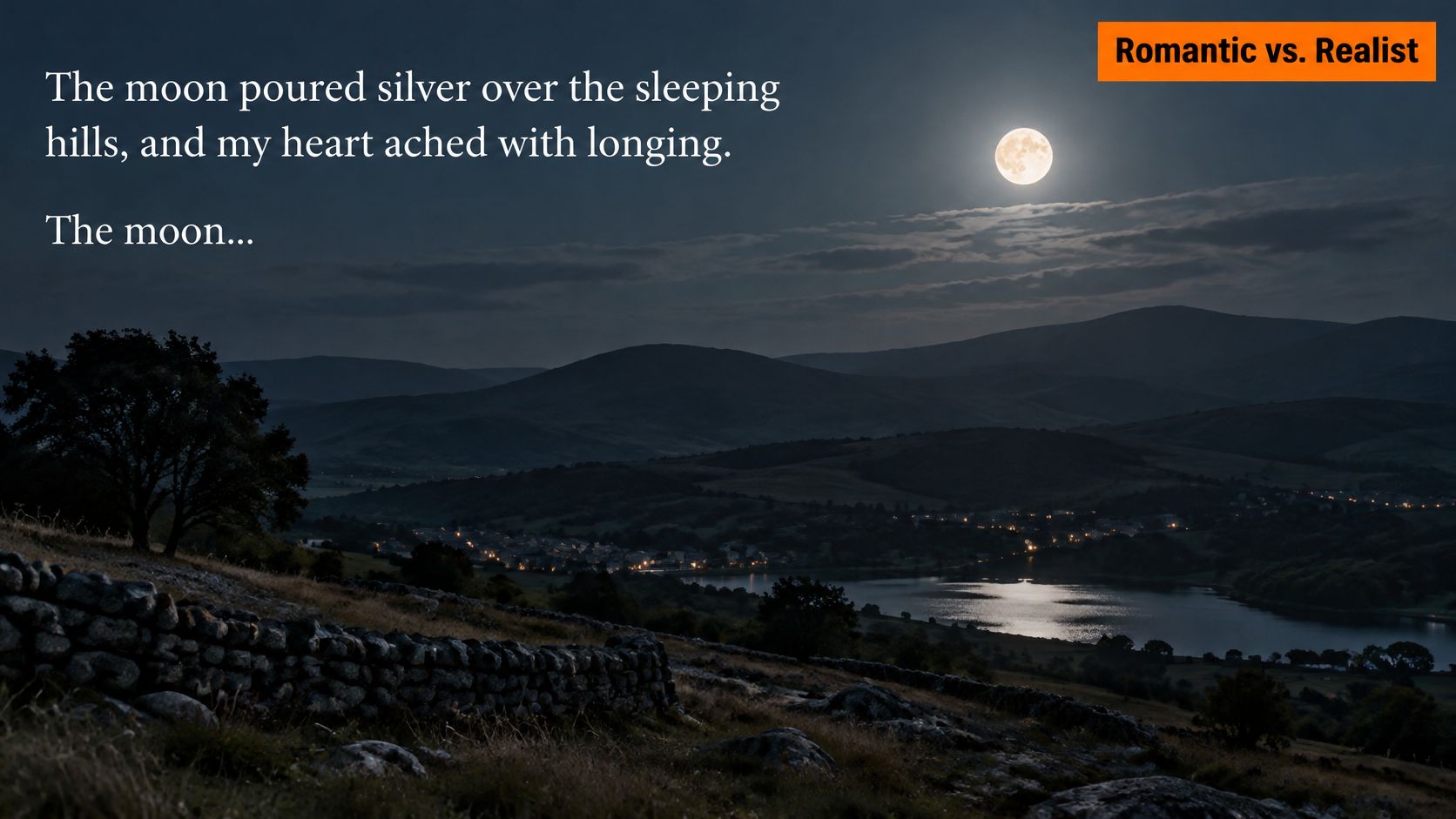
| Romantic emotion | Put longing in the speaker | Heightened imagery; nature stands in for the self | "The moon poured silver over the sleeping hills, and my heart ached with longing." |
| Realist detail | Show ordinary work and a fact you could check | Plain wording; a concrete object carries the meaning | "The moon lit the road to the mill, where the miller's cart stood with a broken wheel." |
| Naturalist pressure | Watch causes bigger than one person's choice | Detached narration; heredity and environment crowd the plot | A family worn down by wages and illness, closer to a case note than a confession |
The night in the first line is a mood. The night in the second is a road, a mill, and a wheel that will not turn.
Four tests on the same moon
Diction. "Poured silver" and "ached" do more work than any object. "Broken wheel" names a tool. Trade those phrases and the period shifts even if the moon stays in the sentence.
Syntax. The Romantic line stacks a scene, then a feeling, until the heart is the main subject. The realist line stops at the damaged cart. That shorter shape works like a clerk's inventory: place, object, condition.
Point of view. "My heart" seats you inside a speaker. The mill sentence has no "I." You stand outside and look at work. That outside eye is still a choice. It is not the absence of style.
Rhythm. Longing spreads across the first line and keeps a soft pulse. The second line lands on "broken wheel" and stops. Read both aloud. The beat shows where the writer wants your attention.
Gothic writing, often published in that same heightened mood, turns the intensity toward fear and the uncanny. Ruined rooms, weather, and a framed tale (a manuscript, a letter, a story told at a fire) keep the reader slightly outside the terror while still inside it. Realist narration stays more restrained, so the detail can carry the meaning. You can check the claim against the world: a mill, a road, a wheel that will not turn. Naturalism keeps that concrete gaze and presses further. People are shaped by heredity and environment. The narrator often sounds detached, and plots treat fate as determined, so choice looks smaller than circumstance. A sled dog altered by climate is not there mainly to inspire. The style asks you to watch causes.
One decade can hold Gothic atmosphere, realist detail, and the start of naturalist determinism. Match the technique in the passage, not the date on the title page alone.
Large corpora make that overlap visible across thousands of books rather than a handful of classroom classics. A 2023 study of the Chicago corpus analyzed more than 9,000 novels written or translated into English and spanning 1880-2000, a 120-year run from late Victorian prose through modernist and postwar writing. The same kind of comparison also shows change inside one career. A writer's later books often drift from the habits of the early ones, and books written near one another in time tend to share more stylistic habits than books separated by many years.
If you want the historical argument in spoken form, this short lecture walks through why those period labels keep getting revised.
When you revise, ask which sentence would lose its style if you deleted the feeling, the object, or the sense that the character could not have chosen otherwise.
Modernism and Inner Thought on the Page
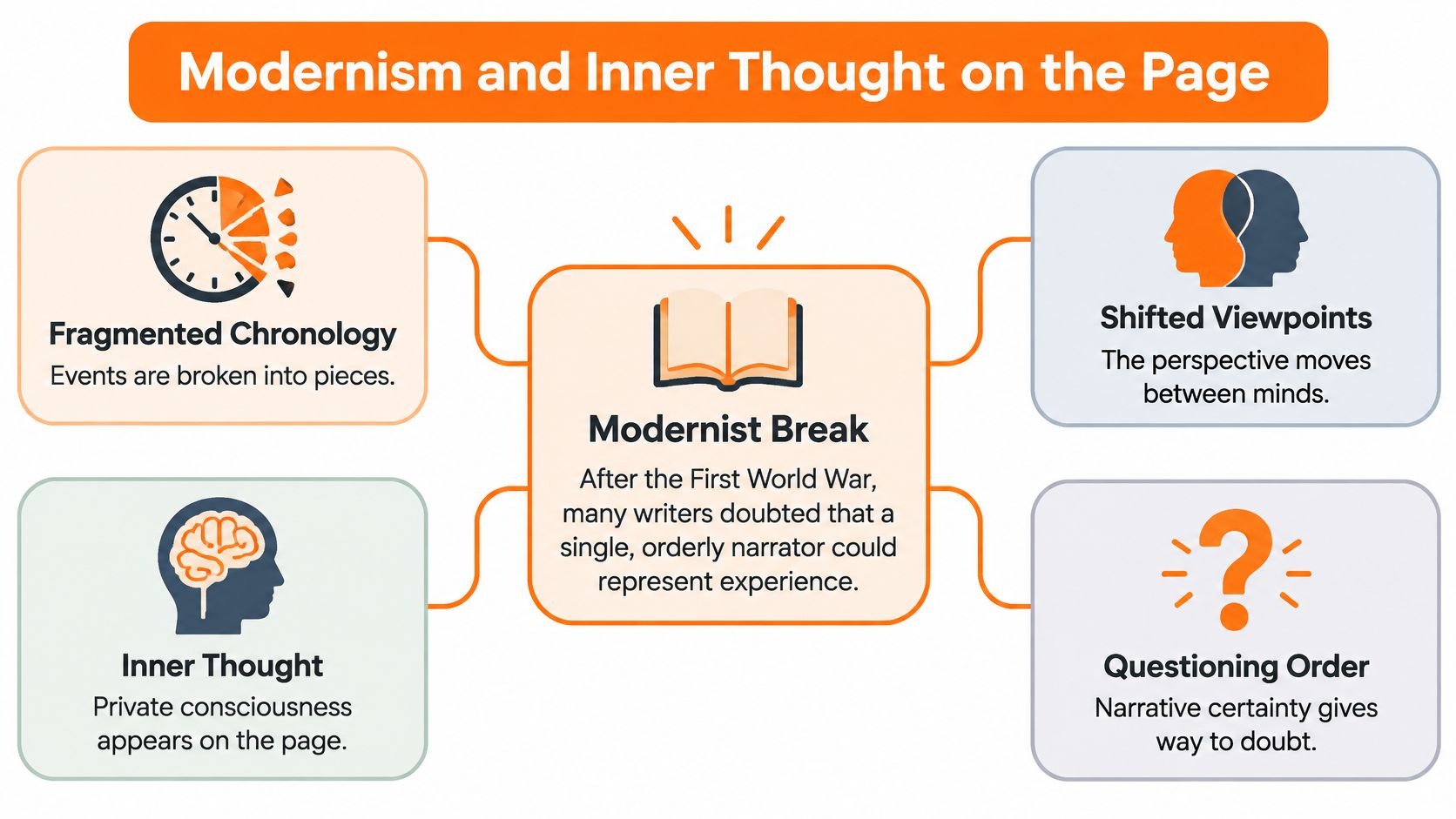
After the First World War, many writers doubted that a single, orderly narrator could represent experience. Public certainty had cracked. A calm voice explaining causes in sequence could feel like a false comfort. Modernist prose often fragments chronology, shifts viewpoints, and moves the reader inside a mind that doesn't sort memories into a neat report.
What the narrator is allowed to know
Point of view decides what information readers can access. Purdue OWL's notes on style, genre, and writing explain that in first-person narration the story is filtered through a character who generally uses "I," so readers get that character's perceptions rather than an unrestricted account. Making the narrator a character limits the material, because that narrator can know only events they take part in. The limit can create dramatic irony. The narrator may describe events accurately and still misunderstand what they mean.
A third-person narrator can offer a broader range of access, including movement between minds. That broader access isn't automatically more honest. It can still withhold, judge, or slide into a character's wording without admitting the slide. For a closer look at what an "I" can and can't witness, see this guide to first-person narration.
Stream of consciousness presents thoughts as an interior monologue that may appear unedited or deliberately hard to follow. Syntax loosens. Associations jump. Punctuation may thin out because the mind on the page isn't pausing to write a clean paragraph.
Two books, two kinds of inwardness
Virginia Woolf's Mrs Dalloway moves among characters through London in one day. A present sight, a flower shop, a car backfiring, a figure in the park, tugs a memory forward, and the sentence returns to the street without a formal scene break. The city stays shared. The consciousness doesn't.
James Joyce's Ulysses pushes the inward method further. Long, loosely punctuated passages follow a mind in motion, including trivial notice and sudden lyric jump in the same stretch. You aren't given a summary of what the character thinks. You travel at the speed of the noticing.
When a passage shifts into a character's thoughts without tags such as "she thought," you're likely reading free indirect style or stream of consciousness.
Try that test on a paragraph. If the vocabulary suddenly sounds like the character, not the narrator, and nobody announces the change, the style is doing the psychological work. D. H. Lawrence pushed a related intensity of feeling into place and body, not only into city wandering. You can explore D. H. Lawrence's Taos connections to see how a writer's environment and relationships sit beside the prose habits readers later call modernist.
The practical payoff is control. You can fragment time because the character can't hold a single story together, not because fragmentation is a badge. If the reader needs a clear causal chain, a modernist inwardness will fight you. If the reader needs the mess of attention, a tidy narrator will sand it flat.
Minimalism, Postmodernism and Magical Realism
Later fiction often refuses both the Romantic ache and the modernist flood of thought. Three habits dominate classroom discussions of that later period, and they disagree about what a sentence should admit.
Minimalism uses short declarative sentences, sparse dialogue, and little interior explanation. Meaning sits in what is left unsaid. Raymond Carver's stories, including "Cathedral," are the usual reference. A narrator might report a drink, a job, a guest on the couch, and stop. You infer the loneliness because nobody names it.
Postmodernism, especially after 1945, draws attention to its own construction. Metafiction, parody, and pastiche remind you that a book is arranged. Italo Calvino's If on a Winter's Night a Traveler addresses the person reading and keeps restarting the book you thought you had begun. The plot includes the act of turning pages.
Magical realism, associated with Latin American writers such as Gabriel García Márquez, states impossible events in a calm, matter-of-fact voice. The fantastic isn't heralded as a miracle. It arrives with the same tone as the weather, so ordinary life and the impossible share one world.
One table, three treatments
Watch the same object change jobs.
A minimalist sentence describes a kitchen table and stops. "The table was chipped. He set the cups down." No moral, no memory speech.
A magical realist sentence lets that table lift into the air and treats the lift as routine. "The table rose to the ceiling during breakfast, and she moved the jam so it wouldn't spill."
A postmodernist sentence pauses to discuss how the table is being described. "You expected a symbol here, and the table knows it, which is why the description keeps clearing its throat."
Writers now often combine these techniques rather than picking a single membership card. A story can use Carver-like dialogue, admit one impossible event without fanfare, and still wink at the reader about the telling. The blend works when each habit has a job. Withheld emotion fits a character who can't speak. A matter-of-fact marvel fits a community that already lives with the unbelievable. A self-referential aside fits a book that wants you to notice the frame. If all three fire at once with no purpose, the page sounds like a sampler, not a voice.
Common Questions About Literary Styles
Can a writer mix styles?
Yes. Most novels blend realist detail with a modernist fragment or minimalist dialogue. The mix should serve the story's pressure, not a wish to sound advanced. If a plain scene floods with unpunctuated thought, the reader needs a reason inside the character. Changing instruments mid-song works when the melody asks for it. A realist kitchen and a modernist panic can share a page when each mode has a job.
Does a complex style mean better writing?
No. A dense modernist passage and a plain realist paragraph can both be strong. Judge style against its purpose, audience, and genre. Complexity that hides a simple claim is clutter. Simplicity that flattens a mind the book needs you to enter is a different failure. There is no universal score where harder sentences win. A plain sentence can be exact, and an elaborate one can be empty. The question is whether the sentence does the work the passage needs.
Can AI imitate a literary style?
It can reproduce genre conventions with real fluency. That is not a distinctive voice. Stylometric comparisons of human and AI creative writing found human short stories formed broader, more heterogeneous clusters, while outputs from GPT-3.5, GPT-4, and Llama 70B clustered tightly by model. Generative-AI prose often reads more formal, academic, and impersonal than human writing, which tends to feel more personal and accessible. Fluency can be a surface trait, like a convincing accent that still leaves word choices generic.
Lexical counts do not crown a winner. In a 2025 MIT Press comparison of literary texts, authentic writing had a mean moving-average type-token ratio of 0.659, compared with 0.705 for synthetic writing, so the synthetic corpus measured higher lexical diversity, not a better style. A 2025 Association for Computational Linguistics study scored large sets of stories on features such as coherence, emotional variance, and sentence length. Those measures can describe a draft. They do not settle authorship, and an automated signal is an estimate, not proof.
Do readers prefer AI-generated fiction?
Not as a settled fact. A 2025 New Yorker essay on a blind comparison said creative-writing students preferred AI-generated passages in almost two-thirds of the cases, and the underlying research was a non-peer-reviewed preprint. Treat that as a signal about enjoyment in one setting. Stylometry still separates narrow, model-specific patterns from the wider spread of human stories. Enjoyment, authorship, consent, and disclosure are different questions. Human judgment about purpose, audience, and who is responsible for the claims remains the deciding factor.
Choose a Writing Style Before You Draft
Pick the style before the draft starts wandering. Three questions are enough.
What must the reader feel? Emotional immersion points toward Romantic heightening or modernist inwardness. Clarity about work, money, or social fact points toward realism or a plain style. Purdue OWL's writing style guidance describes plain style as prioritizing clarity, concision, and precision, and treats diction as intentional word choice that shapes tone. "The experiment failed because the temperature changed" fits a technical report. A story might show the same fact through a character's hands and the smell of a scorched bench. If you want fear to tighten without explaining the fear, writing compelling psychological suspense is a practical companion to these choices. For the tone half of the decision, what tone means in writing keeps diction from getting confused with mood.
How much of the narrator's mind should show? A close third person or a first person puts perception in one head. A wider third person can cross minds. Choose the limit before you invent facts the narrator couldn't know.
How much should the rhythm vary? A level sentence length suits a detached report. Sharp swings suit panic, comedy, or a mind that won't settle. Mark the variation you want in the first paragraph so later pages don't drift into a default beat.
Map the answers onto a register
Writing style options include academic, professional, creative, and casual. Each calls for different diction and sentence length. An academic register can still have a human rhythm, but it shouldn't borrow Gothic weather to prove a result. A casual register can be precise without sounding like a lab note.
You can define the target from examples. Build a short profile from your own sample passages so revisions stay near your preferred tone and sentence structure. Customers can create custom writing style profiles by uploading writing samples or describing a preferred tone, and Lumi learns from those examples to match the voice. We keep academic, professional, creative, and casual as starting options, and a rewrite can stay closer to your formality and sentence structure when it learns from your own pages. Review the final output before you publish or submit it. Matching a voice is not the same job as paraphrasing a sentence only to vary the wording.
Choose one style, write one paragraph in it, and set that paragraph beside the moon sentences, the untagged thought, or the three tables in this guide.
If the paragraph could swap labels without anyone noticing, the technique isn't doing enough work yet. Change one lever only, the imagery, the object, the mind, or the rhythm, and read it aloud again.
Lumi Humanizer rewrites rhythm, phrasing, and sentence variety so a draft can sit closer to the literary or professional voice you chose, while keeping your original meaning. It is built for writers who want a style match, not a generic smooth-over, and you stay responsible for the final read. Visit Lumi Humanizer and test one paragraph against the examples in this guide.