A summary keeps only the main points and cuts most detail, while a paraphrase restates one specific passage in new words and keeps its meaning and level of detail. Both still need a citation.
You've read a paragraph, rewritten it, and made it shorter. Now you're wondering which label belongs on your draft. Learning how to distinguish summarizing from paraphrasing starts with a better question than how many words you removed: what information does your reader still need?
The Core Difference Between a Summary and a Paraphrase
Scope and detail make the difference. A summary presents the central claims of a source or substantial section; a paraphrase reconstructs a particular passage without stripping away the information that makes it specific.
Think of a source about a school library's extended opening hours. If your reader only needs the proposal's overall purpose, summarize it. If your argument depends on which students would benefit, when they could attend, and what conditions the proposal includes, paraphrase the relevant passage.
Summary and paraphrase compared
| Criterion | Summary | Paraphrase |
|---|---|---|
| Scope | Whole source or a major section | One specific passage or claim |
| Length | Substantially shorter, often a fraction of the source | Close to the passage length, sometimes a little shorter |
| Detail kept | Main claims only; examples and minor evidence removed | Most supporting detail, qualifications, and reasoning kept |
| Question it answers | What are the source's most important points? | How can this passage be expressed differently without changing its meaning? |
| Citation needed | Yes | Yes |
Purdue OWL illustrates summarizing with a four-page article condensed into one page, approximately 25% of the original length. That's an example, not a target ratio you should apply to every assignment.
A dense source may require more explanation than a repetitive one. Likewise, a paraphrase can become a little shorter because you remove redundant wording, not because you discard supporting ideas.
Information density matters more than word count
Suppose the library proposal describes access for students who can't study at home, transport arrangements, and staffing limitations. A summary might retain the recommendation and its main justification. A paraphrase of the staffing passage would keep the conditions that determine whether the proposal could work.
Practical rule: Decide which ideas must survive before you decide how short the rewrite should be.
Don't confuse compression with permission to change the argument. A summary can omit an illustration, but it must retain a limitation if removing it would misrepresent the author's conclusion.
The citation requirement follows the origin of the ideas, not the wording. Even when every sentence is yours, the source still deserves attribution.
Three Tests That Settle Most Cases
To work out how to distinguish summarizing from paraphrasing in an actual draft, examine coverage, retained detail, and independent expression. Don't begin by counting words.
Purdue's paraphrasing guidance describes a paraphrase as a new expression of essential information and meaning, more detailed than a summary. Its drafting method also helps you avoid treating paraphrasing as a sequence of synonym replacements.
Use this flowchart to orient your review, then check the wording carefully.
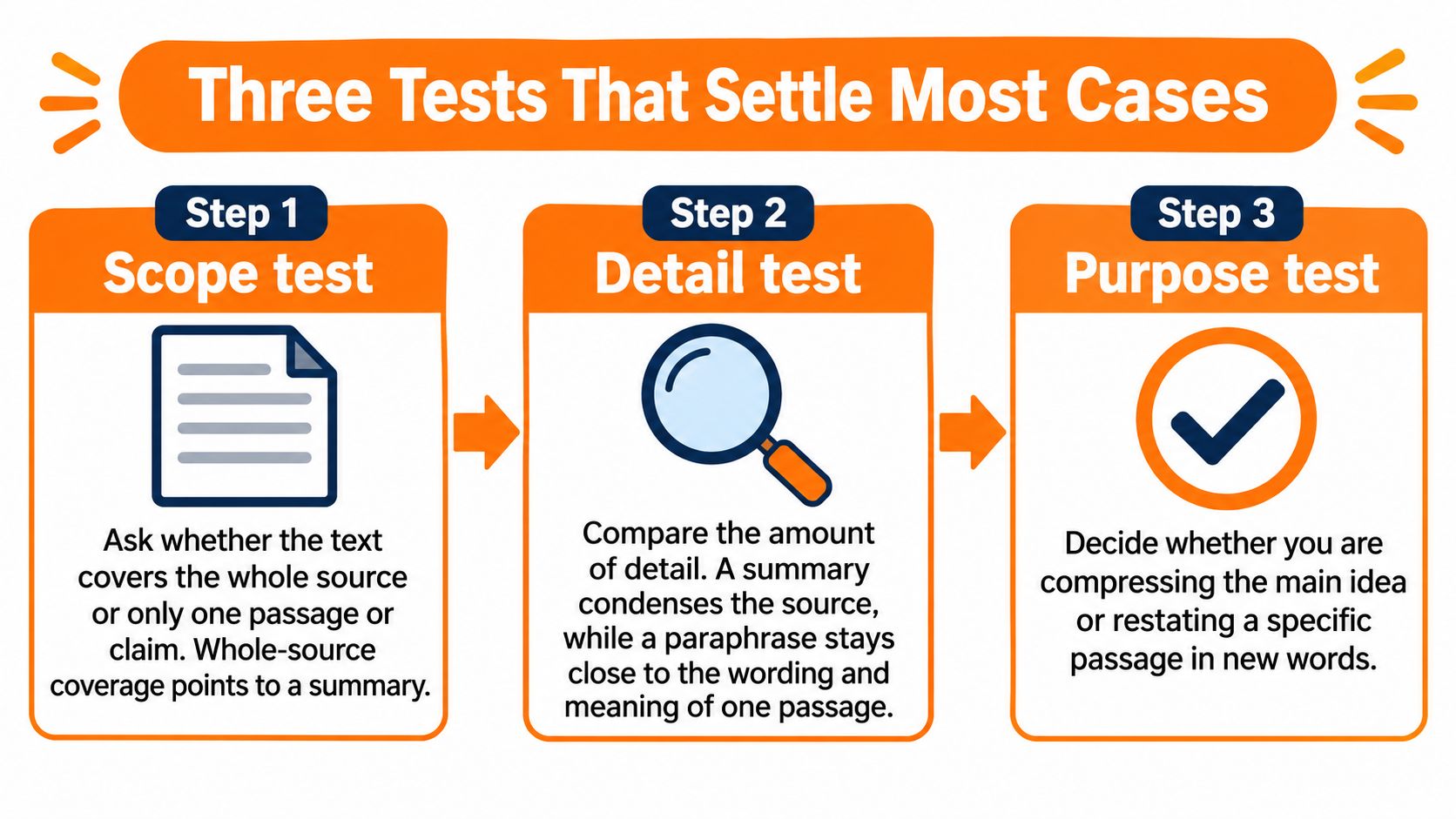
Follow the tests in order
-
Scope test: What portion of the source am I representing?
Look at the source boundaries. Are you explaining the overall library proposal, or restating its paragraph about staffing? Whole-source coverage points toward a summary; a selected passage points toward a paraphrase, although scope alone doesn't settle every case.
-
Detail test: Which information survived?
Mark the source's central claim, evidence, examples, conditions, and reasoning. Then locate their equivalents in your draft. If the staffing requirements and their explanation remain, you're probably paraphrasing; if you've retained only the recommendation and its broad justification, you're summarizing.
Pay particular attention to necessary qualifications. Removing a colorful example may be appropriate compression. Removing the condition that makes a recommendation feasible may change its meaning.
-
Independence test: Did I rebuild the expression?
Compare the grammatical subject, sentence openings, clause order, and organization. If your draft follows the original sentence pattern while replacing individual words, it needs another revision. Keeping the details doesn't make a lightly edited copy an acceptable paraphrase.
These tests produce a practical verdict:
- Broad coverage with selective detail: You've probably written a summary.
- Focused coverage with comparable detail: You've probably written a paraphrase.
- Retained detail with borrowed sentence construction: You've probably produced patchwriting rather than an independent rewrite.
The independence test is a quality check, not just a labeling exercise. A summary can also borrow too much language, even when it successfully reduces the source.
Ask what the reader needs to understand your point: the source's conclusion, or the reasoning that supports it?
That question resolves many borderline drafts. If the assignment asks you to explain why a particular recommendation is conditional, a broad overview won't supply enough information. If you're merely introducing the proposal before evaluating it, reproducing every supporting detail will distract from your own argument.
One Passage Written Three Ways
A useful comparison starts with the same material and changes what the writer preserves. Purdue's writing exercises use an exchange-student passage that works well for this, because it packs several pieces of information into one sentence: who acted, where the students went, why they went, and what they were meant to gain.
Keep the source visible while you compare the versions, just as you would when checking assignment notes.
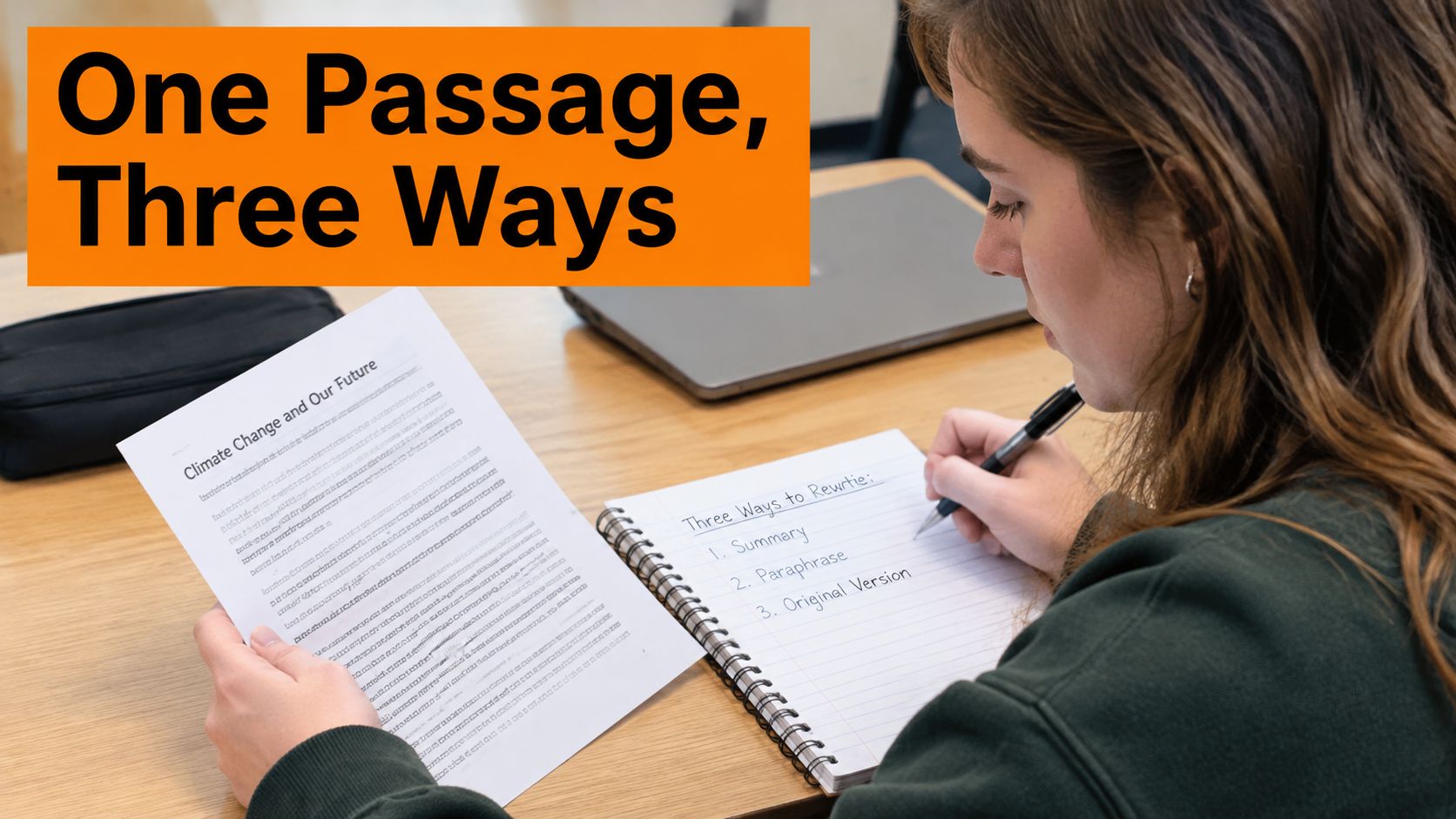
The source and a faithful paraphrase
Purdue's exercise passage reads:
A book by Leibovitz and Miller describes how China sent a group of boys to the United States to learn about developments that could help modernize China.
Faithful paraphrase: A book by Leibovitz and Miller presents China's decision to send a group of boys to the United States, where they studied developments that could contribute to their country's modernization, as shown in Purdue's exchange-student exercise.
The paraphrase keeps the authors, the destination, the description of the group, the learning purpose, and the intended benefit. It changes the grammatical subject and reorganizes how the book relates to the educational mission.
Verdict: A paraphrase. It passes the focused-scope and detail tests, and its construction differs from the original sentence.
A genuine summary and an unacceptable rewrite
Genuine summary: The book describes Chinese students who studied in the United States to learn how to help their country.
Notice how much thinner the information has become. The authors' names, the description of the group, and the specific purpose of the trip are gone. What survives is the book's broad subject, and that is enough if your reader only needs to know what the book concerns before you move to your own argument. If your paragraph depends on why China sponsored the trip or what the students studied, this version has stripped too much.
Verdict: A summary. The next step is to confirm that this broad description supplies enough context for your paragraph, then include the appropriate citation in your assignment.
Patchwriting: A book by Leibovitz and Miller explains how China sent a group of boys to America to study advances that could help modernize China.
Set that sentence beside the original and track the changes. The writer has changed describes to explains, United States to America, and some other wording, but the sentence pattern remains almost untouched. The information density matches the original, yet the shape of the sentence still belongs to it.
Verdict: It fails the independence test. Close the source, explain the event from understanding, and then reopen the passage to verify accuracy.
For another walkthrough of these choices, use the accompanying video.
The pattern across all three versions is density, not length. The paraphrase carries roughly the same information per sentence in different words. The summary carries far less, on purpose, because the reader only needs the book's general subject. The patchwritten version carries the same information while keeping the original's structure, which is why it fails even though its vocabulary changed.
When you're handling several readings, organizing sources in a literature review matrix can help you separate each source's overall argument from passages whose details you'll need later.
Mistakes That Blur the Line
Patchwriting can look convincing because the vocabulary has changed. But George Mason University's writing guidance calls for substantial changes to wording, phrasing, and sentence structure, not isolated substitutions.
The fix isn't to search for less familiar synonyms. Read until you understand the passage, put it aside, and explain the idea without following the source sentence by sentence.
Common mistakes and their fixes
| Mistake | What It Looks Like | Fix |
|---|---|---|
| Patchwriting | Source sentence structure kept, a few words swapped | Close the source and rebuild the sentence from the idea |
| Point-by-point shortening | Summary follows the source order, only shorter | Rank claims by importance and rewrite around the thesis |
| Word-count rule | Judging by whether the text is shorter | Check scope and detail, not length |
| Dropped thesis | Vivid example kept, central claim missing | Write the one-sentence thesis first, then add support |
| Changed certainty | Hedged claim restated as firm, or the reverse | Keep the source's qualifiers in both forms |
| Missing citation | New wording, no attribution | Cite every summary and paraphrase |
Preserve the argument, not just memorable details
Say the library proposal begins with a student's difficulty finding a quiet workspace, then develops an argument about access. A draft that retells the student's experience but omits the recommendation hasn't captured the proposal's central point.
Write the thesis from memory before drafting the summary. Harvard's guidance on summarizing recommends making the central claim clear rather than summarizing every point in its original order.
Changed certainty is subtler. A proposal that says longer opening hours may improve access if staffing is available does not say that longer hours will improve access unconditionally. Preserve both the uncertainty and the staffing condition, even when you compress the surrounding explanation.
Meaning check: Watch the small words that control the claim, including may, only, unless, and under these conditions.
Finally, original wording doesn't make the underlying idea yours. Add attribution while drafting rather than trying to reconstruct your sources afterward.
If you need help interpreting similarity results, this guide to reviewing plagiarism-checker findings can support that review. A match needs investigation: it might involve a quotation, necessary terminology, or wording that still needs revision.
Check Your Draft and Pick the Right Form
Put your source and draft beside each other. Review them for meaning before you polish grammar, because a fluent sentence can still misrepresent the author.
Use this checklist as a visible reminder during revision.
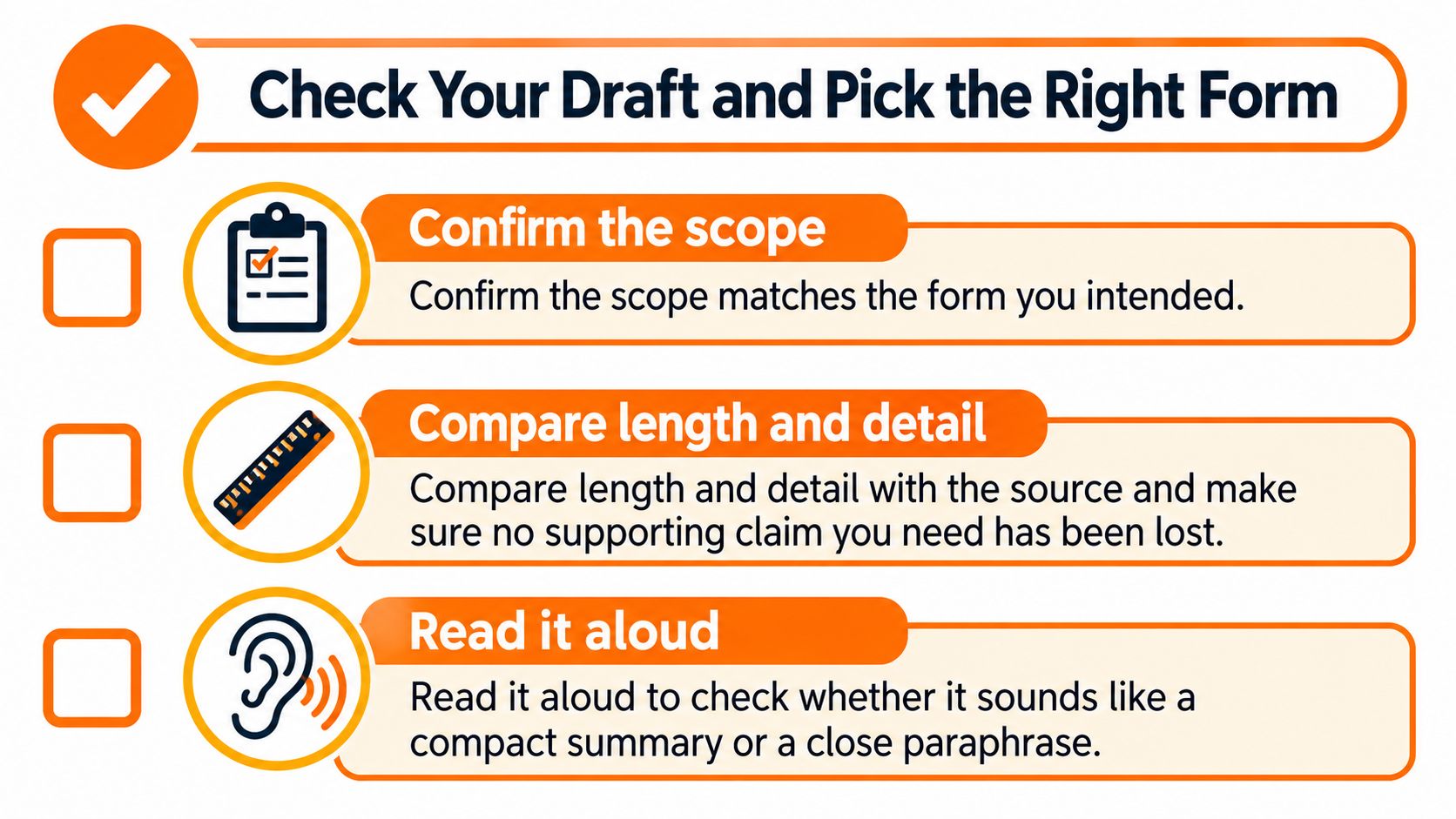
Review meaning before wording
- Confirm the intended scope. Name the source unit you're using: the entire article, a section, or a selected passage. Check that your draft represents that unit.
- Compare coverage and detail. Identify anything you removed. Restore information your argument depends on, especially conditions attached to a claim.
- Examine sentence construction. Read corresponding sentences side by side. Rework passages that retain the source's grammatical pattern with only cosmetic edits.
- Audit accuracy and certainty. For a paraphrase, account for the passage's distinctive ideas. For a summary, verify the central claims and necessary qualifications rather than trying to preserve everything.
- Confirm attribution. Make sure readers can identify the source and tell where borrowed material ends and your analysis begins.
Reading aloud can reveal awkwardness or unnecessary detail, but it won't establish accuracy by itself. Keep the source available for the meaning check.
Use tools after your own review
We offer AI Humanizer, AI Detector, Grammar, Paraphrase, and Plagiarism tools, plus a free AI Text Cleaner. For this task, use grammar checking to review expression, paraphrasing assistance to explore alternative wording, and plagiarism checking to investigate potentially close matches.
A grammar checker won't determine whether you've omitted an important limitation. A paraphrase tool can change expression, but it can't decide what your reader needs or whether the assignment calls for an overview. A similarity result is a reason to inspect the passage, not a verdict on its acceptability.
This guide to using a paraphrase tool can help you approach assisted rewriting as an editing step. Keep humanizing separate: making AI-generated prose sound more natural isn't the same task as faithfully restating a cited source.
The practical decision is straightforward:
- Choose a summary when readers need the source's main argument without its detailed development.
- Choose a paraphrase when readers need a particular passage's evidence, reasoning, or qualifications.
- Clarify the assignment when its wording leaves the expected coverage uncertain.
Knowing how to distinguish summarizing from paraphrasing helps whether you're preparing an essay, research note, or client brief. Choose the form, draft it, and complete the meaning-and-attribution check before submitting it.
Quick Answers to Common Questions
Do I need quotation marks around a paraphrase?
Not when it's entirely in your own words. If you retain a distinctive exact phrase, mark that wording as a quotation and cite the source; the surrounding paraphrase still needs attribution.
Can I summarize a single paragraph?
Yes. Scope is relative: reducing a paragraph to its central point while dropping examples is summarizing, even though the source unit is short.
Can I replace the source's example with my own?
Not while presenting the result as a faithful restatement of the source. You can add your own illustration separately, but clearly distinguish it from the author's evidence.
What if my summary uses a key term from the source?
Keep necessary terminology and cite the source. Use quotation marks for distinctive borrowed wording, but ordinary shared technical terms don't automatically require quotation marks because the source uses them.
Lumi Humanizer offers paraphrasing, grammar, and originality-review tools to support revision after you've checked a source's meaning. Visit Lumi Humanizer to refine your wording, then compare the result with the original and keep the citation attached.