A research abstract is one self-contained paragraph of about 150 to 250 words covering the question, methods, findings, and conclusion, unless the venue sets a different limit. To learn how to write a research abstract, start with what your completed study found, then add only the context readers need to understand it.
You may already have a finished paper and a draft that spends too long explaining the topic. Or your findings may be mixed, leaving you unsure how to end confidently without exaggerating. The job isn't to make the study sound more impressive. It's to make the evidence easy to judge.
What a Research Abstract Has to Do
A research abstract gives readers a compact account of the study, not an invitation to discover the results elsewhere. Someone encountering it in a database should understand the question, approach, main finding, and contribution without opening the manuscript.
Purdue OWL's APA guidance describes a typical 150–250-word, single-paragraph abstract that includes the research topic, questions, participants, methods, analysis, results, and conclusions. Its formatting guidance also specifies double-spacing and no paragraph indentation. Your assignment, journal, or conference instructions override those conventions.
An abstract isn't a shortened introduction
An introduction builds the case for conducting a study. An abstract must also tell readers what happened when you conducted it.
Consider a draft about study strategies. A weak version spends its opening explaining that learning matters, students face academic challenges, and effective revision is important. It ends by promising that results will be discussed.
A stronger version identifies the question immediately: whether retrieval practice and rereading are associated with different examination outcomes. It names the research approach and reports the actual finding before explaining its meaning.
Practical rule: Keep background only when removing it would make the research question harder to understand.
The abstract also needs to match the kind of paper you wrote. A survey needs its population and measures; a review needs its selection and synthesis approach. Don't force experimental language onto research that didn't involve an experiment.
Before drafting, locate the submission instructions and record:
- Length: The maximum word count and whether headings count.
- Structure: Required labels or a continuous paragraph.
- Submission details: Keyword requirements and any separate abstract field.
That small preparation step prevents a polished paragraph from becoming a formatting problem.
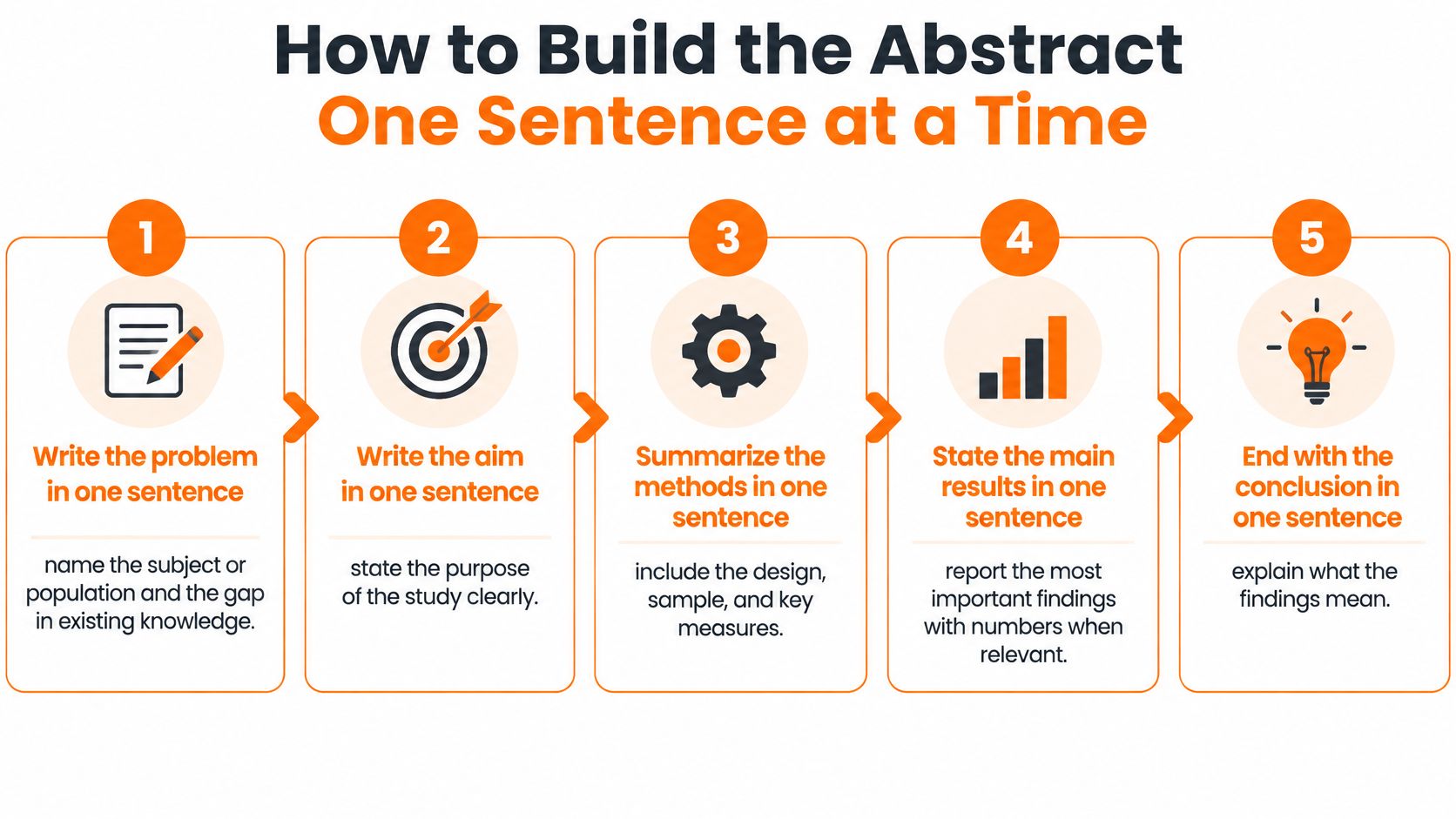
How to Build the Abstract One Sentence at a Time
Write from the finished manuscript, with the methods and results open beside you. Don't reconstruct the study from memory.
Columbia University's abstract-writing guidance offers a useful sentence plan: one sentence for the broad problem, one for the gap or aim, one to three for methods, two to four for results, and one or two for implications. Treat that as a drafting scaffold, not a requirement to use every available sentence.
-
Write the problem in one sentence. Name the subject or population and the specific uncertainty. Delete broad claims that could introduce almost any paper in your field.
-
State the aim directly. Say what you investigated, including the design when it helps distinguish the question. A survey examines an association; a randomized trial can address a different kind of question.
-
Describe the methods readers need to interpret the result. Include the setting, sample, main measure, and analysis approach where relevant. Routine software names and procedural detail usually belong in the manuscript.
-
Lead the results with the primary outcome. Give the comparison, direction, and magnitude before secondary findings. Don't let an interesting exploratory result replace the study's original question.
-
Finish with a bounded conclusion. Explain what the finding supports, not what you hoped it would support. Keep recommendations proportionate to the design and uncertainty.
-
Count and cut. Shorten background first, then remove repeated aims and unnecessary method detail. Protect the information readers need to evaluate the finding.
Sentence budget for a research abstract
For a working draft of about 170 to 250 words, use this allocation as an editorial planning aid rather than a venue rule.
| Abstract Part | Sentences |
|---|---|
| Broad problem | 1 |
| Knowledge gap or aim | 1 |
| Methods | 1–3 |
| Results | 2–4 |
| Conclusion or implications | 1–2 |
The compact visual version helps you check the order before polishing transitions.
Make each sentence carry useful information
Consider this illustrative model: a survey of 184 first-year students compared reported study time with examination scores; students using retrieval practice reported higher scores than students using rereading. The sentence identifies the sample, comparison, and finding without a long procedural introduction. It's a writing example, not evidence that a particular intervention works.
If your project also needs funding, the Grantlas guide to writing grant proposals offers a related resource for explaining the project's purpose and approach. Keep the distinction clear: a proposal describes planned work, while a completed-study abstract reports what you did and found.
Writing Results Sentences With Real Numbers
Results were significant leaves the reader asking the important questions. Which outcome changed? Compared with what? How large was the difference?
The ICMJE manuscript-preparation recommendations call for main findings and, where possible, specific effect sizes together with their statistical and clinical significance. In practice, describe the result before attaching a statistical label.
Replace vague claims with interpretable findings
The examples below are drafting models, not reports of a completed study. Where an estimate isn't available, the sentence shows what you must retrieve from the manuscript rather than supplying invented values.
Weak and stronger results sentences
| Weak Sentence | Stronger Sentence | What Changed |
|---|---|---|
| Results were significant. | Retrieval practice users scored higher on the final exam than rereading users (n = 184). | Gives direction, comparison group, and sample size. |
| Participants improved after the program. | Among analyzed students, report the mean examination-score difference between retrieval practice and rereading, in score points, with its confidence interval. | Requires size, direction, and precision rather than an unsupported improvement claim. |
| Results will be discussed in the full paper. | Retrieval practice users scored higher than rereading users on the final exam (95% CI for the difference reported). | Reports the finding itself and specifies the precision information to insert. |
The first revision still needs clarification if the sample count represents respondents rather than students included in the analysis. The second is a drafting instruction until you insert the actual estimate. In the last row, replace the parenthetical reminder with the calculated interval before submission.
A sentence isn't submission-ready just because it contains a number. Readers must know what that number measures and whom it includes.
Show uncertainty and identify the denominator
A 95% confidence interval communicates precision alongside the estimate; a p-value alone doesn't describe effect size. An evaluation of randomized-trial abstracts also highlights ambiguity in participant counts, which may refer to recruitment, enrollment, assignment, or completion. State the analysis population explicitly.
The same reading habit matters outside academia. If you find independently reviewed longevity programmes, examine who was assessed and what outcomes were measured rather than relying on an improvement claim.
Once wording is final, use a grammar checker for agreement and clarity slips. Then verify every number manually against the manuscript's tables.
Reporting Null and Non-Significant Findings
No evidence of an effect isn't the same as evidence of no effect. The first means the analysis didn't detect a difference; the second requires sufficiently precise evidence to rule out a meaningful difference.
Keep the manuscript's estimates beside you while choosing the wording.

An imprecise estimate may remain compatible with benefit, harm, or little difference. Don't turn a non-significant result into a claim that an intervention doesn't work. Equally, don't disguise it with optimistic language about a trend.
Elsevier's abstract-writing guidance emphasizes reporting major results without speculation. That principle matters particularly when the findings don't support a simple positive conclusion.
Use wording that matches the uncertainty
A reusable drafting template is:
The intervention was not associated with a statistically detectable change in the primary outcome; the estimate was imprecise (95% CI from a to b), so the study cannot rule out a small benefit or harm.
Replace the letters with the actual interval and specify the outcome and effect measure. Use the benefit-or-harm wording only if the interval clearly supports that interpretation.
To make room, cut the name of routine statistical software or a detailed description of questionnaire administration. Don't remove the study design or analysis population to preserve background.
For mixed findings, report the primary outcome first. If a subgroup finding warrants inclusion, identify the subgroup and distinguish a prespecified analysis from an exploratory one. An apparent difference between subgroup results doesn't automatically establish that the groups responded differently.
A cautious, precise null result is more useful to readers than a claim the data cannot support.
For an additional explanation of abstract drafting, this video offers a supplementary resource.
If analysis is incomplete, don't present anticipated findings as completed results. Follow the venue's rules for work in progress, and state the project's status plainly.
Adapting One Study for Different Venues
Create a master abstract before writing submission-specific versions. Build it from verified manuscript content, including the essential estimates and limitations, then adapt its length and presentation.
Venue requirements aren't interchangeable. APA's manuscript-preparation guidelines set an abstract maximum of 250 words, while UAMS scientific-writing guidance describes journal and conference abstracts commonly falling within 200–300 words.
Typical abstract requirements by venue
| Venue | Typical Word Limit | Format to Check |
|---|---|---|
| APA journal manuscript | 250 words maximum | Single paragraph on a separate page |
| Scientific journal or conference | 200–300 words | Structured with headings or one paragraph |
| General course paper | 150–250 words as a working convention | Single paragraph |
| Conference proposal | Limit specified in the call for papers | Check the call for papers |
| Thesis or dissertation | Limit specified by the graduate school | Check the graduate school template |
These are starting conventions, not permission to ignore a submission portal. A course assignment may use a different target, and a graduate school may impose its own layout.
Translate the language, not the evidence
For specialists, retain established technical terms that identify the method accurately. For interdisciplinary readers, replace unexplained acronyms and dense phrases with direct wording.
For example, change an assessment of post-intervention educational attainment into a comparison of examination scores after the program, if that accurately describes the measure. Don't change an association into an improvement caused by the program.
The ACRM structured-abstract instructions illustrate why you should map required headings before editing. A venue may need separate information about design, setting, participants, and outcomes.
An abstract also differs from an executive summary, which may give decision-makers recommendations and operational context. The guide to writing an executive summary can help when you need that separate document.
Compare each adapted version with the master for unchanged populations, estimates, limitations, and conclusions. Shorter wording must not become a stronger claim.
Answers to Common Abstract Questions
Should an abstract include citations?
Usually no. Keep the abstract focused on the study itself, and follow the venue's exceptions rather than importing the literature review.
If readers need to recognize a named instrument or prior dataset, identify it concisely. Naming a measure doesn't automatically require a full reference inside the abstract; check the submission guidance before adding one.
Can I write in the first person?
Often yes, if your venue permits it. Use an active construction such as we surveyed students when identifying the researchers' action helps the sentence.
Passive voice remains useful when the procedure matters more than the actor: Responses were analyzed using thematic analysis. Don't switch voices merely to sound more academic, and avoid we proved when the design supports a more limited conclusion.
The guide to grammar checking for academic writing offers additional help with sentence-level editing. Grammar review can improve expression, but it can't decide whether your interpretation is justified.
Where do keywords go?
In APA journal submissions, keywords follow the abstract, with up to five terms or brief phrases under the manuscript guidance cited above. Check whether your submission system requests them separately.
Choose recognizable terms for the population, method, intervention, or central concept. For a study of learning strategies, useful terms might include retrieval practice, rereading, and undergraduate students, provided those accurately describe the paper.
Avoid promotional terms such as novel research. A reader searching for your study needs its subject and approach, not your assessment of its importance.
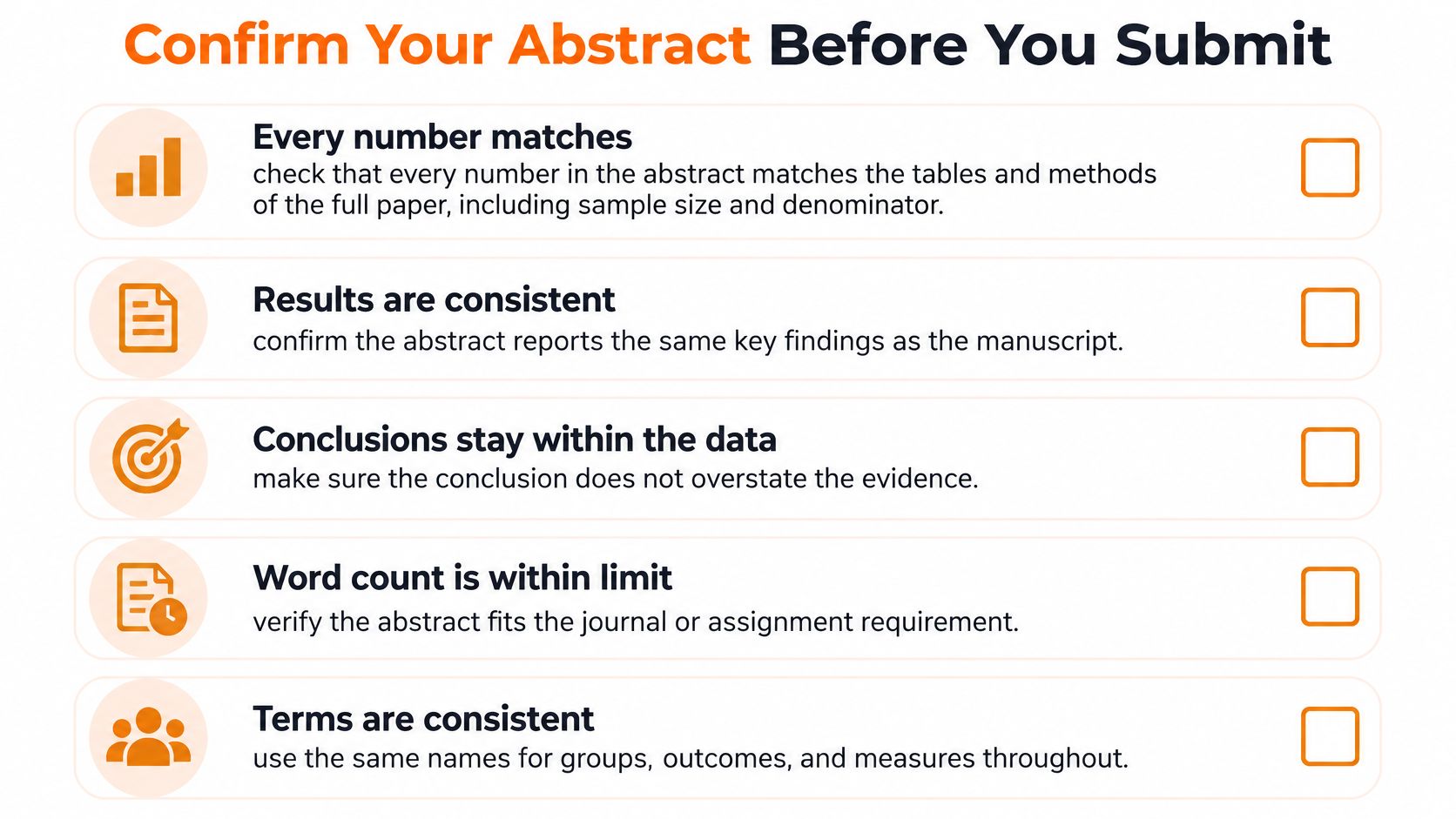
Confirm Your Abstract Before You Submit
Check the abstract against the final manuscript, not an earlier draft. Revisions to exclusions, outcome definitions, or analyses can leave the abstract inconsistent even when its sentences still read smoothly.
Use this final verification sequence:
- Match every number. Confirm sample sizes, analysis denominators, estimates, and uncertainty against the methods and tables. Check that percentages refer to the correct group.
- Align the findings. Report the manuscript's primary outcome rather than selecting a more favorable secondary result.
- Limit the conclusion. Remove causal claims unsupported by the design and recommendations that exceed the evidence.
- Meet the submission rules. Confirm the word count, required headings, keyword placement, and formatting in the actual submission field.
- Keep terminology consistent. Use the same group names, outcome labels, and measurement units throughout.
- Remove ambiguity. Define essential acronyms and replace vague descriptions such as several or promising with information readers can evaluate.
The checklist below provides a compact reference during that final comparison.
Read it without the paper beside you
Read the paragraph aloud as though you've never encountered the project. Look for missing comparisons, unclear pronouns, and methods that don't appear to answer the stated question.
For a more deliberate editing pass, use these techniques for proofreading your own writing. Separate language edits from evidence checks so a smoother sentence doesn't alter the scientific claim.
If you reused wording from previous papers or templates, review originality before submission. Users in academic settings must comply with their institution's academic integrity policies. Editing and originality checks support those obligations; they don't replace required attribution, disclosure, or your own judgment.
Knowing how to write a research abstract means knowing when it's ready: a reader can identify the question, understand the design, evaluate the main result, and see what the conclusion does and doesn't support from the paragraph alone.
Before submitting, use the plagiarism checker for a final originality review.
Lumi Humanizer offers rewriting that makes AI-assisted text sound more natural while keeping its original meaning and intent. If your abstract needs a language polish after you've verified the evidence, visit Lumi Humanizer, then manually check that the revised wording preserves your methods, findings, and uncertainty.