You're ready to submit your draft, but another reread still leaves you wondering what you've missed. The best way to proofread your own writing is to check it in separate passes: meaning, sentences, word choice, mechanics, then facts and references. Give each pass a specific job, because a clean spellcheck doesn't mean your draft says what you intended.
The Five Passes to Run in Order
Start with substantive revision, not punctuation. Decide whether the draft answers the reader's question, presents its argument in a sensible order, and supports its claims. Polishing a paragraph you'll later delete wastes effort.
The Excelsior OWL revision checklist recommends separating revision from sentence-level checking and leaving a day before the final review when possible. That pause helps you approach the words on the page rather than rely on your memory of the intended message.
Give each pass one job
Use the sequence below as a working checklist. Meaning and structure come first because later corrections should happen on text you intend to keep.
Proofreading passes in order
| Pass | Targets | How to run it |
|---|---|---|
| 1. Meaning and structure | Purpose, argument order, missing evidence | Read once straight through and note gaps without fixing wording |
| 2. Sentence check | Run-ons, fragments, overloaded sentences | Read each sentence aloud and flag any you need to breathe through |
| 3. Word choice | Real-word substitutions, small function words, confused pairs | Compare each verb, preposition, pronoun, and number with your intended meaning |
| 4. Mechanics | Spelling, punctuation, capitalization, your personal error list | Read line by line or backward; treat spellcheck results as alerts |
| 5. Facts and references | Names, dates, figures, units, citations, formatting | Check each item against the source document or reference list |
During the opening pass, leave comments such as missing evidence or explain this transition. Resolve those comments before hunting for apostrophes. If the conclusion introduces a new argument, fix that structural problem rather than merely smoothing its wording.
Practical rule: Don't try to judge the argument and inspect every comma at the same time.
Keep a short personal error list beside the draft. Include patterns you repeat, such as inconsistent capitalization, missing articles, or switching between British and American spelling. Add these to the mechanics pass instead of relying on a generic checklist alone.
If your deadline is close, shorten the scope of each pass rather than turning everything into a rushed reread. Keep factual verification separate, especially for claims that affect a reader's decision.
How to Read Your Draft Aloud Without Missing Words
Read what's printed, not what you remember writing. Speaking slowly while following the text gives you a chance to notice missing words, broken grammar, and phrasing you might otherwise skim.
In a 2022 experimental study indexed by APA PsycNet, reading aloud improved detection of both noncontextual errors, such as typos, and contextual errors, such as grammar or word-choice problems, compared with silent reading. Use that advantage deliberately rather than performing the draft at conversational speed.
Follow the words with your eyes
-
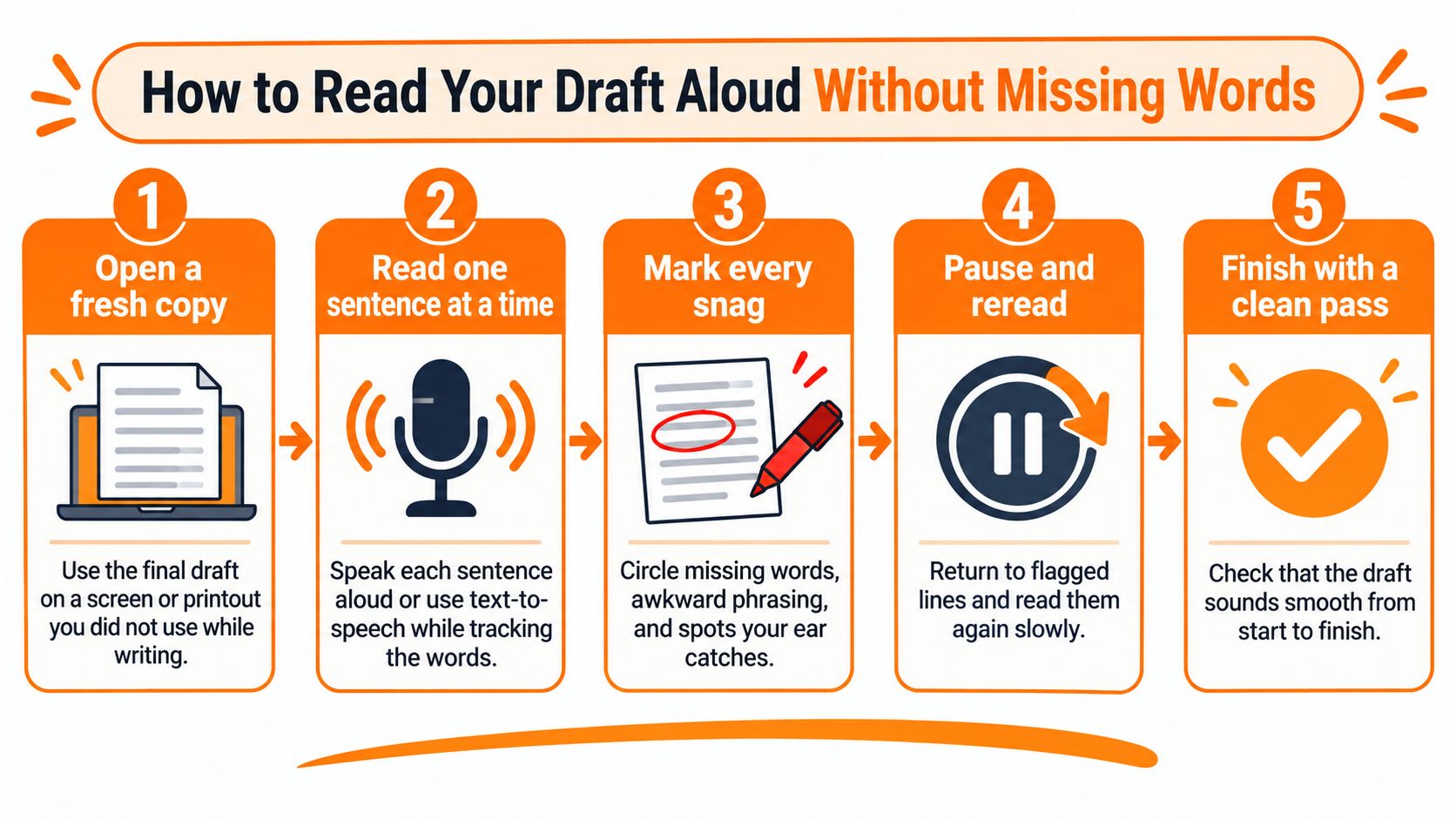
Open a fresh copy. Use the final draft on a different screen or printout from the one you used while writing. Keep comments visible, but hide distracting editing panels.
-
Read one sentence at a time. Speak aloud, or use text-to-speech while tracking each word visually. A cursor, finger, or sheet of paper beneath the line can help you keep your place.
-
Stop at every snag. Mark omitted words, doubled words such as the the, and places where the sentence stops making sense. Don't supply a missing word and continue.
-
Apply the breath test. A plain-language review recommends sentences below 20 words and suggests that needing a breath before finishing can signal excessive length. Treat that as a prompt to inspect the sentence, not an automatic instruction to cut it.
-
Mark problems rather than fixing them mid-read. Add a margin note or highlight, then continue. Stopping to rewrite every phrase makes it harder to maintain your checking rhythm.
-
Fix the marked items together. Reread each changed sentence and its immediate context. A local correction can alter a pronoun reference or make the next sentence repetitive.
Keep this visual reminder beside your draft while you work.
Listen for grammar, not just rhythm
Before: The report was send to the team before the review was finished.
After: The report was sent to the team before the review was finished.
The phrase was send sounds wrong when spoken carefully. The correction is small, but you still need to ask whether sending an unfinished report was what happened.
Reading aloud is a supplement to silent and visual checks, not a replacement for them. A sentence can sound smooth while containing the wrong name, date, or claim.
Catching Real-Word Errors Your Spellchecker Misses
A spellchecker can flag teh because it isn't a standard word. It may accept form where you meant from, because both words are spelled correctly.
That distinction matters. Burgoyne and colleagues' proofreading paper%20Revisiting%20the%20self-generation%20effect%20in%20proofreading.pdf) reports that wrong-word errors are detected less often than non-word errors, while small function words are also disproportionately missed. Your word-choice pass needs to inspect meaning, not merely dictionary validity.
Compare the wording with the intended claim
Read each verb, preposition, pronoun, number, and technical term deliberately. Ask what relationship it establishes: who acted, what changed, where something came from, and whether the sentence describes possibility or certainty.
Before: The survey results form the latest study show a clear trend.
After: The survey results from the latest study show a clear trend.
The correction restores the source relationship. The original contains no misspelled word, yet it interrupts the meaning.
Commonly confused words to check by hand
| Word pair | Example error | Check by hand |
|---|---|---|
| their / they're / there | They're house is on the corner | Try they are. Use their for possession and there for location or existence |
| from / form | The data came form the survey | From names a source; form can mean shape or structure |
| affect / effect | The change had no affect on results | Affect is usually a verb; effect is usually a noun |
| than / then | The model was bigger then the last one | Use than for comparison and then for time or sequence |
| its / it's | The team updated it's plan | Try it is. If that doesn't fit and possession is intended, use its |
| principal / principle | The principle rule of the study | Principal means main or head; principle means a rule or belief |
| complement / compliment | The design complimented the brand | Complement means completes or suits; compliment means praises |
| lose / loose | I don't want to loose the draft | Lose means misplace or fail to retain; loose means not tight |
The principal rule of the study is correct if you mean its main rule. Don't replace a word merely because it belongs to a commonly confused pair.
Check fluent sentences too
For non-native English writers, pay particular attention to articles and prepositions. For AI-assisted drafts, inspect technical terms and claims that sound plausible but don't match the source. Fluency isn't factual accuracy.
Use Lumi's grammar checker as a second check for confused pairs, but judge each suggestion against your intended meaning. A flagged phrase is a question to resolve, not a verdict.
Finish this pass with a targeted search: highlight every occurrence of form, affect, than, and its. Read each result in context, including the sentence before it when needed.
Fixing Long Sentences, Names and Numbers
A Michigan Bar Journal comparison reported that everyday written language averaged 17 words per sentence, typically 15–20, while contract language averaged 42. Contract language also scored lower on Flesch Reading Ease, 20 compared with 56 for everyday language.
Use length as a warning light, not a grading system. Inspect longer sentences for competing ideas, buried subjects, and qualifications that separate the actor from the action.
Split without changing the relationship
Before: The contractor, who was hired in March after the first bid was rejected by the board, was asked to submit revised drawings.
After: The board rejected the first bid. The contractor, hired in March, was asked to submit revised drawings.
The shorter version is easier to follow, but check whether the sequence needs to be explicit. If timing matters, write The board rejected the first bid before hiring the contractor in March.
Sometimes joining related clauses works better than splitting them. This guide to a compound sentence with “and” can help you distinguish a clear connection from an overloaded sentence.
Legal and technical writing may need longer constructions to preserve conditions or scope. Remove words that don't carry meaning, but don't delete a necessary qualification just to lower a word count.
Verify details against the originals
Build a check list directly from the draft:
- Names: Match people, organizations, products, and author names to their original sources.
- Figures and units: Confirm values, decimal points, percentages, currencies, and measurement units.
- Dates: Check that the date belongs to the event or publication you're describing.
- Defined terms: Keep the same spelling, abbreviation, and capitalization throughout.
- References: Match each in-text citation to its reference entry and confirm that the source supports the attached claim.
Start with the longest paragraph as a manageable test case. Its density makes it a useful place to practise separating sentence repairs from factual checks. Then apply the same inspection to the rest of the document.
Checking Spelling, Punctuation and Capitalization
Run mechanics after sentence repairs so you're checking stable wording. Start at the final sentence and work upward, or use a ruler to isolate each line.
Reading sentences in reverse order helps you stop following the argument automatically. Don't reverse the words when checking grammar, though, because you need the sentence's normal order to judge it.
Keep the checklist narrow
- Spelling: Inspect unfamiliar terms, product names, and proper nouns manually. Add a correct specialist term to your dictionary only after verifying it.
- Commas: Remove commas that unnecessarily separate a subject from its verb. In The results of the survey, show a preference, the comma doesn't belong.
- Apostrophes: Distinguish the team's results from the teams' results. Decide whether you mean a single team or multiple teams.
- Semicolons: Check that both sides can stand as complete sentences, unless you're using semicolons to separate complex list items.
- Capitalization: Apply a consistent style to headings, job titles, product names, and text following a colon.
Before: the Analysis showed that Customers preferred mobile.
After: The analysis showed that customers preferred mobile.
The correction isn't a change in meaning. It restores sentence capitalization and removes unnecessary capitals from ordinary nouns.
Search for your recurring mistakes
Open your personal error list and search for each pattern directly. If you type recieve, search for that string rather than hoping another general reread catches it.
If you struggle with which clauses, inspect each occurrence individually. A supplementary clause usually takes commas, but don't insert one before every which without reading the sentence.
The distinction between grammar and spelling is useful here: a correctly spelled word can still have the wrong grammatical form. Keep those checks separate enough that neither gets reduced to accepting software suggestions.
When Self-Proofreading Is Not Enough
Self-review can leave substantial errors behind. In a small study documented in an ERIC-hosted report on proofreading, students corrected only 16 of 77 errors, about 20%; a separate dialect-error comparison in that report found little difference between aloud reading, silent reading, and listening to an instructor.
When you're rereading without noticing anything new, change the task instead of trying harder.
Match the review to the stakes
Use the ordered passes for a self-proofread on low-stakes drafts. For academic submissions, legal or medical documents, and client-facing material, bring in an appropriate external reader. Ask for a specific review, such as checking terminology or tracing claims to sources, rather than requesting feedback in general terms.
Self-proofreading isn't hopeless. Deliberate visual attention matters more than assuming your own words are impossible to inspect; Southeastern Louisiana University's proofreading strategies offer practical ways to change how you encounter a familiar draft.
A second reader is most useful when you tell them what needs checking and give them access to the relevant sources.
Keep a defect log with the location, error type, and correction. For a long document, that record helps you decide where another targeted pass is worth the effort.
For a companion explanation of the process, watch this proofreading walkthrough.
If you're deciding which automated suggestions deserve attention, this guide to grammar-checking tools provides additional context. Software support doesn't replace specialist review when the consequences of an error are significant.
Final Check and Common Questions
Knowing how to proofread your own writing includes knowing when to stop revising and inspect the actual deliverable. Review the final output yourself before publishing or submitting it, including any changes introduced by software.
Use this short release checklist:
- Revisit the weakest area: Rerun the check that produced the most entries in your defect log.
- Read the opening and closing: Confirm that the introduction promises what the draft delivers and the conclusion matches the evidence.
- Inspect headings and layout: Check titles, captions, tables, links, and formatting in the final preview.
- Close every logged issue: Resolve comments and remove editing notes from the submission copy.
For a WordPress article, Read More Info's WordPress posting guide is a useful companion when moving from a checked document to the publishing interface. Inspect the preview rather than assuming pasted text retained its formatting.
How many times should I proofread?
Run each targeted pass once, then repeat the checks affected by your corrections. Reread the full draft after substantial rewriting, not after every small punctuation repair.
Can I proofread my own writing reliably?
You can improve it substantially through deliberate review. For high-stakes work, use an external reader to challenge assumptions and inspect details you may have accepted too readily.
Is spellcheck enough?
No. It checks spelling, not whether every valid word expresses the right meaning. Keep semantic checking and source verification in your workflow.
Should I check originality or AI signals?
Review originality when your submission requires it, using a plagiarism check alongside proper citation practices. If you use an AI detector, review the draft manually and treat the result as one editing signal, not a final verdict.
Lumi Humanizer offers tools for improving grammar, clarity, and the flow of AI-assisted drafts while keeping the intended meaning. Visit Lumi Humanizer and use the Grammar Checker for a final sweep before you submit, then review every accepted change yourself.