You're rereading a draft, and several sentences seem to say what you've already said. To remove redundancy in writing, identify words and ideas that repeat meaning, cut what adds nothing, and check that the shorter version still says exactly what you intended. Keep repetition that helps readers follow an argument, understand a term, or recognize an important distinction.
How to Remove Redundancy One Sentence at a Time
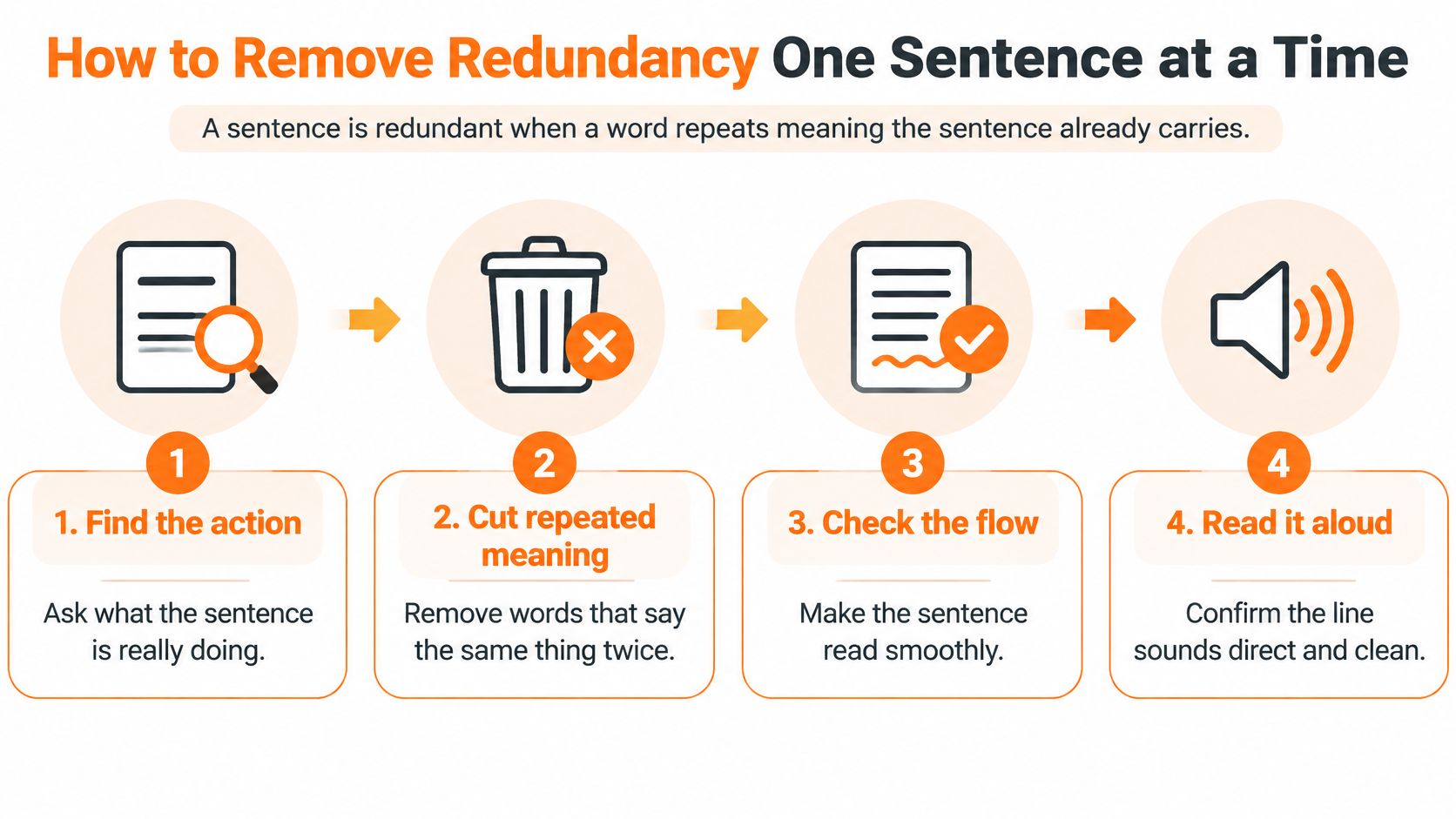
A sentence is redundant when a word repeats meaning the sentence already carries. Start with a small editing pass rather than trying to shorten everything at once.
- Find the action. Identify who or what the sentence concerns, then name what happens.
- Use a plain verb. Replace make a decision with decide and give consideration to with consider.
- Cut repeated meaning. Check whether a modifier or phrase adds information. In its strict sense, unique doesn't need very.
- Reread for accuracy. Confirm that you haven't removed a condition, changed the scope, or lost a cause.
Use this process as a reminder while editing individual lines.
Follow the subject and action
Consider this example from Purdue OWL's Paramedic Method, which shortens an employee sentence from 25 words to 9 and a Sandia Labs sentence from 23 words to 15.
Before
The point I wish to make is that the employees working at this company are in need of a much better manager of their money.
The subject is employees. Their situation is straightforward: they need a better money manager.
The opening announces that the writer has a point, but doesn't contribute to that point. Working at this company can become at this company, and are in need of can become need.
After
Employees at this company need a better money manager.
The revision preserves the central claim. However, notice that much better has become better. If the degree of improvement matters to your argument, keep much. An editing example is a model to evaluate, not a command to copy.
Before and after: Purdue's Paramedic Method examples
| Example | Words before | Words after | Words removed |
|---|---|---|---|
| Employee sentence, shortened to Employees at this company need a better money manager | 25 | 9 | 16 |
| Sandia Labs sentence, shortened to In recent years, engineers at Sandia Labs have participated in the Search and Rescue operations | 23 | 15 | 8 |
The principle has a long history. Cornell University's account of William Strunk's work traces his instruction to “omit needless words” to the 1918 publication of The Elements of Style.
The reusable rule is simple: keep the subject and action, replace inflated expressions with precise verbs, and remove duplicated meaning.
Redundant Word Pairs and Phrases to Cut
Some cuts are easy to recognize once you ask what each word contributes. In ordinary contexts, final outcome, free gift, and unexpected surprise can become outcome, gift, and surprise. The modifier repeats something the noun already communicates.
Category labels create similar clutter. Pink in color becomes pink. Shiny in appearance becomes shiny. Readers don't need you to explain that pink describes color or that shiny describes appearance.
Remove labels that add no information
Purdue OWL's guidance on eliminating words presents this car-buyer example as a reduction from 18 words to 10:
Before
During that time period, many car buyers preferred cars that were pink in color and shiny in appearance.
After
During that period, many car buyers preferred pink, shiny cars.
The revision removes time, the category labels, and a repeated use of cars. It keeps the buyers, their preference, the period, and the qualities they preferred.
Wordy phrases and their shorter forms
| Wordy version | Shorter version | Why it is redundant |
|---|---|---|
| due to the fact that | because | The fact that adds no meaning to the causal connection |
| each and every | each | Every repeats the distributive meaning of each |
| in order to | to | In order is usually unnecessary before an infinitive |
| at this point in time | now | The longer expression communicates the same present-time idea |
| in the event that | if | If already expresses the condition |
| final outcome | outcome | An outcome ordinarily names the final result |
| free gift | gift | A gift is ordinarily given without payment |
| unexpected surprise | surprise | Unexpectedness is already part of the meaning |
| during that time period | during that period | Time repeats the temporal meaning of period |
| pink in color | pink | The color is already named |
| shiny in appearance | shiny | The adjective already describes appearance |
Not every entry involves literal repetition. Some phrases are longer ways of expressing the same relationship. Because, for example, can communicate a cause without the surrounding phrase due to the fact that.
Practical rule: If one word already contains the relevant meaning of another, keep the specific word and test whether the extra word can go.
Treat every replacement as a candidate. Final might distinguish a final outcome from a provisional one, and now might not fit a sentence describing a past moment. Read the complete sentence before accepting the swap.
Sentence and Paragraph Length Targets
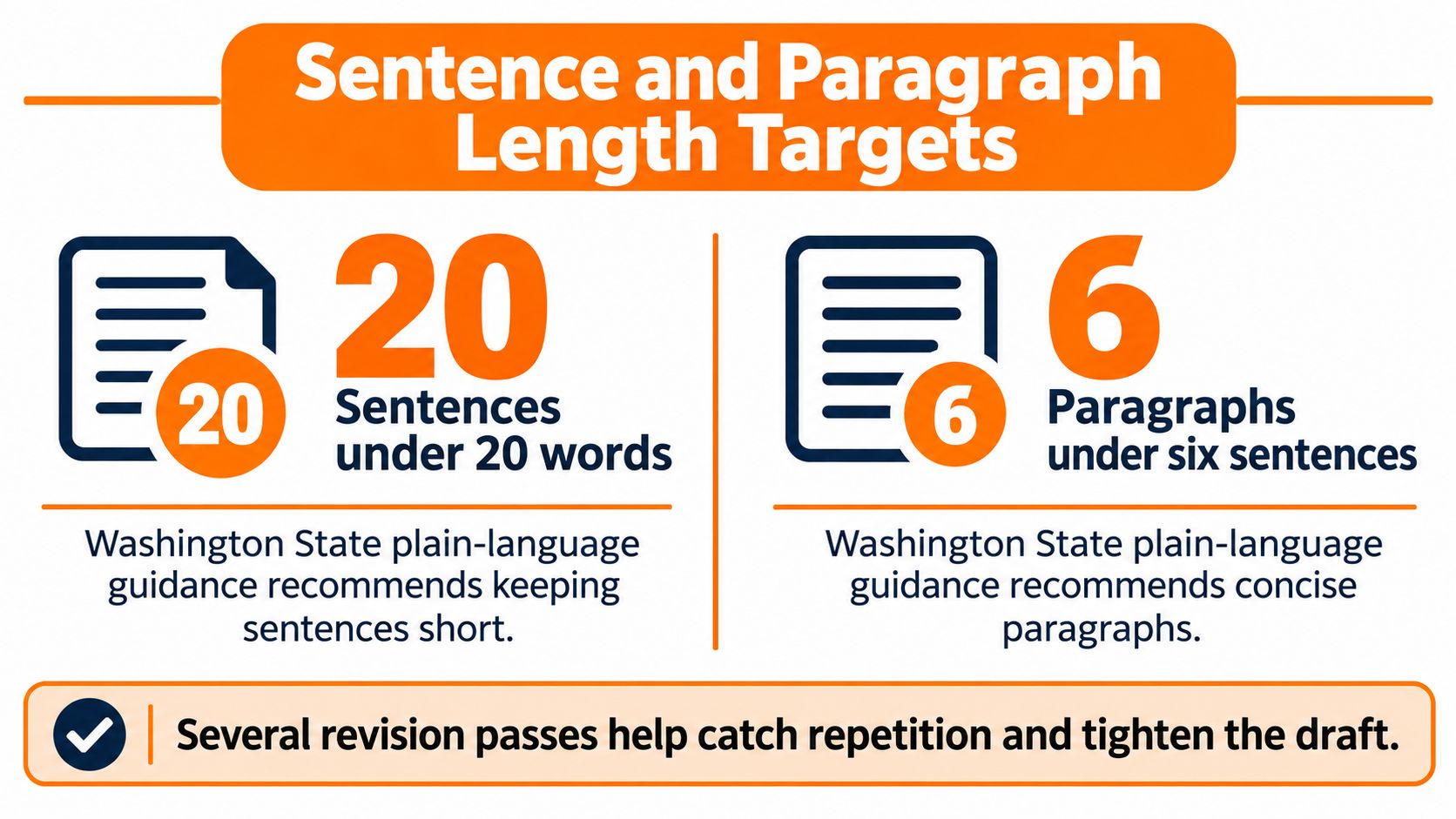
Washington State's plain-language guidelines recommend aiming for sentences shorter than 20 words and paragraphs shorter than six sentences, with repeated revision to make messages more succinct. The U.S. Office of Personnel Management recommends an average sentence length of 15–20 words and generally keeping each paragraph to one topic.
These are editing baselines, not laws. A necessary explanation shouldn't lose an important condition just to meet a count.
Keep these targets beside your draft as prompts for review.
Split distinct claims, not just long sentences
Suppose a project update combines approval, timing, and an expected result:
Before
The committee approved the project after reviewing the revised budget, and the team will begin work next month, with managers expecting the new process to reduce delays once staff members have completed training and started using the updated scheduling system.
After
The committee approved the project after reviewing the revised budget. The team will begin work next month. Managers expect fewer delays once staff complete training and start using the updated scheduling system.
Each sentence now has a clear job. The revision retains both conditions for the expected improvement, rather than implying that approval alone will reduce delays.
A different problem appears when a paragraph keeps praising the same quality:
The instructions are clear. They're direct. They're easy to understand.
Unless those descriptions introduce distinct benefits, combine them: The instructions clearly explain how to submit the form. Specific information does more work than overlapping praise.
For a practical counting routine:
- Measure first. Paste the draft into a word counter and flag unusually long sentences.
- Inspect the cause. Look for repeated clauses, stacked qualifiers, and noun-heavy expressions.
- Decide by meaning. Split unrelated claims, but keep connected conditions together.
A grammar checker can help identify tangled construction, but you decide where a split belongs. At paragraph level, separate different topics and remove repeated explanations within the same topic.
A short sentence can still repeat an earlier sentence. Length checks locate possible problems; they don't diagnose them.
Telling Useful Repetition From Redundancy
Repeated wording isn't automatically wasteful. Use the function of the repetition, rather than its appearance alone, to decide what stays.
Which repetition to keep and which to cut
| Repetition type | Keep or cut | Example |
|---|---|---|
| Accidental duplication | Cut | The same benefit stated in consecutive sentences |
| Structural signposting | Shorten | A brief preview before a list of causes |
| Terminology consistency | Keep | Repeating redundancy rather than switching to wordiness mid-argument |
| Emphasis | Keep once | A thesis restated purposefully in the conclusion, rather than repeated throughout |
| Accessibility scaffolding | Keep | Restating an acronym's full name for readers new to the field |
A systematic review in the Journal of Language and Education describes repetition as potentially strategic or unintentional; its analysis classified 145 of 487 problematic fragments as redundancy involving duplicated lexical or syntactic information, and placed 33.3% of all high-impact fragments in research-question or hypothesis formulation.
That makes introductions and research questions sensible places to inspect closely. The task isn't to eliminate reminders, but to distinguish orientation from another statement of something readers already understand.
Give each paragraph a distinct job
Write a short margin note naming each paragraph's purpose: define a term, present evidence, explain a limitation, or draw an implication. A reverse outline of your draft makes overlapping paragraph functions easier to spot.
Then underline sentences that restate the paragraph's main claim. Compare neighboring sentences for duplicated causes, evidence, or conclusions.
Keep the strongest formulation. Turn the remaining space into progression: add an example, explain a consequence, qualify the claim, or remove the sentence if there's nothing useful to add.
For example, a paragraph that says a policy is confusing doesn't need another sentence saying readers find it difficult to understand. It needs an illustration of the confusing instruction or an explanation of what readers might do incorrectly.
Keep repetition with a job. A familiar term can orient readers more effectively than a fresh synonym.
Watch for two mistakes. First, don't replace a technical term merely to avoid repeating it, because the substitute may suggest a different concept. Second, don't delete a conclusion that interprets evidence just because it mentions the same subject.
Use demonstratives such as this approach only when the reference is unmistakable. Briefly summarize when readers enter a new section, but make the summary serve the transition rather than reproduce the preceding paragraph.
Checking AI-Assisted Drafts for Repeated Patterns
In an AI-assisted draft, inspect more than repeated words. A document can use varied vocabulary while presenting the same explanation repeatedly or giving every paragraph an identical rhythm.
Approach the document as an editor reviewing both structure and wording.
Audit words, patterns, and ideas separately
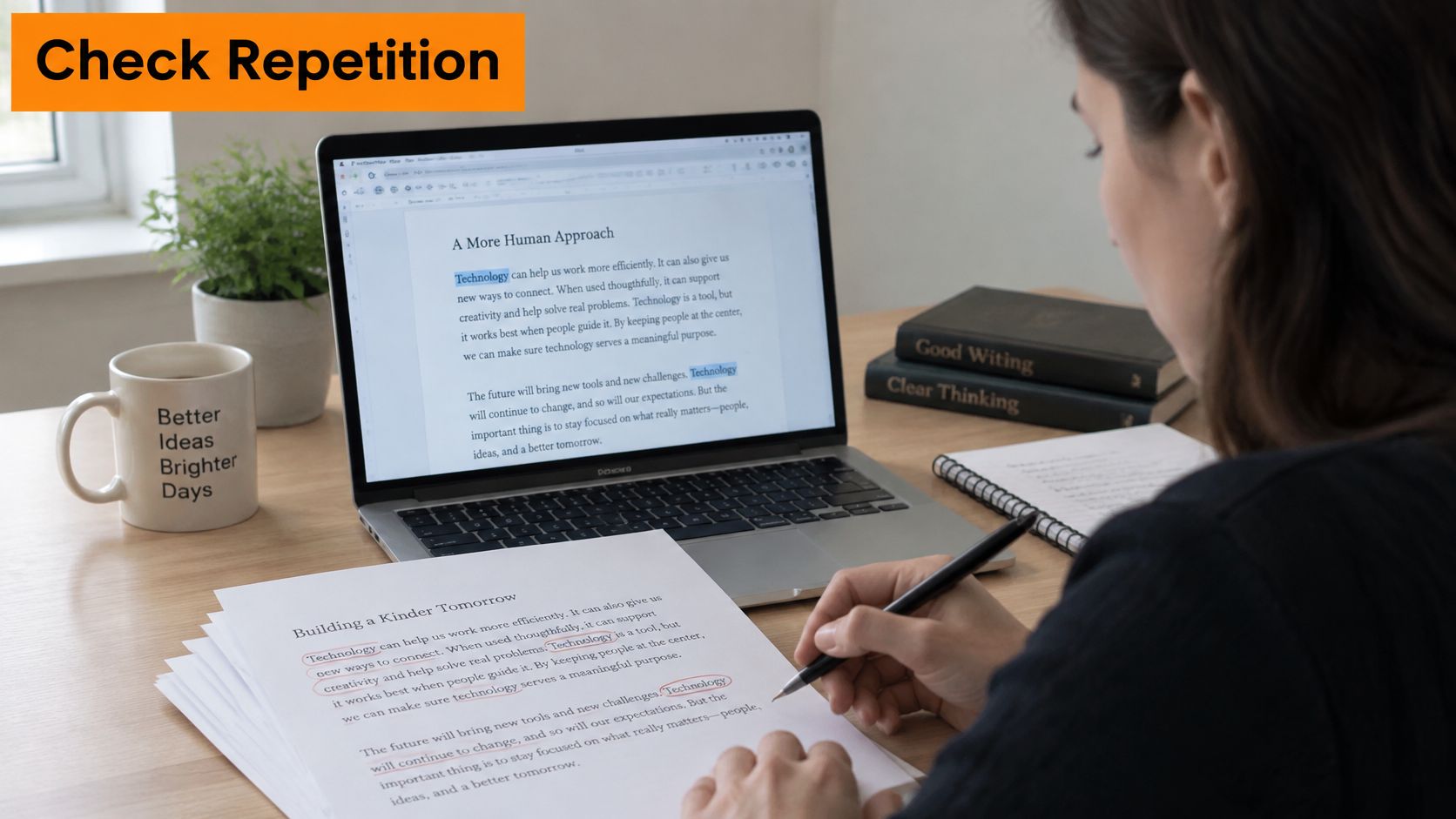
- Lexical repetition. Mark recurring openers. Delete transitions where the relationship between sentences is already clear.
- Sentence-pattern repetition. Look for paragraphs that all make a claim, explain it in the same rhythm, and finish with a summary. Restructure according to the content, using an example where explanation alone feels abstract.
- Idea-level repetition. Compare the introduction, body, and conclusion. A conclusion should explain what follows from the argument, not reproduce its opening explanation.
List the instances before rewriting. This prevents a superficial fix where you replace repeated words but leave repeated ideas untouched.
Keep the original beside the revision. Protect names, product terms, and technical vocabulary from automatic synonym swaps, and review paragraph structure before polishing individual words. These practices also help you preserve your voice when editing AI drafts.
For broader context on incorporating generated material into a writing workflow, AI Optimization Services' content creation guide is a companion resource. Keep your editorial decisions tied to your audience and the document's purpose.
Use the video alongside your own draft review.
After the manual audit, you can use a detector scan as an additional editing signal. A detector result isn't a final verdict about authorship or quality; results vary by draft and detector version.
Reread flagged passages yourself. Add specific examples where the wording is generic, revise sections that still feel uniform, and rescan if useful. Don't remove a sound explanation merely to change a score.
Confirm Meaning Held Before You Publish
A cut is safe when it leaves scope, certainty, causality, and reference unchanged. If removing a phrase changes any of these, rewrite it rather than deleting it.
For example, may reduce delays isn't equivalent to reduces delays. Likewise, some participants doesn't mean participants without qualification.
Separate deletion from replacement
Use a deletion pass to remove material that adds nothing. Follow it with a replacement pass for vague or inflated expressions that need a clearer equivalent.
The Concise-536 benchmark, compiled from 72 college writing centers, includes deletion edits covering 169 sentences, with mean length falling from 13.16 to 9.17 words, and replacement edits covering 116 sentences, with mean length falling from 12.37 to 9.02 words. Those results illustrate different editing operations, not a reduction target for your draft.
Stop when further cutting would remove useful information or require an awkward replacement. The shortest version isn't necessarily the clearest one.
Check the revised document as a reader
Before accepting the edit, verify the essentials:
- Claims and qualifications. Keep limits, uncertainty, exceptions, and conditions intact.
- Evidence and logic. Preserve citations and the relationships between causes, findings, and conclusions.
- Terms and references. Make sure readers can still identify what each noun, pronoun, or abbreviation means.
- Paragraph purpose. Confirm that the remaining sentences support the same topic.
Read the final version aloud and inspect substantive cuts by hand. A deliberate proofreading pass on your own writing helps separate this final review from structural revision.
Always review the output before publishing or submitting it. If sentences remain unnecessarily alike, try a paraphrase pass for variation, then compare the result against the original rather than assuming smoother wording means unchanged meaning.
Common Questions About Removing Redundancy
Is all repetition redundant?
No. Repetition can orient readers, maintain terminology, or support someone encountering an unfamiliar concept. Keep it when you can identify the reader's need it serves.
Does a shorter draft always read better?
Not necessarily. A compressed draft can leave readers guessing about conditions or connections. Stop cutting when the remaining detail is necessary for understanding.
Is paraphrasing the same as removing redundancy?
No. Paraphrasing changes wording for clarity or variation and may leave the length unchanged. Redundancy removal targets material that contributes no additional meaning.
Can software find redundancy?
Software can flag repeated words and difficult sentence construction, but it can't reliably decide whether repetition serves your particular reader. Use suggestions as prompts for judgment, not automatic deletions.
If you're learning how to remove redundancy in writing, finish with a clarity check for leftover wordiness. A grammar-checking pass can support that review while the final decisions stay with you.
Lumi Humanizer offers tools for making AI-assisted prose sound more natural by revising rhythm, phrasing, and sentence variety. Try it on a passage that still feels repetitive, then compare the rewrite with your original to confirm that your meaning and voice remain intact.