You've got one report, but your manager wants a recommendation, a colleague wants the method, and a customer wants to know what changes for them. To understand how to adapt writing for different audiences, keep the claim, evidence, and uncertainty fixed, then change the order, terminology, examples, and depth. Don't start by making everything simpler. Start by deciding what each reader needs to do.
Keep the Core Claim and Change the Delivery
Knowing your audience isn't enough unless it changes specific editorial decisions. Separate the fixed core from the flexible delivery before touching the sentences.
Say a hypothetical team report finds that a new onboarding email raised trial sign-ups by 18 percent, but the test covered only 40 accounts over 14 days. Those invented figures belong to the scenario, not a published finding. The result may justify further testing, but it doesn't establish what every future customer will do.
The executive needs the outcome and a recommendation. The marketing colleague needs enough method to evaluate the result. A customer needs an explanation of the email's practical purpose, not an internal performance pitch.
Practical rule: Change what readers encounter first, not what the evidence permits you to say.
That distinction fits the Plain Writing Act of 2010, which defines plain writing as clear, concise, well organized, and appropriate to its subject and intended audience. Plain language is an audience decision, not a ban on technical vocabulary.
Choose among different writing styles only after identifying the reader's task. A conversational rewrite can still miss the point if it leaves the decision buried.
What Changes for Each Reader
Use this comparison as a starting point for how five common readers differ, then confirm the assumptions with someone who represents the intended audience.
| Reader | Prior knowledge | Lead with | Terminology | Detail level |
|---|---|---|---|---|
| Undergraduate writing for a course | Moderate subject knowledge; unfamiliar with field jargon | The thesis and why it matters | Define field terms at first use | Medium, with a worked example for each claim |
| Graduate reviewer or journal editor | High; expects disciplinary precision | The claim, followed immediately by its limits | Keep discipline terms; define new ones | High, including methods, sample sizes, and controls |
| Executive or client decision-maker | Assume limited method knowledge, but familiarity with the decision | The decision, cost or risk, and recommended action | Replace jargon with plain outcomes | Brief main text; supporting method in an appendix or linked document |
| General public or blog reader | Assume no specialist background | The practical takeaway immediately | Explain unfamiliar terms or avoid them | Enough context and a concrete example for each point |
| Non-native English reader | Establish subject knowledge separately from English proficiency | Key information at the beginning of each section | Common words, consistent terminology, minimal idioms | Short, well-structured sentences and descriptive headings |
Prior knowledge is a more useful editing variable than a label such as professional. A finance director may understand commercial risk while needing an explanation of experimental design. A student may know the technical vocabulary but still need help interpreting a result.
The cross-expertise technical communication paper frames adaptation as building shared understanding through accessible terminology, relevant examples, and restructured technical detail. Use that approach without assuming that less technical means less capable.
The same finding with different openings
For the hypothetical onboarding test, the openings could look like this:
- Executive: Extend the test before rolling out the email broadly. Trial sign-ups rose 18 percent across 40 accounts over 14 days, but the limited test doesn't establish a durable effect.
- Marketing peer: The onboarding-email test covered 40 accounts over 14 days and recorded an 18 percent increase in trial sign-ups. Check the comparison group and assignment method before attributing the increase to the email.
- New customer: The welcome email is intended to help you get started with your trial. An internal test recorded an 18 percent rise in sign-ups across 40 accounts over 14 days, but that doesn't establish whether the email improves your experience.
The customer version exposes a genuine trade-off: the finding may not belong in customer-facing copy at all. Adaptation includes deciding whether a claim serves the reader, not merely finding friendlier words for it.
Use tone in writing to adjust the relationship with the reader. Don't use warmth or confidence to imply stronger evidence.
How to Adapt Writing for a New Reader, Step by Step
Start with a short reader profile rather than a broad demographic category. The technical-communication study published by ACM recommends combining user characteristics, content behavior, and business outcomes, giving you a firmer basis for revisions than assumptions about age or job title alone.
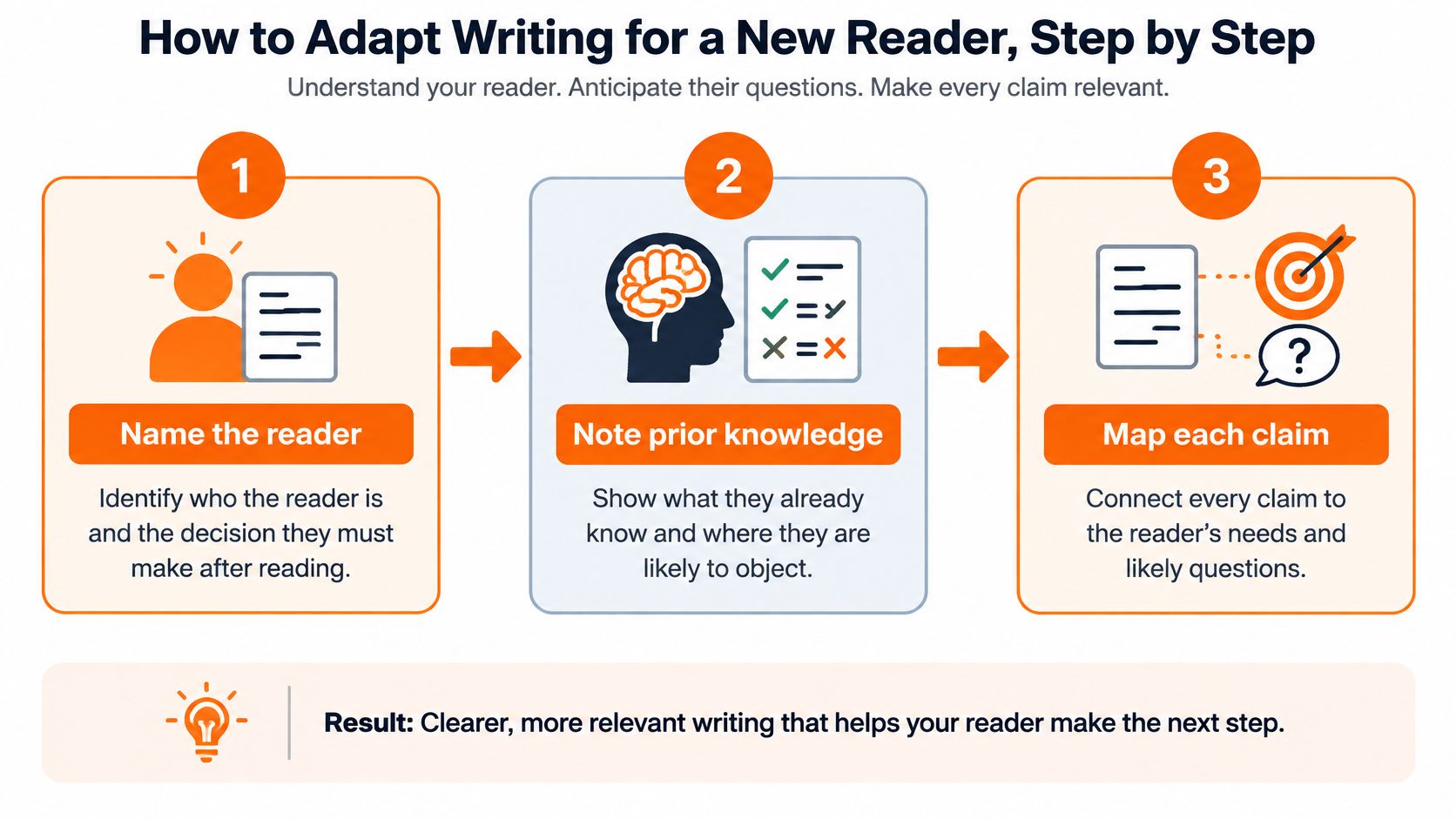
Use this sequence to establish who needs the message and why.
-
Name the reader and their decision. Write a working sentence such as: The operations director needs to decide whether to extend the pilot. That gives you a clear test for relevance.
-
Record what the reader already knows and where they're likely to object. Separate knowledge gaps from disagreements, because an explanation won't resolve a genuine concern about cost or risk. In our workflow, Step 2 is to choose the writing style, target audience, and tone preferences.
-
Map every claim to a reader need. Beside each paragraph, write the question it answers or the decision it supports. Remove material that serves neither, unless it provides essential context or a qualification.
-
Sort terminology into essential, useful, and removable. Define essential terms at first use, retain useful terms only when they improve precision, and replace decorative jargon. Don't substitute different words for the same technical concept to create variety.
-
Reorder before polishing. Put the recommendation first for a time-limited reader, then replace examples with situations they recognize. Once the structure is settled, run a grammar and clarity check so the restructuring doesn't leave broken references or awkward sentences.
A rewrite that explains the measure
Before, in a hypothetical business report
Churn fell four points after the price change.
After, for a board audience
Fewer customers left after the price change, about four fewer per hundred each month, based on three months of data. That timing alone doesn't establish that the price change caused the reduction.
The second version works only if the underlying report confirms a monthly measure and that observation period. If those details aren't documented, ask for them rather than inventing precision during the rewrite.
- Review separately as a novice and an expert. On the novice pass, identify unexplained terms, missing connections, and unclear actions. On the expert pass, check whether the wording still matches the evidence, including qualifications and causal limits.
For a blog, inspect search terms, entry pages, and exit points to identify possible mismatches between the reader's question and your answer. Don't treat an exit as proof of confusion, since readers may leave after finding what they need.
Pair behavior with a comprehension check or task result. Revisit the reader profile whenever the draft's purpose changes, especially when an explanation becomes a recommendation.
What You Must Not Simplify Away
Consider a hypothetical medical summary.
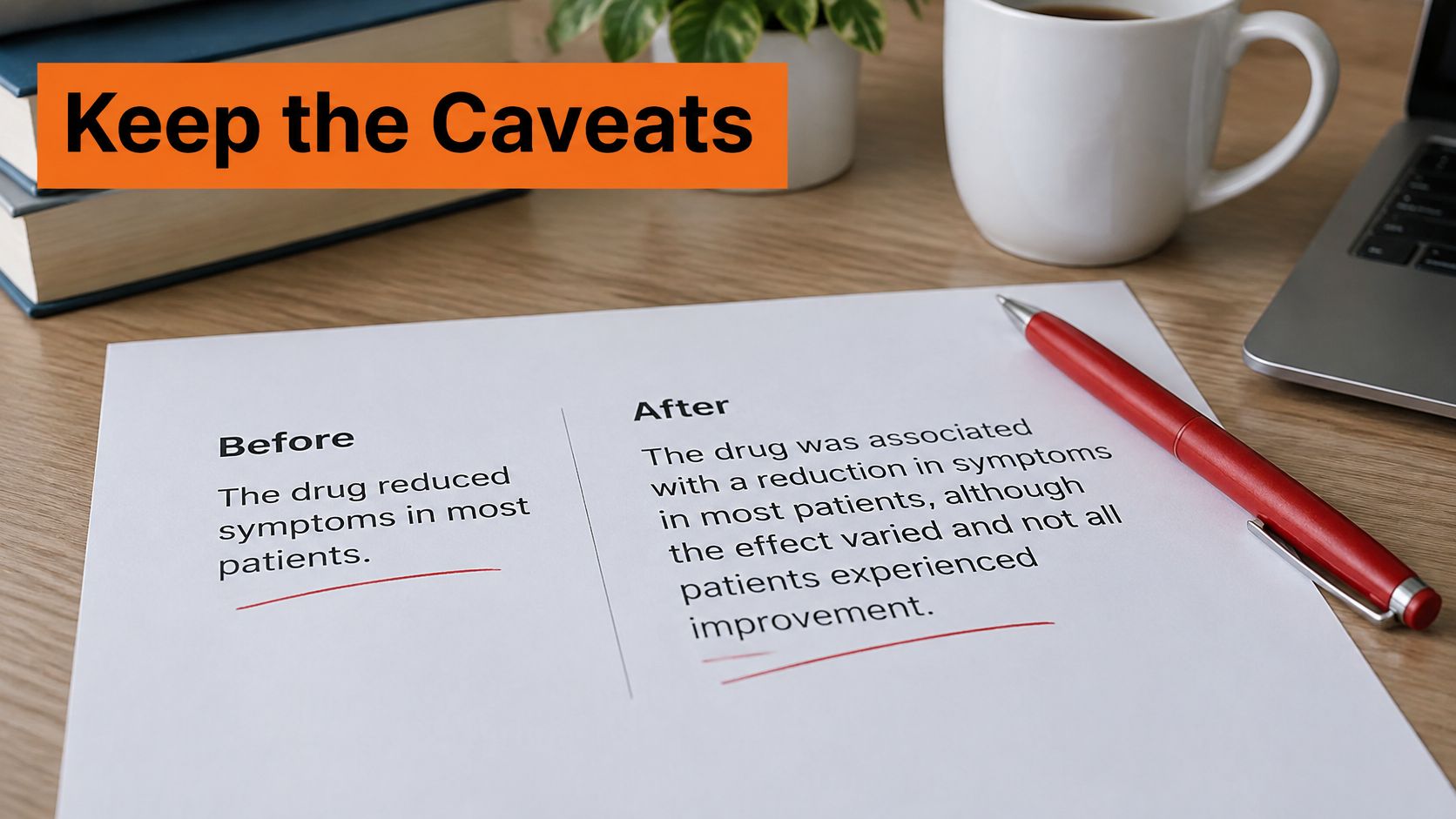
Before: The drug reduced symptoms in most patients.
After: In a 40-person trial, about 7 in 10 patients reported fewer symptoms after eight weeks. The trial had no control group, so it cannot show that the drug caused the change.
These are invented details for an editing example, not a clinical finding. The longer version is clearer because it separates what participants reported from what the trial can establish.
A useful medical rewrite makes room for those qualifications.
Keep the details that govern interpretation
These elements must survive in every version when they're material to the claim:
- Units: Preserve what was measured. A percentage-point change isn't interchangeable with a percentage change.
- Conditions: Keep the setting, duration, comparison, and eligibility restrictions that limit the result.
- Sample size: State who or what contributed to the finding. Don't replace a narrow participant group with people generally.
- Uncertainty: Retain whether a conclusion is preliminary, observational, estimated, or dependent on assumptions.
The APA's guidance on writing for different audiences supports putting findings and real-world significance earlier for general readers, while specialists may need methods and limitations sooner. That's an ordering decision, not permission to remove the limitations.
A qualified conclusion can still support action. Explain which action it supports and which conclusion would go too far.
For example, limited evidence might justify another controlled test without justifying a broad rollout. Stating that distinction helps a decision-maker more than either overstating the result or dismissing it entirely.
Use the video alongside your own source comparison, not as a substitute for checking the underlying evidence.
Watch for edits that change reported into experienced, associated with into caused, or may into will. Each replacement changes the claim, even if the sentence sounds smoother.
The same discipline applies to examples. A culturally familiar analogy may feel effortless to you but introduce another explanation for the reader. Prefer a literal explanation when the analogy requires specialist or local knowledge.
A rewriting tool may alter rhythm and framing. The claims, caveats, and source meaning must remain yours to verify.
Adapting for Translation, Screen Readers and Second Languages
Some readers translate an article before reading it. Others hear it through a screen reader or understand the subject better than they understand the language you're using.
Teaching and Learning Inquiry's guidance on writing for diversity addresses these readers through clear prose, defined terminology, better-structured sentences, and respectful language about disability. Treat those needs as part of drafting, not a final cosmetic pass.
- Put the point first: Start each section with the information readers need, then supply context.
- Expand acronyms: Give the full term at first use, even when an abbreviation seems familiar within your team.
- Write descriptive headings: Make each heading meaningful when someone encounters it outside the surrounding paragraphs.
- Describe link destinations: Use wording such as read the plain-language guide, not click here.
- Prefer literal phrasing: Avoid idioms and metaphors that require local cultural knowledge.
Natural language without translation traps
Before: We will knock this out by Friday, no sweat.
After: We will finish this task by Friday.
The revised sentence preserves the commitment without requiring the reader to interpret an idiom. Conversational language is not automatically inaccessible, but semantic stability matters more than colorful phrasing when the two conflict.
Keep technical terms consistent, too. Calling the same feature an account, profile, and workspace may sound varied while creating uncertainty about whether you mean different things.
For a language-specific adaptation, a guide to English-to-Cebuano writing can help you think beyond direct word substitution. If the material includes narrated demonstrations or subtitles, Translate AI's guide to choosing a video translation partner provides a relevant next step for planning that separate translation task.
Finish with two practical checks:
- Translate a representative paragraph. Ask a fluent reader to check whether the claim, negation, and qualification survived. Machine translation alone can expose possible problems, but it can't confirm accuracy.
- Read the draft aloud. Listen for unclear pronouns, nested qualifications, and sentences that require backtracking. Where possible, also check actual screen-reader navigation, since reading aloud doesn't test heading structure or link behavior.
Common Questions About Adapting Writing
Does writing for a general reader mean writing less?
Not necessarily. Cut repetition and unexplained jargon, but allow space for context. A limitation may need an extra sentence explaining why it matters rather than a shorter technical label.
How many versions should one piece have?
Create a separate version when the reader needs a materially different opening, explanation, or action. Start with an expert version and a general version if those cover the actual uses. Every additional copy creates another document to maintain when the evidence changes.
Do I rewrite the whole article for each reader?
Usually, start with the opening, terminology, examples, and section order. Rebuild the full piece when the reader's decision changes enough that the original structure no longer helps. Don't rewrite a sound explanation just to make every sentence look different.
Can a paraphrase tool handle audience adaptation?
It can offer alternative wording, but you still need to specify the audience and protect essential details. Compare the result with the source rather than judging it only by fluency. A polished sentence can still imply an unsupported conclusion.
How do I know the version worked?
Ask someone from the target group to explain the main takeaway, the action they'd take, and the important limitation in their own words. Don't begin by explaining what you meant. Their unaided response tells you where the draft needs work.
Decide Which Version Goes to Which Reader
Send the reviewer the version that makes the method inspectable. Give the executive a recommendation with enough evidence to judge its risk. Give the public reader a practical explanation without implying a personal benefit the finding doesn't establish.
Before sending, compare the versions side by side. The wording needn't be identical, but the underlying factual statement must be equivalent.
Use a short release check:
- Evidence match: Each claim remains traceable to the original document.
- Reader fit: The opening answers the intended reader's actual question.
- Independent navigation: Headings and link text make sense without surrounding prose.
- Version control: Each copy has a named audience and an owner responsible for updates.
An AI detector estimates AI-generated signals; it doesn't provide a guaranteed verdict. Review the draft manually and treat detector results as one editing signal, not a final judgement.
Choose tools by the job, too. Paraphrasing changes wording for clarity and variation, while humanizing focuses on making AI-generated prose sound more natural. Neither replaces final review before publishing or submitting.
Ultimately, how to adapt writing for different audiences is a routing decision as much as a sentence-level skill. Choose who receives each version, then verify that its framing helps that reader without changing what you can claim.
Lumi Humanizer helps turn AI-generated text into more natural prose while preserving its main point and intent. Visit Lumi Humanizer with a draft and a clearly defined reader, then compare the rewritten version against your evidence before sending it.