You've finished the report at midnight, and now a manager, investor, or supervisor expects a one-page version by morning. Learning how to write an executive summary means learning how to make that page stand alone. Put the decision first, support it with the few facts that matter, and cut everything that doesn't change the reader's choice.
Length and Structure at a Glance
A strong executive summary usually runs 10 to 15 percent of the full report, and most fit on one or two pages, according to Boise State University's College of Business and Economics. Treat that range as a scaling rule. It forces you to separate findings, implications, and recommendations from background a reader can find later.
Target Length by Source Document
| Source document | Summary length | Basis |
|---|---|---|
| 10-page report | About 1 to 1.5 pages | 10 to 15 percent of the source |
| 20-page business plan | About 2 to 3 pages | 10 to 15 percent of the source |
| 100-page technical report | About 10 to 15 pages | 10 to 15 percent of the source |
Read the table as a starting point. A 10-page report normally needs one to one and a half pages, a 20-page business plan two to three, and a 100-page technical report ten to fifteen. The basis column matters as much as the count. Tag each material claim in the summary with where its evidence comes from, such as a pilot result, a cost model, a legal review, or a customer count. A time-short approver can then see which claims are load-bearing and where to push back. Teams that track drafting work visually can improve your team's project board so owners and deadlines stay visible beside the document.
The Four Jobs Your Summary Must Do
- State the problem or purpose: Name the issue in plain terms, without a long history.
- Give the most important results: Choose findings that affect the decision, not every result you produced.
- Explain why they matter: Connect each result to cost, risk, timing, or outcome.
- State the recommended action: Say what you want approved, funded, or changed.
A summary is a stand-alone decision document.
A reader who never opens the full report should still know what happened, why it matters, and what you are asking for. Calculate your target length from the finished report's page count before you draft a sentence, then write to that ceiling. If you start cutting only after you are three pages over, you will protect your favorite paragraphs instead of the decision the reader has to make.
How to Draft the Summary Step by Step
This visual sets out the drafting sequence in its simplest form.
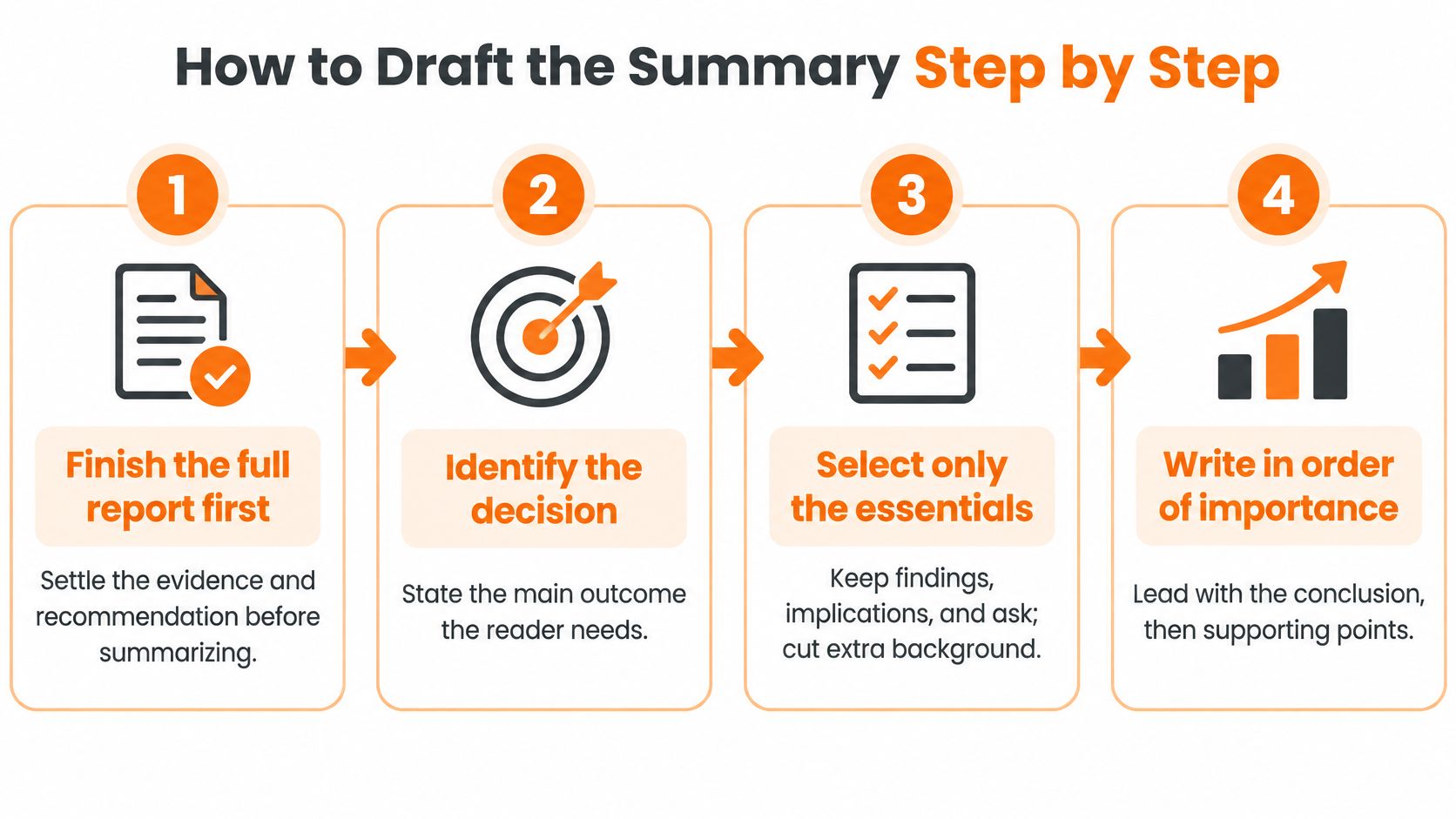
Follow the steps in order. Skipping ahead is how summaries end up describing a report that no longer exists.
Steps One to Three
- Finish the full report first. The evidence and recommendation need to be settled before you compress them. A summary written mid-draft will promise findings the final analysis doesn't support.
- Pull the principal point from each major section. Write down its main finding or recommendation in one line. If a section has no line that matters to the decision, it may earn no space at all.
- Record only the supporting evidence you need. For each point, note one figure, one date, or one named method. Writers preparing related documents can use the same discipline when they structure a business proposal, because both formats punish unsupported claims.
Steps Four to Six
- Rank notes by decision importance. Don't follow document order. Ranking stops you giving equal space to a minor methods note and the finding that justifies the budget.
- Draft from the ranked notes. Open with the conclusion, not roadmap language like "this report examines." Your reader doesn't need a tour. They need the answer.
- Audit every claim against the source. Check each number, date, and name against the finished report. If you've reused wording from source documents or vendor material, run the draft through the plagiarism checker before circulation to catch copied phrasing.
If you're also presenting this summary aloud, executive coaching from Acheloa Wellness is a useful companion resource on communicating decisions clearly under pressure. The written and spoken versions should make the same ask in the same order.
A Research Example in Miniature
For research work, compress the method into the sentence that carries the result. Don't write a separate methods paragraph.
Example: In a cross-sectional survey of 120 respondents analyzed with regression, onboarding time was the strongest predictor of first-month churn, so we recommend shortening onboarding before spending more on acquisition.
That single structure works because it contains the design, the sample, the analytical method, the principal result, and the action the result supports. Anything else about the survey instrument belongs in the report body.
Now test your own draft. Read only the first two sentences. Do they name the decision and the main reason for it? If they describe the topic instead, rewrite the opening before you touch anything else. Fixing sentence one usually fixes the order of everything after it.
Lead With the Decision and Cut the Mini Report
The most common failure isn't weak writing. It's a summary that reads like a shorter report, giving background, methods, findings, and limitations equal weight. The reader finishes informed but still doesn't know what you're asking for.
This image captures the moment your summary has to survive, a busy approver scanning at her desk.

Sequence for that reader. ClickUp's executive summary guide recommends putting the recommendation in the first two sentences and ordering evidence by persuasive impact rather than by the report's original sequence, then following with only the two to four facts most likely to change the reader's mind. That usually means the financial or operational consequence, the deadline, and the principal risk, with background last.
Before and After
Before: "Over the past five years, the regional market has shifted considerably. Competitors have consolidated, customer expectations have risen, and our internal review examined several responses. This report considers whether we should expand the support team."
Three sentences, no ask, no number, no date. A board member reading between meetings learns nothing she can act on.
After: "We recommend approving two additional support hires this quarter. Response times have doubled, renewal risk is concentrated in accounts waiting longest for help, and delaying hiring until next quarter leaves the busiest period uncovered."
The rewrite leads with the approval, the timing, and the consequence of waiting. Market history can follow in one sentence if it's needed at all. Choosing among different writing approaches for business readers matters less than this ordering choice, because tone can't rescue a buried ask.
This short video walkthrough reinforces the same decision-first structure.
Apply the Decision Test
Remove one sentence at a time. If the requested action becomes less clear or less defensible, keep the sentence. Otherwise cut it. Then sort what's left into three piles, proof of the problem, support for the recommendation, and details that only seemed important because they sat prominently in the source. The third pile goes.
Make the mechanical cuts next. Reduce any background past one sentence to the single fact the reader needs. Replace raw tables with the interpreted metric, so a line of figures becomes "costs fell, saving money each year" with your verified figure attached. Freeze the findings before you rewrite, add missing cost or timing details as a dated line labeled as an estimate if it is one, and reread the first two sentences last.
Sequence to remember: ask first, proof second, caveat third.
How Much Method and Uncertainty to Show
Include enough method for a non-specialist to judge reliability, and no more. A full methods section buries the decision, but omitting method entirely leaves every number looking equally solid.
Xero's business plan executive summary guidance reflects the common business-plan instinct to keep summaries tight, while data-science guidance makes the counterpoint that a credible summary should briefly identify data sources, methods, interpretation, and practical implications. Both instincts are half right. You need a credibility layer, not a methodology chapter.
How to Label Each Claim Type
| Claim type | What to state | Example sentence |
|---|---|---|
| Observed result | Data source and period | Churn fell in the 2026 customer data between January and June, observed rather than projected |
| Survey finding | Sample size and method | 120 respondents in a cross-sectional survey, analyzed with regression |
| Estimate or model output | Key assumptions and range | Retention estimated at 4 to 7 points higher, assuming onboarding changes hold, from a 2025 regression model |
| Forecast | Date and main assumption | Demand expected to rise by Q3 2027 if the pricing change holds |
For each major claim, state the population or data period, the comparison method, the main limitation, and whether the result is observed, estimated, or forecast. Four facts, usually inside one sentence.
Why the Label Matters
A revenue projection, a survey result, and a model output can look identical on the page while their uncertainty differs enormously. That's false precision, and approvers feel it even when they can't name it. They ask "where did this number come from" in the meeting, and your summary loses its purpose.
Before: "Sales doubled after the redesign."
After: "Sales doubled between January and June 2026 across the 310 accounts that used the new checkout, an observed figure that excludes returns."
The second version isn't longer by much, but a reader can now judge it. Keep this layer to one or two sentences per major claim, placed beside the claim, not gathered into a caveat paragraph at the end where nobody connects it to the numbers. Your tone can stay natural and direct while every claim names its evidence type, timeframe, and main limitation.
Run the Five-Point Check Before You Send
Treat length limits as ceilings, not targets. Xero's guide to business plan executive summaries notes business-plan guidance is typically one or two pages, alongside the academic standard of no more than 10 percent of the source with a 10-page upper limit. Aim for one page when the decision fits there, and use extra space only for financial, operational, or risk evidence that needs it.
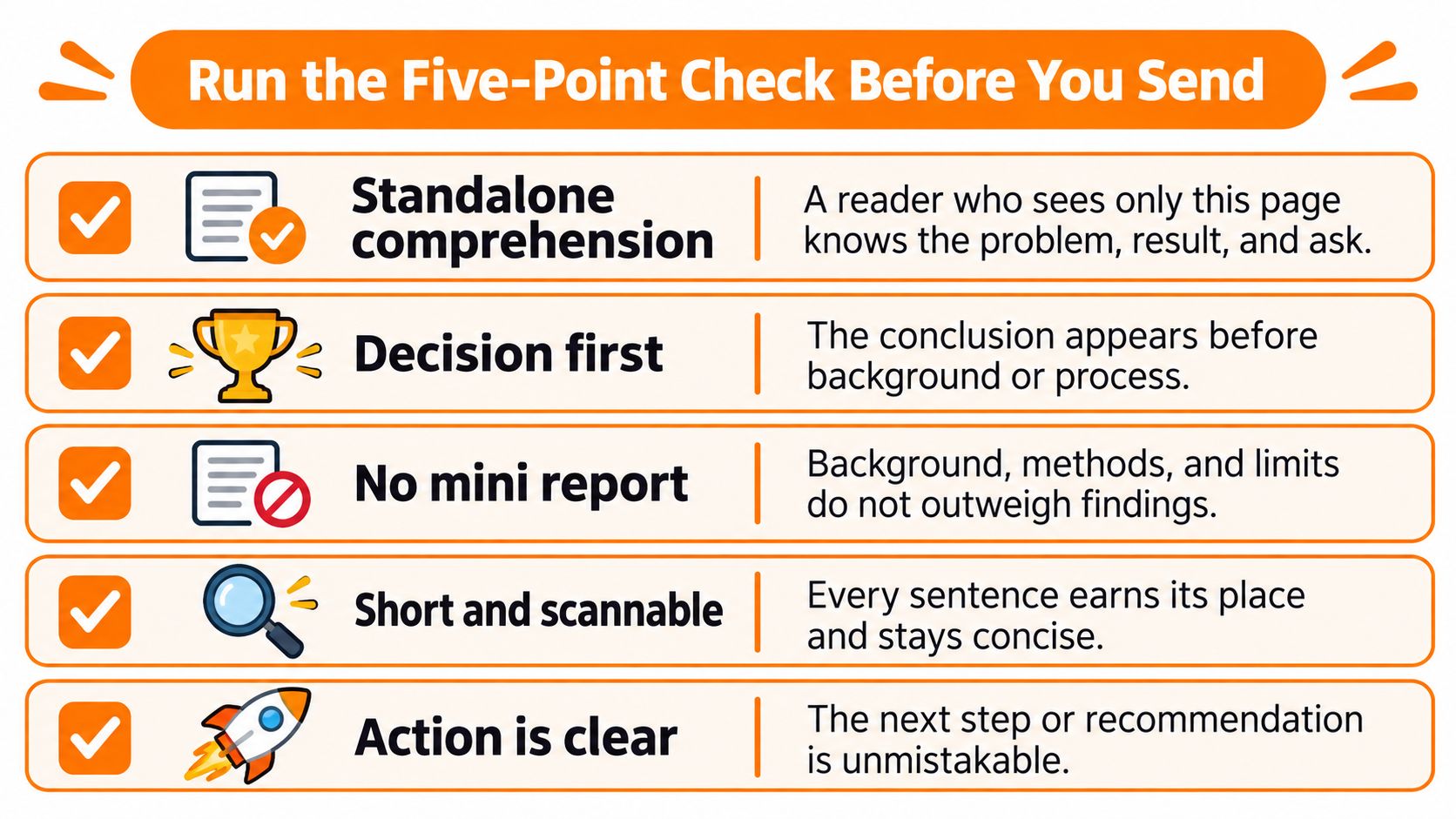
This checklist visual summarizes the five checks below.
The Five Checks
- Standalone comprehension: A reader who's seen only this page knows the problem, the result, and the ask. If they need the report to understand your opening, the summary has failed its main job.
- Explicit recommendation: One clear action, with an owner or a deadline. "Consider options" isn't a recommendation. Name who acts and by when.
- Quantified support: Each major claim carries a figure, a date, or a named source. Vague claims like "significant improvement" invite questions your page should have answered.
- Audience-appropriate terminology: Define or remove any jargon the approver wouldn't use. It helps to run the draft through a final clarity pass using the checks in this guide to grammar checking tools before it leaves your desk.
- Consistency with the full report: Every number, date, and name matches the source exactly. One mismatched figure makes readers distrust the rest.
How to Run the Check
Read the summary alone, as if you were the approver, and mark each sentence that fails a check. Don't skim with the report open beside you, because your memory will fill gaps your reader can't.
Watch for the recurring failure points. Writers draft before the analysis is stable, run well over target length, leave jargon unexplained, omit cost or timing details, or introduce information that appears nowhere in the main report. Replace raw tables and technical digressions with interpreted metrics, timelines, costs, expected outcomes, and the decision required.
You should always review the final output yourself before publishing or submitting it, even after any automated editing pass. Send the summary only once all five checks pass. If one fails, fix that sentence rather than adding a new paragraph to compensate.
Questions Writers Ask Before Sending
Should an Executive Summary Include Charts
Usually not. Use one chart at most, and only when it carries the decision, such as a cost trend the recommendation depends on. Describe its key point in a sentence in the text so the summary still works for a reader who skips the visual or prints the page in black and white.
Is an Abstract the Same Thing
No. An abstract is a short, standardized description of a research paper, written for indexing and scanning by other researchers. An executive summary is written for a decision, and it can stand in for a business proposal or report that has no abstract at all. If your document needs approval, funding, or action, learning how to write an executive summary matters more than abstract conventions.
Can One Summary Serve Several Audiences
Only when they decide the same thing. A board approving strategy and a finance team approving spend ask different questions, so write a short summary for each, drawing on the same verified figures so the numbers never disagree. When your draft is ready, run it through the grammar checker to tighten clarity and catch grammar problems before it reaches the reader.
You've done the hard work of deciding what matters, so don't let stiff, generic phrasing blunt your recommendation at the final step. Lumi Humanizer helps you make AI-assisted drafts sound natural and human while preserving your main point, so your summary reads the way you'd present it. Paste in your draft, review the result carefully, and send a page that sounds like you wrote it on your best day.