
You've read the papers, but your notes still don't show how the studies fit together. To write a literature review matrix, put each source in a spreadsheet row, record comparable evidence in clearly defined columns, and use those entries to develop claims across studies.
The important decision isn't which spreadsheet template to download. It's which differences you need to capture so you can explain what the literature supports, where findings conflict, and what remains uncertain.
The Columns a Literature Review Matrix Needs
Start with the columns below, then remove any that don't help answer your review question. Column design is an argument choice: if you record findings but ignore setting, you'll struggle to judge whether those findings apply beyond the original participants.
Duquesne University's matrix guidance recommends beginning with at least three core columns: author/title/journal, publication year, and study purpose, then adding analytical categories as needed. You can combine bibliographic details into a citation field to keep the sheet manageable.
Before entering sources, write your review question above the table. For example: How does recorded video feedback affect students' essay revision in online courses? That question makes outcome measures and feedback format relevant; the software's brand name may be less useful unless you're comparing platform features.
Core columns and what to record in each
| Column | What to record | Why it earns its place |
|---|---|---|
| Citation | Author, title, journal, publication year | Anchors every row and keeps the matrix traceable |
| Purpose | One to two sentences in your own words | Captures the study without copying the abstract |
| Research question | The question the study asks | Shows whether it addresses your review question |
| Theoretical framework | The lens the authors use | Explains why results may differ across studies |
| Methodology | Design, data collection, analysis approach | Lets you compare evidence quality across methods |
| Sample or setting | Population, sample size, country or institution | Shows how far a finding can travel |
| Key findings | The main result, with its direction | Provides the evidence you'll compare down the column |
| Limitations | Authors' stated weaknesses plus your own clearly labeled note | Flags where a finding needs caution |
| Relevance | How the study bears on your argument | Stops the matrix becoming a reading log |
The concise purpose field follows Toronto Metropolitan University's graduate-review guide, which recommends a one- to two-sentence summary alongside content-specific headings.
For the online-learning question, split sample and setting if geography matters. Add intervention and outcome measure so you don't accidentally treat revision frequency, essay quality, and student satisfaction as interchangeable results.
Practical rule: Keep a column only if its contents could change your interpretation or help you retrieve evidence.
Sort the rows from oldest to newest when examining developments over time. If a column produces the same entry throughout, ask whether it documents an important inclusion criterion or merely adds clutter.
How to Fill Each Row Without Rereading Sources
You can reduce unnecessary rereading, but you shouldn't promise yourself you'll never reopen a paper. The aim is to capture enough detail that returning to the full text becomes a targeted check rather than another reading from scratch.
Use this sequence while processing each eligible source.
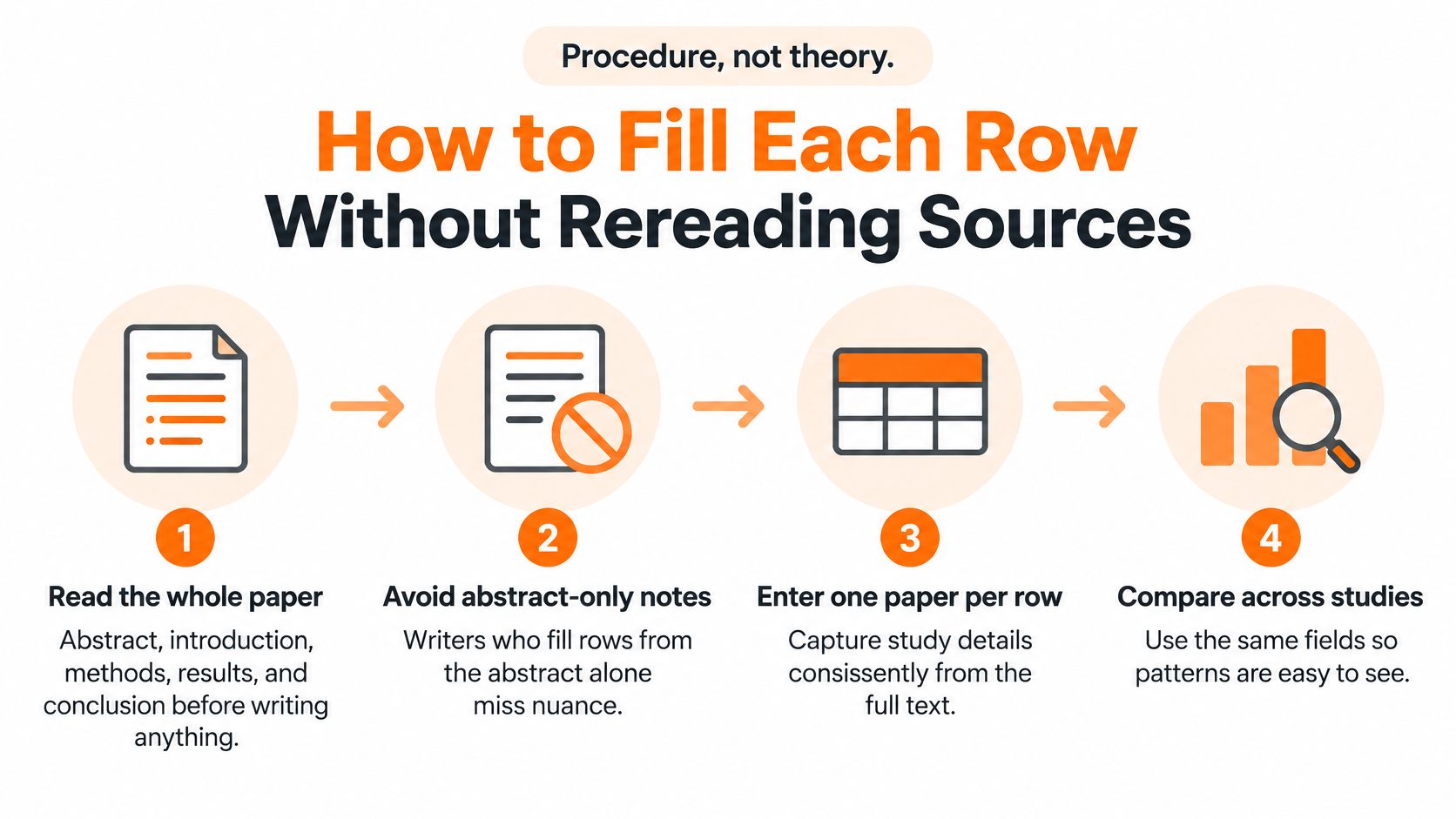
A repeatable extraction routine
-
Read the whole paper before completing the row. Read the abstract, introduction, methods, results, and conclusion, including the limitations. An abstract may describe the headline result without explaining the conditions that qualify it.
-
Enter the citation and a stable source identifier. Use a consistent reference format, and attach or link the saved paper so you can retrieve the exact document later.
-
Write the purpose in your own words. Describe what the researchers investigated, not everything they discussed. If you can't explain the purpose plainly, resolve that uncertainty before extracting findings.
-
Separate the authors' interpretation from your assessment. San José State University's matrix handout offers a useful distinction between They Say and I Say, keeping reported evidence separate from judgments about applicability, weaknesses, and implications.
-
Record compact, specific evidence. Enter the population, setting, design, outcome, and result in their respective cells. Add the supporting page, table, or section beside consequential findings so verification doesn't require hunting through the PDF.
-
Pilot the headings on a small group of papers before scaling up. If methodology produces entries such as survey in one row and quantitative in another, clarify whether you want design, data collection, analysis, or separate fields.
-
Add the completed row before moving to the next source. Keep the spreadsheet open during searching so new terms, missing categories, and unresolved questions inform what you look for next.
For a hypothetical practice entry, you might record 2021, Brazil, mixed methods, 180 undergraduates in separate cells, with the intervention and outcome recorded elsewhere. Those details illustrate the format; they aren't evidence to cite in a review.
If you're struggling to restate a passage, the student guide to paraphrasing can help with wording. Check the result against the paper, because clearer language mustn't erase a qualification.
A finished row should answer every relevant column question without turning any cell into a miniature essay. Another reader should be able to scan it quickly and distinguish the reported result from your evaluation.
A Worked Example Across Four Studies
Suppose you're reviewing video feedback in online courses. The following studies and findings are hypothetical teaching examples, not published evidence.
The illustration shows the kind of comparison workspace you're building.

Replace a vague note with comparable cells
A weak practice row might read: Lee 2020, video feedback helps students, good study. You can't tell what improved, what the researchers compared, or why you judged the study positively.
Replace it with explicit entries:
| Field | Hypothetical Lee entry |
|---|---|
| Citation | Lee (2020), fictional practice source |
| Purpose | Investigate whether recorded feedback changes revision behaviour |
| Design | Quasi-experimental |
| Population | First-year undergraduates |
| Setting | One university |
| Intervention | Recorded video feedback on essays |
| Outcome | Revision rate |
| Finding | Higher revision rate than the written-feedback comparison |
| Limitation | Single cohort, no random assignment |
Complete the same fields for the other fictional sources. The compact comparison below shows only the differences needed for this example.
| Practice source | Design and setting | Relevant finding | Main caution |
|---|---|---|---|
| Lee | Quasi-experimental, single university | Higher revision rate | No random assignment |
| Study B | Comparative classroom study, single university | Higher revision rate | Instructor differences may matter |
| Study C | Small comparison in a different educational setting | No difference in revision rate | Limited sample |
| Study D | Interviews in an online course | Students describe feedback as easier to interpret | Perceptions don't establish revision behaviour |
Reading down the finding column reveals a possible pattern. Reading across each row tells you how cautiously to interpret it.
Write the comparison, not a vote count
Under the theme feedback format, the synthesis cell might say:
Video feedback is associated with higher revision rates in the comparative university studies, but the evidence doesn't establish a general effect. The null result comes from a different setting, while the interview study addresses perceived usefulness rather than measured revision.
Study D isn't another positive outcome study just because participants liked video feedback. It answers a related but different question.
For a visual walkthrough of matrix-based literature-review work, use the video alongside your practice sheet.
The useful comparison isn't which result appears most often. It's whether the studies measured comparable outcomes under conditions that justify discussing them together.
Moving From a Source Log to a Synthesis Matrix
A literature matrix organizes information by source. A synthesis matrix organizes evidence by theme or claim, making it easier to plan an argument rather than a sequence of summaries.
The University of Louisville's literature-matrix guide separates source analysis from thematic synthesis: examine individual studies first, then reorganize their evidence to identify relationships, contradictions, and gaps.
Literature matrix versus synthesis matrix
| Feature | Literature matrix | Synthesis matrix |
|---|---|---|
| Organized by | Individual source | Theme, claim or variable |
| Rows | One per article | One per theme or variable |
| Columns | Extracted fields such as design, sample, findings | Sources, plus agreement and synthesis columns |
| Question it answers | What does this study say, and how was it done? | What do sources agree on, dispute, or leave open? |
| Output | A source-level record | A paragraph plan built on evidence |
Begin by coding recurring concepts in your source matrix. For the hypothetical feedback review, useful codes might include revision behaviour, feedback interpretation, and implementation conditions.
Then create a theme row and place relevant evidence under each source heading. A paper can appear in several theme rows, but each entry should address that particular theme.
Turn a theme into a defensible claim
For a digital-feedback theme, don't write helpful in every source cell. Record what kind of help the study examined, which comparison it used, and whether the outcome was observed or self-reported.
Add an agreement or disagreement field, followed by a synthesis field. The first identifies the relationship between findings; the second explains what you can reasonably conclude from that relationship.
Johns Hopkins University's synthesis guidance supports the move from isolated summaries toward comparisons across sources. In practice, group papers by the claim they inform, not merely because they share a keyword.
Check sparsely populated themes before declaring research gaps. You may need broader search terms, adjacent disciplinary literature, or a narrower theme label. An almost empty row documents the limits of your current collection, not automatically the limits of the field.
A synthesis cell should contain a conclusion you could defend, including the evidence that prevents a stronger conclusion.
Use each completed theme row to plan a paragraph. Decide its central claim, supporting sources, qualification, and unresolved question before drafting sentences.
Don't average incompatible findings into a vague middle position. If studies measured different outcomes or worked with different populations, make that distinction part of the explanation rather than treating it as inconvenient detail.
Checking the Matrix Before It Shapes Your Argument
Test extraction consistency before drafting from the matrix. As a practical pilot, have reviewers independently complete the same small set of papers, then compare every field. Mismatches often reveal unclear headings rather than careless reading.
Use the checklist to make those differences visible.
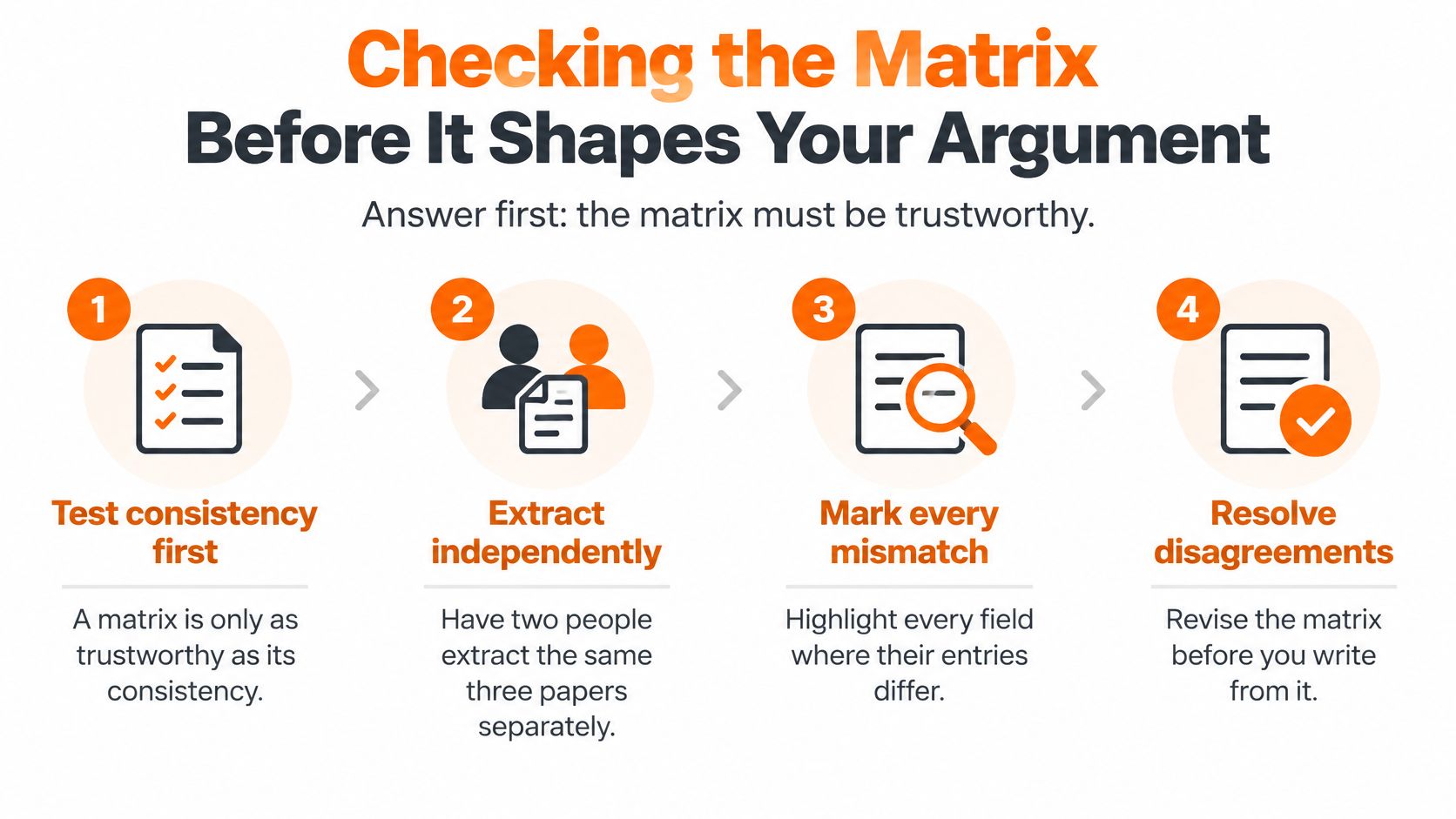
Resolve differences before reporting agreement
For systematic or high-stakes reviews, arrange independent checking of at least a sample. When reporting categorical agreement, include raw percentage agreement and Cohen's kappa, since a dominant category can make raw agreement look reassuring.
An HRB Open Research article reports 93.15% agreement with κ = 0.77 and a 95% confidence interval of 0.66–0.88, alongside a training exercise achieving 100% agreement with κ = 1.00. These are reference points, not universal pass marks.
Resolve disagreements through discussion and adjudication, revise definitions, and recheck affected entries.
- Appraise evidence strength. Record design-specific weaknesses rather than an unexplained quality score.
- Flag comparability problems. Note different populations, measures, contradictory findings, publication bias, and missing grey literature.
- Check source handling. Keep quotations visibly separate from paraphrases; the guide to plagiarism checking explains a separate wording-review task.
An annotated bibliography in table form still isn't synthesis. If your matrix contains no cross-study conclusion, it needs more analytical work.
Draft Your First Synthesis Paragraph From the Matrix
Write a synthesis paragraph before drafting the rest of the review. Choose a well-populated theme with comparable evidence, not the theme containing the largest number of loosely related papers.
Build the paragraph around a bounded claim
- Select the relevant rows. Pull the evidence that directly addresses the theme, including findings that complicate your preferred interpretation.
- State the pattern in an opening sentence. Specify the outcome and context instead of claiming that an intervention works.
- Explain the qualification. Use the design, population, setting, or measurement fields to identify why findings might diverge.
- Place each citation beside the claim it supports. Don't leave readers to guess which source supports which part of a long sentence.
- Finish with a bounded gap. Describe what your reviewed sources haven't established, without claiming that no relevant research exists anywhere.
Using the fictional feedback studies, a draft could read:
Recorded video feedback may support essay revision in university courses. The comparative studies report higher revision rates, although their institutional settings and nonrandomized designs limit a causal interpretation. The contrasting result from another educational setting leaves transferability unresolved, while interview evidence explains students' perceptions rather than demonstrating behavioural change. Further comparative work across settings would help clarify when the approach is useful.
This is a teaching paragraph, so the fictional sources aren't presented as real citations. In your own draft, attach actual references to the specific findings they support.
Check meaning before polishing wording
Compare every sentence against its supporting cells. Watch for quiet upgrades in certainty, such as changing associated with to caused, or replacing students in the sampled course with all students.
Use precise academic vocabulary to distinguish evidence, interpretation, and uncertainty, not to make simple claims sound elaborate. Once the meaning is settled, a pass with the grammar checker can help identify tense shifts and awkward sentences.
Before submitting, use the plagiarism checker to review originality and phrasing that may sit too close to a source. Always review the final output yourself before publishing or submitting it; editing tools don't verify whether your interpretation is justified.
Frequently Asked Questions
Can I change the columns partway through?
Yes. Sheffield's literature-review guidance treats column headings as flexible and tied to the review's aims. Add or remove fields when needed, then revisit earlier entries so the whole matrix remains comparable.
Do I need to read every paper in full?
Read the full text for every completed analytical row you retain. If you can access only an abstract, mark the entry as provisional and don't infer unreported methods or limitations.
What about studies I exclude?
Keep a separate exclusion list with a brief reason for each decision. This preserves your selection record without crowding the analytical matrix.
What if a paper doesn't report a field?
Write not reported after checking the relevant text. Use not yet checked for unfinished extraction and not applicable when the category doesn't fit the source.
Which software should I use?
Excel or Google Sheets works well because you can sort and filter entries. Learning how to write a literature review matrix depends more on consistent extraction and careful comparison than on the software you choose.
Lumi Humanizer can refine AI-generated wording for more natural flow while preserving the original meaning and intent. Once you've checked your synthesis against the papers, visit Lumi Humanizer to polish the prose, then review the result to ensure your citations, qualifications, and academic voice remain intact.