You've got sources open, a half-written introduction, and one sentence at the top you keep deleting. It names your topic, but it doesn't tell you what to argue, so every paragraph after it feels like a guess. That's the problem learning how to write a clear thesis statement solves. Start with a provisional claim, test it against your evidence, and revise it until the sentence can organize the paper.
A Clear Thesis Makes One Debatable Claim
A clear thesis is one sentence that takes a position a reasonable reader could dispute, names its scope, and signals the reasons your body will prove. If nobody could argue against it, you don't have a thesis yet. You've got a topic, a fact, or a summary.
That's the distinction in the Purdue OWL guide to establishing arguments, which explains that a thesis presents a position readers could disagree with and support with evidence. "Social media affects students" labels a subject. It doesn't commit you to anything, so it can't tell you what belongs in paragraph two and what doesn't.
Weak and clear thesis statements by problem type
| Problem | Weak version | Clear version |
|---|---|---|
| Topic only | Social media affects students | Universities should teach social-media literacy because algorithmic feeds can distort students' understanding of news |
| Too broad | Pollution is harmful | Reducing single-use plastic at university cafeterias can lower campus waste because food-service packaging makes up a measurable share of daily trash |
| Indisputable fact | Many students use laptops in lectures | Lecture halls should restrict laptops in introductory courses because typed notes encourage copying over synthesis |
Look at what changed in the second row. "Pollution is harmful" could launch a paper about oceans, lungs, or factory law. The revision names an intervention (reducing single-use plastic), a setting (university cafeterias), and a reason you can check. Now you know what evidence to look for and what to leave out.
Quick test: Could a classmate reasonably argue the opposite? If not, rewrite until they could.
Part of making that shift is word choice. Vague phrasing lets a weak claim hide, so it's worth building a set of precise words for stating claims and reasons before you draft. If your sentence can't survive an imaginary "I disagree because," keep working on it.
Five Steps From Assignment Prompt to Thesis
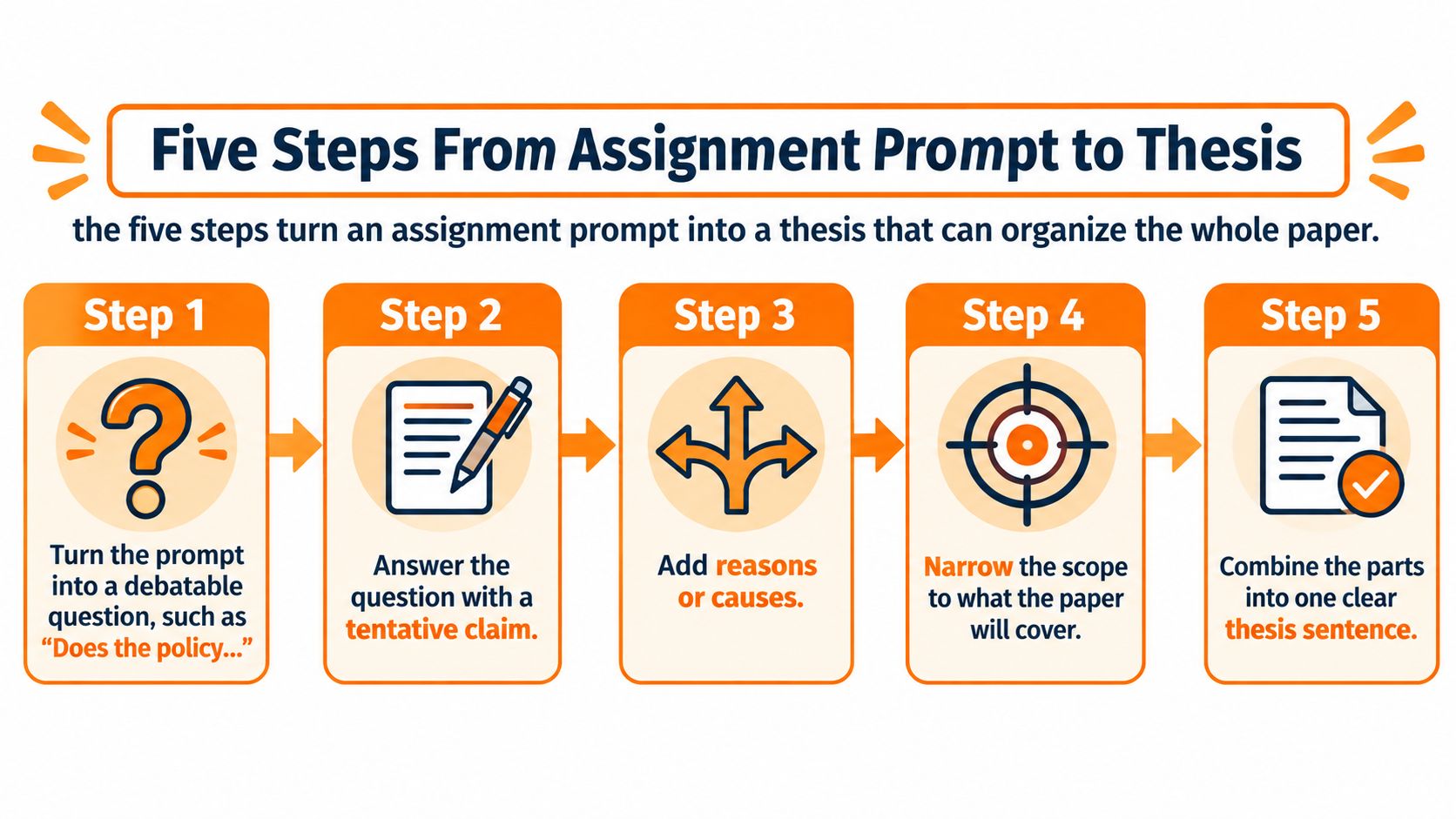
The five steps turn an assignment prompt into a thesis that can organize the whole paper.
-
Turn the prompt into a debatable question. "Discuss waste policy" gives you nowhere to land. "Does this policy reduce campus waste?" does, because you can answer yes, no, or only under certain conditions.
-
Narrow the subject. Name the population, period, place, or mechanism you're examining. "First year students in one cafeteria this semester" is researchable. "People everywhere" isn't.
-
Write a contestable answer. State a claim, not a topic or a fact. Swap vague verbs like "deals with" or "talks about" for analytical ones such as causes, constrains, reveals, or redistributes. The verb tells your reader what kind of argument you're making.
-
Add the principal reasons. List two or three reasons or analytical dimensions that will become your body sections. If a reason can't fill a section, it probably doesn't belong in the sentence.
-
Test every word against your evidence. Delete any component you can't support with a source you have. A thesis that promises three causes but only has evidence for one will fall apart by page two.
A scaffold you can borrow
Although [important counterpoint], [subject] should [precise claim] because [reason 1], [reason 2], and [reason 3].
The counterpoint is optional in a short essay, but it's useful when your assignment rewards complexity. Don't force it into a five paragraph paper where it eats space you need for evidence.
This is also how markers read you. The Berkeley generic essay rubric scores clarity, focus, precision, logical organization, and direct evidence support as separate dimensions, and it distinguishes a developed thesis from one that's merely present or overly broad. One sentence can be grammatically fine and still lose marks on three of those.
Build a claim evidence matrix before drafting
Make a simple table with one row per reason and columns for source, finding, warrant, and limitation. The warrant column matters most. It forces you to write out why that finding supports your reason, which is exactly the link students usually skip. If a row stays empty, cut that reason from the thesis rather than hoping evidence turns up later.
Once each reason maps to a section, an expository essay outline can hold that structure while you draft. A reader should be able to identify your purpose, argument, and scope from one sentence. If they can't, the sentence isn't finished yet, even if it sounds polished.
Revise a Working Thesis as Evidence Comes In
A working thesis is a provisional answer, not a promise. Changing it doesn't mean your research failed. It usually means your research worked.

The University of Wisconsin Writing Center handbook on thesis statements treats revision during drafting as acceptable and beneficial, and encourages writers to investigate alternatives rather than just polish wording. That matters because most students assume the sentence they wrote on day one has to survive to submission. It doesn't.
The revision loop
Work in this order and repeat it as sources arrive:
- Question: Start with a genuine "how" or "why" question you don't already know the answer to.
- Provisional claim: Write your best current answer in one sentence.
- Evidence check: Test it against sources, assignment limits, and the structure you're building.
- Counterclaim: Find the strongest source that pushes the other way.
- Revised claim: Adjust the sentence to fit what you can now defend.
Say you start with "Remote work improves productivity" after reading two studies on home offices. Then your evidence splits. Output rises on focused individual tasks and drops on collaboration heavy projects. Your revised claim becomes "Remote work raises output on focused individual tasks but weakens output on collaboration heavy projects because teams lose unplanned contact." Nothing failed there. The claim got more accurate, and now it gives you two distinct body sections instead of one blurry one.
When evidence contradicts your claim, you've got three honest options. Narrow it to the group or setting where it holds. Qualify it with the condition that makes it true. Or replace it with the claim your evidence supports. What you shouldn't do is force sources to fit the original sentence by quoting selectively.
The clip below works through that same shift from a first guess to a defensible claim.
Build one habit from this. After each new source, reread your sentence and ask whether it still holds. This is especially useful if you're writing in a second language, because clarity here isn't about simpler vocabulary. It's about representing uncertainty and scope accurately.
Keep the Thesis Precise Across Disciplines and Lengths
The clearest thesis matches its certainty and scope to the evidence, not to its length or confidence. A short, bold sentence that overclaims is less clear than a longer one that says exactly where the claim stops.
Use the rule of maximum decision relevant precision. Name the subject, the analytical action, the central claim, the scope, and the significance. Then move everything else into the body. The UNC Writing Center guide to thesis statements notes that a thesis doesn't need to include every aspect of an argument, and that placement can vary by discipline and topic.
Adding detail can make a thesis worse
Compare these two versions.
Our study of 40 undergraduates using three methods and two surveys finds that peer review, mentoring, and timed feedback each improve revision quality.
Structured peer review improves revision quality in first year writing because it forces students to reread their own claims.
The second version drops the sample, the methods, and the surveys. Those details belong in a methods section, where a reader expects them. In the thesis they crowd out the mechanism, which is what your reader needs. More information isn't the same as more clarity.
Shape changes with the assignment
A one page literary analysis can hold a single arguable sentence about how a symbol works. A lab report or policy brief usually needs the population, measure, or setting inside the claim, because without them the finding means nothing. Neither shape is better. Each one answers a different reader's question.
Watch your key terms, too. Decide what counts as effective, harmful, or successful before you use the word, or your evidence won't have a target. And if your results only hold in one course or one semester, say so in the sentence. A boundary isn't weakness. It's information, and markers read it that way.
Acknowledge the Other Side Without Losing Your Claim
A thesis can name the strongest objection and still take a clear position. In fact, naming it often makes the position easier to trust, because your reader stops wondering whether you've noticed the obvious problem.
Use the pattern Although X, Y because Z. Fordham's Writing Center page on thesis statements and counter claims describes the thesis as a claim that sets up an argument and may address possible objections by conceding a limited point before asserting the main interpretation.
Although online classes offer flexibility, colleges should not replace most introductory courses with fully asynchronous instruction because students often need immediate feedback, structured deadlines, and opportunities for discussion.
Take it apart clause by clause. "Although online classes offer flexibility" concedes something real but limited, so you look fair without giving away your argument. "Colleges should not replace most introductory courses" is specific about who's acting and which courses are in scope. The three reasons at the end each become a body section, and each one can be supported separately.
Where concessions go wrong
The common failure is stacked hedging. Students write that something "might possibly sometimes" help, and by the end of the sentence no position survives. Fix it by putting your uncertainty in one qualifier that names a condition, such as "in large introductory courses," and stating the claim plainly everywhere else.
Short essays can skip the counterpoint entirely. Assignments that reward complexity usually expect one, and knowing how a rebuttal answers an objection helps you decide how much space it deserves. Before you submit, try one check. Delete the concession and read what's left. If the claim still stands on its own, your sentence is doing its job.
Check Your Thesis Before You Draft the Body
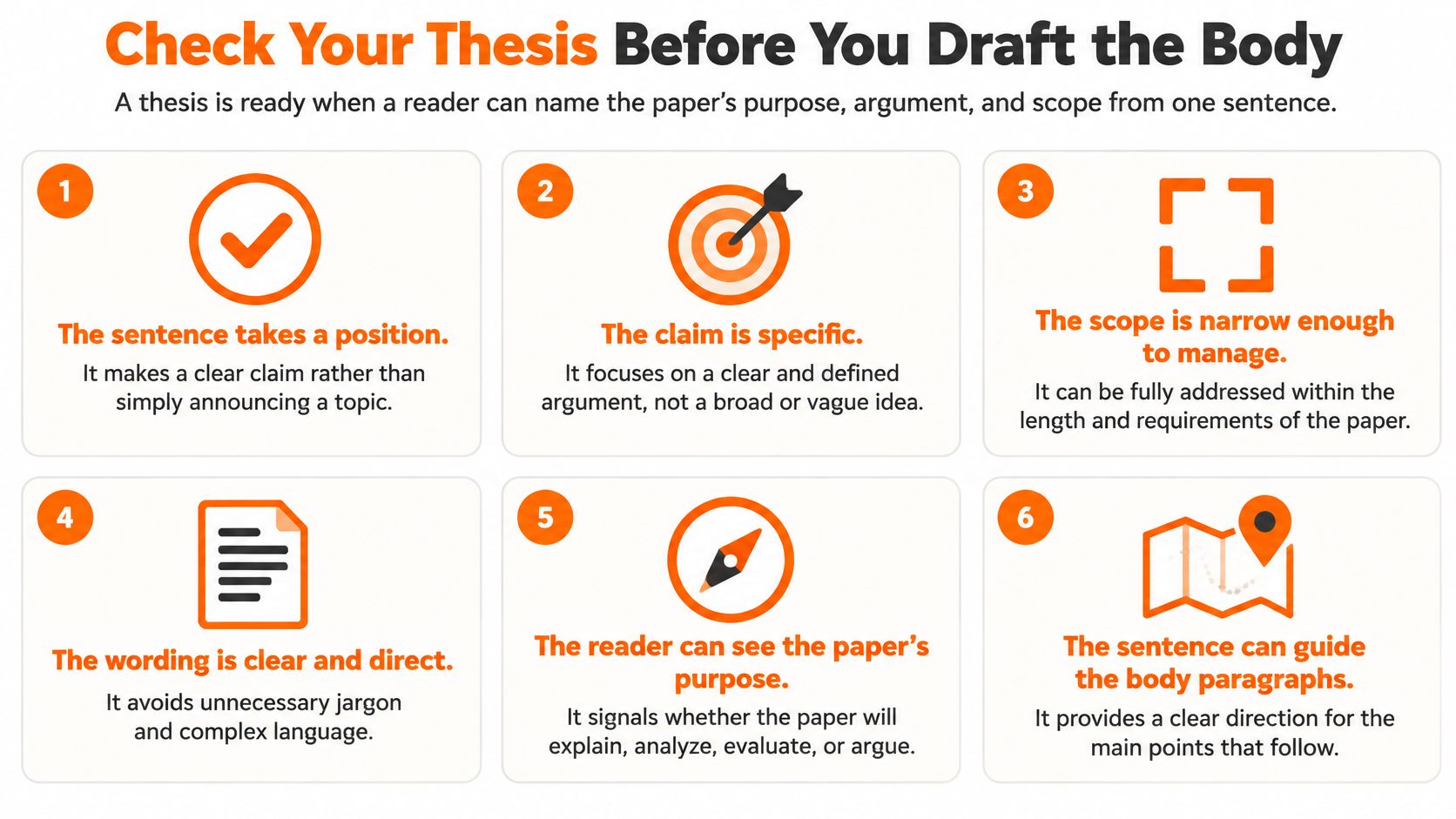
A thesis is ready when a reader can name the paper's purpose, argument, and scope from one sentence. Run the check below before you spend hours on body paragraphs, while the sentence is still cheap to change. It works like a pre-flight inspection: you confirm the parts move before you commit, and you keep adjusting as conditions change.
Six tests, in order:
- Position: The sentence takes a side someone could dispute.
- Verb: It uses an analytical verb, not "is about."
- Mapping: Each stated reason matches one body section.
- Support: Every component has a source you can cite.
- Terms: Key terms are defined or measurable.
- Qualifier: Any qualifier names a real condition, not just caution.
Say a draft passes four of six. It takes a position, maps to three sections, has sources, and includes a qualifier, but the verb is "affects" and "effective" is never defined. Fix those two and the paper sharpens, because now you know what evidence counts as proof and what counts as padding. A thesis that fails the mapping test is telling you something useful: one of your reasons is carrying weight the evidence cannot hold, so cut it now rather than after three pages.
Then read the sentence aloud to a classmate and ask them to predict your first body paragraph. If they guess wrong, either the thesis or the outline needs work. Start drafting with the reason you can support best, and keep the sentence visible while you write so later evidence can still revise it. If your paragraphs read awkwardly once the argument settles, Lumi Humanizer is designed to preserve the main point of the text while improving clarity, voice, and flow.
Common Thesis Statement Questions
Where does a thesis go? At the end of the introduction, usually as the last sentence or two. Your reader should meet the claim before the evidence, so they know what the evidence is for.
Can a thesis be a question? Only in genres that explicitly invite open inquiry. In most academic essays, state the answer. A question tells your reader what you're wondering, not what you're arguing.
How many sentences should it take? One, or two if a concession and a claim need separate sentences. If you're at three, you're probably writing an abstract instead of a thesis.
Does every assignment need one? Not always. Short reflective pieces can run on a central point without a formal argument, so check your rubric before forcing one in.
What if my instructor asks for a thesis in a lab report? Then it usually restates the finding and its scope in one sentence, naming what you measured and where the result applies.
Knowing how to write a clear thesis statement won't fix tangled body sentences on its own. If your paragraphs still read awkwardly after revision, a grammar check can tighten the wording without changing what you're claiming.
Once your claim is sharp, your sentences still need to sound like you wrote them. Paste a draft into Lumi Humanizer and we'll smooth stiff, generic phrasing into natural prose while keeping your argument, evidence, and meaning intact. It's a fast final pass before you submit, so your reader notices the thesis instead of the machinery behind it.