You've written the argument, added your sources, and reached the conclusion, but the draft still feels disconnected. The most useful essay writing vocabulary isn't a collection of impressive words. It's a set of phrases that tells readers what you're claiming, how your evidence fits, and how certain your conclusion should be.
Two drafts can make the same point while creating very different reading experiences. One leaves readers to work out the connections; the other makes those connections explicit without explaining every move.
Choose phrases by the job they do, not by how formal they sound. A contrast needs however or whereas, an illustration needs for instance, and an uncertain interpretation may need suggests rather than proves.
- Start the argument: State a position readers can identify and evaluate.
- Develop the reasoning: Add support, address objections, explain causes, and illustrate ideas.
- Control the ending: Qualify your claims, connect paragraphs, and draw a conclusion that follows from the evidence.
There's no need to replace familiar language with rare synonyms. In an analysis of student assignments, the most frequent word families supplied much of the text, supporting a balanced approach to common and academic vocabulary (SAGE Open).
The examples below are hypothetical teaching examples, not findings to cite in an essay. Use their sentence patterns, but supply evidence for the claims you make.
1. Thesis and Claim Phrases for Introducing Your Main Argument
This essay argues that introduces a position. The central question is introduces an inquiry. This paper contends that signals a claim you intend to defend, rather than a subject you'll merely describe.
Choose the opening that matches your assignment. An argumentative essay needs a defensible position; an exploratory paper may begin with a question before developing an answer.

Turn a Topic Into a Position
Weak: This essay will talk about social media and teenagers.
Stronger: This essay argues that schools should address late-night social media use through sleep education rather than blanket phone bans.
The revision names a problem, takes a position, and identifies an alternative. Readers can now ask whether the evidence supports sleep education over restrictions, rather than wondering which aspect of social media matters.
For a literature assignment, try: This essay argues that the narrator's contradictions reveal self-deception rather than deliberate dishonesty. Use English Literature study resources to explore relevant concepts, then support your interpretation with passages from the text.
Practical rule: A thesis phrase introduces your claim. It doesn't make an unclear claim specific.
The common misuse is announcing a topic instead of making an argument. Replacing talk about with examine won't solve that problem if the sentence still gives no indication of your position.
Use the signal phrase where it helps, then let the argument proceed without repeating it. If you're unsure how the claim should shape your supporting paragraphs, an expository essay outline can help you connect the introduction to the body.
2. Addition Transitions for Building Support Without Repetition
A paragraph about a mentoring program can quickly become a list of benefits. Addition transitions show how a new point supports an idea already in motion. Before choosing one, ask: How does this point strengthen the argument? If there's no clear answer, the connection may need explanation.
- Additionally: Introduce another reason that supports the same position.
- What's more: Add a reinforcing consideration that extends the argument.
- In addition: Add information without strongly emphasizing its importance.
- Also: Make a straightforward addition when a more formal phrase feels heavy.
Build Support Rather Than a Longer List
Before: The program would explain workplace procedures. The program would introduce new staff to colleagues. The program would provide somewhere to ask questions.
After: The program would explain workplace procedures. In addition, pairing new staff with experienced colleagues would give them a familiar person to approach with questions.
The stronger version connects two related benefits: pairing new staff with colleagues creates a source of support. The transition signals the connection, while the rest of the sentence explains it.
The common misuse is adding an addition phrase before a point that changes direction. A sentence about the program's administrative burden may call for however, because it introduces a complication rather than further support.
Research on learner academic writing identifies phraseological problems and connector-position errors alongside vocabulary limitations (Applied Linguistics). A transition needs to fit both the sentence's grammar and its role in the argument.
If every sentence begins with an addition word, remove some. Combine related details, repeat a useful subject, or explain the connection directly.
3. Contrast and Concession Words for Handling Opposing Views
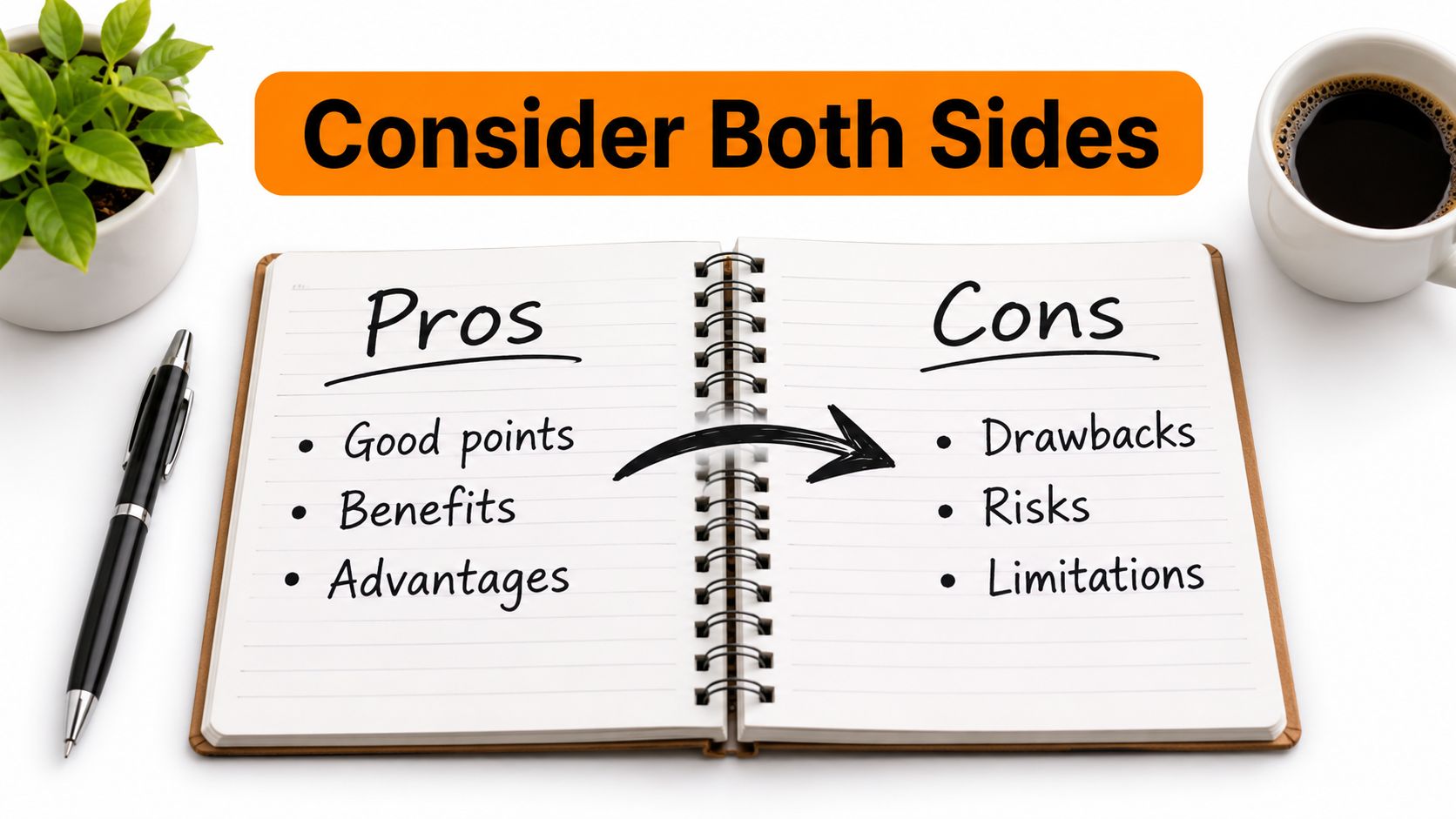
Contrast shows a difference. Concession acknowledges a point that complicates your argument. Distinguishing them helps you respond to objections without pretending they don't matter.
Use whereas to compare ideas within a sentence: The proposal prioritizes convenience, whereas the existing policy prioritizes supervision. Use however to turn toward a conflicting consideration in a new sentence.
Acknowledge the Objection Before Responding
Weak: Some people think remote work is bad. But remote work is good.
Stronger: Admittedly, remote work can make spontaneous discussion harder. Nevertheless, that concern supports planning deliberate opportunities for collaboration rather than rejecting remote work altogether.
The stronger version identifies a specific objection and answers its implication. It doesn't claim that a benefit automatically cancels a drawback.
- Admittedly: Accept a relevant limitation or objection.
- Nevertheless: Explain why your position still holds despite that difficulty.
- By contrast: Compare clearly different features or situations.
- Conversely: Describe a reversed relationship, not just any disagreement.
The common misuse is treating every opposing view as something to dismiss. Sometimes an objection should narrow your claim, change your recommendation, or remain an acknowledged limitation.
A concession doesn't always need a rebuttal in the next sentence. But readers should eventually understand whether you reject the objection, accommodate it, or revise your position because of it.
For a fuller explanation of that response, see what a rebuttal does in an argumentative essay. Check punctuation too: write The concern is reasonable. However, the proposed remedy is too broad, rather than joining complete sentences with a comma alone.
4. Cause and Effect Connectors for Showing Why Something Matters
Therefore, consequently, as a result, and this led to can make an argument easier to follow. They can also make an unsupported causal claim sound more convincing than it deserves.
Start by separating sequence, association, and causation. Something happening after a change establishes an order of events, but it doesn't by itself establish that the change produced the outcome.
Match the Connector to the Evidence
Suppose a school introduces a later start time and subsequently records fewer late arrivals.
Overclaim: The later start time caused attendance to improve.
Calibrated: Late arrivals declined after the start time changed. This pattern is consistent with the change helping students arrive punctually, although other explanations would need examination.
The revision describes the observation before interpreting it. It also avoids turning fewer late arrivals into a broader claim about attendance.
A connector can express your reasoning, but it can't supply missing evidence.
Use as a result when you can justify the causal relationship, not merely when events happened in sequence. Use therefore when a conclusion follows from the stated premises: The assignment requires analysis of the original text; therefore, a summary alone won't meet its requirements.
The common misuse is substituting chronology for explanation. If all you know is that a change happened first, write afterward, subsequently, or following the change.
When reviewing this distinction, focus on the claim before polishing the connector.
Ask what else might explain the outcome and whether your source addresses those possibilities. If it doesn't, describe the relationship cautiously rather than asserting a cause.
5. Example and Illustration Phrases for Making Abstract Points Concrete
For instance introduces a case. Specifically narrows a statement. Such as introduces examples within a sentence, while namely identifies precisely what you mean.
Choose the phrase after deciding what your reader needs. A broad claim may need an illustration, but a vague category may need a clearer name.

Make the Example Do Explanatory Work
Consider a hypothetical essay about public libraries.
Abstract: Public libraries can support people seeking employment.
Concrete: Public libraries can support people seeking employment. For instance, a library might provide computer access for someone completing an online job application.
The example identifies a person, a resource, and a task. It illustrates a possible mechanism without pretending to establish how widely that service is available.
- For example or for instance: Introduce a representative illustration.
- Specifically: Clarify the exact aspect you're discussing.
- Such as: Name examples without implying that your list is complete.
- Namely: Identify the particular items intended, rather than an open-ended selection.
The common misuse is presenting an illustration as proof of a general claim. A plausible scenario can explain an idea, but it can't establish a real-world trend.
When you use a source-based example, preserve the distinction between your explanation and borrowed information. Purdue OWL's guidance on quoting, paraphrasing, and summarizing explains that paraphrases and summaries still require acknowledgment of the original source.
After the example, explain its relevance. A sentence stating the connection directly can help during drafting, even if you later express it more naturally.
6. Hedging and Qualifying Words for Appropriate Certainty
May, appears to, suggests, and to some extent help you express limits accurately. They aren't apologies for having an argument.
Choose a qualifier based on what's uncertain. You might be uncertain about the explanation, the strength of an effect, or whether a finding applies beyond the people or texts examined.
Qualify the Uncertain Part
Overconfident: Remote work destroys team culture.
Calibrated: Remote work may weaken informal team relationships when colleagues have few opportunities for casual conversation.
The revision narrows the outcome and states a relevant condition. It doesn't make a sweeping claim and then soften it vaguely at the end.
Compare those choices with a literary interpretation: The narrator's hesitation suggests discomfort, but it doesn't establish that the account is deliberately false. Here, the distinction is between a plausible reading and a stronger conclusion the passage cannot support.
- Suggests: Introduce a supported interpretation without calling it conclusive.
- Appears to: Mark a judgment based on available observations.
- May reflect: Offer a possible explanation.
- Cannot establish: State a limit explicitly.
Editing test: Identify exactly what you're uncertain about, then place the qualifier beside that claim.
The common misuse is hedge stacking: It could possibly be argued that this might perhaps suggest… A cleaner version is This suggests… or This may indicate…, depending on the evidence.
A study of first-year ESL undergraduates associated stronger essay ratings with both academic-vocabulary density and diversity (Hong Kong Metropolitan University publication record). That finding isn't a reason to insert more formal expressions indiscriminately.
Keep direct statements direct when the evidence warrants them. You don't need possibly before an accurately reported observation.
7. Sequencing and Paragraph Transitions for Guiding the Reader
First, next, and finally tell readers where they are in an ordered explanation. A paragraph bridge does something more: it explains why the next idea belongs after the previous one.
Use subsequently for a later event and meanwhile for something happening at the same time. Don't use them merely to make a paragraph opening sound academic.
Connect Ideas, Not Just Paragraph Numbers
Mechanical: First, the committee considered costs. Next, it considered delivery. Finally, it considered quality.
Linked: The committee initially compared purchase costs. That comparison raised a related question: whether cheaper materials would require more frequent replacement.
The revision connects the next issue to the previous analysis. Readers can understand why replacement frequency matters rather than receiving another item in a list.
- Building on this point: Develop a particular idea you've just established.
- This raises a related question: Introduce an issue that follows from the discussion.
- A different explanation is: Shift from an observation to an alternative interpretation.
- At the same time: Introduce simultaneous events or a qualifying consideration, making the intended meaning clear.
The common misuse is writing a bridge with no clear reference. Building on this leaves readers guessing if the preceding paragraph contains several different claims.
Replace the vague reference with a noun: Building on this distinction between access and participation… That small change often does more than a more effective transition.
For structural revision, use a guide to writing a multi-paragraph essay to check paragraph roles. The research writing tips from Kohru also provide a useful place to consider organization before sentence-level polishing.
If the paragraphs don't belong in that order, rearrange them. A transition shouldn't hide a structural problem.
8. Conclusion and Summary Phrases for Closing With Purpose
A conclusion should answer the question your introduction created. Taken together, ultimately, and the broader implication is can introduce that answer, provided you've already developed the reasoning.
In conclusion is acceptable, but it doesn't add substance by itself. The important work happens in the sentences that follow.
Synthesize Instead of Repeating
Suppose an essay has compared flexible working arrangements and communication practices.
Repetitive: In conclusion, this essay has argued that remote work matters.
Stronger: Taken together, these arguments support evaluating remote work through communication practices rather than location alone. The practical question is how teams maintain coordination when colleagues aren't routinely together.
The revision returns to the position while explaining its significance. It doesn't introduce a fresh statistic or promise an outcome the body hasn't established.
The common misuse is using a concluding phrase to introduce new evidence. If a study, quotation, or example is necessary to establish your conclusion, discuss it in the body before relying on it at the end.
Choose taken together when combining findings or reasons. Choose ultimately when stating your final judgment, and the broader implication is when explaining a consequence that follows from the discussion.
If your conclusion summarizes a source, changing its vocabulary doesn't remove the citation requirement. Purdue OWL's reference and citation guidance explains that paraphrasing must preserve meaning while changing wording and grammar, with attribution retained.
Finish by checking that the conclusion is no stronger than the argument you made. A careful ending can acknowledge a boundary without abandoning your position.
Where Each Essay Phrase Group Fits and What to Watch For
| Item | Where It Fits | Formality | Main Risk |
|---|---|---|---|
| Thesis and Claim Phrases: Introducing Your Main Argument | Introduction, usually near the end | Academic to professional | Vague or overused phrasing |
| Addition Transitions: Building Support Without Repeating Yourself | Between supporting points | Formal or conversational | Using them for points that do not reinforce each other |
| Contrast and Concession Words: Handling Opposing Views | Counterarguments and shifts in argument | Formal | Conceding without a clear rebuttal |
| Cause and Effect Connectors: Showing Why Something Matters | Linking evidence to outcomes or conclusions | Formal to professional | Claiming causation without sufficient evidence |
| Example and Illustration Phrases: Making Abstract Points Concrete | Before examples, data, or quotations | Neutral to formal | Using weak or unrepresentative examples |
| Hedging and Qualifying Words: Stating Claims with Appropriate Certainty | Claims with limited or qualified evidence | Academic to professional | Excessive hedging that weakens the claim |
| Sequencing and Paragraph Transitions: Guiding the Reader Through Your Structure | Ordered points, steps, or paragraph shifts | Formal to professional | Mechanical sequencing without meaningful connections |
| Conclusion and Summary Phrases: Closing an Essay with Purpose | Conclusion paragraph | Formal to professional | Repeating the thesis mechanically or adding new evidence |
Putting These Phrases to Work Before You Submit
Start with your thesis and conclusion. Read them together, without the body paragraphs, and ask whether they express the same central position at an appropriate level of certainty.
If the introduction promises to explain a cause but the conclusion describes only an association, revise the promise or strengthen the analysis. Don't solve the mismatch by inserting therefore.
Then choose a paragraph that feels difficult to follow. Identify the relationship between its sentences before selecting new essay writing vocabulary: are you adding support, contrasting explanations, giving an example, or drawing an inference?
Revise Meaning Before Style
- Name the relationship: Write a brief note beside the paragraph, such as objection and response or observation and interpretation.
- Replace the vague signal: Change also to a more precise connection only if the meaning calls for it.
- Check the claim: Make sure the revision hasn't turned possibility into certainty or sequence into causation.
- Read aloud: Listen for repeated openings, overloaded sentences, and transitions that interrupt rather than clarify.
Keep a small vocabulary notebook organized by function instead of alphabetically. Record the phrase, its grammatical pattern, and a sentence you've written yourself; that gives you something more useful than a synonym list.
Academic vocabulary lists can support that practice. Averil Coxhead's Academic Word List contains 570 word families, selected from academic texts rather than from a preference for formal-sounding language (Coxhead's Academic Word List study).
Learning a word family is only the beginning. Practise using its forms in claims and explanations, and check whether the surrounding words fit naturally.
Clear academic writing lets readers distinguish what you observed, what your source says, and what you infer.
If you use writing assistance, follow your course's rules before submitting work. Draft independently, retain earlier versions, verify factual claims, and make sure you can explain every sentence you keep.
Use our grammar checker for a final pass on grammar, spelling, and clarity after you've reviewed the argument. Treat suggested changes as proposals, not instructions to accept automatically.
The final question isn't whether your essay sounds advanced. It's whether readers can follow your reasoning without having to guess what you mean.
Lumi Humanizer reviews vocabulary, sentence structure, and writing patterns to improve flow while preserving the original meaning and intent. If your course permits AI-assisted revision, visit Lumi Humanizer to refine an AI-assisted draft, then review each change for accuracy, appropriate certainty, and your own voice.