You're about to send an email, and you've changed use to utilize because the original sounded too casual. If you're wondering how to sound professional, start by reducing the reader's effort: name the issue, say what you recommend, and make the next step clear. In speech, give the same message in short thought groups with room to pause.
Professional communication doesn't require a different personality. It requires enough precision that people don't have to guess what you mean, how certain you are, or what you need from them.
Phrase Swaps That Make Writing Sound Professional
Professional writing names the action, the owner, and the deadline when those details matter. Vague urgency and unnecessary apologies make readers interpret your intentions before they can act.
Tone is a genuine difficulty. In Grammarly's 2023 State of Business Communication report, 71% of knowledge workers said choosing words that avoid offending others and balancing overly formal versus overly casual language were challenges in text-based workplace communication.
The useful target is controlled tone, not stiffness.
Casual phrases and professional swaps
These are sample replacements, not facts to paste into a message without checking.
| Casual or weak phrase | Professional alternative | Why it works |
|---|---|---|
| Hey guys | Hello Dana and team | Names the readers and sets a respectful greeting |
| Just wanted to touch base | I am following up on the vendor proposal sent 4 May | Names the item and the date |
| Let me know if that is cool | Please confirm by Friday if this works | Turns approval into a specific action with a deadline |
| We kind of need this asap | I need the signed contract by 5 p.m. Thursday | Replaces vague urgency with a fact |
| Basically, the thing is | The main point is | Removes filler and states the point directly |
| I am not an expert, but | Based on three test runs | Replaces self-doubt with evidence |
| Our implementation of the new system | We implemented the new system | Uses a plain verb instead of a nominalization |
| Mistakes were made | I sent the wrong file; the correct one is attached | Shows who acted without hiding behind the passive |
| Thanks so much!!! | Thank you for reviewing this | Keeps warmth without exclamation overload |
Cut basically when it delays the point. Replace I think maybe we could with I recommend when you're making a recommendation, but keep uncertainty when it's real. Don't claim test evidence merely to sound confident.
Directness also needs context. I need the contract today may be appropriate during an agreed handoff; with a new client, explain why the timing matters. Understanding how tone works in writing helps you distinguish a clear request from an abrupt demand.
Practical rule: Remove self-deprecation, not legitimate limits on your knowledge.
For a hypothetical follow-up, replace this opening:
Before: Hey, just checking in to see whether you've had a chance to look.
After: Hello Dana, I'm following up on the vendor proposal sent 4 May. Could you confirm by Friday whether we should proceed?
If a sentence could go to anyone on any project, add the specific item, decision, or date.
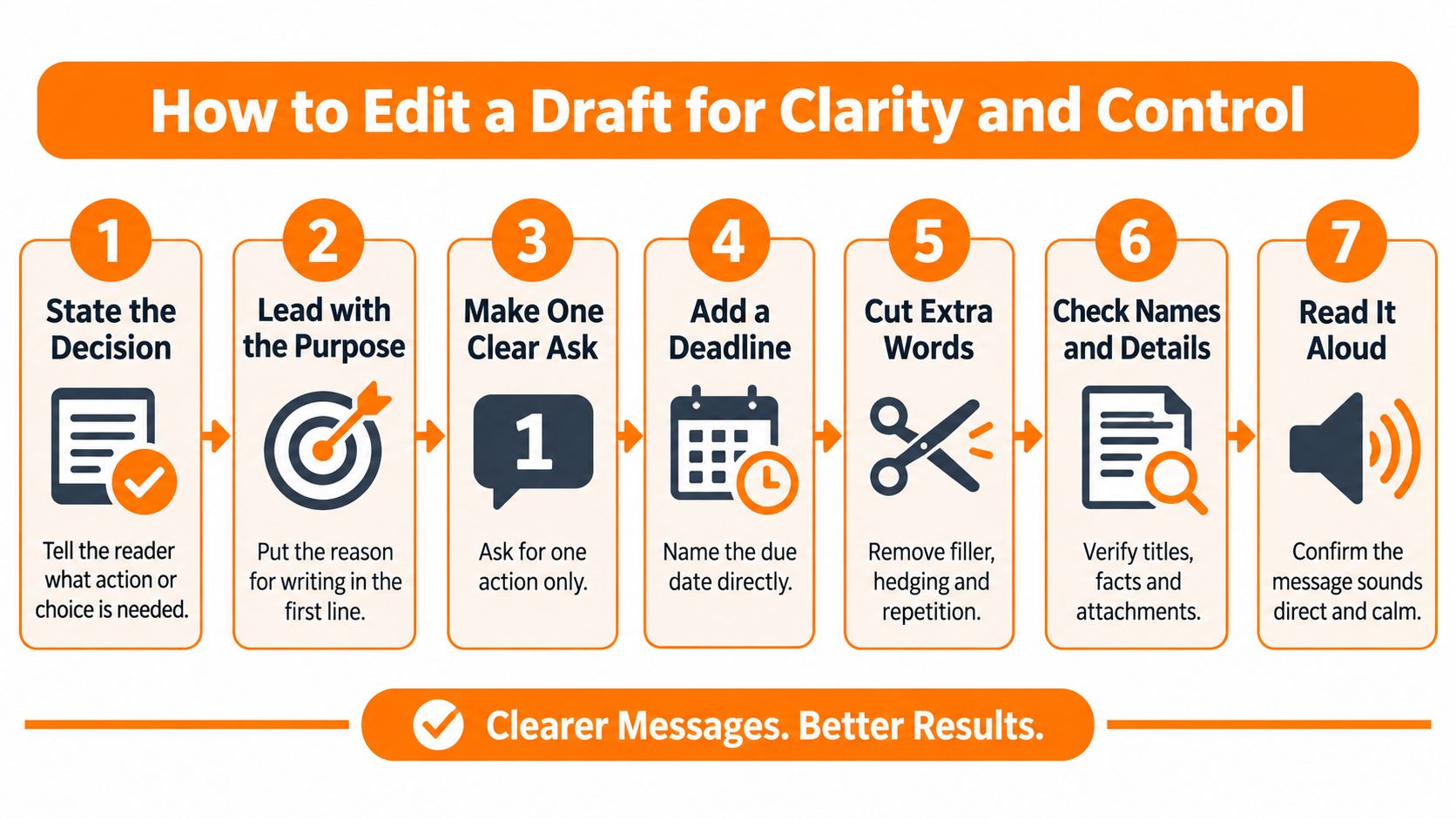
How to Edit a Draft for Clarity and Control
A draft sounds professional when readers can find its purpose, requested action, and deadline without effort. Editing should preserve the substance while removing avoidable work.
In the 2020 Labrador plain-language study, readers were almost 40% more likely to understand plain-language text. That's a reason to simplify the expression, not to strip out necessary technical detail.
Make the substantive edits first
-
State the reader's decision or action. Write it at the top of your working draft, even if you later adjust the opening. If you can't describe what the reader should do, the message probably needs a clearer purpose.
-
Put the conclusion before the background. Follow your recommendation with the strongest supporting reasons, rather than making readers reconstruct your reasoning from a chronology.
-
Choose concrete verbs. Replace make a decision with decide and conduct a review with review. Keep the longer phrase only when it carries a distinction you need.
-
Split sentences at clause boundaries. Purdue OWL's plain-style guidance recommends about 20 words per sentence for task information and about 25 for conceptual information; use those as editing prompts, not rigid limits.
-
Name the actor when responsibility matters. Ana sent the report is cleaner than The report was sent by Ana. Passive voice is still useful when the actor is unknown or irrelevant.
Before: The implementation of the revised schedule is something the team will look at at some point.
After: The team will review the revised schedule on Monday.
The revision removes padding, but it also adds a commitment. Use Monday only if that review is scheduled.
-
Remove unnecessary jargon and define essential terminology at first use. Don't replace a precise technical term with an everyday word that changes its meaning.
-
Test the revision with a representative reader. Ask them to identify the purpose, requested action, owner, and deadline without rereading. Their hesitation tells you more than your familiarity with the draft.
Check the message as a whole
Use this visual pass to inspect the practical details after the sentence-level edits.
A broad audience needs more explanation than a specialist team. The Nielsen Norman Group's readability guidance recommends approximately an eighth-grade reading level for broad consumer-facing content, while advising simpler writing even for highly educated audiences.
Readability scores can flag complexity, but they can't verify accuracy or judge whether a specialist term belongs. Inspect headings, lists, and terminology yourself, then use a grammar checker for a final clarity pass. The strongest revision keeps the authority of the original without keeping its clutter.
Email and Proposal Templates You Can Adapt
A useful template gives your message a shape without making it sound copied. These hypothetical messages show how to make a request, follow up, recommend a change, or decline without burying the point.
Keep the recipient's situation in view as you adapt them.

Requests and follow-ups
Client request with a deadline
Hello Priya, Please send the final logo files by 12 June so I can prepare the brochure for its scheduled print handoff. Vector files would be best; let me know if you need help locating them.
Thank you, Alex
Follow-up after no reply
Hello Priya, I'm following up on the logo files for the brochure. Could you send them by 14 June, or confirm a revised delivery date? If there's a file-format issue, I'm available for a 10-minute call.
Thanks, Alex
The follow-up offers a way to resolve the obstacle instead of merely announcing that you're still waiting. Don't repeat the entire earlier message unless the recipient needs that context.
Recommendations and boundaries
Proposal opening
Hello team, I recommend adopting the shared booking tool to save the time we currently spend reconciling separate calendars. It would give reception a common view of availability. Please approve a pilot at Monday's planning meeting.
Thanks, Morgan
Polite decline
Hello Sam, Thank you for inviting me to lead the workshop. I can't take on the session this month because my project schedule is full. I'd be happy to review your outline by email instead.
Best, Taylor
The proposal leads with the recommendation and a qualitative saving rather than an invented financial return. For a longer document, practical business proposal guidance can help you connect the recommendation to scope, evidence, and approval.
Student extension request
Dear Professor Ahmed, Could I have a two-day extension for the methods assignment, moving submission from 18 June to 20 June? Illness has interrupted my final revision. I've completed the analysis and need the additional time to check the references.
Thank you for considering my request.
Maya Chen
Each message uses a greeting, purpose, dated request, supporting explanation, and short sign-off. That structure leaves room for warmth without weakening the request.
With a new client, use their preferred name and provide enough context to establish the relationship. With a close colleague, a shorter greeting may fit. For help with subject lines, greetings, and reply habits, PrayerPetals offers guidance to practice proper email etiquette.
Speak With Calm Control in Meetings and Calls
Prepare your message in short thought groups, then pause where the grammar naturally ends. A steady delivery gives listeners time to follow the substance without forcing you to perform a different voice.
The Interspeech acoustic study found that the most confident-sounding utterances combined no filler, lower fundamental frequency, and a higher speech rate, while mid-sentence filled pauses, higher pitch, and slower speech produced the least confident impression. Its discussion also reports spontaneous monologues averaging approximately 117 words per minute, with variation between speakers.
Those findings aren't instructions to rush or artificially lower your voice. Professional delivery depends on the task: a complicated risk explanation needs more room than a familiar status update.
Practise a complete thought
-
Record a 60-second project explanation. Count words and fillers, then listen for unfinished clauses and sentences that carry too many ideas. Record it again with shorter thought groups and clean sentence endings.
-
Rehearse a meeting update. Answer What's the status? with the answer, the reason, and the next step. Try five minutes a day for a week as a practice schedule, not a promise of a particular result.
A hypothetical update might sound like this:
The launch is on hold. The vendor hasn't confirmed delivery of the payment component. I'll bring a revised date to the planning meeting once we have that confirmation.
That answer is useful because the listener can distinguish status from explanation and action. You don't need to compress everything into one breath.
Let pauses do their job
Pause after a complete statement, before a new point, or while inviting a response. Avoid inserting a hesitation into the middle of a name, instruction, or important claim.
Watch for these habits during playback:
- Filling every silence. Allow yourself a quiet pause instead of automatically adding um or uh.
- Making statements sound unresolved. Notice habitual upward pitch at sentence endings, but don't treat every rising tone as an error.
- Stacking ideas. Finish the status before explaining the cause, and finish the cause before naming the next step.
An occasional hesitation isn't a professional failure. The useful question is whether listeners can follow the message and identify what happens next.
Stay Clear and Credible Without Changing Your Accent
You don't need to sound like everyone else to contribute professionally. Comprehensibility and accent conformity are different goals, and advice that confuses them can put the burden of listener bias on the speaker.
Research summarized by Arizona State University found that identical messages delivered with a Persian accent were rated as less warm and friendly than the same messages delivered with an American accent. The explanation points to listener processing effort and social-group associations, not weaker ideas; the coverage also describes a separate study in which perspective-taking improved judgments of candidates' ability without eliminating differences in trust, benevolence, or integrity.
Improve access without erasing identity
Keep culturally meaningful phrasing when it communicates something you intend. If an idiom may be unfamiliar to the room, explain its meaning rather than abandoning it automatically.
Directness also travels differently across cultures and relationships. A framing line can make a firm recommendation easier to interpret:
I recommend moving the launch to June because the vendor delay is confirmed. That would give us time to test the complete payment process.
The explanation makes the recommendation easier to evaluate. It doesn't turn the decision into an apology.
For a recently learned language, prepare key terms and transitions before a meeting. If someone looks uncertain, restate the idea with a concrete example rather than assuming your accent is the problem.
Make listeners responsible too
Meeting organizers and reviewers can reduce unnecessary barriers:
- Circulate proposals beforehand. Give participants access to the argument independently of live delivery.
- Restate the substance. A facilitator can summarize a contribution and ask the speaker to confirm the interpretation.
- Use written review where practical. Evaluate the recommendation against stated criteria, with anonymized review where appropriate.
Listeners should ask specific questions about meaning rather than making broad judgments about fluency. Which delivery date are you recommending? is useful; asking someone to sound more professional without identifying a problem isn't.
For multilingual editing, check that a smoother sentence still carries the original level of politeness, certainty, and responsibility. Our output quality is highest for English content, and effectiveness in other languages varies with complexity, so non-English drafts need closer checking for meaning.
Use AI Drafts Without Losing Your Voice
AI-assisted workplace writing is already common. Public Spectrum's coverage describes a survey of 289 professionals across government, private-sector, and nonprofit organizations in which almost 90% used generative AI at work at least monthly; it also discusses Johns Hopkins research, reported by Yahoo Finance, finding less formal and less complex workplace writing when prompts contained language patterns associated with women, across four models.
Treat a rewrite as an editorial suggestion, not an impartial verdict on your voice. A polished version can still distort your confidence, expertise, or relationship with the reader.
Reviewing those choices requires attention, not just a quick skim.

Calibrate the rewrite
- Compare versions side by side. Look for changed commitments, missing qualifications, or an unexpectedly formal relationship with the recipient.
- Keep meaningful hedges. May, likely, and subject to approval can express real limits. Removing them isn't automatically an improvement.
- Check certainty against evidence. Changing The pilot may improve retention to The pilot will improve retention creates a stronger claim, not merely a stronger sentence.
- Verify domain terms. A familiar synonym may be wrong in a legal, technical, or academic context.
Humanizing adjusts the voice and flow of AI-generated text. Paraphrasing rewrites wording for clarity or variation; neither process establishes that the underlying claim is true.
Use this video alongside your own comparison of the original and revised wording.
Keep responsibility with the writer
Professionalism means fit-for-purpose communication: clear decisions, transparent evidence, respectful disagreement, and accessible wording. Maximum formality can make a straightforward note sound impersonal or evasive.
Always review the final output before publishing or submitting it. Students must follow their institution's academic integrity policies and make any required disclosures; workplace users should follow their employer's rules on approved tools and confidential information.
An AI detector estimates AI-generated signals rather than providing a guaranteed determination. Don't let a detector result replace checking the message's accuracy, ownership, and suitability.
Common Questions About Sounding Professional
Should I remove my accent to sound professional?
No. Work on being understood, especially when explaining unfamiliar terms or giving instructions. An accent isn't evidence that someone lacks expertise, and you shouldn't have to erase your identity to participate.
Is it acceptable to use AI for work emails?
Yes, when your organization permits it and you retain responsibility for the message. Check the facts, commitments, recipient details, and confidentiality requirements before sending, and follow any applicable disclosure rules.
How long does it take to improve?
There's no fixed timetable. Try the suggested five-minute daily speaking practice for a week, then compare recordings for filler use, complete thoughts, and pause placement rather than judging whether you sound impressive.
Can I sound professional in a language I learned recently?
Yes. Start with a familiar email pattern, read your draft aloud, and ask a trusted reader to restate the main point. Correct the ambiguity they identify rather than replacing every phrase that reflects your background.
A useful feedback request is specific: ask whether the recipient can identify your recommendation or whether a sentence sounds abrupt. Broad requests to make something more professional can produce unnecessary formality.
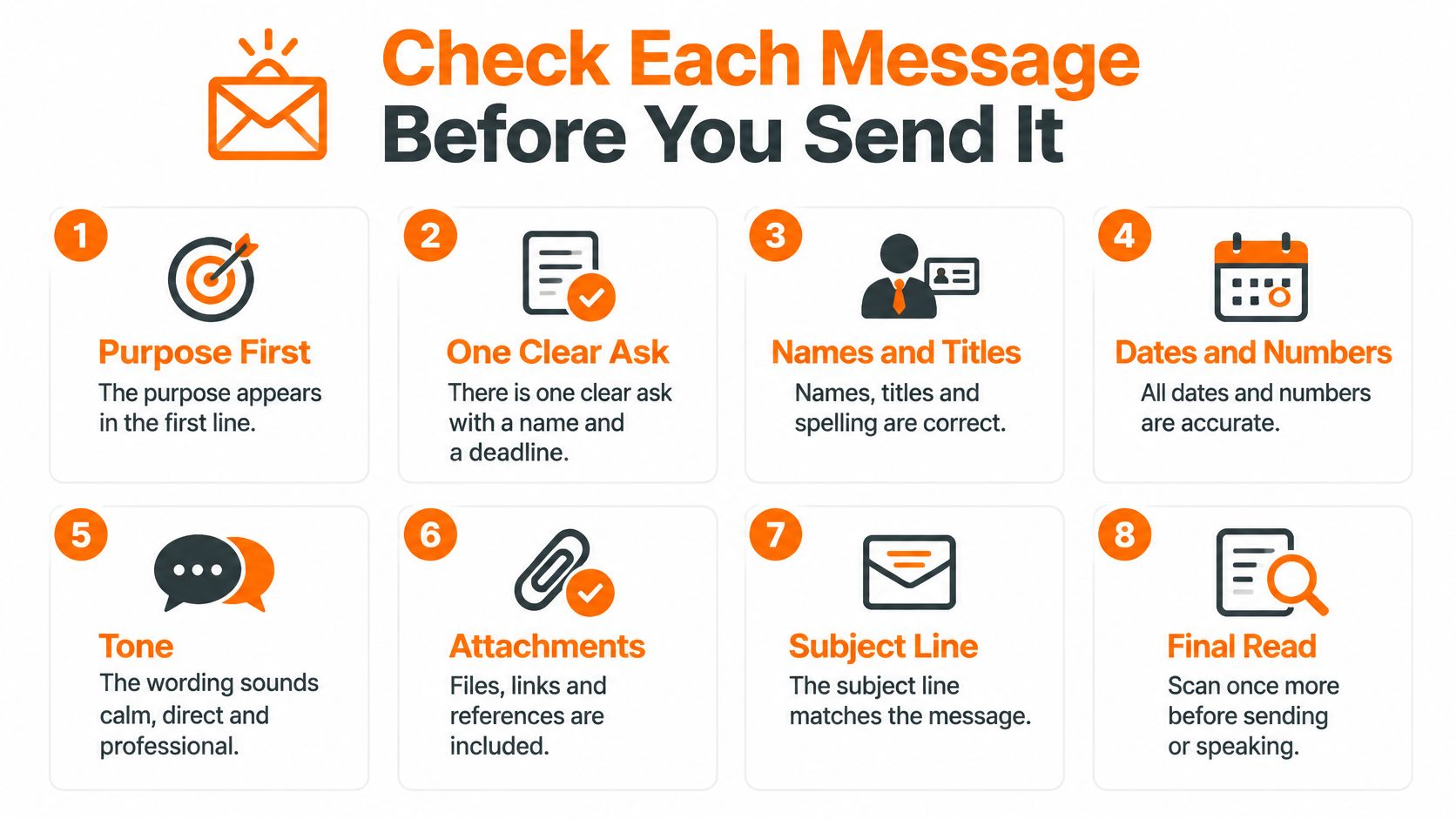
Check Each Message Before You Send It
Knowing how to sound professional matters most at the point of sending. Set aside a brief final pass to catch the details that sentence polishing can miss.
Run a practical final check
- Purpose first. The opening makes clear why you're writing.
- A usable ask. The responsible person and deadline are explicit where needed.
- Accurate details. Names, titles, figures, and attachments have been verified.
- Honest uncertainty. Hedges reflect actual limits rather than habitual self-doubt.
- Focused paragraphs. Each paragraph handles a distinct idea.
- Suitable tone. The wording fits the relationship and situation.
- Understandable terminology. Unfamiliar terms have enough explanation.
- An aloud check. You've heard the wording, not merely skimmed it.
Use the visual checklist when reviewing an email's presentation and sending details.
Add the check your role requires
Students should confirm disclosure requirements before submitting. Multilingual writers can ask a colleague to restate the main point, while content creators should check that headings name the topic and each section serves a distinct purpose.
For sentence-level review habits, use this guide to grammar checking. Check links, recipients, and file versions separately, because correct grammar won't catch a proposal sent to the wrong person.
Choose a template and a speaking drill to practise this week. Apply them to a real message and a real project update, then judge the result by whether another person can respond without asking you to clarify the basics.
Lumi Humanizer helps make AI-assisted drafts sound more natural while preserving their main point and improving clarity, voice, and flow. Before your next email or proposal, visit Lumi Humanizer to refine the draft, then make your own final check of its facts, commitments, and tone.