
You've gathered your case material, but the opening still feels harder to write than the analysis. To write a case study introduction, move from the broader problem to the specific case, explain why it deserves attention, identify the knowledge gap, and finish with a clear question and thesis. Plan that sequence before drafting so background details don't crowd out your purpose.
The Five Parts a Case Study Introduction Needs
A case study introduction does five jobs in a deliberate order. It names the broad issue, identifies the case, explains its significance, establishes what's already known, and ends with a thesis or roadmap.
Each part narrows the previous one. Readers shouldn't have to work out why a hospital, company, classroom, or individual belongs in a discussion of the larger problem.
The University of Southern California's case study guidance offers a useful check through four foundational questions: who or what is being studied, why the topic matters, what was known beforehand, and how the study advances understanding. The five-part sequence below turns those questions into drafting decisions.
Give each part a clear job
Consider a hypothetical hospital scheduling case. The sentences below illustrate structure, not verified findings about hospitals or existing literature. In an actual paper, the background claims, literature gap, and conclusion would need supporting evidence.
The five parts of a case study introduction
| Part | Question it answers | Example opening sentence |
|---|---|---|
| Broad issue | What larger problem does the study belong to? | Many outpatient clinics struggle with long gaps between booking and appointment. |
| The case | Which organization, person or event is studied? | This study examines one regional hospital that moved its appointment booking online. |
| Significance | Why does this case matter beyond itself? | Hospitals that change scheduling systems often report delays they did not expect. |
| Prior knowledge | What is already known, and where is the gap? | Earlier work has focused on large urban systems, leaving smaller hospitals largely unstudied. |
| Roadmap and thesis | What will the study show, and how is it organized? | This paper argues that the delays fell mainly after staff changed booking rules, not after the software changed. |
The significance sentence needs particular care. Don't just call the case important. Explain what readers can learn from examining it, such as the difference between installing software and changing the work people do around it.
Likewise, the prior-knowledge sentence isn't permission to declare a gap without checking. If earlier studies include smaller hospitals, narrow the gap to the process, setting, or explanation they haven't addressed.
Practical rule: Give readers a reason for the case, not just a description of it.
For a compact assignment, check whether all five parts appear within the opening two or three paragraphs. That's a drafting test, not a requirement to give every part its own paragraph. Combine related jobs where the connection is clear, and expand only when readers need more explanation.
How to Open With the Problem and Narrow to the Case
Start with something you can investigate, not a general tribute to the topic's importance. A hospital's reputation or history won't explain what you're studying about its scheduling process.
A case study research framework describes case studies as exploratory or explanatory investigations of real-life phenomena in context, commonly organized around how and why questions. That gives you a practical drafting procedure.
-
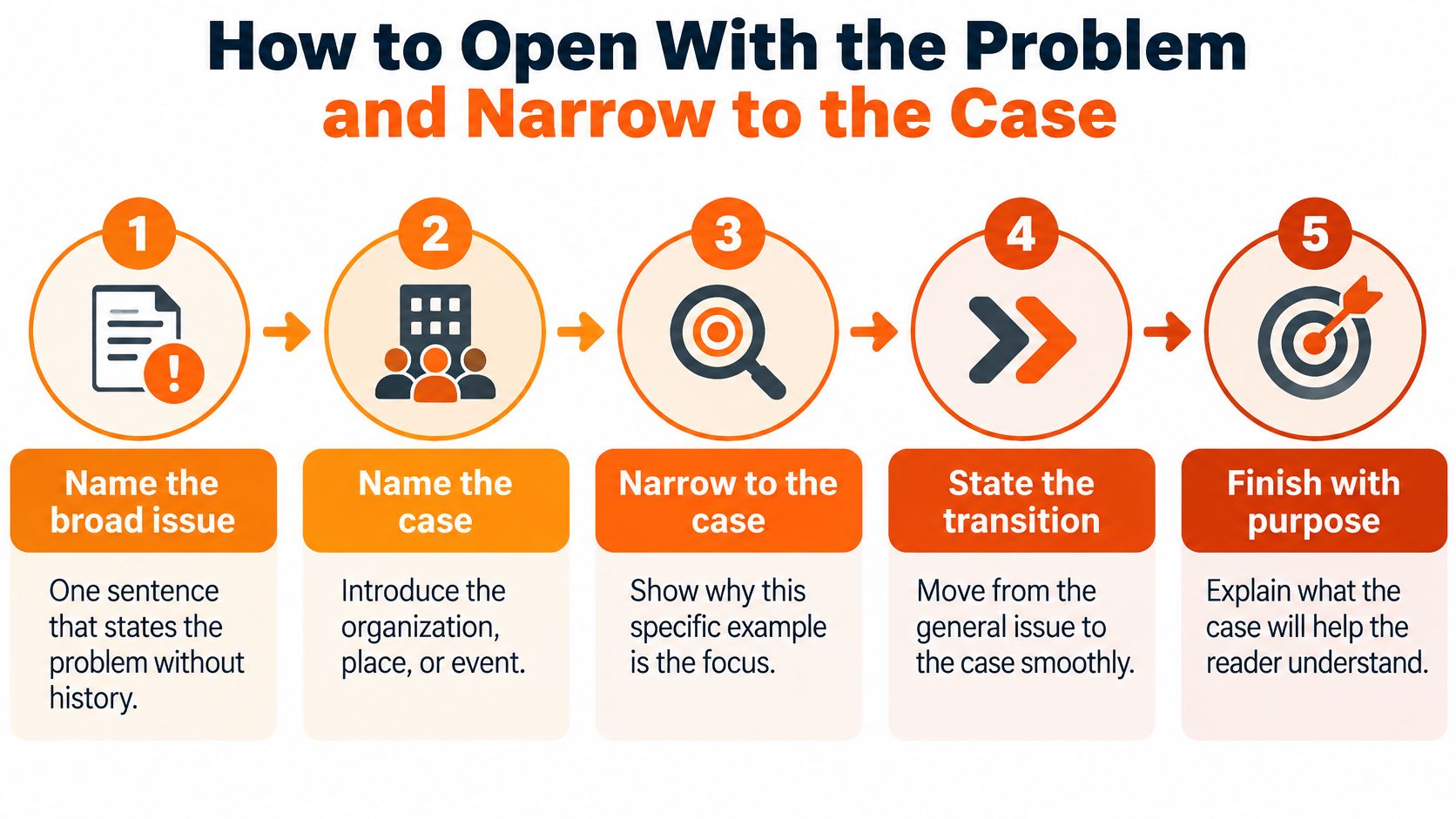
Name the broad issue. State the problem without beginning its entire history. In the hypothetical hospital example, the issue is the delay between booking and receiving an appointment, not healthcare technology generally.
-
Name the case. Introduce the organization, person, event, or setting you'll examine. Keep this identification brief so readers encounter the analytical focus before a catalogue of background facts.
-
Explain the fit. Say why this particular case helps investigate the issue. Perhaps the hospital changed its booking rules separately from its software, allowing you to examine those changes distinctly.
-
Add the knowledge gap. Identify what previous work hasn't adequately explained, using the literature you've reviewed. A useful gap identifies a missing explanation, not merely the absence of a paper about your chosen organization.
-
Finish with a how or why question. Turn the setting into an investigation. Make sure your evidence can address the question rather than merely describe the organization.
Use this process flow to keep the movement from general problem to specific purpose visible.
Replace a topic label with a research question
| Weak opening focus | Stronger opening focus |
|---|---|
| A case study of a hospital | How did the hospital reduce appointment delays after adopting online scheduling? |
The weak version names a setting. The stronger version identifies a setting, a process, and a direction for the analysis. It gives readers something specific to look for in the body.
The common mistake is expanding the case-identification sentence into a full institutional history. Save founding details, departmental changes, and organizational charts for the background section unless they directly explain the question.
For a professional audience, the distinction between investigating a problem and proposing action also matters. Guidance on business proposal writing can help you keep a recommendation document separate from an evidence-led case study.
After reading the opening, someone unfamiliar with your project should be able to name the problem, case, and question without asking you to explain them aloud.
Keeping Context Short and Length in Proportion
Allocate about 10% of the assignment to the introduction as a planning benchmark, following Sheffield Hallam University's case study guidance. Its recommended content is straightforward: summarize the case, identify the issue, and outline the assignment's organization.
Introduction length by assignment length
| Assignment length | Introduction length (about 10%) | Context to keep short |
|---|---|---|
| 1,500 words | About 150 words | Two or three sentences describing the case |
| 2,000 words | About 200 words | One short paragraph on the case setting |
| 3,000 words | About 300 words | A brief case description, with detailed facts moved to later sections |
These targets help you make decisions before drafting. Reserve space for the question and thesis first, then decide which contextual details readers need to understand them.
Budget for purpose before background
Say you're studying a company's order-processing problems. An opening that lists its founding year, revenue, staff count, and market history may be accurate but still leave the investigation unclear.
A more useful opening identifies the company's role, the process under examination, and the operational problem. Add its size or history only if those details help explain that problem.
Context belongs in the introduction when removing it would make the question harder to understand.
A complex or contested topic may need extra explanation. Treat the length target as a benchmark rather than a rigid ceiling, and follow your assignment's requirements where they differ.
Count the draft's words, then mark which sentences establish context and which establish purpose. If background dominates, move supporting facts into the body rather than compressing everything into denser prose.
Choose a direct academic register rather than an elaborate one. Comparing different writing styles can help you recognize when formal language has become unnecessarily complicated.
Writing a Thesis That Avoids Common Failures
Your thesis should state what the case helps you understand, not merely announce that you'll discuss it. For a completed study, that means naming the finding or contribution your evidence can support.
Keep the draft, question, and evidence notes visible while you revise.

The case study methodology guidance published through SAGE supports a sequence that states the research question, defines the setting and unit of analysis, justifies case selection, previews the evidence and approach, and identifies the contribution. Include enough methodological information to make the investigation credible, but leave procedural detail for the methods section.
Your unit of analysis is what you're examining. A hospital may be the setting while its appointment-booking process is the unit of analysis. Naming that distinction prevents a narrow investigation from sounding like an assessment of the entire institution.
Match the claim to the evidence
A descriptive purpose might read: This study describes how the clinic introduced online booking. An explanatory purpose goes further: This study explains why delays fell after staff changed the booking rules.
The second statement requires evidence about the explanation, not just evidence that events occurred in sequence. Don't use a stronger verb because it sounds more academic.
For the hypothetical hospital case, a complete opening could read as follows. Its literature claims and findings are illustrative and would require verification before use.
Many outpatient clinics wait weeks between booking and appointment, and smaller hospitals are rarely studied. This paper examines one regional hospital that moved booking online, a case chosen because its delays followed a change in scheduling rules. It asks how the hospital reduced delays after adopting online booking and argues that staff rule changes, not the software, drove the improvement. Interviews, appointment logs and internal memos support the analysis, though a single site cannot show whether the result holds for larger systems.
Notice that the evidence sentence names relevant materials without listing interview totals, collection procedures, or coding decisions. To make the approach clearer, you could add that the analysis compares staff accounts with the documented sequence of scheduling changes.
Use this video as an additional drafting resource.
Diagnose the sentence that isn't working
Introduction symptoms, causes and fixes
| Symptom | Likely cause | Fix |
|---|---|---|
| Opens with a broad history of the topic | Background written first and never narrowed | Reach the case within two sentences |
| Research question appears near the end | Question held back for effect | State it in the first paragraph |
| Case described as representative | No reason given for selection | Explain why this case fits and what it cannot show |
| Reads like a methods section | Procedure detail added too early | Keep one sentence on data and move the rest to methods |
| Conclusion promised before analysis | Claim overstates a single or small sample | Write an explanatory claim only where supported, and state its limits |
| Case described without a problem | Setting named but no question given | Turn the case into a how or why question |
Choose verbs carefully when revising. A guide to essay-writing vocabulary can help with phrasing, but substituting demonstrates for examines changes the promise you're making.
Before accepting the thesis, state plainly what the case shows and what it cannot show. If you can't make that distinction, the claim still needs narrowing.
Questions Writers Ask About Introductions
Should I write the introduction first or last?
Draft it early to establish direction, then revise it after completing the analysis. For example, you may begin by investigating software adoption but discover that staff decisions deserve the emphasis in your final thesis.
Don't preserve an early promise that the completed paper no longer fulfills. Your introduction should describe the study you wrote.
Does the introduction need a literature review?
It needs a concise account of relevant prior knowledge, not the full literature review. For example, identify an unresolved question about scheduling decisions rather than summarizing every article on digital healthcare.
Explain enough for readers to recognize the gap. Leave comparisons among theories, methods, and individual studies for the literature review.
What if the case was assigned?
Explain why the assigned case suits the research question rather than pretending you selected it. For example, write that the hospital's documented scheduling changes allow examination of implementation decisions.
That explains analytical relevance without inventing a selection process. You can still acknowledge limitations in the material available.
Can I use first person?
Yes, where your discipline, supervisor, or assignment permits it. Use it for your own research decisions, such as I compare staff accounts with appointment records, rather than unsupported personal opinion.
Keep references to yourself and the paper consistent. If the opening becomes difficult to organize, return to the sequence of issue, case, significance, prior knowledge, and thesis.
Check the Introduction Before You Draft the Body
Learning how to write a case study introduction is partly learning when to stop adding background. Your opening is ready when readers understand the investigation and your body can deliver what it promises.
Run this final check against the actual draft:
- Read aloud. Can a reader identify the problem, case, significance, gap, question, selection rationale, and contribution after a single reading?
- Remove repetition. Cut sentences that merely restate the title without adding analytical direction.
- Check proportion. Compare the opening with your planned word budget and move supporting detail into the appropriate body section.
- Verify manually. Match factual claims to sources, check that the thesis reflects the evidence, and treat detector results as one editing signal, not a final verdict.
- Review clarity. Untangle long sentences, identify vague pronouns, and confirm that your revisions haven't changed the claim.
If you need a reusable planning sheet, TheContentMap's brief templates for stronger first drafts offer a resource for organizing drafting requirements before you write.
Revise until the opening passes these checks. Then begin the body with the section your roadmap has prepared readers to expect.
Lumi Humanizer helps make AI-assisted text sound more natural, with custom writing styles based on your own examples. Visit Lumi Humanizer to refine an awkward introduction after you've checked its structure and evidence, then review the rewrite to ensure it preserves your meaning.