You've highlighted your sources, opened a blank document, and realized you don't know how to turn those notes into an argument. To write a synthesis essay, organize sources around a shared question, explain how their evidence relates, and use those relationships to support your own conclusion. The difficult part isn't finding another quotation. It's making the reasoning between quotations visible.
What Makes a Synthesis Essay Different
A synthesis essay combines sources to reach a conclusion; a source summary reports what each text says separately. Your job is to explain what readers can understand by considering the sources together.
Purdue University's writing guidance distinguishes explanatory synthesis, which brings sources together to explain a perspective, from argumentative synthesis, which uses relationships among sources to support a claim. Both require interpretation, not just accurate reporting.
Synthesis forms compared with a source summary
| Form | What it does | Thesis looks like | Typical prompt |
|---|---|---|---|
| Explanatory synthesis | Brings sources together to explain a perspective | Explains how sources shape one view | Explain how a policy is debated |
| Argumentative synthesis | Uses relationships among sources to support a claim | Takes a position the sources jointly support | Argue whether a policy should change |
| Source summary (not synthesis) | Reports each source in turn | No conclusion across sources | Does not meet a synthesis brief |
Say your assignment concerns public libraries. An explanatory thesis might identify a tension between expanding digital access and maintaining physical community spaces. An argumentative thesis might recommend expanding digital services while protecting in-person support.
Neither thesis should merely announce that the sources discuss libraries. It should tell readers what you've concluded about the issue.
Quick test: If each body paragraph describes a different source and never connects it to another, you've probably written a sequence of summaries.
You don't need to squeeze every source into every paragraph. You do need to organize the essay around ideas, acknowledge evidence that challenges your interpretation, and avoid manufacturing agreement.
Choose the form by reading the prompt's main verb. A request to explain a debate points toward explanatory synthesis; a request to argue whether something should change points toward argumentative synthesis. If the wording is ambiguous, clarify the assignment before choosing a position.
Five Steps From Sources to Thesis
Start with the question, not an introduction you'll have to rewrite. A source-to-claim workflow lets you discover a defensible position before committing to it.
-
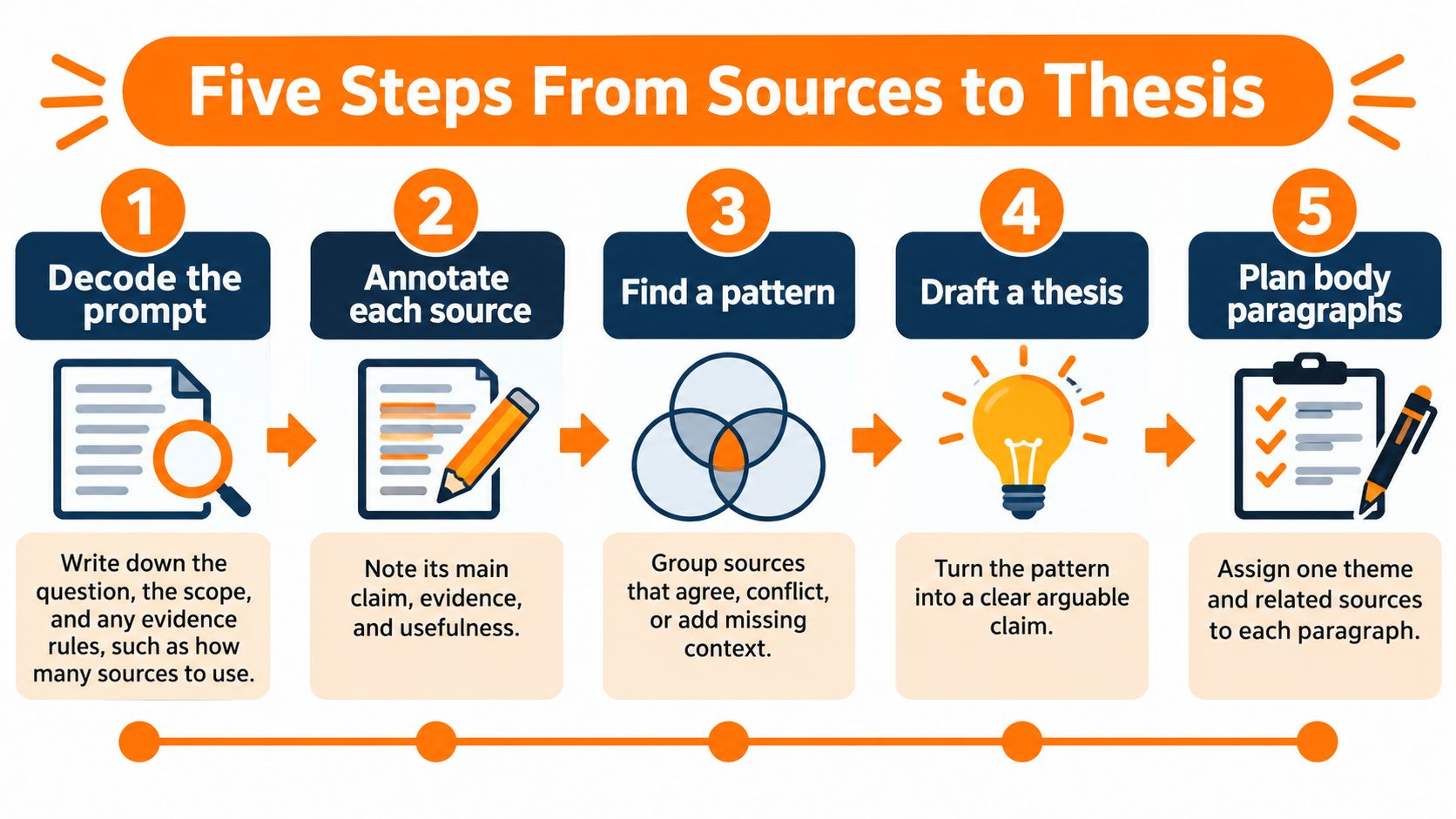
Decode the prompt. Write down the question, its scope, and its evidence rules, because a persuasive essay can still miss the assignment. Distinguish a question about whether libraries should expand digital services from one about how they should fund that expansion.
-
Annotate each source. Record its main claim, assumptions, evidence, and possible contradictions, adding a page number or other locator beside each note so you can verify it later. Keep your reactions separate from the author's statements.
-
Build a synthesis matrix. Put sources across the columns and recurring themes down the rows, because this makes overlapping evidence easier to spot. For the library example, possible rows include access, community programs, staff support, and funding.
-
Identify a defensible relationship. Look for convergence, qualification, or disagreement rather than collecting passages that happen to mention the same topic. If a source addresses a different population or question, record that limit instead of forcing it into your preferred argument.
-
Draft the thesis. State the conclusion that the combined evidence supports, including any condition that materially changes it. Then assign each planned body paragraph a theme and the sources needed to develop that theme.
The visual below condenses that process into a planning sequence.
Turn your matrix into a working claim
A matrix cell shouldn't contain a copied paragraph. Write a concise note such as supports equipment access but doesn't address training, then add the location of the supporting passage.
If you need help setting up the document, this guide to building a literature review matrix offers a useful organizational model. For a synthesis essay, keep the matrix focused on the assignment's question rather than trying to map an entire field.
Explicit connections are a skill worth practicing: a replication and extension study described in UNLV's synthesis-essay resource found that 61.5% of students made several explicit connections after instruction, compared with 36.5% in the earlier study, an absolute improvement of 25 percentage points. That comparison isn't a promised result for your essay; it highlights the specific behavior to practice.
For practice questions that test your understanding, you can explore ChatGPT prompts for studying from AccountShare. Use prompts to ask yourself about assumptions or alternative interpretations, then check every answer against the original material and follow your course's assistance policy.
Before drafting, finish this sentence: These sources relate because one strengthens, limits, or challenges the other's claim about ______.
If you can't complete it precisely, return to your notes. You may need a narrower question, a different pairing of sources, or a less absolute thesis.
Write Paragraphs That Reason Across Sources
Build each body paragraph around a theme, then explain how the sources relate to that theme and your thesis. Putting citations next to each other isn't enough.
Consider this hypothetical paragraph about public libraries.
Weak version: Source A says libraries lend laptops. Source B says community programs draw members. Source C reports rising internet use. Libraries should therefore expand digital services.
The conclusion arrives without an explanation. Community programs might matter, but the paragraph hasn't shown how they support digital expansion. Rising internet use also doesn't establish what library users need.
Keep your notes and original texts available while you work through those connections.

Build the stronger version
Suppose your hypothetical source packet also contains an access report and a neighborhood survey. A stronger paragraph could read:
Stronger version: Libraries should treat digital expansion as a supported service, not simply an equipment purchase. Source A's access report identifies a need for borrowed devices, while Source D's neighborhood survey describes uneven use of existing online resources. The survey qualifies the access report's implications: making equipment available doesn't establish that residents can use it effectively. Together, these findings support expanding device access alongside targeted instruction rather than measuring success by equipment availability alone.
Notice the difference. The stronger paragraph doesn't just include more detail. It makes the relationship between the evidence explicit and derives a recommendation from it.
The University of Nevada, Reno's synthesis guidance emphasizes tracing relationships among sources, including agreement, disagreement, and qualified agreement. Apply that principle through this paragraph sequence:
- Topic claim: State the reason this paragraph contributes to your thesis.
- Evidence: Select relevant material from sources that can meaningfully interact.
- Comparison or contrast: Explain exactly where their claims or evidence connect.
- Commentary: State what you infer from that relationship and why it matters.
Audit the stronger paragraph sentence by sentence. The opening is the claim; the next sentence provides evidence; the following sentence supplies comparison; the final sentence offers commentary. These labels are diagnostic tools, not a requirement that every paragraph have identical sentence counts.
For language that accurately signals those relationships, consult this essay-writing vocabulary guide. Choose qualifies when evidence limits a claim, not disproves unless it overturns it.
Use the accompanying video as another opportunity to examine how an essay connects evidence and reasoning.
Handle disagreement without inventing consensus
Don't immediately choose a winner when sources conflict. LSU's synthesis guidance recommends recording contradictions as well as repeated ideas and developing a question that accounts for both.
What to compare when sources conflict
| Difference to check | Question to ask | Example |
|---|---|---|
| Scope | Do both sources cover the same population or region? | One study covers urban schools, the other rural ones |
| Time frame | Do the findings cover the same period? | Short-term results against long-term results |
| Definition | Do both define the key term the same way? | Digital literacy as tool skills versus critical evaluation |
| Evidence type | Is one a survey, a case study, or a theory? | Survey data against an expert's interpretation |
| Assumptions | What does each author take for granted? | A claim that assumes funding stays constant |
Suppose one commentator defines digital literacy as operating software, while another defines it as evaluating information critically. Their recommendations may differ because they're addressing different skills.
A conditional thesis could argue that libraries should provide basic technical instruction for operational needs and evaluation-focused instruction for information-literacy needs. That preserves the distinction instead of pretending the commentators agree.
To check whether you're synthesizing rather than stacking summaries, try these diagnostics:
- Remove a source: Does the paragraph's reasoning change?
- Name the relationship: Can you accurately use complicates, qualifies, corroborates, or challenges?
- Locate your inference: Does the ending explain something neither source establishes alone?
For additional practice separating claims from assumptions, explore reasoning exercises for secondary learners from Keybaki. A paraphrase tool can help with wording, but the comparison and commentary must remain your intellectual work.
Address challenging evidence directly: although device access may improve availability, uneven use means availability alone isn't sufficient evidence of effective service.
Revise in Three Passes Before You Submit
Revise the argument before polishing its sentences. A fluent paragraph still needs rebuilding if its evidence doesn't support its claim.
Research on undergraduate ESL writers discussed in this University of Hawaiʻi repository paper found that higher-scoring writers were more likely to locate important information and integrate it, while copying and overreliance on source passages reduced performance. That makes evidence selection and integration better starting points than surface editing.
| Revision pass | What to check | What to fix |
|---|---|---|
| Evidence selection | Each source's authority, relevance, accuracy, and limitation | Remove irrelevant material; verify notes against originals |
| Integration | Whether evidence receives interpretation and interacts with other evidence | Replace quotation clusters with concise evidence and analysis |
| Argument architecture | Thesis, thematic paragraph order, counterevidence, and implications | Reorder, narrow, or rebuild claims that the evidence doesn't sustain |
Check and repair the argument
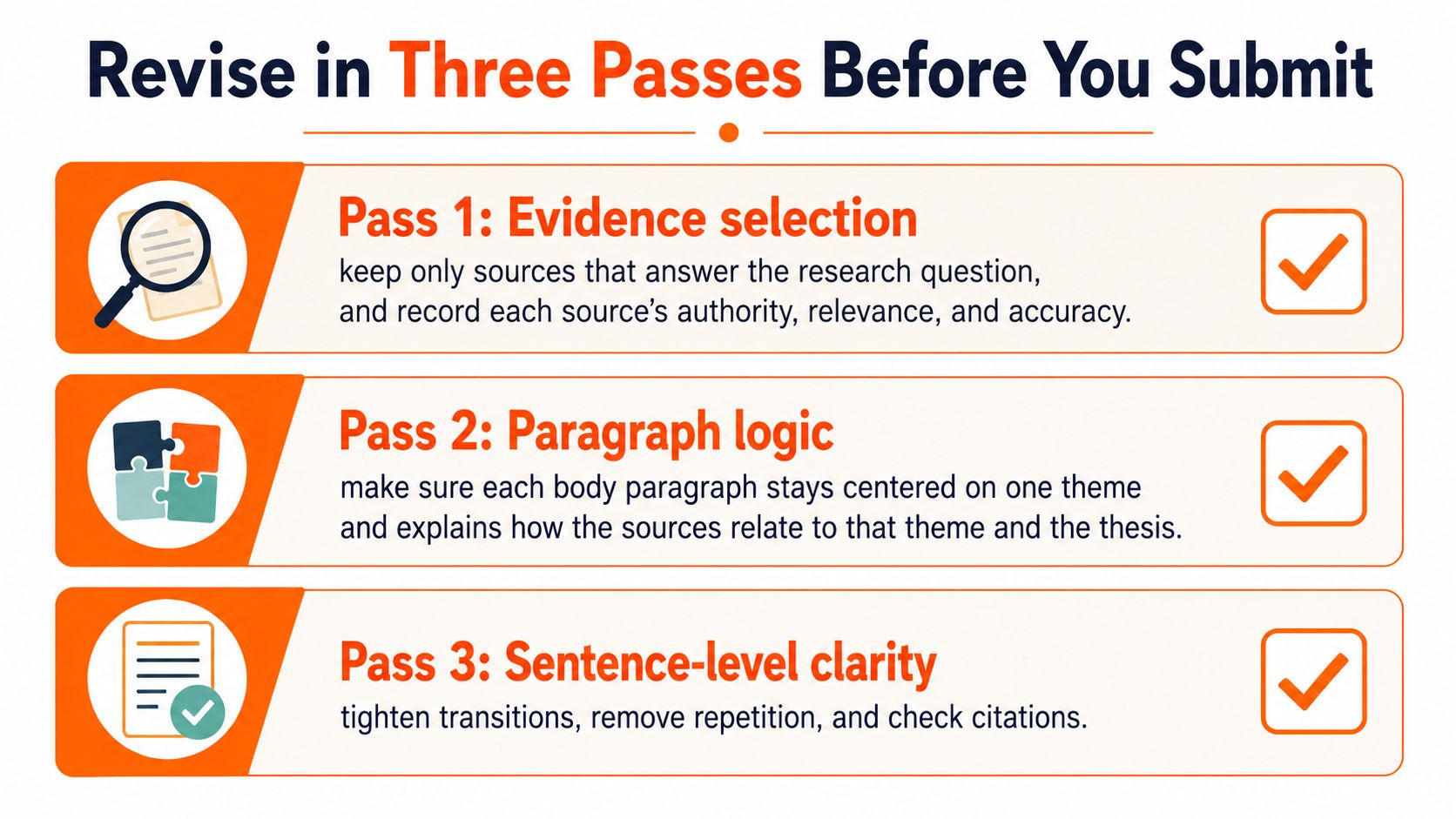
During the evidence pass, ask whether each passage answers the research question. A credible source can still be irrelevant to your particular claim, and an appealing quotation may contribute nothing.
During the integration pass, examine what happens after each quotation or paraphrase. Explain what the evidence means, why it matters, and how it changes the interpretation of another source.
During the architecture pass, read only the thesis and topic sentences. They should form a coherent argument rather than a list of authors; use this guide to writing an essay conclusion if your ending repeats the introduction instead of drawing an implication.
Keep the revision checklist beside your draft.
Watch particularly for source-by-source organization, unsupported personal opinion, equal-length summaries of every text, and ignored contradictions. Equal coverage isn't the goal; relevant, fairly represented evidence is.
Once the argument holds together, make the final clarity edit. Tighten transitions, remove repetition, check citations, and correct grammar and spelling. Editing sentences earlier can mean polishing material you later delete.
Common Questions About Synthesis Essays
How many sources does a synthesis essay need?
Follow your assignment's requirements. For AP English Language synthesis, the College Board's official scoring guidance requires evidence from at least three provided sources, clear source identification, and an explanation of how the evidence supports the reasoning.
Can I include my own opinion?
Yes, your thesis and commentary express your judgment, but they need evidential support. For example, a recommendation to fund library training should follow from evidence about users' needs, not just your preference for technology.
How is a synthesis essay different from a literature review?
A literature review typically maps scholarship, debates, and gaps across a field. A synthesis essay develops a focused conclusion from selected sources, although an explanatory assignment may clarify a debate rather than advocate a policy.
Can a chart or table count as a source?
Yes, when the assignment permits it; AP course-development guidance explicitly includes alternatives to written text, such as charts, graphs, and tables. In a hypothetical library packet, a graph of declining visits could be connected to a written account of changing user habits, provided you describe it accurately and document it.
Confirm Your Thesis Before You Submit
Submit only when your thesis still holds after you've considered the evidence that complicates it. Knowing how to write a synthesis essay means knowing when to revise your conclusion, not just when to add another supporting quotation.
Make the final decision
Try stating the thesis in a sentence that identifies the relationship among the sources. Then ask whether every body paragraph contributes a distinct reason for accepting it.
If the answer is no, return to your matrix and rebuild the claim. Don't patch an unsupported thesis with stronger-sounding wording.
- Check attribution: Match citations to the required reference list or bibliography, and verify quotations against the originals.
- Check interpretation: Make sure borrowed evidence receives commentary rather than being left to explain itself.
- Check assistance: Independently verify suggestions and disclose relevant assistance when your institution requires it.
Review the draft manually. If you use an AI detector, treat its results as an editing signal, not a final verdict; results vary by draft quality, detector version, and how much editing the text needs.
Once the reasoning and citations are settled, use an originality review to flag wording that deserves a closer attribution check. The sources, the reasoning, and the final choice remain your responsibility.
Lumi Humanizer helps make AI-assisted text sound more natural by improving clarity, voice, and flow while preserving its main point. If your course permits this kind of assistance, visit Lumi Humanizer after you've settled the argument, then compare the revision with your sources to ensure every claim and qualification remains accurate.