You're rereading a paragraph, and every sentence seems to march along at the same pace. To learn how to vary sentence structure, start with the relationship between ideas: join equal points, subordinate supporting details, and give important claims room to stand alone. Change the structure when it helps readers understand, not because sentences look alike.
The Four Sentence Types and When Each Fits
A flat paragraph can contain perfectly correct sentences. The problem is often that the writer gives every detail the same grammatical weight, leaving readers to work out which points belong together.
Start by identifying clauses, not counting words. An independent clause expresses a complete thought and can stand alone; a dependent clause contains a subject and verb but cannot stand alone. Purdue OWL's guide to sentence types classifies sentences by these clause patterns.
The four sentence types by clause count
| Type | Clause pattern | Example | Best use |
|---|---|---|---|
| Simple | One independent clause, no dependent clause | The team shipped the update. | Core claims and clear emphasis |
| Compound | Two or more independent clauses, no dependent clauses | The sample was small, but the results were consistent. | Joining two ideas of equal weight |
| Complex | One independent clause plus at least one dependent clause | Because the sample was small, the results are tentative. | Showing cause, condition or contrast |
| Compound-complex | Two or more independent clauses plus at least one dependent clause | Because the sample was small, the team reran the test, and the results held. | Developing a paragraph with several linked ideas |
Test the clauses before naming the sentence
In because the sample was small, you can identify a subject and verb, but you're still waiting for the main point. Remove because, and the sample was small becomes a complete thought.
Don't confuse grammatical complexity with length. A simple sentence can include descriptive phrases and several objects without containing another clause.
Watch the paragraph change
Before, using only simple sentences
The team tested the update. The sample was small. The results were consistent. The team repeated the test. The results held. The team approved the release.
After, using all four types
The team tested the update. The sample was small, but the results were consistent. Because the sample was small, the team repeated the test. When the results held, the team approved the release, and preparations began.
The revision introduces an illustrative final action, preparations beginning, to demonstrate the compound-complex pattern. In an actual edit, you'd include that action only if the original information supported it.
Notice the difference between The sample was small, but the results were consistent and Although the sample was small, the results were consistent. Both acknowledge a limitation, but the second places the results in the main clause.
Use a simple sentence for a core claim, a complex sentence for a meaningful condition or qualification, and a compound-complex sentence only when several linked ideas belong together.
How to Revise a Paragraph in Five Passes
A useful revision begins with meaning, not cosmetic changes. Before moving words around, identify what each sentence contributes and what information must survive.
The Claremont Graduate University cohesion handout explains how familiar information and new information connect across sentences. That connection matters more than making every opening different.
-
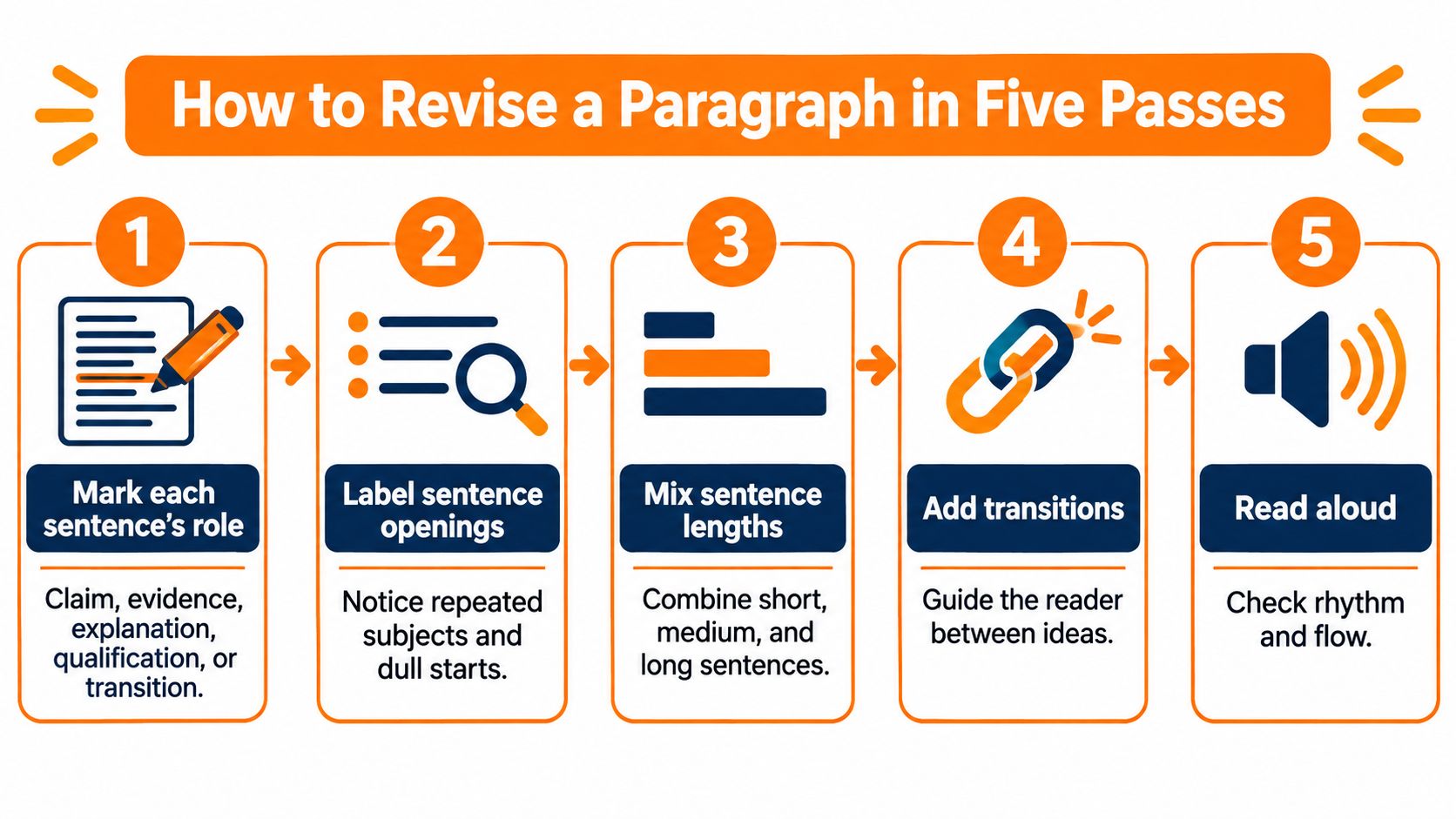
Mark each sentence's role. Label it claim, evidence, explanation, qualification, or transition. A central claim usually needs a prominent position, while a qualification may fit inside a supporting clause.
-
Label the structure. Use S for simple, C for compound, CX for complex, and CC for compound-complex. This makes repeated patterns easier to notice without relying on a vague feeling that the paragraph sounds dull.
-
Inspect repeated labels. When you find a run of three identical labels, try revising the middle sentence by joining related ideas or subordinating a minor point. Treat this as a diagnostic exercise, not a rule that overrides purposeful repetition.
-
Compare adjacent openings. If neighboring sentences repeat the same subject and verb, consider moving useful context forward. Keep established information near the beginning and place the new contribution where readers can recognize its importance.
-
Read aloud and check the links. Listen for awkward pauses, delayed subjects, and unnecessary complexity. Remove a connector such as therefore if the following statement isn't a conclusion.
Use this visual reminder while working through a draft.
Follow the changes through a survey paragraph
Before, S, S, S, S
The survey revealed a scheduling problem. Respondents preferred evening sessions despite their childcare concerns. The team proposed a later start with the room booking unchanged. The revised timetable remained provisional pending instructor approval.
After, S, CX, C, CX
The survey revealed a scheduling problem. Although respondents had childcare concerns, they preferred evening sessions. The team proposed a later start, but the room booking remained unchanged. Until the instructors approved it, the revised timetable remained provisional.
The revision preserves the survey's central finding and its qualifications. It also makes contrast and dependency explicit rather than leaving those relationships inside compressed phrases.
For a broader editing routine, use this guide to rewriting a paragraph for clarity. A finished paragraph should have a visible main claim, connected supporting information, and a rhythm that doesn't distract from either.
Vary Openings Without Losing the Subject
She wrote her paper at the computer becomes At the computer, she wrote her paper. The action hasn't changed, but the reader encounters the location first.
Rearranging sentence parts can help you see that difference in emphasis.
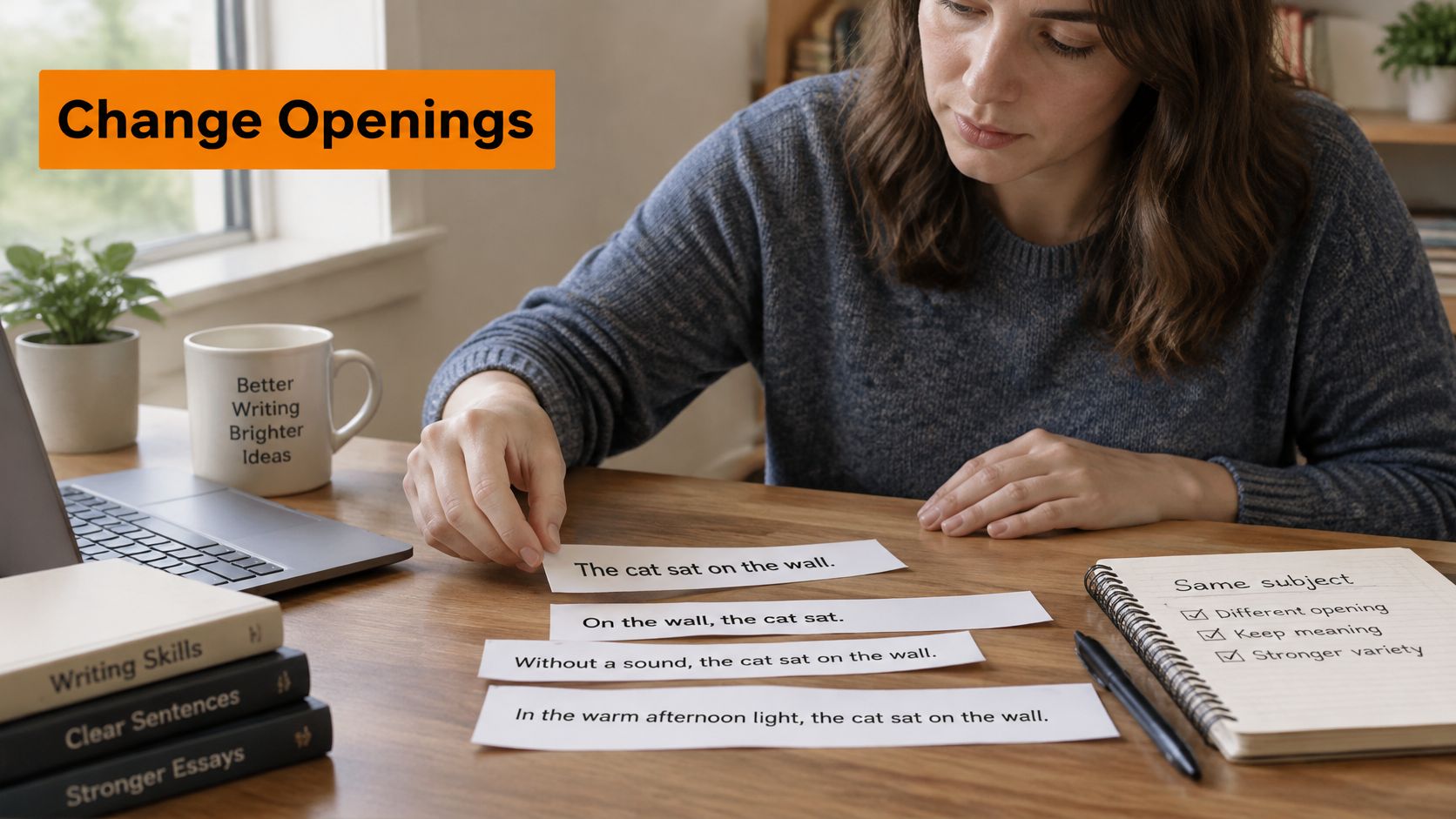
The Spelman College sentence-variety handout illustrates this technique with introductory phrases and dependent clauses. Its example I whistled a jaunty tune while I was waiting at the Writing Center becomes While I was waiting at the Writing Center, I whistled a jaunty tune.
Move context forward for a reason
Consider a student describing a revision session.
Before
Maya reviewed the comments at her desk. Maya compared the introductions after she finished reviewing the comments. Maya then rewrote the opening.
After
At her desk, Maya reviewed the comments. After she finished reviewing them, she compared the introductions. Then she rewrote the opening.
The prepositional phrase establishes location, the dependent clause marks timing, and then carries the sequence forward. The revised version makes the order easier to track without adding an explanation or changing what Maya did.
Practical rule: Move context to the front only when readers benefit from meeting it before the action.
Keep the actor easy to find
An opening phrase shouldn't leave readers searching for its subject. In Reviewing the comments, the introduction seemed weak, the introduction appears to be reviewing the comments; While Maya reviewed the comments, she noticed a weak introduction names the actor.
Don't replace repeated subject-first openings with repeated transitions. A paragraph beginning every sentence with however, moreover, or therefore has acquired another predictable pattern.
For another demonstration of sentence variety, watch the following video.
A quick paraphrasing pass can suggest alternative wording, but compare every suggestion with the original. A more elaborate opening isn't automatically a clearer one.
Choose Coordination or Subordination for Emphasis
Compare these versions of the same situation:
The deadline was close, so the team shortened the report.
Because the deadline was close, the team shortened the report.
Which idea deserves the reader's attention: the linked circumstances, or the team's decision? The answer determines the better structure.
Purdue's sentence-structure activity explains that coordination gives independent clauses roughly equal weight, while subordination makes one idea grammatically secondary. The first version presents deadline and action as balanced information; the second presents the deadline as the reason for the main action.
Let importance determine grammar
Use coordination when readers should consider both statements together. Use subordination when one statement supplies the background, exception, condition, or reason for another.
Changing the connector can change the argument. Compare Because the budget was limited, the team tested the prototype with Although the budget was limited, the team tested the prototype: the first makes the budget a reason, while the second presents it as an obstacle.
- Cause: Use because when one fact explains another.
- Condition: Use if when an action depends on something happening.
- Concession: Use although when the main point holds despite a limitation.
For additive relationships, this explanation of a compound sentence with and can help you distinguish linked clauses from a shared list of actions.
Match punctuation to the structure
According to Purdue OWL's sentence punctuation patterns, an introductory dependent clause takes a comma before the independent clause.
Although the data were limited, the study produced useful results.
When joining independent clauses, use a comma with a coordinating conjunction such as and, but, or so. A semicolon can also connect closely related independent clauses.
Comma splice
The sample was small, the results were consistent.
Corrected compound sentence
The sample was small, but the results were consistent.
A grammar check can flag the punctuation problem, but it can't decide whether you intend contrast, cause, or addition. Choose the relationship first, then make the punctuation support it.
Fix Choppy, Forced or Muddled Sentences
The instructions were brief. The steps were unclear. The participants asked questions. Each sentence is complete, yet the paragraph reads like disconnected notes.
The issue isn't that short sentences are wrong. The writer hasn't shown how the observations relate, so readers must supply the connection themselves.
Variation problems, causes and fixes
| Symptom | Likely cause | Fix |
|---|---|---|
| Short sentences read as choppy fragments | Each idea is treated as its own sentence | Join related ideas with a conjunction or subordinate the minor one |
| Every sentence opens with the subject | Default habit with no variation tool | Front-load a phrase or dependent clause where the context leads |
| Inversions or fragments feel forced | Variation added for style, not meaning | Restore conventional order and let the main claim set the structure |
| The reader cannot see how sentences relate | Connectors or pronouns no longer match the logic | Rework the link so the conjunction states the real relation |
| Three parallel points read as a monotone | Parallel ideas were varied for no reason | Keep the shared structure, since parallel form reinforces the comparison |
If the scenario supports causation, revise the opening example to Because the instructions didn't explain the steps clearly, participants asked questions. If it doesn't, don't invent that causal connection just to combine sentences.
Keep repetition when it helps comparison
Consider these parallel points:
The method reduces setup time. The method reduces material waste. The method reduces training demands.
The repeated opening helps readers compare the benefits. You might combine them into a list, but there's no need to force an inversion or fragment merely to avoid repetition.
Purdue OWL's sentence-variety guidance recommends choosing structures around relationships and splitting overly complicated sentences when that improves understanding. A long sentence containing a limitation, an explanation, and a recommendation may work better when the recommendation begins its own sentence.
Stop varying a sentence when the reader has to pause to reconstruct what you mean.
This kind of structural editing differs from paraphrasing for a new tone. You're deciding how to organize existing meaning, not replacing the argument or making every line sound different.
Check Your Revision Before You Submit
A smoother paragraph can still be less accurate than its original. Compare the versions line by line before you accept the rewrite, especially when editing academic findings or business recommendations.
Use this meaning check alongside a grammar-checking review, rather than treating grammatical correctness as proof that the revision says the right thing.
- Preserve the boundaries. Confirm that every claim, number, date, and qualifier survived. Losing usually, may, or in this sample can turn a limited observation into a broad assertion.
- Audit the connectors. Replace therefore if the next sentence merely adds detail. Use also only when addition is the intended relationship, or remove the transition altogether.
- Reject unsupported additions. Check that a cleaner sentence hasn't introduced certainty, causation, or a conclusion the original never established.
Use automated changes as proposals
Our AI Humanizer rewrites AI text to reduce patterns AI detectors tend to catch, changing rhythm, phrasing, and sentence variety rather than only swapping synonyms. It's designed to preserve the main point while improving clarity, voice, and flow.
Results vary by draft quality, detector version, and how much editing the text needs. Output quality is highest for English content, so review meaning carefully rather than accepting every change automatically.
Understanding how to vary sentence structure gives you a basis for that review. Keep changes that clarify your intended emphasis, and reject changes that merely make the draft look more complicated.
Frequently Asked Questions
How much sentence variation is enough?
There's no universal target. Look for passages where repeated shapes obscure emphasis or make connected ideas feel separate, rather than trying to reach a particular mix.
A paragraph can work well with similar sentence lengths if its ideas progress clearly. Judge the reader's experience, not the appearance of a sentence-length chart.
Should every paragraph mix all four sentence types?
No. A short explanation may need only simple and complex sentences, while a comparison may benefit from repeated compound structures.
Choose the form that expresses the relationship accurately. Forcing a compound-complex sentence into a straightforward paragraph can bury the point instead of developing it.
Will varied sentences stop AI detectors from flagging my text?
No tool can promise that. Detectors may assess word choice, punctuation, and sentence construction, but their results are estimates rather than proof of authorship.
Vary sentences to improve readability, not to chase a guaranteed classification. If you're writing for a course, journal, or client, follow its rules for AI assistance and keep records of your drafting process where appropriate.
Lumi Humanizer offers AI-assisted rewriting focused on clearer phrasing, more natural rhythm, and sentence variety while preserving your main point. Visit Lumi Humanizer to revise a paragraph, then compare the result with your original and keep only the changes that make your meaning easier to follow.