You've reread your draft, smoothed the sentences, and still can't explain why it feels unfinished. Learning how to use a reverse outline gives you a practical next step: summarize each paragraph, label its job, and check whether the sequence supports your main claim. Fix the structure before you spend more time polishing sentences.
What a Reverse Outline Shows That Your Draft Hides
A reverse outline is a map created from an existing draft, with an entry for each paragraph showing what it contributes to the central claim. A planning outline records what you intend to write; a reverse outline records what you wrote.
Say you've finished a nine-page policy essay recommending remote work. On a quick skim, it seems balanced: you introduce the issue, discuss productivity, include examples, and end with a recommendation.
Then you map it. Four paragraphs make the same point about improved focus, while none addresses the coordination costs for managers or teams. These are hypothetical details, but they illustrate the difference between a draft that sounds complete and an argument that earns its conclusion.
Separate the subject from the contribution
The useful question isn't just what a paragraph discusses. It's what the paragraph does for the argument.
Purdue OWL's reverse-outlining guide recommends recording the paragraph's topic alongside how it advances the overall argument. If you can't summarize either briefly, treat that difficulty as a revision signal.
For the remote-work essay, a topic note might say fewer interruptions. Its function might be presenting evidence for individual productivity. That distinction helps you notice that individual productivity doesn't, by itself, establish a team-wide benefit.
Practical rule: Describe the paragraph you have, not the paragraph you meant to write.
This method suits essays, research papers, proposals, and reports, especially when the draft feels nearly finished but its weakness is hard to name. Before starting, have these ready:
- A complete working draft: It can be rough, but the argument should exist on the page.
- A provisional thesis: State the central claim plainly enough to test it.
- A separate workspace: Use a document, spreadsheet, or sheet of paper so sentence-level details don't distract you.
How to Build the Paragraph Map in Six Steps
Keep your draft open beside a blank document. Don't correct grammar while you map; your immediate task is to make the structure visible.
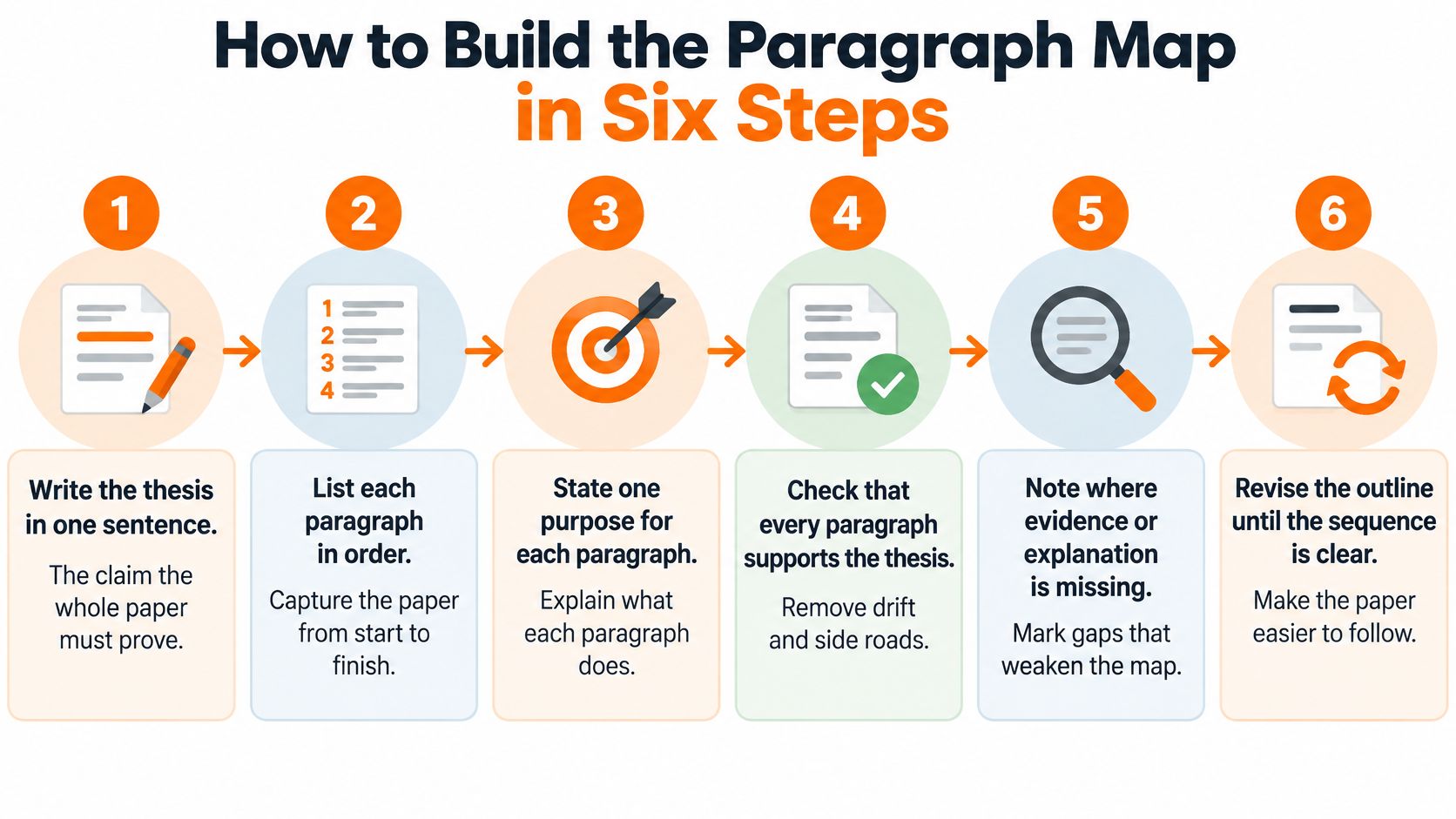
The George Mason University Writing Center recommends summarizing paragraphs, comparing the resulting sequence with the thesis, and revising order and cohesion. Use the following routine to turn that advice into an editing process.
-
Write the thesis in a sentence. Record the claim the whole paper needs to establish, not merely its subject. For a hypothetical nine-paragraph draft, try: Employers should offer remote work where individual focus benefits outweigh coordination costs.
-
Number every paragraph. Include the introduction, conclusion, and short transitional paragraphs. Preserve the original order so you can trace every map entry back to the draft.
-
Summarize each paragraph's actual point. Keep the entry short enough to scan, but specific enough to distinguish it from neighboring entries. Remote work is too broad; fewer interruptions may support focused tasks is more useful.
-
Record its function separately. Beside each summary, write what the paragraph contributes, such as definition, evidence, interpretation, or counterargument. Don't force a paragraph into a flattering label if you can't identify the work it performs.
-
Read the entries against the thesis. Mark repetition, unexplained claims, and ideas whose relevance isn't clear. Ask both what the paragraph is about and why it belongs at this point.
-
Create a revised outline and apply it. Decide what to move, combine, remove, or develop before rearranging the draft. Afterward, reread the paragraph boundaries because a new order usually requires new connections.
Use this visual as a desk-side reminder of the workflow.
What the working rows look like
In the hypothetical remote-work draft, entries might look like this:
| Paragraph | Actual point | Function |
|---|---|---|
| Opening | Employers need criteria for remote-work decisions | Introduces the problem and thesis |
| Early body paragraph | Remote work includes different scheduling arrangements | Defines the scope |
| Evidence paragraph | Fewer interruptions may help focused work | Supports a benefit claim |
| Later body paragraph | Team coordination may require additional planning | Raises a limitation |
| Closing | Suitability should guide the policy | Draws a recommendation |
Visual planning has a different purpose. If you're developing an art project before drafting, The Online College of Art & Design offers a resource to plan your A Level Art ideas. A reverse outline instead inspects the material you've already produced.
Your finished map should show the thesis at the top and a distinct, traceable entry for every paragraph.
Labeling Each Paragraph by Its Job
A label such as climate change identifies a subject, but it tells you little about the paragraph's role. It could describe a definition, an objection, or a piece of evidence that the writer hasn't explained.
Keep topic and function in separate fields. The University of Wisconsin–Madison Writing Center explains how brief paragraph summaries help reveal organization and development problems. Write a fresh summary when the existing topic sentence doesn't accurately express the paragraph's point.
For example, suppose adjacent paragraphs both receive the topic label climate change. On closer inspection, the earlier paragraph defines the term, while the later paragraph presents a figure without explaining its significance. They aren't necessarily repetitive: the function labels expose a missing interpretation instead.
Paragraph function labels and fixes
| Function | Recognize it when | Fix when misplaced or alone |
|---|---|---|
| Defines a term | The paragraph explains what a key word means in this paper | Move it ahead of the first use of the term |
| Presents evidence | A figure, quotation or example appears with no claim attached | Add a sentence stating what the evidence proves |
| Interprets evidence | The paragraph explains what the evidence means for the thesis | Connect it directly to the claim it supports |
| Raises a counterargument | The paragraph states an objection to your position | Answer it in the next paragraph or qualify the claim |
| Transitions | Two stages of reasoning are linked with no new point | Merge it into a neighbouring paragraph or cut it |
| Draws an implication | The paragraph concludes what follows from earlier points | Check that the premises appear earlier in the sequence |
These are diagnostic categories, not rigid rules. An evidence paragraph can contain a claim and interpretation too; the label should identify its main contribution, not prohibit supporting work.
Likewise, a short transition isn't automatically unnecessary. Keep it when readers need help understanding a genuine change in direction, but don't preserve it merely because it sounds polished.
A clear function tells you why a paragraph belongs. It doesn't prove that the paragraph is convincing.
After identifying the job, inspect the sentences that supposedly perform it. Remove irrelevant details, check whether the evidence addresses the stated claim, and notice where the explanation stops too soon.
Checking the Map Against Your Thesis
Read the map as an argument audit, not a list of covered subjects. You're checking whether readers receive the information and reasoning needed to accept your conclusion.
Start with completeness: a 12-paragraph paper should produce 12 paragraph descriptions, following the paragraph-by-paragraph mapping approach described by Washington State University's Writing Program. Then distinguish completeness from usefulness, because recording every paragraph doesn't mean every paragraph belongs.
The checklist below separates those decisions.
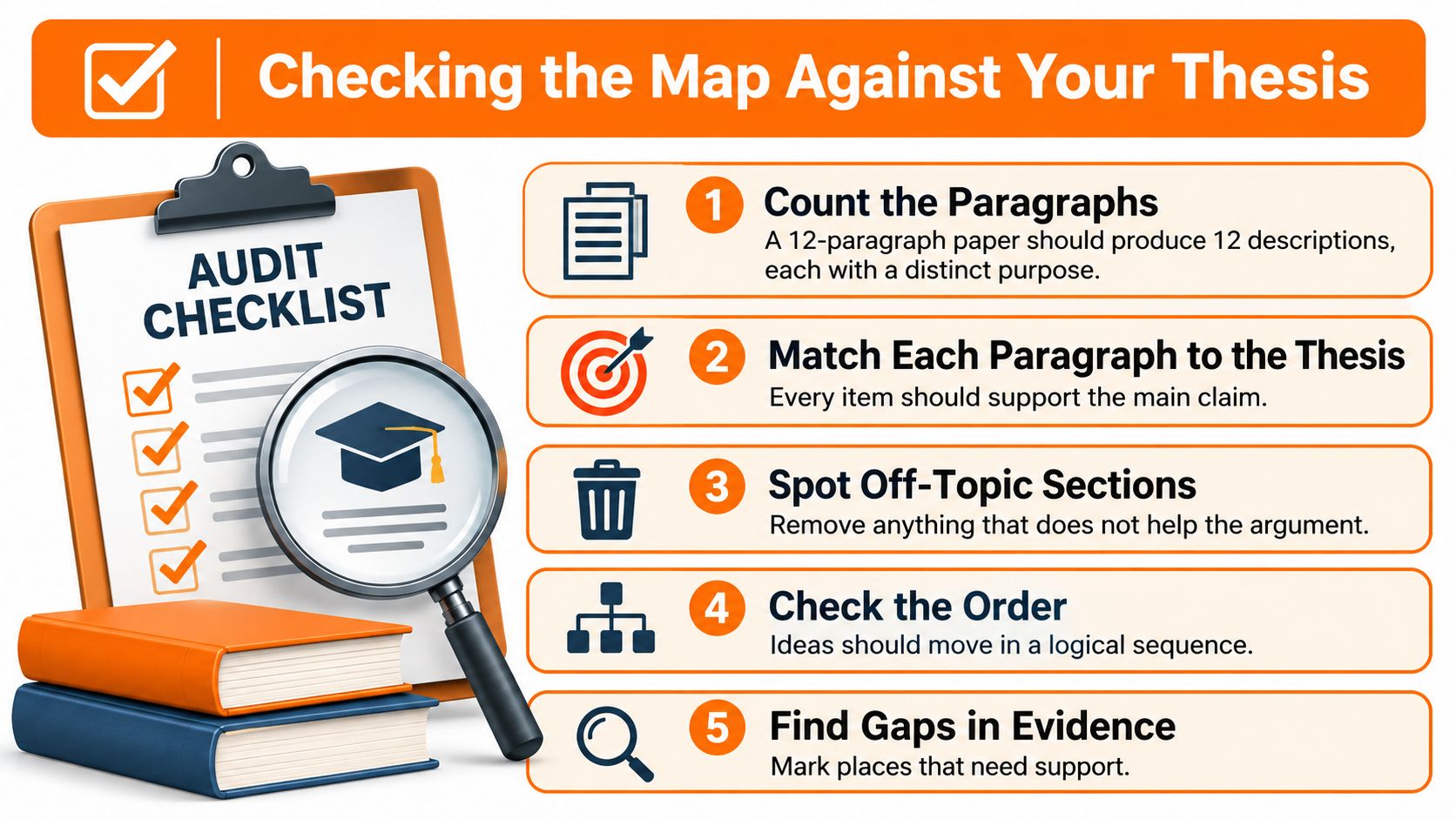
Audit checkpoints for a finished reverse outline
| Checkpoint | Passes when | Warning sign |
|---|---|---|
| Paragraph count | Each paragraph has its own description | Two paragraphs carry the same description |
| Distinct purpose | Each description does a different job | Two consecutive descriptions repeat one idea |
| Claim coverage | Each major claim has evidence and interpretation | A citation appears with no explanation attached |
| Sequence | Background, supporting steps and conclusion come in order | The outline jumps from background straight to conclusion |
Treat repeated descriptions as prompts to investigate, not automatic deletion orders. Paragraphs might address the same claim through different evidence or examine contrasting conditions. If that distinction matters, make it visible in the summaries.
Claim coverage requires more than locating citations. For each major claim, identify the relevant evidence and the explanation connecting that evidence to your point.
Look for the missing reasoning step
Suppose a policy paper contains three evidence paragraphs followed by a recommendation. The evidence describes employee preferences, but the recommendation concerns organizational performance.
The missing step is an explanation of why those preferences justify that policy. You may need different evidence, a narrower recommendation, or reasoning that connects the findings to the decision.
For an explanatory paper, an expository essay outline can help you assess whether readers receive definitions and context before detailed explanation. Use the structure that fits the assignment rather than treating every paper as a debate.
The map identifies where to investigate. You still need to verify source accuracy, evaluate whether the evidence is relevant, and check whether the conclusion follows from it.
Fixing Paragraphs That Fail the Check
When a paragraph looks focused but still feels unconvincing, annotate its internal parts: claim, evidence, reasoning, counterpoint, and bridge. Use only the labels that apply; a paragraph doesn't need to perform every function.
The revision image below illustrates the shift from reading continuous prose to inspecting particular parts.
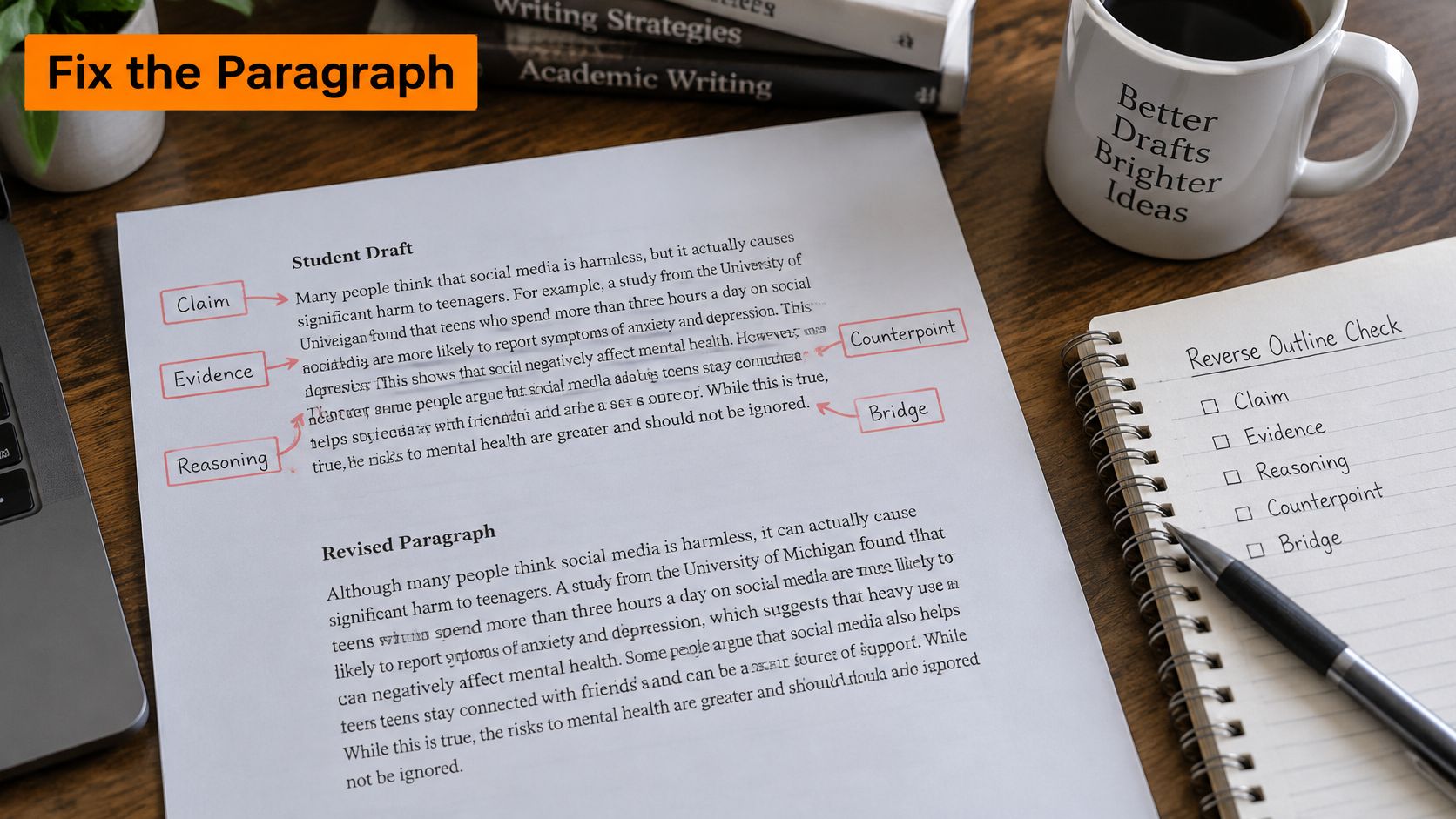
Kennesaw State University's reverse-outlining guide provides a foundation for examining paragraph purpose and support. Adding internal labels helps you inspect evidence-heavy paragraphs without reducing them to a topic alone.
Before and after a reasoning repair
Consider this entirely hypothetical paragraph:
Before: In an invented sample, 62 percent of firms adopted the tool. This shows that the tool is popular.
The ending repeats the finding in looser language. It doesn't explain which firms the result represents or how the finding supports the paper's argument.
After: In this hypothetical sample, 62 percent of firms adopted the tool. However, the sample includes only firms with more than 200 staff, so the finding describes adoption among larger employers rather than small teams. The following paragraph examines whether smaller organizations face different implementation constraints.
The revision adds a limit and a reason for the next paragraph. It doesn't turn adoption into proof of effectiveness.
Choose the repair according to the failure:
- Split: Separate unrelated claims that require different explanations.
- Merge: Combine paragraphs that repeat the same contribution.
- Move: Relocate useful material whose prerequisites appear later.
- Rewrite: Repair an unclear claim or supply missing reasoning.
A moved paragraph often needs a new bridge sentence. If its logic is sound but its wording remains tangled, use a focused paragraph clarity revision rather than rebuilding the whole argument.
For a further walkthrough of the revision process, use the video below.
These labels describe relationships between ideas, not particular English expressions. That makes them useful for multilingual drafts and non-native English writers too. Once the structure is settled, reserve spelling, grammar, and sentence clarity for a separate editing pass.
Confirm the Revised Order Before You Submit
Read the revised outline without looking at the draft. Can you follow the argument from the opening problem to the final conclusion without supplying missing explanations from memory?
If you can't, resist the urge to solve the problem with smoother wording. A polished transition won't repair an unsupported inference.
Use the map as an editing list
Work through the reordered draft against its labels. Change only what the new structure requires before making broader stylistic edits.
- Align topic sentences: Make each opening accurately introduce the paragraph's contribution in its new position.
- Repair references: Check phrases such as this finding and the earlier objection against the revised order.
- Adjust bridges: Explain real relationships, such as contrast, cause, qualification, or consequence.
- Protect meaning: Confirm that moving evidence hasn't separated it from an important limitation or citation.
A rough draft essay example can help you distinguish unfinished wording from unfinished development. A rough sentence may communicate sound reasoning; an elegant sentence may conceal a gap.
Finish with a reader's check
Read the final version aloud. Listen for abrupt shifts, repeated explanations, and sentences that assume readers know something you haven't introduced.
Keep your map beside you during this pass. Confirm that each paragraph still performs its assigned function, especially if you've rewritten or shortened it substantially.
Always review the final output yourself before publishing or submitting it. Maps and editing tools help you make decisions, but they don't replace your judgment about accuracy, relevance, or meaning.
Knowing how to use a reverse outline means knowing when structural revision is complete, not endlessly rearranging paragraphs. Use this final test:
If you can state the thesis and explain why each paragraph appears in its place, and the evidence supports those decisions, the structural revision is done.
Frequently Asked Questions
Is a reverse outline the same as a regular outline?
No. A regular outline is a blueprint you draw before writing. A reverse outline is an inspection you run after a draft exists, labeling what each paragraph already does. That difference matters: a topic list can show that two paragraphs cover the same subject, while a reverse outline shows that one paragraph argues and another merely repeats the introduction.
How long does it take?
Set aside a separate revision session rather than squeezing the map into proofreading. Label first, judge later. Dense technical paragraphs and unclear claims take longer than straightforward descriptive passages, and the first pass usually feels slower than the second.
Can I use it after I've already revised?
Yes. It helps most when sentence-level editing has polished the prose but you still sense that a paragraph is doing two jobs at once or arriving before its evidence. The map makes those structural problems visible again.
Do I need one for a short essay?
Not always. If you can state the thesis and explain why each paragraph appears where it does, a direct reread may be enough. Build the map when you suspect a structural problem but cannot name it.
Does it check whether my sources are accurate?
No. Verify facts, quotations, citations, and source quality separately. A well-organized argument can still rest on unreliable evidence.
Lumi Humanizer helps make AI-generated text sound more natural while preserving its main point. Once your paragraph map holds together, visit Lumi Humanizer to refine the wording, then review every change before you submit.