You've cleaned up an AI draft, but the result sounds more confident, more formal, and less like something you'd write. To preserve your voice when editing AI drafts, compare the text with your own writing, restore your intended stance, and accept changes individually rather than approving a wholesale rewrite. Check the result against both a measured baseline and a reader's judgment, not just your impression that it sounds better.
Build a Voice Baseline Before You Edit
You open an old client email and recognize the rhythm at once: short sentences, one aside, a plain recommendation. Then you read the AI-assisted draft due this afternoon and hear none of it. That gap is why you build a baseline before touching a single line. Your own writing is the reference, not a generic definition of good prose.
Collect three to five pieces you wrote without AI assistance. Pick different contexts, such as an essay, a client email, and a blog post, and label each by audience and purpose. Save them in a dated folder with a one-page voice profile. Record sentence rhythm, contractions, self-reference, hedging, stance, and recurring terminology. A spreadsheet or document is enough.
Record habits without turning them into rules
Use this template on a 500-word sample. The values in the third column are illustrative, not recommended targets. Replace them with your own counts.
Voice signals to record before editing
| Voice signal | How to measure it | Example from a pre-AI draft |
|---|---|---|
| Average sentence length | Words divided by sentences across one 500-word sample | 14 words per sentence |
| Contractions | Count don't, it's, we're per 500 words | 3 per 500 words |
| First-person references | Count I, my, we per 500 words | 6 per 500 words |
| Hedging words | Count may, might, suggests, seems, likely per 500 words | 4 per 500 words |
| Rhetorical questions | Count body-text question marks that ask the reader to consider a point | 2 per 500 words |
| Recurring terms | List nouns used across three or more pieces | workflow, draft, reader |
Don't stop at averages. Highlight a short emphatic sentence, a longer explanation, and a phrase your regular readers would recognize. Those excerpts help you interpret the numbers. Stance belongs in the profile too. Note whether you write this proves or this suggests, whether you name a recommendation or hide behind it is recommended, and where you ask a question instead of making a flat claim. Those choices shape voice as much as sentence length does.
A 2026 stylometric study in Digital Scholarship in the Humanities found comparatively stable stylistic patterns in AI-generated texts and greater dispersion and individuality in human writing. That makes variation worth preserving, not an inconsistency to eliminate.
Practical rule: Use your baseline to notice changes, not to force every document into the same pattern.
Say a graduate student's essays average 14-word sentences and regularly include I think and probably. An AI draft averages 22 words and contains no first person. Those measurements flag a passage worth inspecting. They don't prove that every longer sentence needs cutting.
If you struggle to describe your preferences, compare different writing styles and their practical uses. Then choose your three most important signals to track during editing, such as sentence rhythm, hedging, and discipline-specific terminology.
How to Edit an AI Draft Without Flattening It
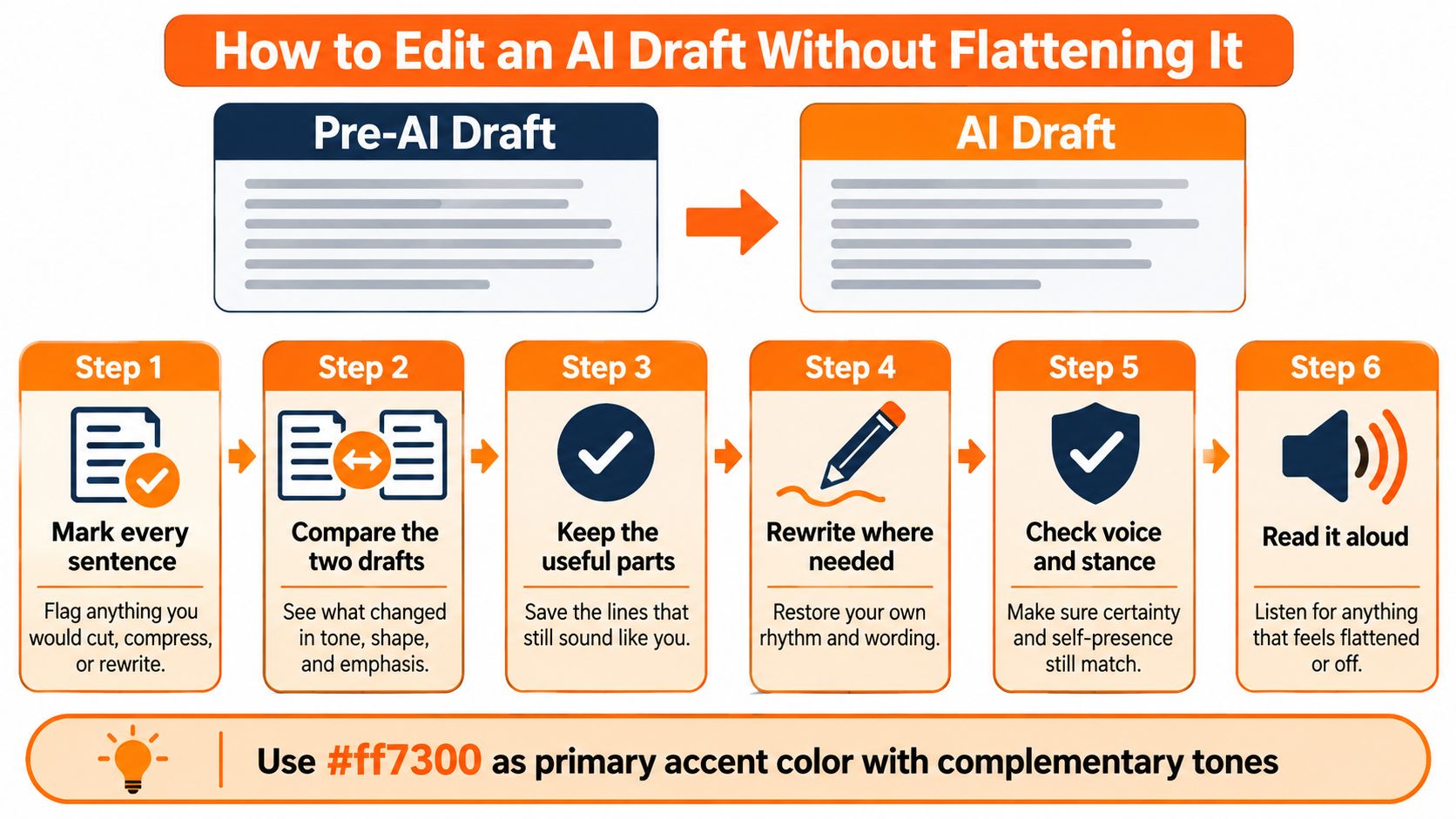
Keep the human-written material and AI draft side by side, then revise sentence by sentence. Separate decisions about meaning from corrections to grammar. Otherwise, an apparently harmless cleanup can become an unplanned rewrite of your argument.
The strongest starting point is a two-pass, author-controlled workflow: save your ideas, evidence, stance, and characteristic wording first, then ask AI to identify local problems. A 2026 Frontiers in Education study reports that students often found AI revisions clearer but less reflective of their intended ideas and style; participants who preserved voice selected suggestions and rewrote them rather than accepting wholesale replacements.
Use this sequence to keep the editorial decisions yours.
-
Mark sentences you wouldn't write. Flag stock introductions, repeated paragraph openings, inflated descriptions, and expressions such as it is important to note. Don't replace everything immediately; first identify where the draft stops sounding familiar.
-
Check what each proposed edit changes. Compare the factual proposition, certainty, first-person or culturally meaningful phrasing, and disciplinary terminology. A smoother sentence fails this check if it changes any of those without your approval.
-
Keep the useful correction, not necessarily its wording. Accept a suggestion only when those checks pass, then express it in language you'd choose. Sometimes the useful suggestion is to move a sentence or explain an unfamiliar term.
-
Label accepted changes in version history. Use categories such as grammar, structure, and meaning/stance. If a change affects your argument, give it a substantive review rather than hiding it among punctuation fixes.
-
Handle local errors after voice edits. Use a grammar checker for spelling, agreement, punctuation, and unclear construction. Review its suggestions individually, especially when a correction replaces an intentional expression.
-
Read the opening aloud. Listen for wording you'd avoid when explaining the same point to the intended audience. Reading aloud tests cadence, but it doesn't replace checking the evidence.
Reject improvements that change the claim
Consider a non-native English writer's sentence:
I found that the method was useful for our team.
An AI revision changes it to:
The method proved highly beneficial across teams.
That revision removes the writer's presence, strengthens useful into proved highly beneficial, and expands one team into multiple teams. The original needs no comma correction and may need no edit at all.
For business writing, Olivetree Marketing's guide to AI support for service-led businesses offers broader context for deciding where AI assistance belongs. Keep that workflow decision separate from approving the wording of a particular client claim.
When a human draft exists, most sentences should still be recognizably yours. Each accepted change should have a reason you could explain to a colleague.
Check Certainty and Stance After Every Change
A revision can retain the topic while changing what you're willing to claim. Certainty, self-presence, and evidence boundaries are part of meaning, not decorative features to remove for a cleaner finish.
A 2026 UCL comparison of UK master's writing found that AI polishing reduced hedging and self-mention while moving prose toward categorical, impersonal language. It also described how AI-assisted drafting and editing can progressively narrow rhetorical variation.
Inspect substantial revisions with the source material beside you.

Stance shifts AI edits commonly introduce
| Original sentence | After AI edit | What shifted |
|---|---|---|
| I think the policy helped | The policy helped | Personal judgement removed |
| The data may suggest a gap | The data shows a gap | Certainty raised beyond the evidence |
| In my experience, students struggle here | Students often struggle here | Self-mention replaced by a generic claim |
| Why does this matter? | This matters because | Rhetorical question turned into a statement |
| This sample covers two cities | The findings apply broadly | Evidence boundary dropped |
These are illustrative comparisons, not automatic reasons to reject an edit. Removing I think can be appropriate when the evidence supports a direct factual statement. It's inappropriate when doing so disguises a personal interpretation as an established result.
Match the sentence to the evidence
Suppose a policy analyst writes: The data may suggest the program underperformed in rural areas. After polishing, it becomes: The program underperformed in rural areas.
The shorter version asserts an outcome rather than a tentative interpretation. Check whether the analysis established underperformance, merely indicated it, or left competing explanations unresolved. Restore the qualifier that accurately represents the evidence.
Also inspect phrases such as in this sample, among respondents, and during the pilot. Deleting them may make a conclusion easier to read while making it harder to defend.
Understanding tone in writing helps distinguish a deliberate change in presentation from a change in belief. You can make a cautious conclusion more readable without making it more certain.
A cleaner sentence isn't more authentic if it removes caution you intended to keep.
Test Whether the Draft Still Sounds Like You
Ask another reader to compare the writing before trusting your own familiarity with it. After repeated revisions, you may remember what you meant so clearly that you stop noticing what the text says.
A University of Maryland study involving 81 volunteers found that participants generally believed their edited AI drafts reflected their personal style, while computational analysis showed the final texts remained stylistically closer to AI-generated writing than to their independently written work.
A colleague can help identify differences you've stopped hearing.

Run a reader check and a baseline comparison
-
Remove identifying details. Give a colleague comparable original and revised passages without names or labels. Ask whether the same person appears to have written both, and which phrases support that judgment.
-
Compare your tracked signals. Check sentence length, contractions, first-person references, and hedging against samples from a similar context. Inspect conspicuous differences rather than trying to achieve an exact numerical match.
-
Explain intentional departures. A grant report may need greater formality than a personal blog. Keep a difference you can justify by audience, genre, or purpose; investigate one you can't explain.
For a hypothetical consultant's proposal, suppose the revision averages 22-word sentences and one hedge per 500 words, compared with a baseline of 16 words and five hedges. Restoring three justified qualifiers and two first-person judgments might correct the position, but adding them merely to match counts would be artificial.
For longer projects, establish those choices before revising chapter after chapter. Guidance on using AI to write a book is useful when you need a repeatable process across a manuscript.
Use the video alongside your own comparison, rather than as an alternative to examining the draft.
Keep detector results in their proper role
An AI detector can estimate AI-generated signals, but it can't establish that a passage sounds like you. Review the draft manually and treat its result as one editing input, not a final verdict.
A study of language-model revision and AI-mediated writing discusses detector limitations, including variation across systems and degradation after paraphrasing; perplexity and burstiness aren't reliable proof of human authorship, particularly for academic and non-English writing. Results also vary by draft quality, detector version, and how much editing the text needs.
Treat a weak baseline match as a diagnostic, not an authenticity score. For voice, the reader's comparison deserves more weight than a detector result.
Fix the Drift Patterns That Flatten Voice
Repeated editing habits can make different writers sound interchangeable. Start with the visible symptom, then choose the smallest correction that restores the intended effect.
Drift patterns, causes and fixes
| Drift pattern | Likely cause | Fix |
|---|---|---|
| Moreover, Additionally, Furthermore in every paragraph | Default connectors | Use your own linking words, or none |
| Your phrasing swapped for standard academic wording | Fluency pass normalizes idiom | Restore it if the meaning is clear |
| Dense paragraphs holding four claims | Long compound sentences | Split by idea and keep your key sentence |
| Personal example replaced by a generic one | Generic filler | Restore your own example, even if less polished |
Replacing a stock connector is quick. Restoring a deleted example takes more care because you must check its relevance, accuracy, and connection to the argument.
Split the construction, not the thought
Say a crowded paragraph explains what a pilot tested, why it failed, which results remain useful, and what should happen next. Don't ask for a shorter rewrite of the whole paragraph first. Separate those jobs and preserve the sentence that carries your judgment.
A hypothetical revision might read:
Test: We piloted evening appointments to make the service easier for working parents to use.
Result: Attendance remained low. The booking process still required a daytime phone call.
Decision: I'd fix the booking process before adding more evening slots.
The revision improves organization without replacing a concrete explanation with a generic recommendation. Nielsen Norman Group's web-writing guidance recommends clear organization, topic sentences, and limiting paragraphs to one main idea.
Apply the same judgment to active and passive voice. STE Guide can help you decide if passive wording adds clarity, rather than changing every passive construction mechanically.
Unusual isn't the same as unclear. Keep a distinctive phrase when readers can understand it and it serves the point.
Frequently Asked Questions
Can I start from an AI draft at all?
Yes. Establish your ideas, evidence, and stance independently, then compare the generated draft with those decisions. The risk is accepting its wording and reasoning without substantive review.
How many pre-AI samples do I need?
Three to five pieces from different contexts make a practical starting set. Add more when you write for substantially different audiences, and keep those contexts labeled.
Is a paraphrase tool the same as a humanizer?
No. A paraphrase tool rewrites text for clarity and variation. Humanizing aims to make AI text read more naturally; neither guarantees preservation of your individual voice.
What if my natural style is formal or heavily hedged?
Keep those characteristics when they're intentional and appropriate. You're checking whether the revision represents your choices, not whether it meets a generic standard of conversational writing.
Run a Final Voice Check Before You Submit
Make the decision explicit: submit only when the baseline comparison and reader check support the revision, and you've verified every factual claim and citation. If either voice check exposes an unexplained mismatch, keep editing.
Don't run another tool over a generic passage immediately. Rewrite it yourself using a relevant example you can substantiate, your actual judgment, and the evidence boundary you intend. Then ask the reader to assess that passage again.
A review of AI-assisted academic writing in the National Library of Medicine cautions against using generated output verbatim and emphasizes authors' responsibility for voice, critical thinking, and accountability. A polished draft doesn't transfer that responsibility away from you.
Make the final pass narrow
An optional final pass should address rhythm where the meaning is already settled. Lumi supports custom writing style profiles built by uploading your writing samples or describing your preferred tone, helping rewrites stay closer to your formality and sentence structure.
That assistance doesn't confirm authorship or replace review. Read the final output line by line before publishing or submitting it, especially wherever a smoother sentence might have changed your certainty.
Knowing how to preserve your voice when editing AI drafts means retaining control over those decisions. Save the approved draft's measurements in your dated baseline file, labeled by audience and genre, so your next comparison starts with evidence rather than memory.
Lumi Humanizer offers a natural-language rewrite designed to preserve your main point while improving clarity, voice, and flow. Try it on a passage whose meaning you've already checked, use a style based on your own examples, and compare the result with your original before accepting it.