
You've opened the document, reread the assignment, and rewritten the opening without getting further. To learn how to overcome writer's block, identify whether you're stuck finding ideas, organizing them, putting them into words, or judging what you've written. Then choose a small task that addresses that stage, rather than waiting to feel inspired.
Find the Stage Where Your Writing Stalls
A writing block needs a diagnosis before it needs a technique. Brainstorming won't solve every problem, especially when you already know what you want to say but can't get the sentence down.
A 2026 synthesis in Writers' Block Magazine reported that articulation accounted for 36% of reported blockages, compared with 18% during idea evaluation, 15% during idea generation, and 4% during planning. These figures describe the reported blockages in that synthesis, not a universal breakdown for every writer.
Writing stages, signs and first fixes
| Stage | What it feels like | Share of reported blocks | First fix to try |
|---|---|---|---|
| Articulation | You know the point but cannot phrase it | 36% | Say the idea aloud, then type it roughly |
| Idea evaluation | Every sentence feels wrong before it exists | 18% | Draft in one session and judge in another |
| Idea generation | Nothing comes to mind at all | 15% | Answer a list of prompts or questions on paper |
| Planning | You do not know what comes next | 4% | Write a three to five heading outline |
The usual advice to brainstorm or wait for inspiration targets idea generation, which represented only the share shown above. Even freewriting needs a purpose: generating possibilities is different from practicing an explanation you already understand.
Consider a researcher who knows the argument but can't phrase the opening paragraph. That's an articulation block, so saying the argument aloud may help more than collecting additional references.
A novelist who writes a sentence and deletes it before starting the next has a different problem. That writer needs protection from premature evaluation, not necessarily a better plot idea.
Run a 60-second check
Use these questions as a quick diagnostic, not a test you can fail:
- Last completed sentence: What's the last sentence you finished?
- Next required move: What does the reader need next, such as an example, explanation, transition, or claim?
- Point of difficulty: Are you missing content, order, wording, or confidence in the result?
If you can explain the next point conversationally, don't treat yourself as though you have no ideas. Work on translating that explanation into text.
The distinction also matters when you're writing in another language. Building writing fluency means practicing the movement from thought to sentences, not demanding grammatical perfection during every attempt.
First move: Choose the first-fix column that matches what stopped you, not the advice that sounds most disciplined.
A Five-Step Warm-Up for a Blank Page
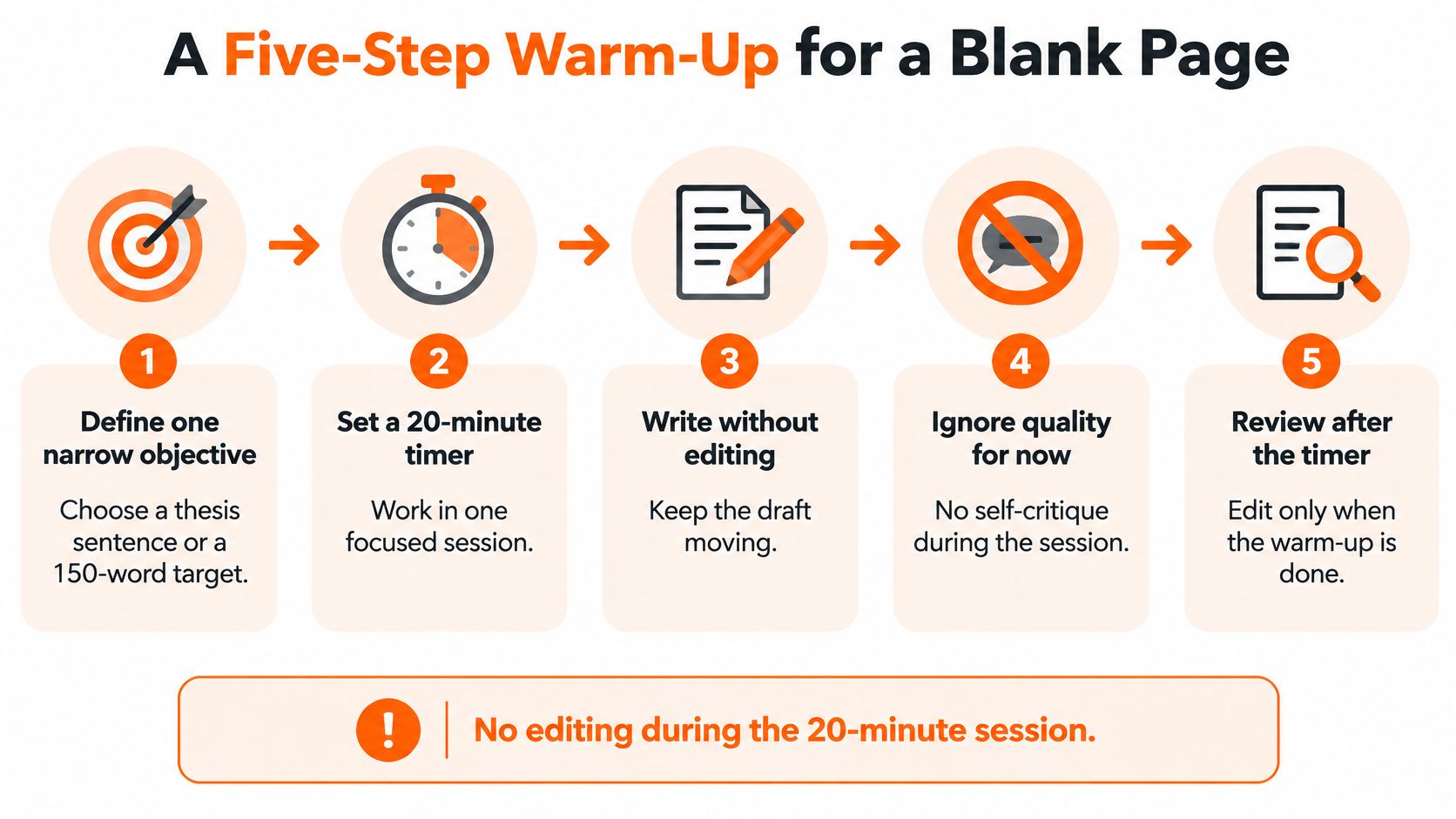
When starting feels impossible, give yourself one narrow objective and a 20-minute drafting window. The purpose is to produce something you can work with, not a passage you'd immediately publish.
Use this visual as a reminder to keep drafting and reviewing separate.
-
Define one narrow objective. Choose a thesis sentence, an explanation of a result, or a rough paragraph of about 150 words. A concrete endpoint makes beginning less demanding than an instruction to work on the whole project.
-
Write for 20 minutes without editing. Don't delete awkward wording or return to fix the opening. Leave a bracketed note for missing information so you can continue without inventing a fact.
-
Describe the difficulty from a distance. Address yourself by name or describe the task in the third person: Dana needs an example for the second section. Use this to make the problem more specific and less like a judgment about your ability.
-
Take a short break away from the screen. Stand up, stretch, or get some water rather than opening another feed. Give yourself a pause from the task and its self-criticism.
-
Revise after you have a complete rough passage. Keep the useful claim, identify the missing evidence, and repair the wording afterward. Delaying that decision lets you evaluate an actual passage instead of an imagined perfect one.
What this method can and can't do
Self-distancing is a reasonable starting aid, but it isn't a proven universal productivity treatment. An assessor-blind randomized trial involving 187 first-year students with elevated social anxiety found greater reductions in social anxiety with self-distanced writing at one-month follow-up, not an established improvement in professional writing output.
Treat the warm-up as an experiment in beginning. Don't assume that a technique studied for anxiety will automatically increase your word count.
For a hypothetical example, a blogger spends an hour staring at an empty document, then tries this routine and produces 280 rough words in 20 minutes. During revision, they cut 90 words and discover that the remaining material contains a usable argument.
The discarded words weren't necessarily wasted. They helped the writer find a point worth keeping.
Measure this warm-up by whether you began and stayed with the task. The opening sentence can earn its place later.
Build a Routine With Timed Writing Rounds
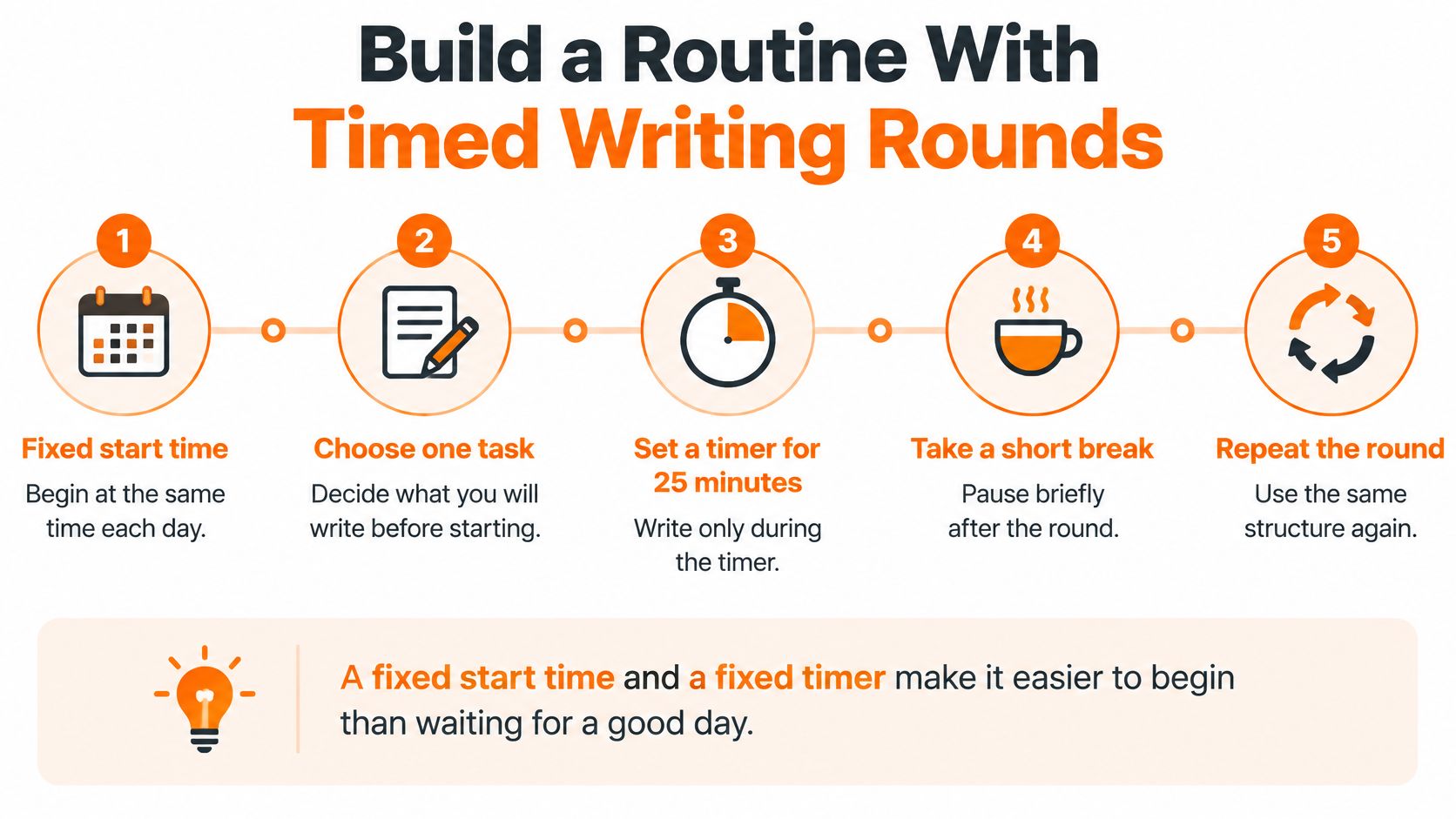
A fixed start time and a timer give you a concrete appointment with the draft. You don't have to decide whether today feels like a writing day before you begin.
The University of Auckland's Pomodoro guide recommends choosing a task, working for 25 minutes, taking a 5-minute break, and taking a longer break after four rounds. It explicitly lists essay writing and assignment research as suitable activities.
The timeline below makes that routine easy to keep beside your workspace.
Give each round a different job
For a hypothetical 2,000-word article, your session might look like this:
- Opening round: Draft the introduction's rough claims without trying to make the first line memorable.
- Example round: Explain a concrete situation that demonstrates the argument.
- Evidence round: List the sources and claims you need to verify, keeping research separate from drafting.
Pick a start time you can protect on ordinary weekdays, not only on an unusually quiet day. Decide the task before starting the timer, and close unrelated tabs.
Founders juggling writing with operational work may also find Jan Kutschera's focus systems for founders with ADHD relevant when adapting timed work to their schedules. Treat any schedule as adjustable, not as a test of personal discipline.
Leave an easy restart
Before closing the document, write a handoff note describing the next sentence or example. A note such as explain why the cheaper option failed gives you somewhere specific to begin.
Track progress without turning minutes into a score. Practical ways to improve writing speed should help you produce useful text, not encourage padding.
After each round, ask whether the new material answers the assignment, supports a claim, or advances the story. Timed rounds provide structure, not a guarantee of output.
How to Overcome Writer's Block From Fear of Judgment
When every sentence feels assessed before it exists, more pressure may be the wrong intervention. Change the feedback conditions, rather than treating avoidance as a simple lack of effort.
The moment before drafting can feel more like preparing for criticism than explaining an idea.

Research involving doctoral writers published in Discover Education identified supervisory criticism, unclear feedback, and family or community expectations as triggers. The reported responses included scheduled writing, peer support, handwriting, and outlines.
Perfectionism and fear of errors while writing in a second language deserve attention too. A writer who needs help forming an argument shouldn't receive the same intervention as someone who understands the task but fears an advisor's reaction.
Check the conditions before choosing a tactic
Start with anxiety and feedback: do you know who will read the draft, what they expect, and what their comments mean? Then check for a language or skill gap, such as difficulty interpreting evidence or constructing a paragraph.
Choose a response that addresses the actual obstacle:
- Create private space: Keep an explicitly labeled rough-drafts folder that isn't shared.
- Request narrow feedback: Give a peer an unfinished paragraph and ask whether the second claim is clear.
- Make criticism actionable: Ask an advisor for three concrete changes rather than accepting a general needs-work response.
- Change the medium: Draft by hand if the shared document or comment sidebar feels exposing.
Consider a hypothetical graduate student who has avoided her thesis for two weeks because every comment feels final. She asks her advisor to identify three priorities, then writes a messy outline the next morning. The useful change is a clearer, lower-stakes task, not a sudden increase in motivation.
Use the accompanying video as a pause for reflection before choosing your next writing action.
Support threshold: I recommend involving a supervisor, mentor, or counselor if you remain blocked after two weeks of a changed routine.
That's a practical check-in point, not a clinical cutoff. Seek support sooner if distress is substantial or extends beyond writing.
Revise in Passes Instead of Rewriting Everything
A draft can feel stuck even when its ideas are sound. The problem may be the order of the argument, unclear sentences, or wording that needs polish. Revise with one question at a time so you can identify which stage needs attention instead of changing everything in a single read.
John McPhee described spending two difficult years on the first draft of his California geology book, followed by approximately six months on the subsequent drafts combined, in his account of wrestling with a first draft. His timeline is not a model to copy. It shows that a difficult draft can require sustained revision without indicating a lack of ability.
Make three distinct passes
| Pass | Question to answer | Action |
|---|---|---|
| Structure | Does each section answer its question, and does the main claim appear early? | Move, combine, or remove paragraphs |
| Clarity | Does each sentence communicate something specific? | Cut filler and replace vague wording |
| Line editing | Is the wording correct and readable? | Check grammar, spelling, repetition, and rhythm |
Start the structure pass by writing a margin note that describes what each paragraph does. A reverse outline of your draft helps you see the argument on the page, rather than the outline you meant to follow. For further guidance, strengthen your writing through revision.
Keep a short checklist beside the draft:
- Pass 1: Which paragraph could move or go?
- Pass 2: Which sentence says nothing specific?
- Pass 3: Read aloud and mark sentences that run beyond a comfortable breath.
Consider this weak sentence:
There are many factors that can be considered when thinking about productivity.
If the paragraph presents three habits, make the subject explicit:
Three habits decide how much you write each day.
That revision works only if the paragraph identifies those habits. Specific wording cannot make an unsupported claim accurate.
Use tools after deciding what you mean
Lumi Humanizer's AI Humanizer can improve the clarity, voice, and flow of AI-drafted text while preserving its main point. It does not supply evidence or replace your judgment. Review the final draft manually before publishing or submitting it, and treat detector results as one editing signal, not a final verdict.
Frequently Asked Questions
Can I still write when my deadline is an hour away?
Yes. Skip the full routine setup and use the blank-page warm-up for one focused, 20-minute round with a narrow goal, such as a rough paragraph. Leave enough time to check the argument, evidence, and wording before submitting.
Is writer's block a character flaw?
No. Calling yourself lazy doesn't identify whether you're missing an idea, a structure, usable wording, or safe feedback conditions. Use the stage diagnosis to choose a more relevant intervention.
Does a block mean I have nothing to say?
Not necessarily. If you can explain the point aloud, you have something to work with even if the written version feels awkward. If anticipated criticism stops you from recording it, address the fear of judgment rather than searching endlessly for another topic.
Choose One Strategy and Test It Tomorrow
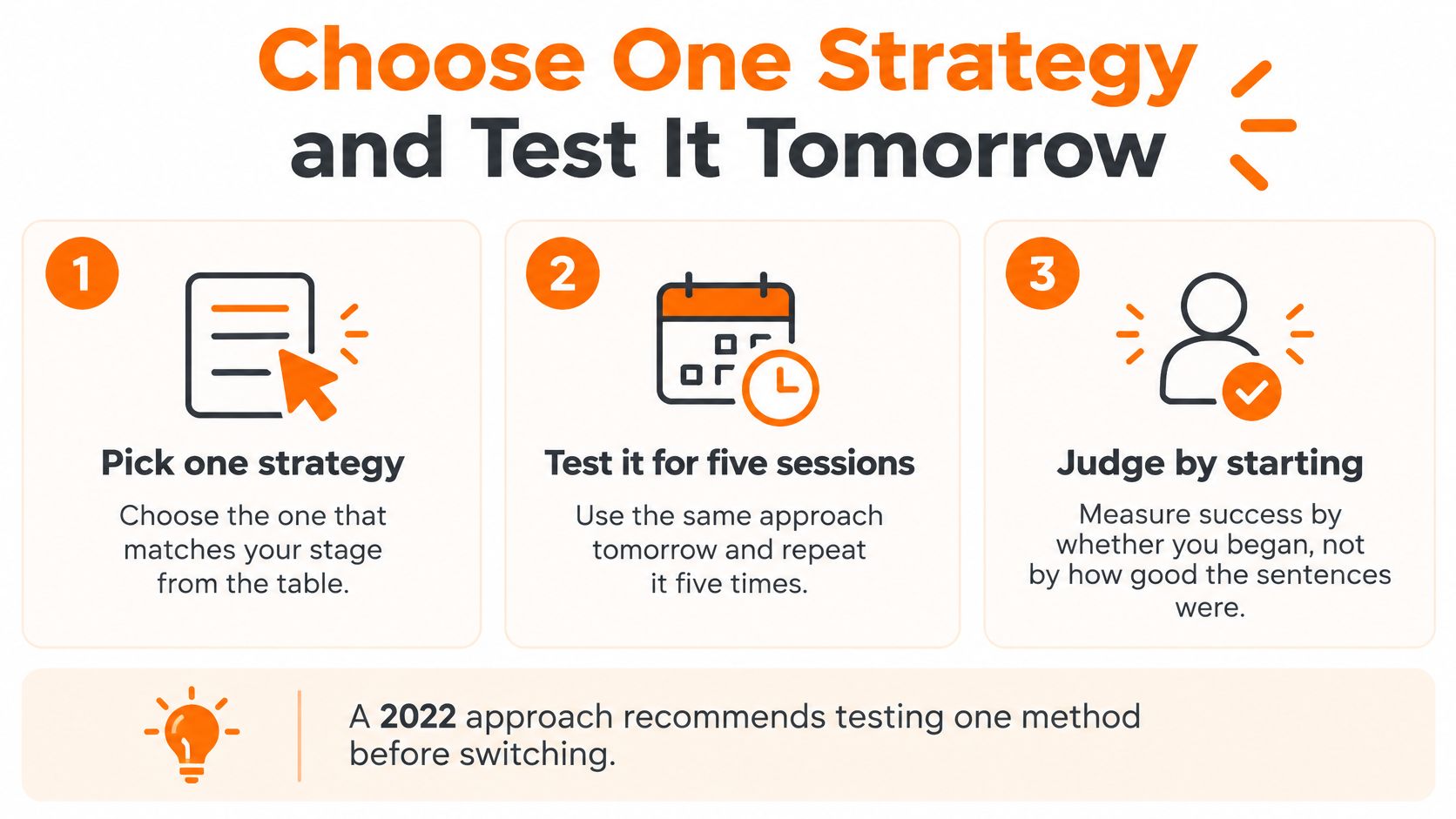
Pick one strategy that matches your obstacle and test it for five sessions before deciding whether it helps. That's a practical trial period, not a research-established dose.
A 2022 mixed-method survey of 146 writers identified twelve strategies, with participants rating taking a break, switching projects, deliberately continuing to write, and discussing ideas with others as the four most useful. Those are self-reported judgments, not proof that one method will work best for you.
The useful principle is to change the task or change the input. A blocked novelist can draft a later chapter instead of repeatedly attacking the same scene; a student can explain the argument to a classmate and note where the listener gets confused.
Use this checklist to turn the choice into a repeatable experiment.
Set up tomorrow's session
- Name your stage using the symptom that best describes the stoppage.
- Choose one intervention rather than combining every technique.
- Book a fixed start time you can realistically protect.
- Write the objective on a sticky note beside your screen.
- Log minutes and rough words without treating either as proof of quality.
- Review after five sessions and check whether you started more often than before.
Compare similar writing tasks where possible. If you begin more reliably but still produce unusable material, adjust the objective or get feedback on the underlying skill.
The practical answer to how to overcome writer's block is to match the intervention to the obstacle and evaluate what happens when you try it. Tomorrow, arrive with one named task instead of an instruction to finish everything.
Lumi Humanizer helps make AI-assisted drafts sound more natural while preserving their main point, so you have clearer material for your own revision. You can create a writing style from your examples to keep rewrites closer to your preferred tone, formality, and sentence structure. Visit Lumi Humanizer when you have a rough passage ready to refine, then review the result yourself before submitting.