Writing fluency is the ability to produce written text smoothly and efficiently, with few pauses or hesitations, while keeping the text accurate and coherent. You know the moment it breaks down. You understand the topic, you're staring at a half-written assignment, and every sentence takes three attempts to finish.
That stop-start feeling doesn't mean your ideas are weak. It usually means one part of the writing process is taking too much conscious effort.
What Writing Fluency Means in Plain Terms
When students ask what writing fluency is, the plain answer is this. You can get language onto the page steadily without constantly stopping to find words, fix spellings, or rebuild sentences.
Think about driving. A learner thinks about every gear change, checks every mirror twice, and sometimes stalls. A fluent driver still pays attention, but the basic actions run automatically, so more attention stays on the road ahead.
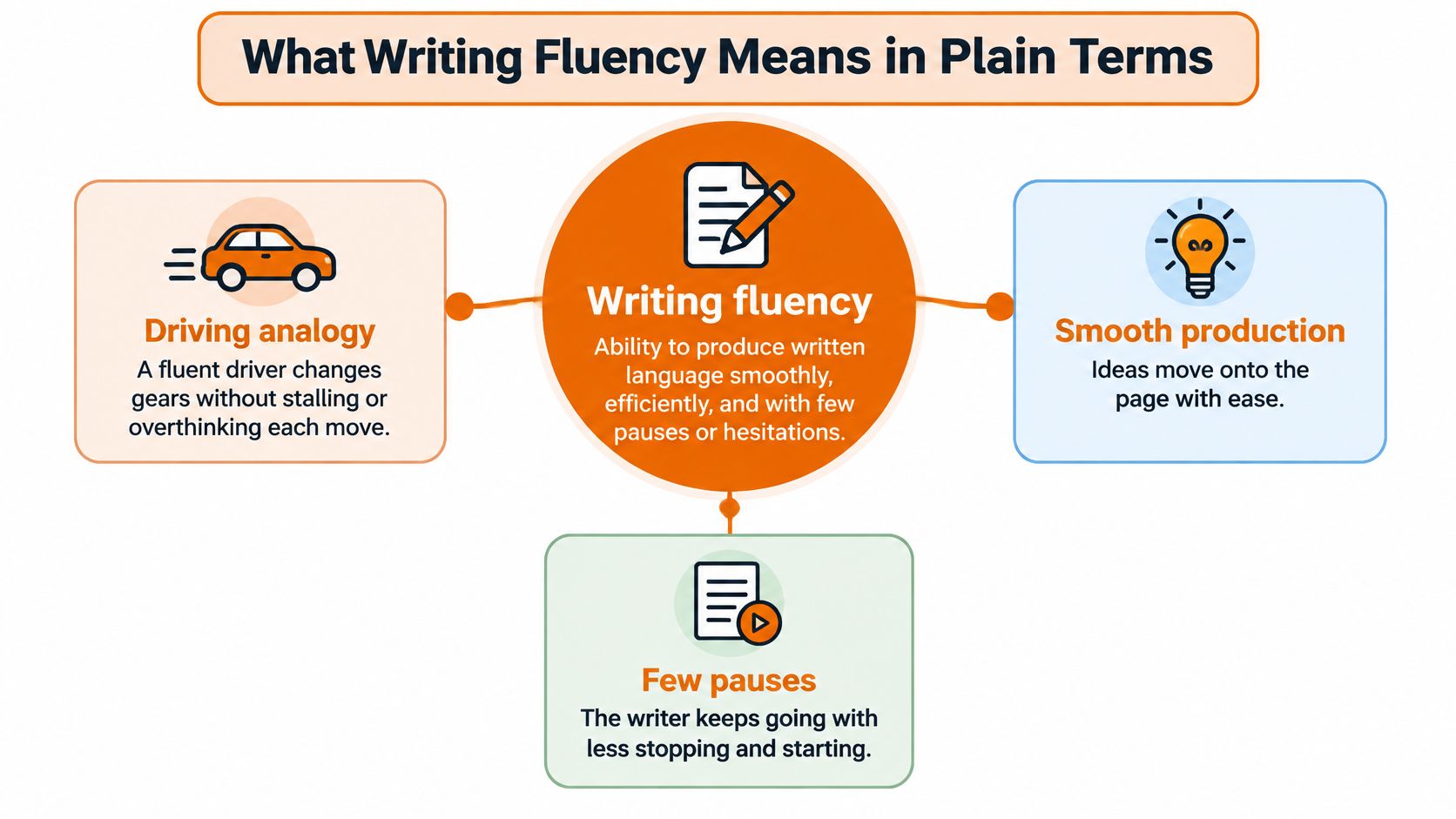
Writing works the same way. Fluency includes automatic retrieval of vocabulary and grammar, legible and accurate words, and sentences that connect locally, as the 2024 Springer article on composing and burst fluency defines it. Speed matters, but it's only one piece.
Two Drafts With the Same Word Count
Say two students each finish a 300-word draft. One writes it in 25 minutes in long, unbroken bursts, pausing mainly between paragraphs. The other needs 50 minutes, deletes the opening line six times, and stops mid-sentence to search for common words.
Both students produced 300 words. Only the first draft shows fluency, because the language kept moving while attention stayed on meaning.
A common measure is composing rate, which is words produced divided by minutes spent writing. It is useful, but it has a limit. A slower rate can reflect careful planning or revision, not weak skill.
Try this on your last draft: Don't count words first. Mark where you stopped, then ask why each stop happened.
That is why researchers also track burst fluency, the words produced during active writing after pauses are excluded. It separates how fast you move when you're writing in real time from how often you stop altogether.
The Four Parts of Writing Fluency
Fluency feels like one smooth action, but you can break it into parts you can observe. Hold a recent draft against the table and look for the row that causes you the most trouble.
| Component | What It Measures | Quick Example | Warning Sign |
|---|---|---|---|
| Speed | Words produced per minute of active writing | 120 words in a 10-minute draft gives 12 words per minute | High output that needs heavy cleanup afterward |
| Automaticity | Letters, spellings and common phrases produced without conscious effort | Typing a familiar phrase without stopping to check the spelling | Frequent pauses in the middle of words or phrases |
| Continuity | Length of writing bursts and how often pauses interrupt them | A full paragraph written before the first long pause | Many short bursts separated by long gaps |
| Local coherence | Sentences that connect logically and read clearly in sequence | Each sentence is grammatical, but the next one repeats the same point | Paragraphs that read like separate notes |
| Accuracy | Correct grammar, spelling and meaning at the pace of writing | Fast drafting that keeps word choice precise | Speed rising while errors rise with it |
The Two Systems Behind the Table
The Journal of Writing Research review separates transcription fluency from text-generation fluency. Transcription covers legible letters, correctly spelled words, and grammatical phrases that become increasingly automatic. Text generation covers locally coherent text produced at a reasonable pace while you sustain attention on the content.
That split explains a common frustration. You might type quickly yet struggle to make sentences connect, which is a generation problem. Or you might have clear ideas but lose them while hunting for keys and spellings, which is a transcription problem.
Fast Is Not the Same as Fluent
A useful short definition describes fluent writing as quick, effortless, and accurate. Those are three separate tests, not one. If your speed rises while errors multiply, you're writing faster, but you're not writing more fluently.
- Speed without accuracy: The draft grows, but cleanup takes longer than drafting.
- Accuracy without continuity: Every sentence is correct, but each one costs a long pause.
- Continuity without coherence: Words flow, but a reader can't follow how sentences connect.
Find the row where your draft struggles most. That row, not your overall word count, tells you what to practise next.
Why Fluency Matters for Students and Non-Native Writers
A timed exam gives you a prompt, a clock, and a blank page. You know the argument you want to make, but spelling, word choice, and sentence structure keep pulling your attention away from it. By the time you have fixed the second sentence, the thread of the third is gone.
That is the cost of weak fluency. Producing sentences and reasoning about ideas draw on the same limited pool of attention. When basic production takes effort, less remains for planning, evidence, and organization. A well-reasoned essay can still feel stuck because the writer ran out of mental room while the ideas were still there.
This is also why the split between writing speed and writing smoothness matters. A student who types quickly but loses ideas mid-sentence faces a different problem than one who writes slowly and keeps every idea intact. Same low word count, different cause, different fix.
A Different Pressure for Non-Native Writers
Writing in a second language adds a retrieval problem on top of the attention problem. You may know exactly what you mean in your first language but need extra time to find the English phrase that carries it. Hesitation often comes from slower retrieval of vocabulary and grammar, and readers who only see the final text can mistake that delay for uncertain thinking.
Academic readers judge the prose in front of them. Frequent rewrites and tentative phrasing can make solid research read as shaky, even when the underlying work is strong. Fluency protects your ideas by letting them arrive on the page in the order you intended.
Fluency Is Trainable, and Gains Are Uneven
Fluency isn't a fixed talent. The International Journal of Applied Linguistics review describes a university study where 37 English-language learners showed improvement in writing fluency over a single academic semester when fluency was measured through text length.
The same literature keeps expectations honest. Some classroom studies find no statistically significant change in words-per-minute fluency across several years of modest weekly English instruction, even when the overall pattern rises.
Smooth prose can still hide weak reasoning, so build fluency in service of quality rather than in place of it.
Uneven progress is normal. What matters is which part stalls. If your speed climbs but sentences still arrive in fragments, the slowdown sits in production. If ideas form but words take long to surface, it sits in retrieval. Naming the stalled part tells you what to train next.
How to Measure Your Writing Fluency
You need two lenses, because one number hides too much. A product measure divides words produced by total writing time. A process measure looks at burst length, which is the text you write between pauses.
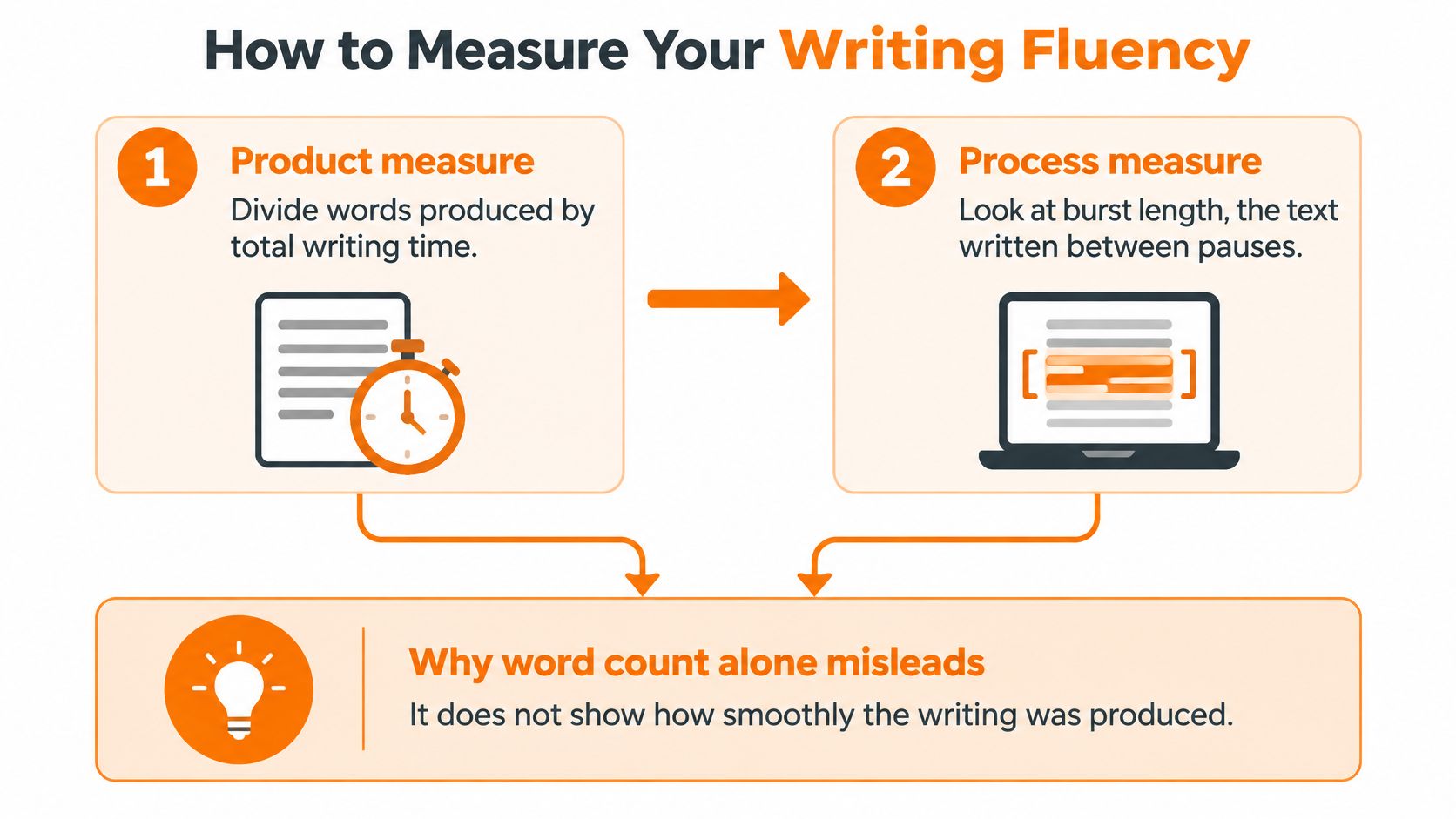
Word count alone misleads because it ignores pauses, deletions, and accuracy. You could hit the same total as last week while stopping twice as often, and the count wouldn't show it.
A 10-Minute Baseline Routine
- Pick a familiar prompt: Describe your last week, so limited topic knowledge doesn't skew the result.
- Set a 10-minute timer: Write without editing or going back, because corrections hide your natural pauses.
- Count the words: Use the total on the page when the timer ends, not after cleanup.
- Divide by 10: That gives you words per minute for this session.
- Note your pauses: Mark every pause longer than two seconds and estimate your longest unbroken burst.
- Count deletions and obvious errors: This shows whether speed is costing you accuracy.
- Repeat weekly: Use an equivalent prompt and log the numbers in a simple table.
Researchers use keystroke logging at millisecond precision to record pauses, deletions, insertions, and revisions, according to the Applied Linguistics keystroke study. You don't need that level of detail. A phone stopwatch and a notes app are enough for personal tracking.
How to Read Your Numbers
More words with shorter pauses suggests automaticity is improving, because basic production needs less conscious effort. More words alongside rising errors points the other way. You're trading accuracy for speed.
- Words up, pauses down: Keep the current practice going.
- Words up, errors up: Slow down slightly and separate drafting from checking.
- Words flat, bursts longer: You're still progressing, because continuity improved before total output did.
If you want a rough sense of the level your finished text reads at, a quick check of your writing level can complement these process numbers. It won't replace them, because it examines the product rather than how you produced it. Record your first baseline today, even if the number disappoints you. Without a starting point, later improvement is just a feeling.
Finding Which Part of Fluency Is Slowing You Down
The most common pattern is the long pause before each new sentence. The typing itself looks fine, but the writer stops at every full stop to decide what comes next. That usually points to planning, not typing skill.
Other patterns tell different stories. Pauses often signal planning or problem-solving, while deletions and rewrites signal repair. Matching the pattern to the cause stops you from practising the wrong thing.
| Pattern | Likely Bottleneck | Test to Run | Fix to Try |
|---|---|---|---|
| Long pause before each new sentence | Planning and idea organization | Outline three points before timing a draft | Outline each section in short bullets first |
| Pauses mid-word or hunting for keys | Transcription | Type a copied paragraph for five minutes and compare pauses | Short daily typing drills on familiar text |
| Frequent deletions in the opening sentence | Monitoring and perfectionism | Draft one timed session without using backspace | Set a no-edit draft window of 10 minutes |
| Fluent typing but awkward, repetitive sentences | Language generation | Read the draft aloud and mark each stumble | Sentence-combining practice |
| Fast drafts that need heavy cleanup | Accuracy | Count errors per 100 words | Check grammar after drafting, not during |
Test One Bottleneck at a Time
Don't change your outline, your keyboard, and your editing habits in the same week. If the numbers improve, you won't know what caused it. Pick the row that matches your draft most closely, run its test, and give the fix a fair trial.
The copied-paragraph test is especially revealing. If you pause just as much when copying, your ideas aren't the problem, because copying removes idea generation entirely. If copying flows but original writing stalls, look at planning or language generation instead.
A test is only useful if it can rule something out. Change one condition, keep everything else the same, and compare.
Keep the device and task type constant across sessions. Typing and handwriting can produce different results, especially if you're unfamiliar with the keyboard or you have dyslexia. Comparing a handwritten draft on Monday with a typed draft on Friday tells you about the medium, not your progress.
For the accuracy row, it helps to understand what a post-draft check can and can't do. This plain guide to how grammar checking works is a useful reference before you build checking into your routine. Run that check after the draft exists, because interrupting a burst to fix a comma trains the stop-start habit you're trying to break.
Practice Methods That Build Fluent Prose
Start with sentence combining, because it trains language generation directly. You take short, simple sentences and merge them into one complex, coherent sentence.

The Educational Psychology Review replication study involved 171 Turkish students in Grades 2-4, with 88 receiving sentence-combining instruction with peer-assisted learning and 83 receiving regular instruction. The intervention group achieved statistically higher scores for sentence fluency, writing quality, and essay length.
Sentence Combining in Practice
Here's a before and after you can copy. Before: "The study was long. It had many results. The results were useful." After: "The long study produced many useful results."
The facts didn't change. What changed is that you handled the connections inside one sentence instead of restarting three times. Practise with five sets a day from your own notes, and vary how you combine them rather than always joining with "and."
Timed Freewriting Without the Pressure to Perform
Write for 10 minutes, three times a week, on topics that don't matter. Don't stop to correct anything. Log your words per minute each time so gradual change becomes visible.
Short video guidance can help you set up this kind of low-stakes routine before you start.
If speed itself is your bottleneck, these practical ways to build drafting speed pair well with timed sessions. Keep the sessions short enough that you'll repeat them.
Outline First, Then Draft, Then Check
Outlining before drafting cuts planning pauses, because the decisions about order happen before the timer starts. Use three or four short bullets per section. Reading the draft aloud afterward catches stumbles and broken rhythm that silent reading skips over.
Drafting comes before editing. If you correct while you compose, you're training interruption, not fluency.
Once the draft is complete, run it through the grammar checker to catch errors and unclear sentences. That order matters. The tool supports the finished draft instead of breaking up the bursts that produced it. If your goal includes workplace writing, structured practice in professional email writing in English from Englify applies the same habits to a format where clear, steady sentences matter daily.
Expect your numbers to dip early. Practice exposes weak points in retrieval and planning before it fixes them, so a temporary drop is information, not failure. Change one habit at a time and give it two weeks before you judge it.
Set Your Fluency Baseline This Week
Run one 10-minute timed draft on a new prompt and record three numbers. Note your words per minute, your longest burst, and how many long pauses you took.
- Match your pattern: Find the closest row in the bottleneck table.
- Choose one habit: Pick outlining or sentence combining, not both.
- Practise daily for two weeks: Leave the rest of your drafting unchanged.
- Repeat the timed draft: Use an equivalent prompt and compare the numbers.
More words with fewer long pauses means progress. After that draft exists, check it for errors and unclear sentences, then revise by hand. We review writing patterns, sentence structure, and vocabulary to improve flow while keeping the original meaning and intent, and our AI Humanizer is designed to preserve the main point of your text while improving clarity, voice, and flow. Those tools help after drafting, not during it, and they don't replace the practice that builds fluency.
Do one thing today. Write one timed baseline draft and record the number.
Frequently Asked Questions
Is writing fluency the same as writing fast?
No. Speed is one part alongside automatic production, continuity, and accuracy. A fast draft full of errors doesn't count as fluent.
Can fluency improve in a few weeks?
Yes, though gains are often uneven. An early dip is common because practice exposes weak points first. A two-week test on one habit is a fair first check before you change approach.
Does typing or handwriting change the result?
It can. Results differ by device and familiarity, and students with low computer familiarity or dyslexia may write more fluently by hand. Compare sessions only on the same device, or you're measuring the medium instead of your progress.
Is a grammar checker enough to build fluency?
No. A checker helps with errors after drafting, but it can't train retrieval, planning, or continuity. Fluency grows from repeated drafting under light time pressure, with checking kept as a separate step.
When you've built a steadier drafting habit but a finished piece still reads stiff or generic, Lumi Humanizer can rework the rhythm, phrasing, and sentence variety of your completed text while keeping your original meaning intact. Use it on drafts you've already written and revised, so the fluency you practise stays yours.