The most popular advice about how to improve transitions between paragraphs is also the least useful: add a better connector word. If two paragraphs don't build on each other, "however" or "furthermore" won't fix them. It'll only make a weak boundary sound confident.
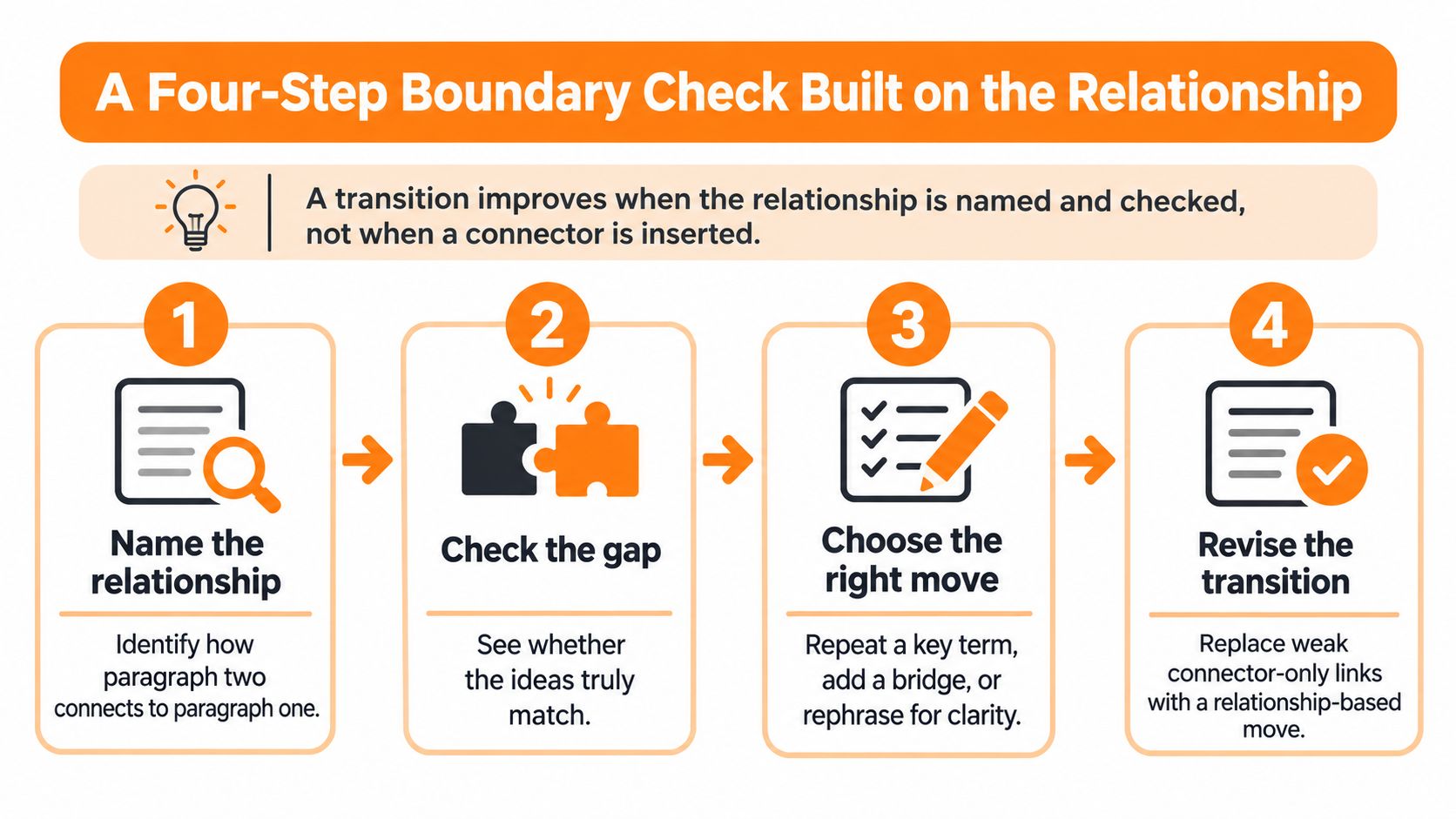
A transition improves when you name the relationship between two paragraphs, check whether that relationship is real, and then decide what the boundary needs. Sometimes that's one small signal. Sometimes it's a rewritten topic sentence, a bridge sentence, or moving a paragraph somewhere else entirely.
A Four-Step Boundary Check Built on the Relationship
Start with this answer: name the relationship first, choose wording second. A connector is a label for a logical move. If you haven't identified the move, you're guessing.
The Five Moves at Every Boundary
- Write each controlling claim in the margin. Reduce each paragraph to one short sentence. If you can't state the claim, your reader can't follow it either, and no transition will hide that.
- Label each paragraph's function. Is it making a claim, presenting evidence, admitting a limitation, or drawing an implication? The UNC Writing Center's transitions guide frames this as a four-pass edit, identifying the function on both sides before you select a signal.
- Name the relationship in plain words. Continuation, contrast, cause and effect, sequence, example, or qualification. Say it without connector language first. "Paragraph two limits paragraph one" is more useful than reaching for "however" and hoping.
- Pick the smallest signal that fits, or none. If a repeated key term already carries the link, you may not need a connector at all. If you do, choose one that encodes the relationship you just named, not one that merely sounds academic.
- Remove the transition and reread. If you can still reconstruct why paragraph two follows paragraph one, the logic is doing the work. If you can't, add a bridge sentence that summarizes what came before and forecasts what follows.
A transition should be removable without the argument collapsing. If removing it exposes a gap, the gap was always there.
The University of Barcelona style guide on connectors makes the same test explicit: first name the relationship between paragraphs in plain language, then choose wording that accurately signals it. "In addition" signals accumulation. "However" signals contrast. Using one when you mean the other misleads a careful reader.
Relationships Between Paragraphs and the Signals That Fit Them
| Relationship | Question to ask | Signal that fits | Common misuse |
|---|---|---|---|
| Addition | Does the new paragraph add a second reason? | In addition, Also | Using 'however' when nothing conflicts |
| Contrast | Does it oppose or complicate the last point? | However, In contrast | Attaching it to a point that agrees |
| Cause and effect | Does the last point produce this one? | As a result, Therefore | Calling a coincidence a cause |
| Sequence | Is this a later stage of the same process? | Next, Later | Using it for unrelated topics |
| Example | Does it illustrate the claim just made? | For example, In one case | Offering an example that does not support the claim |
| Qualification | Does it limit the earlier conclusion? | Still, Yet, That said | Stacking several qualifiers in a row |
A Worked Boundary
Say paragraph one ends by showing that remote work cuts commuting time. Paragraph two opens, "Also, managers need new evaluation methods." Run the check. The margin claims don't connect. The only link is "also", which promises addition but delivers a subject change, from employees to managers.
The fix carries the old term forward and names the true relationship, which is cause and consequence: "Remote work reduces commuting time, but that benefit changes how managers evaluate performance. They need measures based on results rather than visibility." Now the reader sees why evaluation follows commuting. The connector didn't create that logic. It only reported logic you built into the sentences.
If you can't name the relationship in one phrase at step three, stop. You don't have a wording problem yet.
Telling a Structure Problem From a Wording Problem
Here's the test that separates the two: can you write a transition specific enough to connect only these two paragraphs? If your bridge sentence could sit between any pair of paragraphs in the draft, it isn't connecting these ones. And if you can't write a specific one at all, the paragraphs may not belong next to each other.
That distinction matters because smoothness is often a structural problem, not a vocabulary problem. The Purdue OWL guide to transitions recommends a transition specific enough for only those two paragraphs and notes that difficulty creating one can indicate the paragraphs do not belong together. Virginia Tech guidance cited there makes the same ordering point: revise major structural problems, such as moving an entire paragraph, before minor edits like adding a transitional phrase.
Students often do this backward. They polish connectors for an hour, then a tutor moves paragraph three to the end and the whole problem disappears. Tools like a margin summary help here. Writing claims in sequence means building an outline after drafting, which is why learning how to use a reverse outline pairs well with this check. You see the argument's skeleton without the sentences distracting you.
Flow Problems, Likely Causes, and the Right Fix
| Symptom at the boundary | Likely cause | Fix to apply first |
|---|---|---|
| Abrupt jump to a new topic | Paragraphs share no controlling idea | Reorder, move, or split the paragraph |
| Logic is sound but unstated | Missing bridge sentence | Add a one-sentence bridge that summarizes and forecasts |
| Relationship is vaguely signaled | Topic sentence does not refer back | Rewrite the topic sentence to carry one key term forward |
| Connector feels forced | The relation was misnamed | Name the relation in plain words, then choose the signal |
| No specific transition fits | Paragraphs may not belong together | Move the paragraph or cut it |
Notice the order implied by the table. Structure first, bridges second, wording last. Moving a paragraph feels drastic, so writers avoid it and reach for adverbs instead. But word-level polish can't rescue a misplaced paragraph. It can only make the misplacement harder to spot, including for you.
Practical rule: if you've tried three different connectors at the same boundary and none feels right, the fourth connector isn't the answer. Move, split, or cut something.
When the logic is sound but implicit, add the bridge. When the relationship is there but weakly signaled, rewrite the topic sentence. When the ideas themselves are misaligned, reorder. Three different problems, three different remedies, and only one of them is solved by a word list.
Carrying One Concrete Term Across the Gap
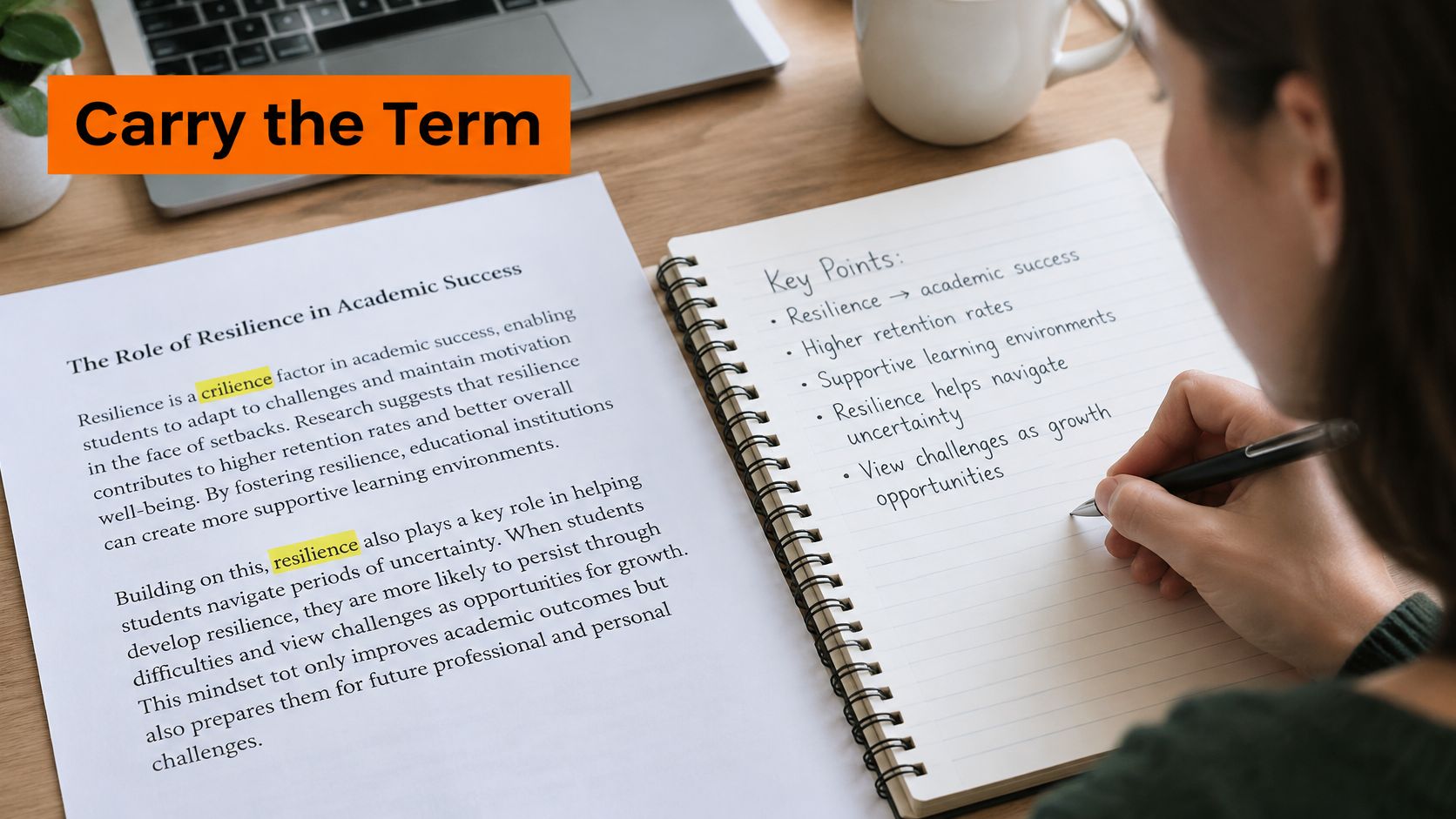
Repetition, not connector vocabulary, does most of the connecting work in real student writing. In one analysis reported in the Journal of Indonesian Social Sciences and Humanities study of cohesion ties, researchers identified 944 cohesion ties in 10 students' academic-background sections, and repetition or reiteration accounted for 454 ties, or 48.09%, making it the most frequent cohesive device. A separate breakdown in that study found repeating key nouns represented 66.27% of observed practices, while explicit transition signals made up only 8.88%.
That's a practical hierarchy for revision. First, preserve the topic thread by repeating an important term or using a precise reference. Then add a signal only when the relationship needs to be explicit. Finally, check that paragraph order reflects the argument's actual progression.
Before and After
- Before: "The new grading rubric is more detailed. The next issue is cost."
- After: "The new grading rubric is more detailed, but its cost determines whether departments can adopt it."
The first version announces a topic change. The second repeats the prior focus, the rubric and adoption, while introducing the next focus, cost. Readers get continuity and direction in one sentence. The word "but" helps, yet the carried term does the heavier work.
This short video walkthrough shows the same carry-forward move applied to a full draft paragraph:
The Four Moves
- Extract the controlling term. Find the noun or phrase the previous paragraph was really about, not just a word from its last sentence.
- Place it early in the next opening sentence. Readers anchor on familiar material before they accept new material.
- Add the new claim after it. Old information first, new information second, inside the same sentence when you can.
- Check the support underneath. Confirm the previous paragraph's final evidence supports this opening. If it doesn't, you've found a structure problem wearing a wording costume.
A Full-Passage Repair
Say a three-paragraph draft covers a pilot program. Paragraph two describes funding limits: a fixed grant, no renewal, costs rising. Paragraph three opens cold: "Staff training took six weeks." True, but disconnected. Name the relationship: funding limits are the cause, and training is the next stage the funding had to cover.
Rewrite the opening: "Those funding limits shaped the next stage, staff training, which the grant compressed into six weeks." One carried term, one named relationship, and two paragraphs that previously sat side by side now read as one line of thought.
Mistakes That Make Paragraph Flow Worse
These habits survive revision because they look like good writing at a glance. The prose sounds polished. The logic underneath is missing.
The USC writing guide on paragraph structure describes a paragraph as having a topic sentence, supporting details, and a concluding or bridge sentence, and notes that a transitional statement may be one or two sentences establishing the relationship between controlling ideas. That's the standard these five habits fail.
- Opening every paragraph with a connector: "Furthermore," "Moreover," "Additionally" at every boundary creates rhythm without logic. Delete half of them and see which boundaries still hold. Those are your real transitions.
- Using "however" without contrast: If paragraph two agrees with paragraph one, "however" tells the reader to expect conflict and then doesn't deliver it. Name the actual relationship and replace it.
- Starting with a vague "This": "This shows that training matters." This what? The funding limit, the survey, the failure? Replace it with a precise reference such as "This funding limit" or "This result".
- Stacking connectors: "However, nevertheless, in contrast" says one thing three times. It reads as uncertainty, not emphasis. Pick the single signal that fits and cut the rest.
- Announcing a topic without its relevance: "Another factor is funding" gives the reader a noun and no reason. Compare: "Funding limits explain why the pilot never expanded, so the next question is who paid for it." The second version states why funding appears here, at this boundary, in this argument.
One more hiding place: very long paragraphs. A paragraph longer than a printed page often contains a boundary you've avoided making, two claims fused together because separating them would force you to write the transition between them. Split it, then run the boundary check on the new gap.
Once the relationships are correct, do the surface pass. A quick run through a grammar checker catches the punctuation and agreement slips that rewriting topic sentences tends to introduce. Logic first, cleanup after. Reversing that order is how polished drafts stay incoherent.
Flow Across Languages and AI-Assisted Drafts
A grammatically correct connector can still sound unnatural. It happens when the word is right for the grammar but wrong for the relationship, or when it repeats information mechanically because a template, not a decision, put it there.
The National Taiwan University writing materials on cohesion and coherence recommend beginning with information readers already know and moving toward new information, and they caution that transitions should reflect an existing logical relationship rather than create one. Fewer transitions work better when the structure is already clear. That's the principle to carry across languages, because connector habits don't transfer cleanly. A signal that's routine in your first language may sound stiff or overly formal in English academic prose.
Three Checks for These Drafts
- Diagnose in your own language first: Name the relationship, contrast, cause, qualification, example, or continuation, in whichever language you think fastest. Then choose the English signal. Translating a connector word by word skips this step and produces most "correct but odd" boundaries.
- Carry a term, vary the wording: Bring one meaningful term into the next topic sentence, but don't repeat the whole previous sentence. The transition should come from your content, not a stock phrase.
- Read for connector density: Scan only your paragraph openings. If most start the same way, the flow is templated even when each link is individually logical.
AI-assisted drafts fail the density check constantly. Say four consecutive paragraphs open with "Additionally". Rewrite two with carried terms: "That time saving, though, changed how managers judged performance." And: "Performance data raised a second problem, who owned the results." Same additive logic, but now each opening contains information. The preserving your terminology point matters here too, since generic rewrites often flatten disciplinary language into general words. There's more on that balance in this guide to how to preserve your voice when editing AI drafts.
If you use the AI Humanizer on an assisted draft, treat it as one step among these checks, not a substitute for them. Output quality is highest for English content, with effectiveness varying for other languages based on complexity, so check boundaries by hand afterward, especially in translated text.
Confirm Each Boundary Before You Submit
Do a final audit of every adjacent pair of paragraphs. Require a named relationship for each one. Flag any pair whose relationship you can't name in one phrase, because that flag is telling you where the argument, not the wording, needs work.
The Final Pass, in Order
- Paragraph order and splits: Does the sequence of margin claims match your thesis? A draft can read smoothly while every paragraph is clear and none of them builds toward the main argument.
- Bridge sentences: Does each one summarize the prior point and forecast the next, in terms specific to those two paragraphs?
- Topic sentences: Does each opening carry one concrete term forward before introducing its new claim?
- Connector words: Only now. Check each one against the relationship you named, and delete the ones doing no work.
For AI-assisted drafts, Lumi reviews writing patterns, sentence structure, and vocabulary to improve flow while keeping the original meaning and intent, and the AI Humanizer is designed to preserve the main point of the text while improving clarity, voice, and flow. That helps a uniform draft sound less mechanical. You still own the boundary judgments, since you're the one who knows what the argument is. A final read with fresh eyes, the same mindset you'd bring to using a grammar checker as a last review step, catches what familiarity hides.
Frequently Asked Questions
How many transition words is too many? There's no safe count. If most paragraphs open with one, that's too many, because it means connectors are substituting for carried terms and named relationships.
Should every paragraph start with a transition? No. Every paragraph should connect, but a repeated key term or a topic sentence that opens with known information often connects without any connector word at all.
Can a paragraph ever have no transition? Yes, when the order itself is obvious, such as chronological steps or a list you announced in advance. The test is whether removing the signal leaves the relationship intact. If it does, the paragraph already has its transition.
Learning how to improve transitions between paragraphs mostly means learning to distrust the quick fix. Name the relationship, carry the term, and fix the structure when the name won't come.
Run your next AI-assisted draft through Lumi Humanizer after you've done the boundary check, and it'll smooth the rhythm and phrasing while keeping your argument and terminology intact. Then reread each paragraph opening yourself, because the final call on whether two paragraphs connect is yours.