
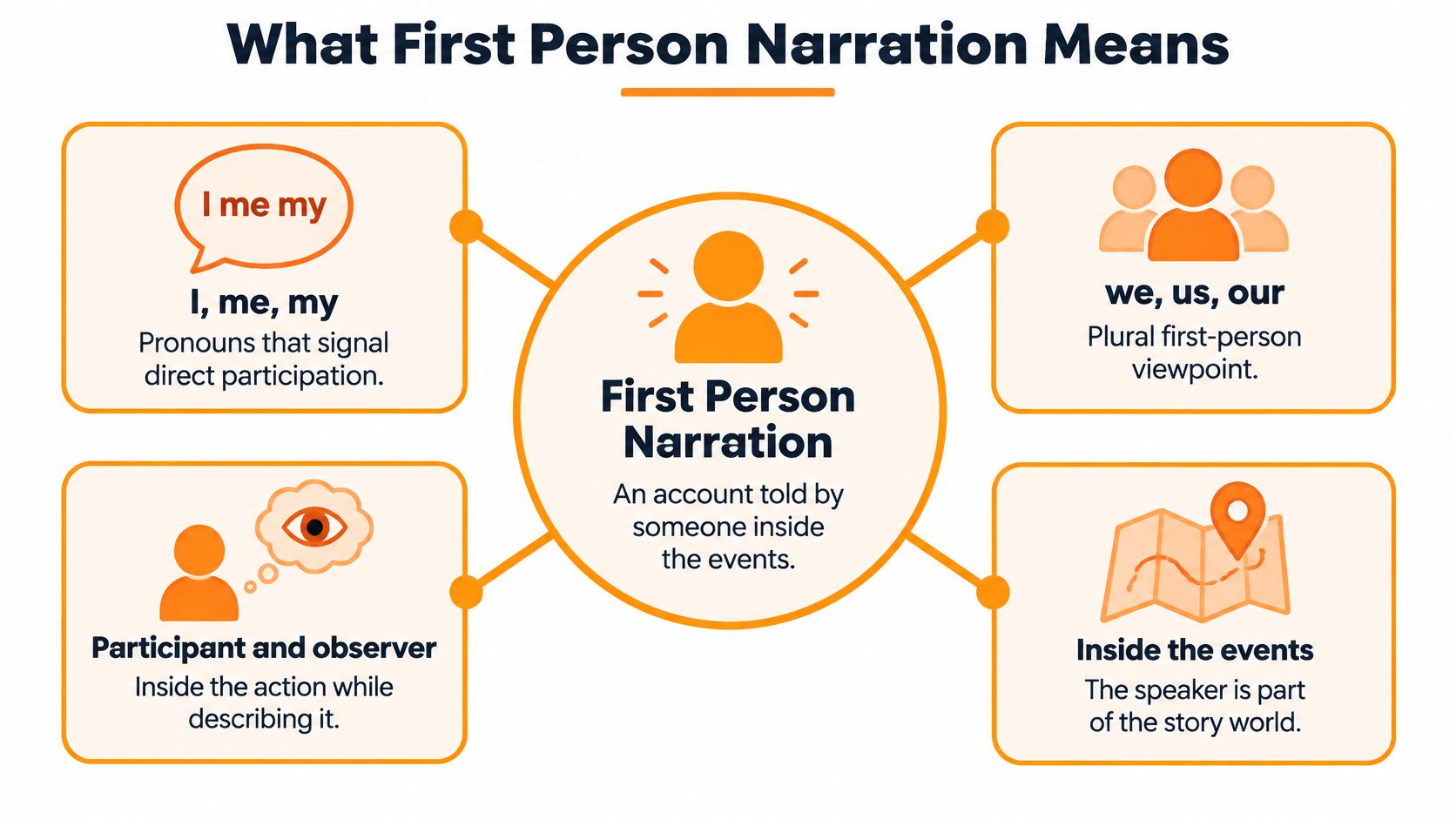
First person narration is an account told by someone inside the events, marked by I, me, my, we, us, and our. The pronoun alone doesn't create trust, even when it brings readers closer to the speaker.
The familiar advice to use first person for instant intimacy skips the harder question: what does this particular speaker let the reader understand? A convincing voice needs a clear role, a deliberate tense, and believable limits on what it knows. Closeness can help readers enter an experience without making them believe, like, or sympathize with the person describing it.
What First Person Narration Means
A first-person speaker belongs to the story world and supplies the account readers receive. The Hillsborough College creative writing lesson on points of view identifies this combination of participation and observation as the defining feature of the viewpoint.
Compare these sentences:
| First person | Third person |
|---|---|
| I heard the door slam and hid behind the stairs. | She heard the door slam. |
In the first sentence, the speaker hears something and acts. Readers receive the incident from someone who was there. The second sentence places the teller outside the character, although third-person narration can still give close access to her thoughts.
Participation isn't the same as personality
Changing she to I changes grammatical perspective. It doesn't automatically give the speaker an individual way of noticing, interpreting, or responding.
Consider a continuation: I counted the footsteps because my brother always took the stairs two at a time. The detail makes the speaker's attention meaningful. They aren't recording every sound in the house; they're listening for a particular person.
Memoirs, autobiographies, personal essays, diary fiction, and character-led novels are familiar homes for this viewpoint. A memoir's speaker makes factual claims, while a fictional speaker inhabits an invented world. Both need a consistent relationship between their experience and their account.
When the speaker says we
We waited behind the stairs remains first person. The speaker might represent a group, or one person might be describing an experience shared with others.
Make that group identifiable. We feared the announcement claims shared feelings; we gathered outside the office reports shared action. Those aren't interchangeable claims.
For an adaptation exercise, you could turn a story into a video with AI using ClipNova AI, then compare the voiceover with the visible action. Ask which details belong to the speaker's experience and which the images introduce independently.
Practical rule: Choose the person whose experience gives the account its purpose, not simply the pronoun that sounds most personal.
Protagonist Observer and Unreliable Speakers
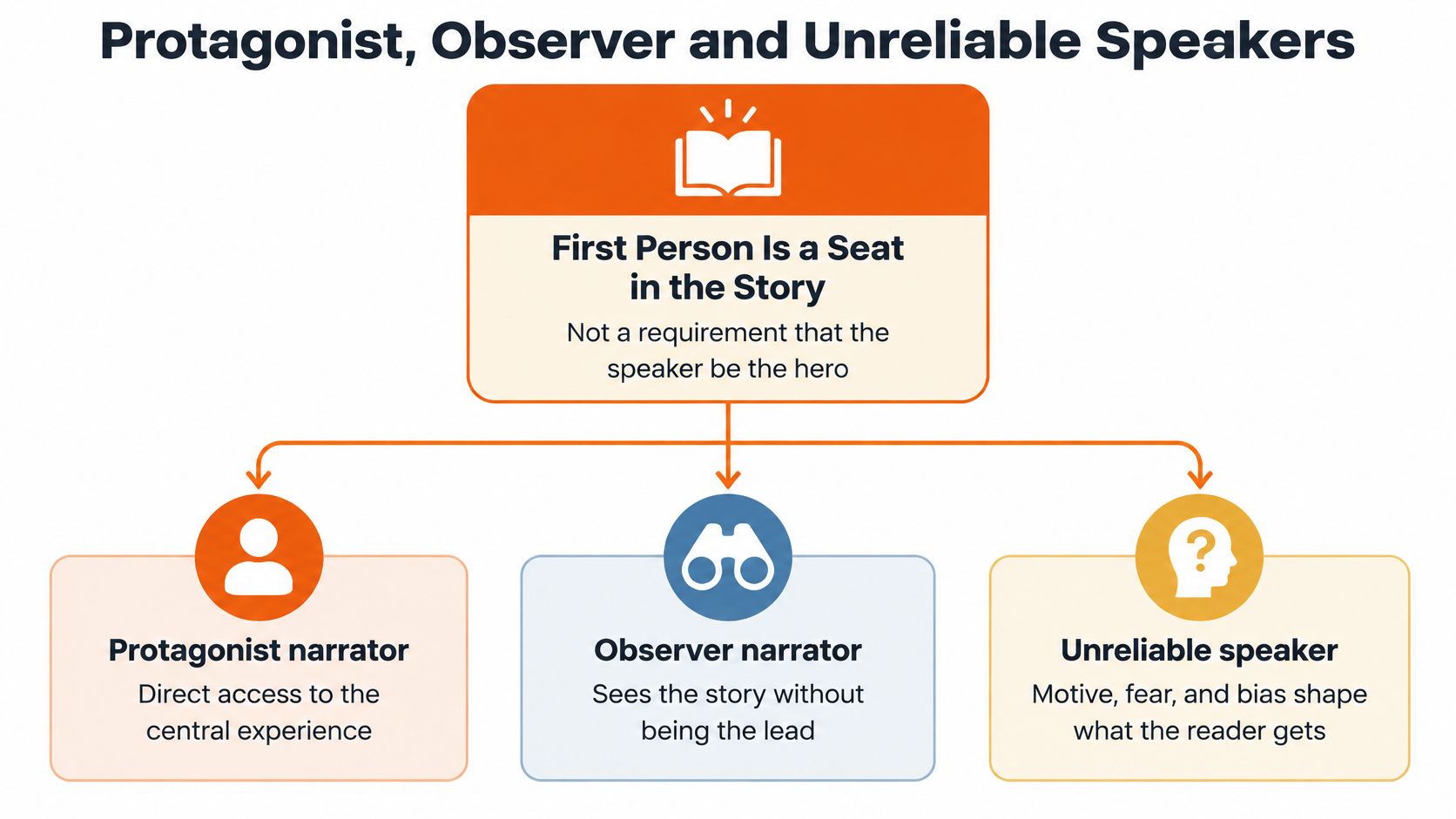
First person is a seat inside the story, not a requirement that the speaker be the hero. The narrator can describe their own central struggle, witness someone else's, or give an account readers have reason to question.
The Ignited Ink guide to first-person narrators distinguishes protagonist, observer, and unreliable approaches. These choices affect both the information readers receive and the interpretive work they must do.
Three seats for a first-person narrator
| Narrator role | What the reader gets | Main risk |
|---|---|---|
| Protagonist | Direct access to the central character's experience and motives | Bias can look like the whole truth |
| Observer | A filtered view that can make the main character more mysterious | Important facts stay outside the speaker's reach |
| Unreliable | A gap between the account and the details, which the reader interprets | Alienation if the distortion is incoherent or unearned |
The protagonist owns the central problem
A protagonist narrator might describe deciding whether to admit a mistake. Readers hear the fear, reasoning, and excuses that precede the admission.
That access is useful, but it isn't independent verification. A speaker who explains why they concealed a mistake may be examining their motives or making themselves look better.
An observer changes the emphasis. A colleague describing that same admission can notice pauses, evasions, and consequences, but can't directly supply the decision-maker's private struggle.
Unreliability needs a recognizable pattern
Say a narrator insists that a friend is perfectly calm, then describes trembling hands and a breaking voice. Readers can recognize distress that the speaker denies or misunderstands.
The contradiction works because the details support an alternative interpretation. Randomly changing facts doesn't achieve the same effect. Give the distortion a reason, such as loyalty, embarrassment, jealousy, or an unwillingness to face a loss.
Unreliability can overlap with either of the other roles. A protagonist can misrepresent their own actions, and an observer can misunderstand the person they're watching.
For a short inference exercise, solve a quick browser mystery at Mystery Hunch and separate explicit information from your conclusions. Apply that distinction when drafting: what does the narrator report, and what should readers work out?
In professional writing, a founder's testimonial can claim responsibility for a decision. A colleague's case narrative offers a more indirect account of the founder's behavior. Neither role permits invented access to someone else's mind.
Choose a stable role for the piece. If a letter, interview excerpt, or second narrator introduces another I, label the change so readers don't have to guess who's speaking.
Tense Choice and What the Speaker Can Know
Compare the same realization in different tenses:
I opened the letter and realized I had been wrong.
I open the letter and realize I am wrong.
Past tense presents the event as completed. Present tense presents it as unfolding. The Author Learning Center guide to first-person point of view explains how that choice changes the narrator's relationship to the experience.
Past tense gives the speaker room to distinguish an earlier understanding from a later one. A narrator can admit that the letter seemed reassuring at the time but eventually proved misleading. Present tense keeps the immediate interpretation closer to the foreground.
Establish a time frame before shifting it
Choose one primary tense for the main account. A flashback or retrospective comment can use another tense, but the shift should identify a real change in time rather than an accidental change in wording.
Purdue OWL's tense-consistency principle is to make changes relative to an established time frame. That doesn't mean every verb must look alike. In I open the drawer and find the note I wrote yesterday, the past-tense verb belongs to an earlier action.
A useful editing question is: When does this action happen relative to the main scene? Answering it is more reliable than mechanically changing every verb to present or past.
Put a boundary around the speaker's knowledge
A first-person speaker can report what they perceive, remember, infer, or credibly learn. Distinguish those routes rather than treating them as equivalent.
- Direct perception: I saw her leave reports an observed action.
- Inference: I thought she wanted to leave identifies an interpretation.
- Later discovery: I learned the next morning that she had left explains how information became available.
By contrast, I knew the thought she never spoke introduces access the narrator hasn't earned. It needs an established explanation, such as mind-reading within the fictional world or a later conversation in which the other person disclosed that thought.
Retrospection also lets a narrator regulate emotional distance. A study of pronouns and psychological distance describes how moving away from first-person self-reference can support a more distanced response to negative experiences.
That's a deliberate technique, not permission for uncontrolled viewpoint changes. A reflective passage might describe the speaker's earlier behavior more observationally while keeping the reader oriented.
Before moving on, check the page:
- Primary tense: The main scene has a consistent time frame.
- Available knowledge: Every claim has a believable route to this speaker.
- Marked transitions: Memories, later discoveries, and reflective pauses are clearly signaled.
When Closeness Helps and When Trust Falls
First person can bring readers closer to a story without making them more empathetic or more trusting. Immersion, engagement, empathy, and trust are separate responses, so choose a viewpoint for the response it can support, not for an automatic intimacy upgrade.
| Reader response | First person | Third person | What to do with it |
|---|---|---|---|
| Narrative engagement, controlled experiment | Mean 4.50 (SD 0.87) | Mean 4.26 (SD 0.92) | Expect a small gain, partial eta squared .02, not a transformation |
| Immersion, 2024 self-paced reading study and discussion of perspective findings | Mean 64.3 | Mean 58.8 | Higher reported immersion; reading time did not differ significantly |
| Emotional engagement, 2024 meta-analysis of nine studies involving 6,770 participants | Significantly greater | Lower in the comparison | Emotional engagement increased, but the combined effect on emotional engagement and behavioral intent wasn't significant |
Read each response separately
Narrative engagement concerns involvement with the account. In the controlled experiment, the difference was statistically significant, F(1, 538) = 10.11, p = .002. Its small effect size suggests a modest shift, not a guaranteed connection.
Immersion is the feeling of entering a story world. Higher reported immersion does not necessarily mean readers process the story faster or trust its speaker more. A reader can feel inside a scene while remaining skeptical about the person describing it.
Empathy means understanding or sharing another person's feelings. First person does not reliably increase it. Trust concerns whether readers accept the narrator or account as credible. Readers may understand a narrator's shame and still doubt the explanation for what happened.
The meta-analysis supports a narrower conclusion than “first person persuades better.” Emotional engagement and an intention to act are different outcomes.
Readers can feel close enough to understand a speaker's excuses and still decide not to believe them.
Match closeness to the writing task
First person places the speaker's perceptions and goals at the center of the account. That can increase involvement, while also making the speaker's omissions, selective memory, and self-justification more noticeable. A morally complicated narrator may become more compelling without becoming more credible.
Choose first person for personal essays, testimonials, case narratives, and character-led brand stories when the speaker's perspective is part of the value. If readers need to assess a disputed claim, give them observable evidence and distinguish what the speaker reports from what they infer.
For audio or branded narratives, storytelling techniques for content creators can help shape delivery. Viewpoint and factual credibility remain separate choices.
Viewpoint is also distinct from tone in writing. A first-person account can sound defensive, restrained, curious, or affectionate. Choose an attitude that fits the speaker's situation; personal pronouns alone do not supply warmth.
Rewrite a Flat I Into a Situated Voice
A paragraph can be grammatically first person and still give readers little sense of a particular mind. Consider this workplace scene.
Before
I was nervous in the meeting. I thought the client was unhappy. I said we could fix it.
The speaker names feelings and an interpretation, but readers have little evidence to assess either. The final promise also leaves responsibility vague: who will do the fixing?
After
I kept my thumb on the printed agenda so it would not shake. The client had not looked up since the third slide. I said we could rebuild the timeline, and I heard how thin that we sounded.
The revised paragraph adds a physical tell, an observable behavior, and a reaction to the speaker's own wording. It doesn't declare that the client is unhappy. Readers can consider that possibility without being told it's a fact.

Revise the evidence before the vocabulary
Work through these changes in order:
- Replace a feeling label with an action. Instead of adding stronger synonyms for nervous, show the speaker holding down the agenda. Keep a direct feeling statement when plain admission suits the voice.
- Cut unavailable facts. Replace claims about the client's private judgment with something the speaker could observe. If an interpretation matters, identify it as an interpretation.
- Keep the time frame steady. Maintain the scene's main tense, and mark any remembered conversation or later realization.
- Give we a real referent. Name the team responsible for rebuilding the timeline, or let the narrator recognize that they've promised work on other people's behalf.
Notice that the revision doesn't merely add sensory decoration. Each detail changes what readers can infer about the meeting and the speaker's conduct.
A useful example of diction can help with the next pass: deciding whether the vocabulary fits this particular narrator. A junior employee, a technical lead, and an exhausted account manager may notice different problems and describe them differently.
Separate editing jobs
Use a grammar checker for spelling, agreement, and clarity, and review its suggestions for accidental tense changes. Software can flag a sentence, but you still need to decide whether its time reference is intentional.
Paraphrasing for variation is a different job from humanizing generated prose. If every sentence has the same cadence, the problem may be rhythm and voice rather than repeated vocabulary. A humanizing pass should preserve meaning while making those choices less mechanical.
Neither operation can supply experiences the speaker never had or justify unsupported claims. Start with one paragraph of your own, apply the revision moves, and read it aloud before changing the whole draft.
How Often Fiction Has Used First Person
First person has not been a steady default in fiction. A study of French novels, for example, estimates that first-person memoir novels made up about 10% of literary production in the first half of the seventeenth century and roughly 30% in the first three decades of the eighteenth. The study of French novels offers one view of how the form's popularity shifted over time.
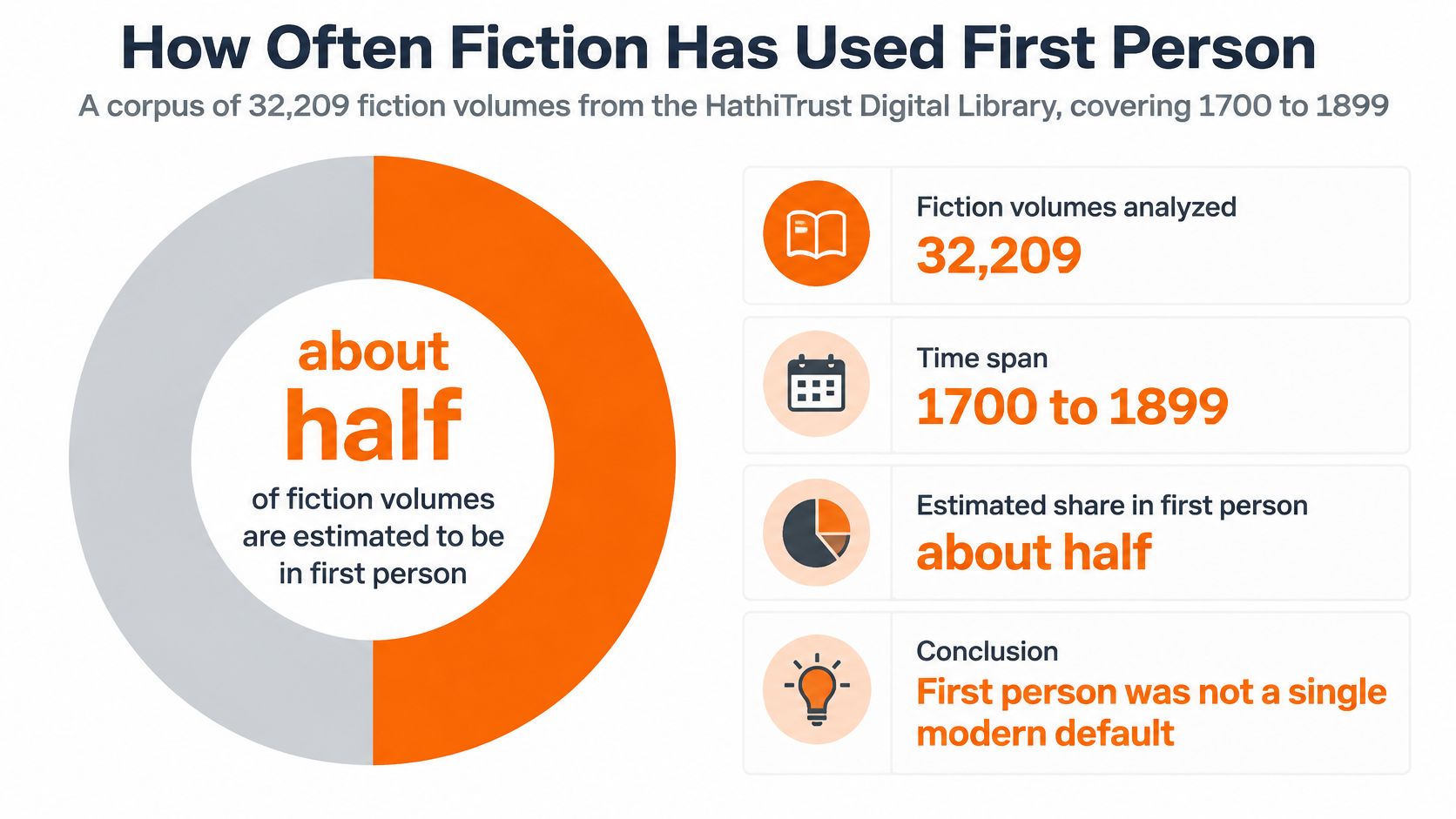
A separate analysis of 32,209 fiction volumes published from 1700 to 1899 estimated that about half of eighteenth-century fiction used first person, compared with about one quarter of nineteenth-century fiction. The analysis of fiction volumes also found different proportions among women and men writers across the full period.
First-person share of fiction, 1700 to 1899
| Group or period | Approximate share using first person |
|---|---|
| Eighteenth-century fiction | About half |
| Nineteenth-century fiction | About one quarter |
| Women writers, full period | About 23% |
| Men writers, full period | About 35% |
Count works, not words
These estimates describe the share of fictional works or volumes, not the share of all words written. Each work counts as a work, whether it is short or long.
The author-group figures describe this collection, not an inherent preference associated with gender. Publication period and corpus composition shape how such comparisons should be read. For writers, historical popularity offers context, not a rule: the right viewpoint depends on the story's purpose and on what its narrator can know.
The eighteenth-century estimate is about half; the nineteenth-century estimate is about one quarter. Read together, the figures show that first person's prevalence changed across periods rather than increasing steadily toward a universal preference.
Earlier French fiction provides another perspective. The historical study places first-person memoir novels at about 10% of literary production in the first half of the seventeenth century and roughly 30% in the first three decades of the eighteenth. That rise connects first person with autobiographical framing and individual witness, while later patterns show that literary conventions can shift.
For a writer, history supplies possibilities, not permission slips. A blog, memoir, or novel needs a viewpoint suited to its purpose and audience. Popularity can explain a convention, but it cannot decide which speaker should tell your story.
First-Person Narration FAQ
Can academic or business writing use I?
Yes, when the writer reports their own method, decision, or experience and the relevant style permits it. I excluded incomplete responses identifies who made a methodological choice more clearly than a sentence that hides the actor.
Follow the assignment, journal requirements, or house style when they require an institutional voice. The useful test is whether the speaker's presence adds accountable knowledge, not whether personal pronouns sound more conversational.
Collective voice and difficult material
Is we always warmer than I?
No. We approved the change can share responsibility accurately, but it can also hide who made the decision. In business prose, name the group when readers need to know whose authority or experience the sentence represents.
Don't use we to assume that every reader shares an attitude. A sentence that includes the audience grammatically can still exclude people whose experience differs.
Should a painful memory stay in first person?
Keep I when the purpose is to acknowledge an experience or take responsibility for an action. If the purpose is careful analysis, a more observational frame may be useful.
That doesn't require rewriting the whole account in third person. You can describe actions plainly, separate remembered sensations from later judgments, and avoid making every sentence carry the full emotional intensity of the event.
AI assistance and authorial voice
Does first person make AI-assisted prose sound human?
Not by itself. Repeated sentences beginning with I was, I felt, and I think can still sound mechanical, especially when the speaker's reactions remain generic.
A cadence and personal-style pass should address rhythm, emphasis, and word choice without inventing personal experience. An AI-detector estimate isn't a guarantee of authorship, originality, or acceptability under an institution's rules.
- Check the claims: Confirm that personal statements reflect experiences you can represent.
- Check the voice: Read aloud for repetitive openings and reactions that don't fit the speaker.
- Check the context: Follow any disclosure or AI-use requirements that apply to the work.
Write one paragraph in the chosen role and tense, then delete anything the speaker couldn't know. Keep the viewpoint only if the voice earns the reader's trust, because that's the practical test of first-person narration.
Lumi Humanizer helps reshape AI-generated text into more natural prose while preserving its meaning. Once you've checked your narrator's role, tense, and knowledge limits, visit Lumi Humanizer to refine a paragraph's tone and cadence, then review the result against the voice you intended.