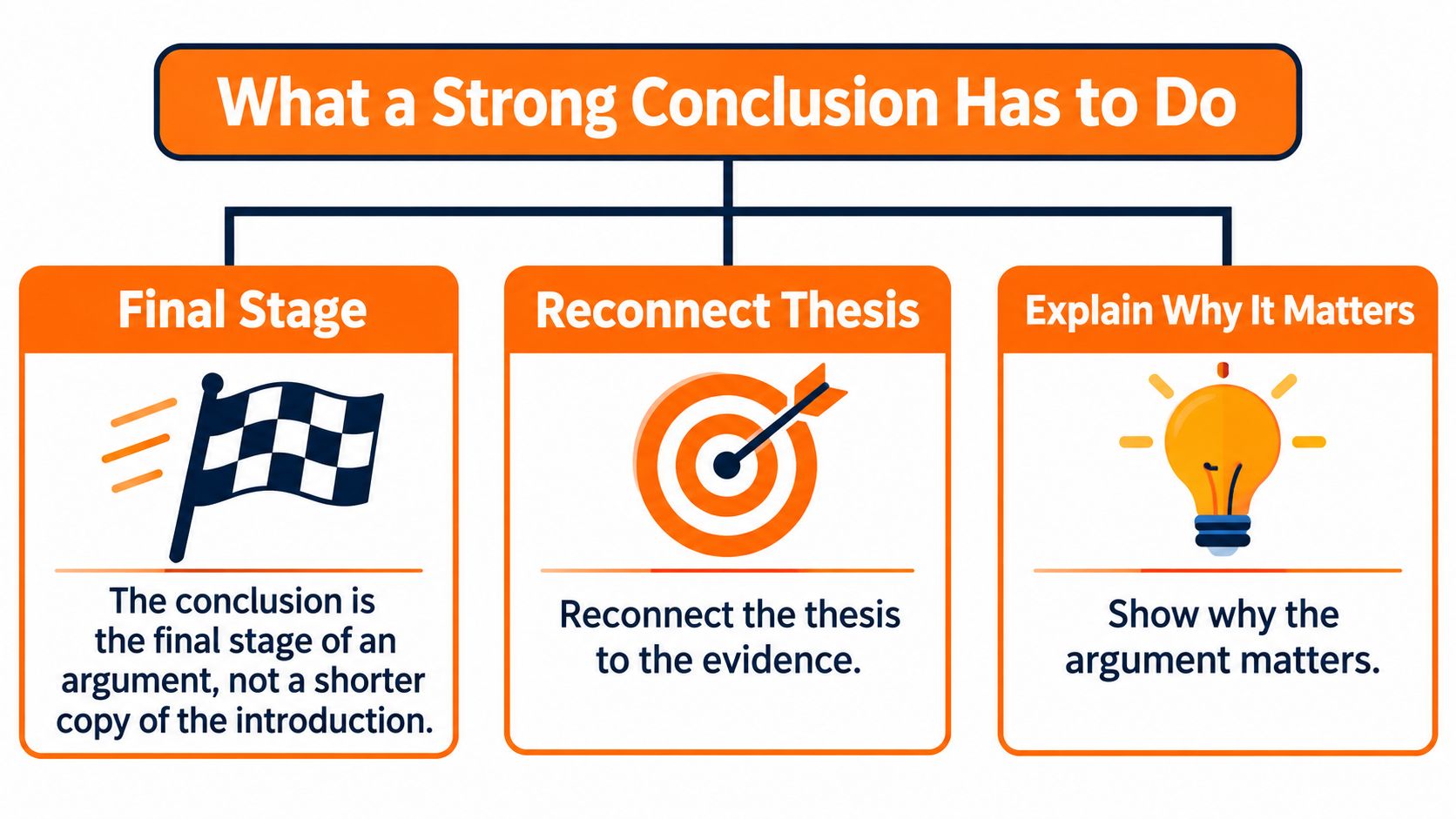
You're staring at a finished body, a cursor blinking below it, and no clear way to end without repeating yourself. Learning how to write an essay conclusion solves that problem. A conclusion is the final stage of an argument, not a shorter copy of your introduction. It reconnects your thesis to the evidence you've earned and explains why the result matters.
What a Strong Conclusion Has to Do
A strong conclusion does three jobs at once. It restates what you've proved, shows how your evidence proves it, and answers the reader's quiet question, so what? If any one of those jobs is missing, the essay feels unfinished even when the body is solid.
The University of Iowa's history-writing guidance describes the standard essay as having three structural parts, an introduction containing the thesis, body paragraphs supplying evidence, and a conclusion that restates the thesis while suggesting broader implications. That structure tells you where each task belongs. You're not proving anything new at the end. You're converting proof you already have into a final judgment.
The Three Questions Behind the Paragraph
William & Mary's conclusion guide organizes the work around what the writer intended to prove, how the evidence proved it, and what broader significance follows. That's a useful order for drafting. Start with your central claim in fresh language, then synthesize the main evidence instead of listing every paragraph, then state the significance.
Notice that synthesis is different from summary. Summary says, first I discussed this, then that. Synthesis says how those points work together, which is why a reader learns something from the ending itself.
Hamilton College warns that stopping abruptly, or merely repeating the paper, leaves readers uncertain about significance. Your conclusion has to add to the introduction because the reader has now traveled through your analysis. If you need the wider frame first, this guide to essay structure for better grades helps you place the ending inside the whole essay.
Quick test: Can you say in one sentence what the essay established and why that result matters beyond the body paragraphs? If you can't, the conclusion isn't finished yet.
That test also exposes weak bodies. If you handled an opposing view earlier, for example through a clear rebuttal in an argumentative essay, your ending should reflect what survived that challenge. It shouldn't pretend the challenge never happened.
How to Write the Conclusion Step by Step
A weak ending is often unfinished reasoning. A claim appears in the last paragraph that the body never earned, or a strong body point never makes it into the closing. This four-stage method works like a final inspection on a build. Each stage checks that every closing sentence traces back to work you already did.
General advice on ending strategies, such as the Harvard Writing Center strategies guide, describes common moves like returning to the thesis and stating significance. This guide turns those moves into a specific order you can follow: transition from the final body paragraph, synthesize the argument, restate the thesis as a result, and answer the so what.
Stage 1 Transition From Your Last Point
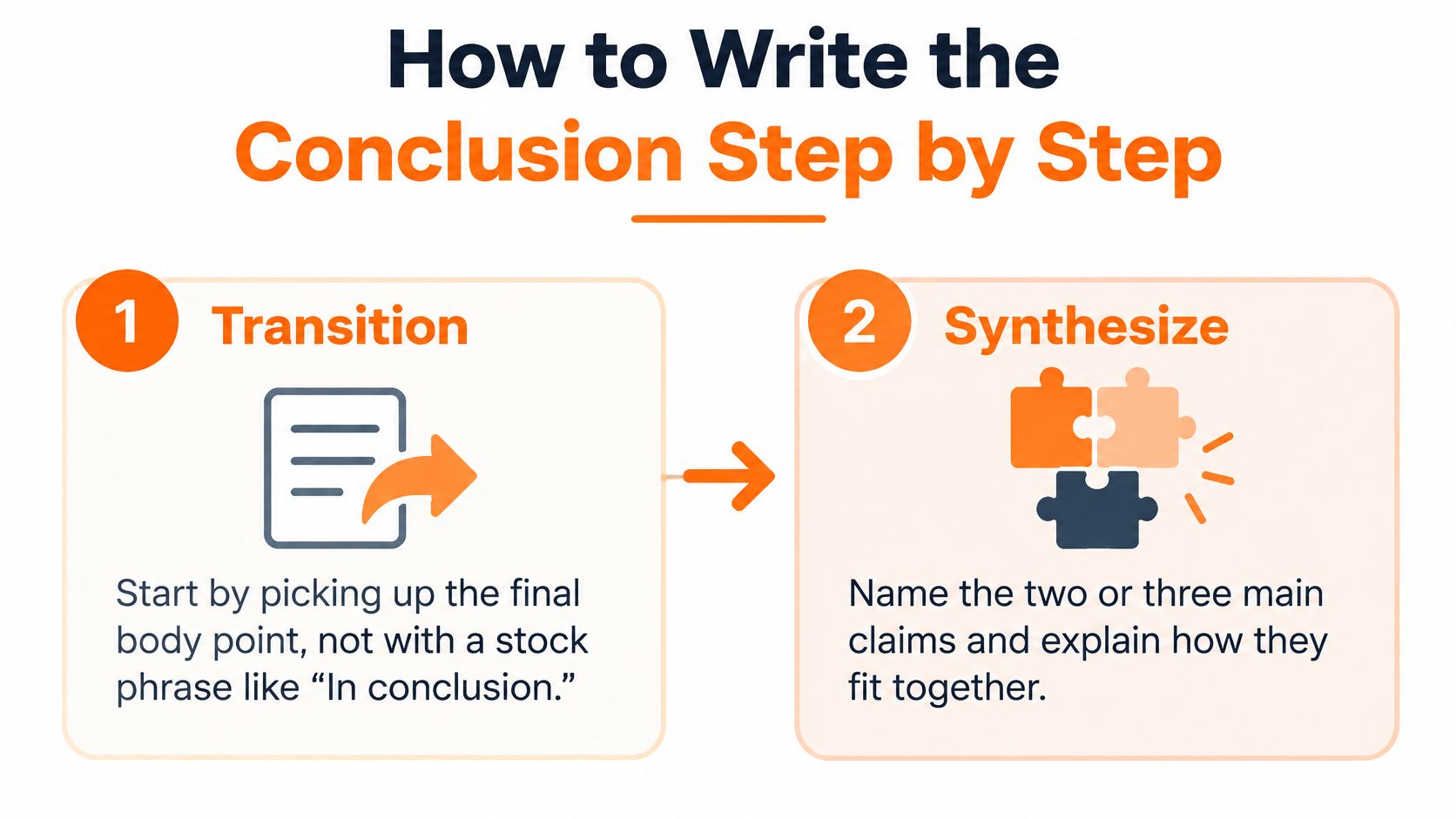
Pick up the idea your final body paragraph ended on and turn it toward the whole argument. Students often open with "In conclusion." That phrase announces an ending instead of performing one, and it wastes the sentence where momentum matters most.
Try a bridge instead. If your last paragraph ended on access to public transit, start with what access means once cost and emissions are included. The reader feels movement, not a restart. One sentence is enough here.
Stage 2 Synthesize Instead of Listing
Name your two or three main claims and explain how they connect. Listing feels safer. It reads like a table of contents, and it adds nothing new.
Suppose your essay covers transit cost, emissions, and access in separate sections. A list repeats three benefits. A synthesis links them. Lower fares expand access for low income riders, and fuller buses mean fewer car trips, so transit functions as economic and environmental policy at once. That connection could not appear in any single body paragraph, because each paragraph handled one point alone. Precise linking words help you join those points cleanly, and building your essay writing vocabulary for transitions and synthesis gives you options beyond "also" and "in addition."
The video below walks through this transition and synthesis move in a short draft, so you can hear the difference between listing and connecting.
Stage 3 Restate the Thesis as a Result
Now restate your thesis in language that reflects what the essay demonstrated. Your introduction promised an argument. Your conclusion reports the outcome, including any limit the evidence revealed.
Accuracy counts more than drama. If the body supported a narrower version of your opening claim, write the narrower version. Markers trust that honesty, and it keeps the trace clear from evidence to final claim.
For a subject-area example that keeps its final claims proportionate to classroom evidence, see the 2026 inclusive education paper guide. It stays specific about what was shown instead of stretching into a sweeping verdict.
Stage 4 Answer the So What
Close with significance. Name one academic implication, one practical consequence, or one research question your result opens. Keep the scale matched to the paper. A school level essay on uniforms can recommend a criterion for a school board. It cannot settle national policy.
Every sentence in your conclusion should connect evidence to the thesis, clarify the resulting insight, or establish significance. If a sentence does none of those, cut it.
Before you stop, run a backward traceability test. Point to the body paragraph that earned each closing claim. Keep new quotations, statistics, and major counterarguments out of this paragraph, because they need analysis and no space remains to give it. In a short essay, the result is usually five to six sentences, roughly one or two per stage.
A Weak Conclusion Rewritten Line by Line
Examples make the difference clearer than rules do. Take one thesis and watch a weak ending become a working one.
Say the introduction claims, "School uniforms reduce visible economic differences but limit student choice." A weak conclusion for that essay often reads like this.
"In conclusion, school uniforms have many pros and cons. They reduce differences but limit choice. Schools should think carefully."

What's Wrong With That Version
Three problems sit in those three sentences.
- The opening announces instead of arguing. "In conclusion" tells the reader the essay is ending, which they already know from the page layout.
- The middle repeats without synthesizing. "Reduce differences but limit choice" copies the thesis and adds nothing the body earned.
- The close is too vague to use. "Think carefully" gives a school board no criterion for deciding anything.
None of those sentences could only have been written after the body existed. That's the failure. A conclusion should be impossible to write before you've done the analysis.
The Rewrite
The University of Maryland Global Campus writing guidance notes that you may place the restated thesis at the beginning, middle, or end of the concluding paragraph, but the wording should be fresh and independent. Using that freedom, the rewrite might read as follows.
"Uniforms can promote social parity, although that benefit comes with a measurable loss of personal expression. Because the gain is social and the cost is personal, a board weighing a uniform policy should measure both effects in its own schools before deciding, rather than assuming one outweighs the other."
The position hasn't changed. "Social parity" restates reduced economic differences, and "loss of personal expression" restates limited choice. What's new is the relationship between them and a specific implication a decision maker can act on.
Notice the rewrite isn't better because it's longer or uses fancier words. It's better because it connects the claims and ends with a reason the argument matters. It also stays inside what the body can support. It doesn't suddenly claim uniforms improve grades if grades were never discussed.
Try this habit on your own draft. Read your conclusion aloud and mark every sentence you could have written before researching. Those are your rewrite targets. Replace each one with language that depends on evidence you presented.
Mistakes That Weaken an Essay Ending
Most weak endings fail in predictable ways, and each one has a fix you can make in a single revision pass. Purdue OWL's argumentative essay guidance advises writers to readdress the thesis in light of evidence already presented, synthesize the body's information, and explain why the topic matters, rather than introducing a new statistic, quotation, or major argument the body never developed.
Keep that boundary in mind as you scan your draft against the table below.
| Mistake | What it looks like | Fix |
|---|---|---|
| Repeating the introduction | Thesis sentence copied word for word | Restate in fresh wording shaped by the evidence |
| Listing body points | Three topics named in sequence | Synthesize the relationships between them |
| New evidence | A new statistic or quotation appears | Move it into a body paragraph and analyze it first |
| Ending with a question | Closing line hands the issue back to the reader | Give closure and state the implication |
| Abrupt stop | Paragraph ends right after the last body point | Add a so-what sentence |
| Unsupported broad claim | Sweeping statements beyond the essay's subject | Keep the ending within the subject |
The new evidence mistake deserves special care. If a fact feels essential in your final paragraph, that usually means your body has a gap. Move the fact earlier, analyze it there, and let the conclusion use only its result.
How Long a Conclusion Should Run
A short essay conclusion usually runs about five to six sentences. That count is not a rule. Length should scale with the number and importance of the arguments you developed.
A useful benchmark is coverage. A complete ending restates the thesis in light of the evidence, gives an integrated account of the major subclaims, and states the final significance. If one of those jobs is missing, the conclusion will feel rushed no matter how long it looks on the page.
Run a quick traceability test. Read each closing claim and ask where the body earned it. A sentence that restates and connects has a clear source in earlier paragraphs. A sentence with no source is unfinished reasoning showing through.
Two signs tell you the length is off. A conclusion as long as the introduction usually means evidence is being re-explained instead of synthesized. Compress the findings into one or two conceptual relationships.
A single-sentence ending has the opposite problem. One sentence can restate a thesis, but it cannot show how three claims connect and why they matter. Count your sentences after drafting and label each one by its job. Cut any sentence without a job.
Frequently Asked Questions
Can a Conclusion Introduce a New Idea
It can add an implication, a limit, or a further research question. It shouldn't introduce a new statistic, quotation, or major argument the body never developed, because there's no space left to support it.
Should I Begin With In Conclusion
You can, but the phrase adds nothing. Starting from your final body point usually makes the transition clearer and saves a sentence for actual synthesis.
Can the Conclusion Be a Single Paragraph
Yes, for most short essays. Longer papers with several arguments may need more sentences for synthesis, but the structure stays the same.
Does Every Essay Need a Recommendation
No. Add one only when your argument supports it, and keep it proportionate to the evidence you've presented.
Check the Conclusion Before You Submit
A weak ending often hides one unsupported sentence. Read your draft like a marker checking for proof. Each claim in the last paragraph should point back to a body paragraph that earned it.
- Does the ending restate the thesis in fresh wording that reflects what you proved?
- Do the main points return in combined form, showing how they fit together?
- Is anything left open that a reader would still expect you to answer?
- Can every closing sentence be traced to evidence earlier in the essay? Cut or develop any line that fails that test.
- Did you add material that could have been written before the body existed? Remove new evidence or a disconnected closing question.
- Have you read it aloud once to catch broken sentences and flat rhythm?
That short sentence-level pass matters. A general grammar and spelling checker can catch errors in grammar, spelling, and clarity, and this overview of how a grammar checker fits your final review shows where automated checks help most. If you borrowed wording from sources, compare those passages against the originals to confirm they are properly paraphrased or cited.
Whatever tools you use, always review the final output before publishing or submitting it. A checked conclusion proves control over the argument instead of letting loose ends undo it.
If your conclusion reads clearly but sounds stiff or mechanical, Lumi Humanizer can make AI-assisted text sound more natural while keeping your argument and meaning intact. Paste in your final paragraph, choose an academic style that matches your voice, and review the cleaner draft before you submit.