Listing similarities and differences isn't how to write a compare and contrast essay that earns marks. A good essay uses the comparison to prove something. You'll do that by picking matched criteria, building an arguable thesis, organizing around those criteria, and checking that your evidence is fair before you claim a winner.
What a Compare and Contrast Essay Must Prove
Popular advice tells you to brainstorm as many similarities and differences as you can. That's only raw material. It doesn't make an argument.
Compare these two sentences about trams. Weak: "Lisbon has trams, and Porto has trams too." Stronger: "Both cities use trams, but Lisbon's trams serve residents' daily commutes on steep streets, while Porto's have become a sightseeing attraction, so the same vehicle carries two different public purposes."
The second sentence answers so what. It names a shared feature, shows a difference in function, and draws a conclusion from it.
That's the job described in the University of Nevada, Las Vegas guide to compare and contrast essays, which presents this form as analysis that produces a meaningful insight or argument, not a list. A Venn diagram can help you sort shared and unique features at the start, but you'll still need to decide what that pattern shows.
A list becomes an essay when you can finish this sentence: "This comparison shows that..."
Before you plan further, read your assignment wording closely. Does it ask you to compare, to contrast, or to judge the pair? That answer tells you how much weight your thesis should give to similarities versus differences, and whether it's expected to recommend one subject over the other.
How to Pick Criteria and Build Your Thesis
Don't start drafting until you know what you're comparing and why. Work through these five steps in order.
Five steps before you draft
- Choose two subjects in the same category. Two novels, two cities, or two study methods give you shared ground. Mismatched subjects force a comparison that goes nowhere because there's no common measure.
- Brainstorm, then sort. List similarities and differences freely, then put them in a Venn diagram. Shared features go in the middle, unique features on each side. The point is to see the pattern, not to use everything.
- Keep two to four criteria that matter. Useful criteria include cost, accessibility, reliability, or rhetorical strategy. Drop true details that don't bear on your question. If you're comparing language study routines, for example, daily practice habits that make Irish study more consistent could be one criterion, while textbook color wouldn't be.
- Ask what each criterion reveals. For every point you keep, note the pattern. Does one subject consistently trade flexibility for feedback? That pattern is where your judgment comes from.
- Write the thesis. Name both subjects, name the main criteria, and state the significance or judgment. Place it at the end of your introduction, after brief context.
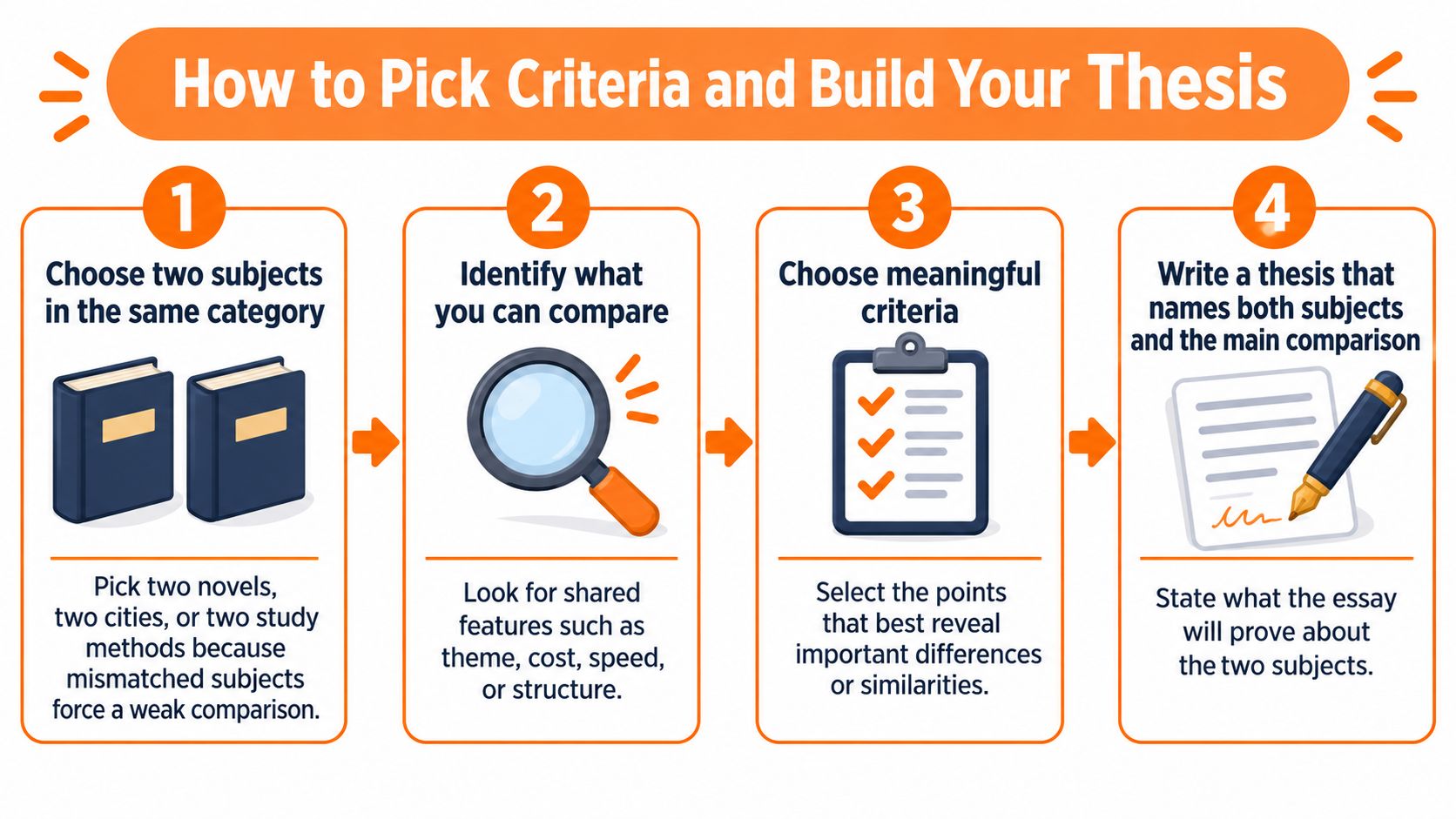
The UNC Writing Center guidance on comparing and contrasting explains that the thesis prevents the paper from becoming an unfocused list, and that a workable thesis names the subjects, identifies the main criteria, and states the significance or judgment that emerges.
Weak thesis versus strong thesis
Weak: "Online and in-person classes are similar and different."
Stronger: "Although online and in-person classes both require independent study, in-person classes provide stronger immediate feedback and accountability."
The stronger version signals a similarity, identifies two differences, and points toward a conclusion. If you want more practice tightening a claim like this, our guide on writing a clear thesis statement walks through the same move for other essay types.
Finish with a simple test. If a reasonable reader could disagree with your thesis, you've got an argument. If no one could disagree, you've only got a description.
Choosing Between Block and Point-by-Point Structure
You have two standard structures, and neither one is automatically correct.
Block organization, also called subject-by-subject, presents all points about Subject A, then repeats the same points for Subject B. Point-by-point organization takes one criterion at a time and discusses both subjects under it before moving on.
Say you're comparing two city transit systems on cost, coverage, and reliability. In block form, you'd cover all three points for System A, then all three for System B. Your reader has to hold A's cost and coverage in memory until B finally arrives. In point-by-point form, cost comes first for both systems, then coverage, then reliability, so each section shows the relationship directly.
The UAGC Writing Center outlines for compare and contrast assignments show this mechanics clearly, and they note that the number and arrangement of body paragraphs should follow the comparison criteria rather than an arbitrary essay template. A typical three-criterion plan might cover cost, flexibility, and interaction, and that count, not a fixed five-paragraph rule, sets your length.
Block and point-by-point structure compared
| Method | How the body runs | Works best when | Main risk |
|---|---|---|---|
| Block (subject-by-subject) | Covers all points for Subject A, then repeats the same points for Subject B | Each subject needs substantial background and the essay has two or three criteria | Repetition, and the comparison fades before the conclusion |
| Point-by-point | Takes one criterion at a time and discusses both subjects under it before moving on | The essay has three or more shared criteria that matter to the thesis | Choppy paragraphs unless transitions connect each criterion to the thesis |
Services that sit side by side can be judged the same way, whether you're weighing transit systems or looking at tutoring platforms and the key differences between the two. Choose the structure that makes relationships easiest to follow.
If you're unsure, count your criteria. Three or more shared criteria usually favor point-by-point. Two subjects with heavy independent background may need block structure, but only with strong transitions and synthesis along the way.
Writing Body Paragraphs That Analyze Rather Than Summarize
The most common failure is two summaries placed side by side with no reasoning between them. That matches student experience too. A 2025 study in the Journal Informatic, Education and Management surveyed 40 second-year university EFL students about difficulties writing compare-and-contrast essays and found the body paragraph was the most challenging section.
The difference looks like this in practice.
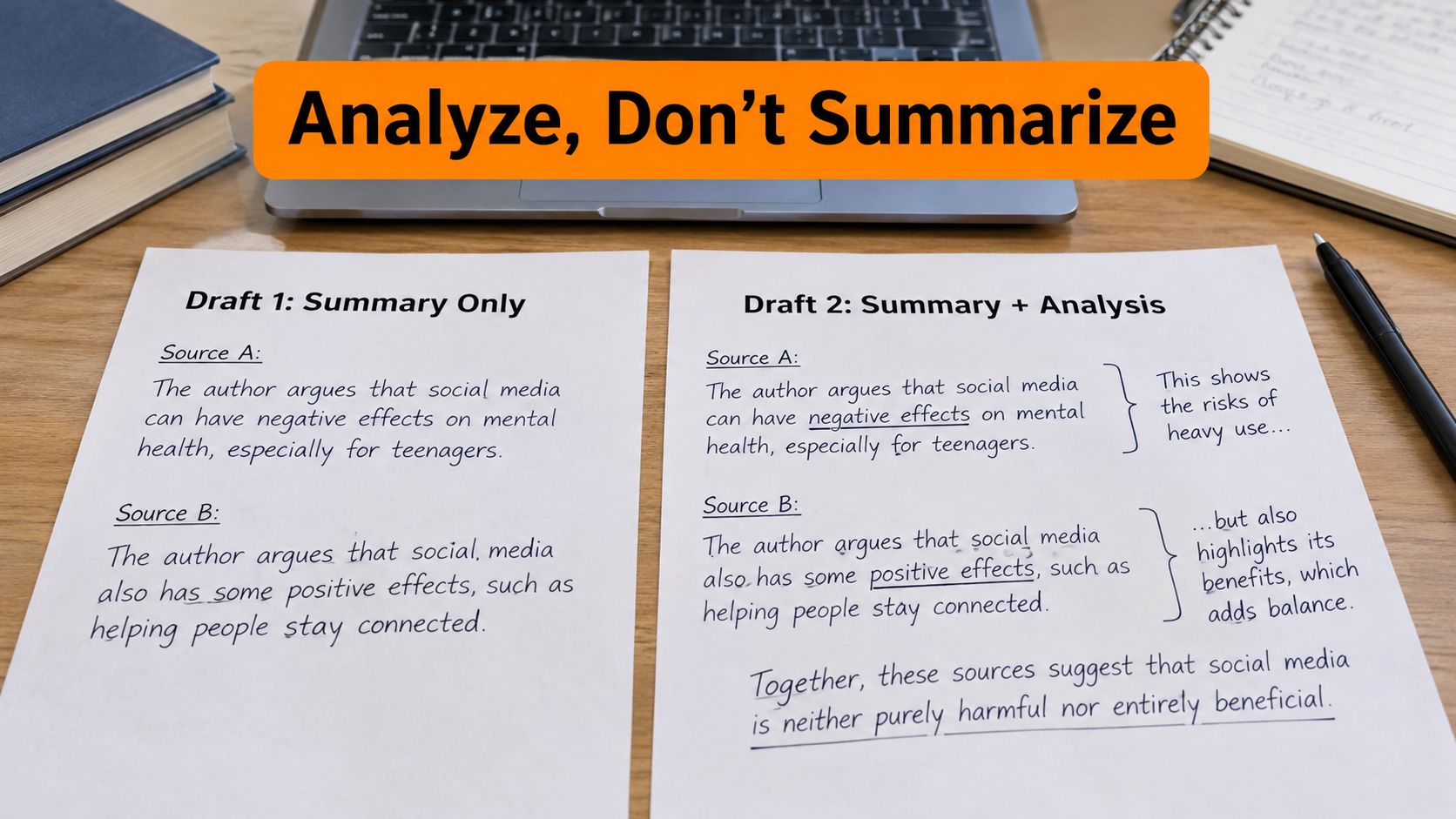
Before: "Bus fares are lower than the cost of a car. Driving is more expensive."
After: "For a daily commuter, a monthly bus pass costs less than fuel and parking alone, so cost pushes regular commuters toward transit, whereas occasional drivers gain little from switching."
The second version doesn't add new facts. It adds interpretation. It says who the difference affects and why it matters.
Use claim, evidence, link
The UC Berkeley Student Learning Center guidance on comparing and contrasting warns that students often describe each subject but omit the connective reasoning that explains similarity, difference, or significance. Prevent that with a claim-evidence-link habit.
- Claim: Open with a sentence naming the criterion, which is where effective topic sentences do their work.
- Evidence: Give a fact or quotation about each subject under that same criterion.
- Link: Write one or two sentences answering, "So what does this relationship show?"
Keep criteria matched. Compare cost with cost, not cost with reliability. Give both subjects comparable space and evidence, and don't pair inflated positives for one side with superficial negatives for the other.
Transitions should signal the logic, not replace it. Use similarly for a shared feature, in contrast or whereas for a difference, and more significantly for the point that carries the most weight. Each word should introduce an explained relationship.
This short video shows the same paragraph move applied step by step.
Check every paragraph before you move on. Does it cover both subjects, use matched criteria, give evidence for each, interpret the relationship, and connect back to the thesis? For sentence-level problems that remain after that check, run the draft through our grammar checker.
Keeping the Comparison Fair When the Evidence Is Uneven
Fairness doesn't mean equal paragraph length. It means applying the same criteria to both subjects and letting the evidence decide the conclusion.
Watch for this trap. A writer compares two historical leaders, finds detailed memoirs for one and only brief records for the other, then omits the weaker side's failures to make the essay easier. The paragraphs look balanced. The method isn't.
The UMGC writing guidance on writing to compare or contrast offers the corrective: apply the same criteria to both subjects, avoid selectively omitting unfavorable evidence, and let evidence support the conclusion rather than forcing a preferred result.
Three fairness checks
- Criteria audit. Is each criterion applied to both subjects, and does it matter to the thesis?
- Evidence-quality check. Where is evidence thin, older, or indirect, and what would close the gap?
- Counterargument paragraph. Where does the comparison break down? Our explainer on counterclaims in argument essays shows how to state that opposing point fairly.
Fairness test: A fair conclusion can name where its own evidence runs out.
A fair conclusion says Subject A performs better on criterion X under conditions Y, and it names the gaps. A false conclusion says both subjects are equally strong when the evidence doesn't support that.
Some subjects can't be measured identically, such as a novel and its film adaptation. Name your shared basis, such as theme, structure, or audience, and state what each medium can't offer.
Write one counterargument paragraph, then reread your thesis. If it still holds, your argument is stronger. If it doesn't, revise the thesis.
Writing the Introduction and Conclusion
Your introduction does three jobs in three to five sentences. It gives context, names the two subjects and criteria, and states your judgment.
Skip the generic hook. Open with why the pair matters. For the tram essay: "Lisbon and Porto both run tram lines through hilly streets, but the trams do different jobs." Add one or two sentences of context, then your thesis. A short roadmap naming the criteria in order is enough. Don't summarize the body.
What the conclusion must do
- Restate the argument in new words, not copied from the introduction.
- Synthesize the main pattern across your criteria.
- Explain why the finding matters beyond the assignment.
Don't introduce new evidence here. If a new fact feels necessary, it belongs in a body paragraph where you can analyze it.
Test the fit quickly. Read only the first sentence of each body paragraph in sequence. If those sentences add up to your conclusion, the structure holds. If they point somewhere else, either the body or the conclusion needs revision.
Auditing Your Draft Before You Submit
The final pass decides whether your essay reads as an argument or as two summaries. Work through these six checks in order.
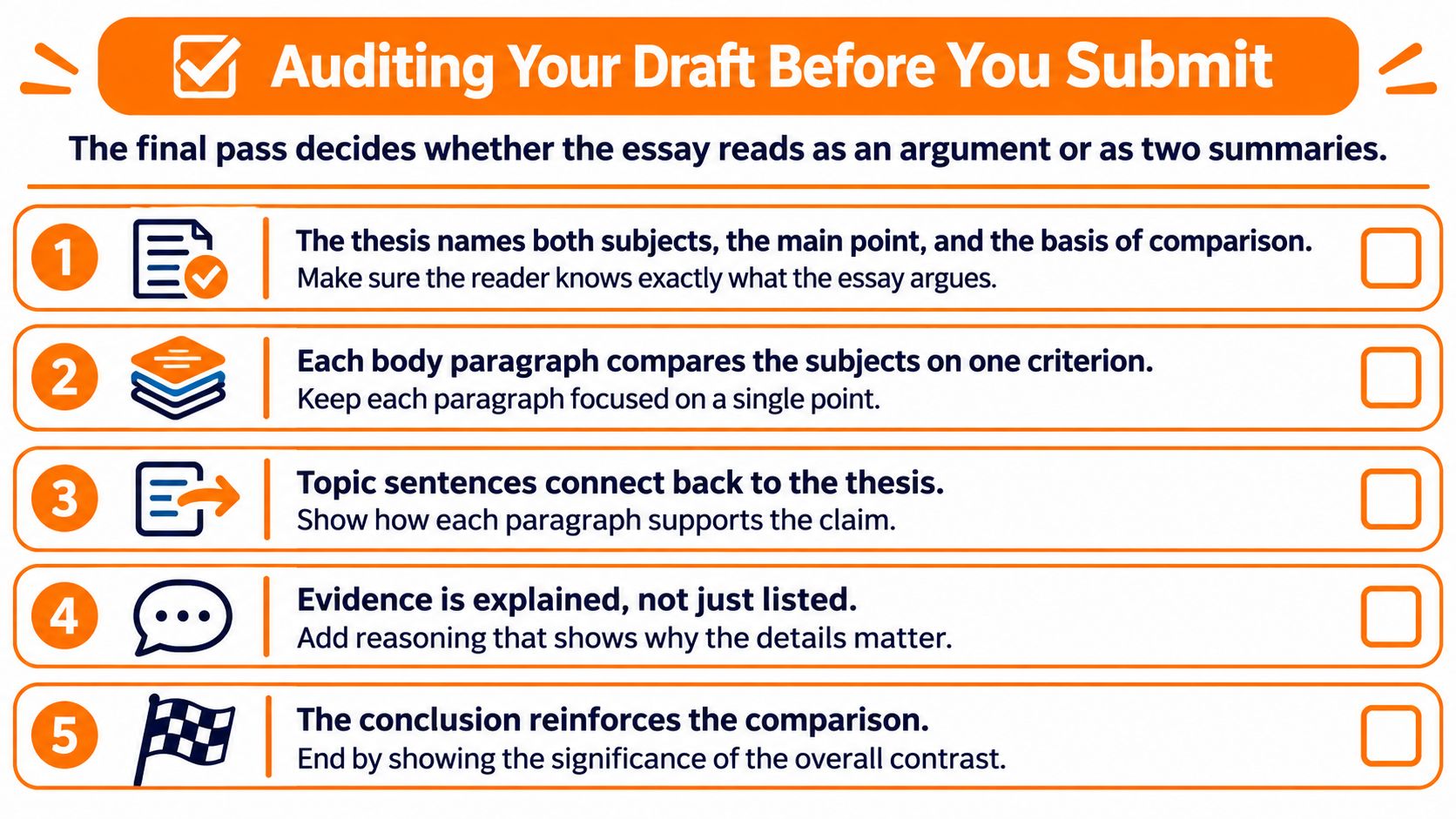
- Thesis check. It names both subjects, the main criteria, and a judgment.
- Paragraph coverage. Every body paragraph covers both subjects under one matched criterion.
- Evidence and interpretation. Each paragraph gives evidence for both subjects and at least one sentence interpreting the relationship.
- Transitions. They show whether the next point adds a similarity or a contrast, and they tie back to the thesis.
- Conclusion. It restates the argument, synthesizes the pattern, and explains why the findings matter, without new evidence.
- Counterargument. The fairness concern you found is addressed, not hidden.
Here's a quick failure example. A paragraph discusses cost for one subject and reliability for the other. That fails check 2, because the criteria don't match. The fix isn't a transition word. It's rewriting the paragraph around a single shared criterion.
Once the structure passes, review the surface. Use our plagiarism checker to review originality and any sourced passages, then run a final grammar check for sentence-level errors before you submit.
Common Questions About Compare and Contrast Essays
Do I have to cover both similarities and differences
Usually yes, but your thesis decides which side carries the argument. A paper can lean toward differences if it explains why those differences matter more for the question you're answering.
Can I compare two subjects that have little in common
Yes, if you can name a shared criterion that makes the pairing meaningful, such as how each subject is maintained by hand. If no criterion connects them, choose a different pair instead of forcing it.
Do I need outside sources
It depends on your brief. For literary or primary texts, quotations from the subjects themselves are usually the evidence. If your course requires scholarly sources, add them and confirm every borrowed passage is cited.
Is compare and contrast the same as a comparison essay
Not quite. Use compare and contrast when the assignment asks for both similarities and differences. If it asks only for similarities, a plain comparison is the correct form, and your thesis should reflect that narrower job.
However you learn how to write a compare and contrast essay, the same rule applies to each answer above. Tie it back to the thesis.
Once your comparison argues something clear, polish the draft so it sounds like you, not a template. Lumi Humanizer reviews writing patterns, sentence structure, and vocabulary to improve flow while keeping your original meaning and intent, with academic, professional, creative, and casual style options. Paste in your final draft, choose the style that fits your assignment, and submit prose that reads naturally.