You've highlighted the speech, identified some emotional language, and still aren't sure what to write beyond naming the techniques. To learn how to write a rhetorical analysis, focus on how a writer's choices affect a particular audience, then judge whether those choices serve the writer's purpose. Your job isn't to retell the argument or say whether you agree with it.
Start With the Rhetorical Situation
A rhetorical analysis explains how a text works on its readers and how well it serves its purpose. Before labeling techniques, establish who's speaking, who must be persuaded, and what makes the message matter now.
Consider a hypothetical school board speech asking parents to approve a levy, a tax measure to fund district needs.
| Element | Question to ask | Example from a levy speech |
|---|---|---|
| Author | Who is speaking, and what standing do they have? | A superintendent with ten years in the district |
| Exigence | What problem made this text necessary now? | Budget cuts announced the week before |
| Audience | Who must be persuaded or moved to act? | Parents at a 7 pm meeting who will decide the vote |
| Purpose | What response does the text want? | A yes vote on the levy |
| Constraints and medium | What limits the choices, and where and when does the text appear? | A three-minute speaking limit, a livestream, and a quote in the next morning's paper |
Exigence means the problem that prompts someone to communicate. Constraints are the conditions that restrict or shape their choices. The UNLV rhetorical analysis guide places these circumstances alongside audience, purpose, and context because they give your analysis direction.
In this scenario, a line about cost means little until you know who must pay and when they'll vote. The speaking limit also matters: the superintendent may compress financial explanations into memorable phrases, while the livestream exposes those phrases to people outside the room.
Turn context into an analytical question
Ask why this speaker would choose reassurance rather than confrontation. Our guide to tone in writing can help you describe that attitude precisely, rather than calling the speech positive or negative.
If you're struggling to organize your annotations, Zemith's practical tools for analyzing text offer another resource for approaching close reading. Keep your attention on passages that reveal a relationship between the speaker's choices and the audience's concerns.
Starting test: Can you state what the text wants its audience to do, and why this audience at this moment might be moved?
That sentence gives you a direction for reading. It isn't your thesis yet, because you haven't judged how effectively the speech pursues its goal.
Build an Evidence Matrix Before You Draft
An evidence matrix is a working table for your notes, not something you usually submit with the finished essay. It helps you separate what you can observe from what you infer about an audience's response.
Create columns for passage or location, rhetorical choice, appeal or contextual dimension, intended audience effect, purpose connection, and countereffect. This follows the practical approach in Clemson's rhetorical analysis guidance: identify a feature, judge whether it helps or hurts the text, and explain that judgment with textual support.
For the hypothetical levy speech, your notes might look like this:
| Passage | Rhetorical choice | Appeal | Audience effect | Purpose link | Countereffect |
|---|---|---|---|---|---|
| Opening personal history about serving the district for ten years | Emphasizing experience | Ethos | Listeners may trust the speaker's familiarity with local needs | Makes a yes vote seem safer | Skeptical voters may see institutional self-interest |
| Paragraph 4, repeated reference to children waiting | Repetition and inclusive language | Pathos | Parents may feel personally responsible | Supports the call to vote yes | Cost-focused voters may feel pressured rather than informed |
| Financial passage claiming a 38 percent increase without a baseline year | Numerical comparison | Logos | Gives the need an appearance of measurable support | Frames the levy as a necessary response | Voters can't assess the comparison's significance |
Read across each row. Experience doesn't by itself equal credibility: you must explain why local knowledge might matter to these parents. Likewise, repetition doesn't automatically persuade; its force depends on whether listeners accept the responsibility the speaker assigns them.
Be accurate about terminology. Our is inclusive first-person language, not second-person address. You'd need language such as you or your to identify a direct second-person appeal.
Identify what's actually disputed
Stasis means the point at issue. Is the disagreement about fact, definition, cause, value, or action?
In the levy scenario, parents may accept that cuts occurred but disagree about what action to take. Evidence proving that cuts exist won't necessarily establish that this particular levy is the best response.
Keep a limitation or alternative reading beside each major strategy. A plausible objection makes your judgment more precise, not less confident.
Use short quotations when you draft, and record their locations now. Your notes should preserve enough wording to verify the choice without letting copied passages replace your interpretation.
How to Write a Body Paragraph That Argues
A strong body paragraph makes a small argument about the text. The Austin Peay State University rhetorical analysis handout emphasizes connecting specific techniques and examples to the author's goal, including whether those choices work.
Use this sequence as a drafting guide, not a rigid sentence formula:
- Make an evaluative claim. Open by judging a strategy's effectiveness, so the paragraph has something to prove.
- Provide precise evidence. Select a brief phrase or detail that lets readers inspect the choice themselves.
- Name and explain the strategy. Identify what the author does, then describe its likely effect on the intended audience.
- Connect that effect to purpose. Explain why gaining trust, creating concern, or clarifying a comparison would help produce the desired response.
- Consider a counter-reading. Show how a skeptical listener might respond differently, and identify the assumption behind that response.
- Return to your thesis. End by explaining what this passage contributes to your overall judgment.
The visual below summarizes the opening moves. Your paragraph still needs the purpose connection and qualified judgment that follow them.
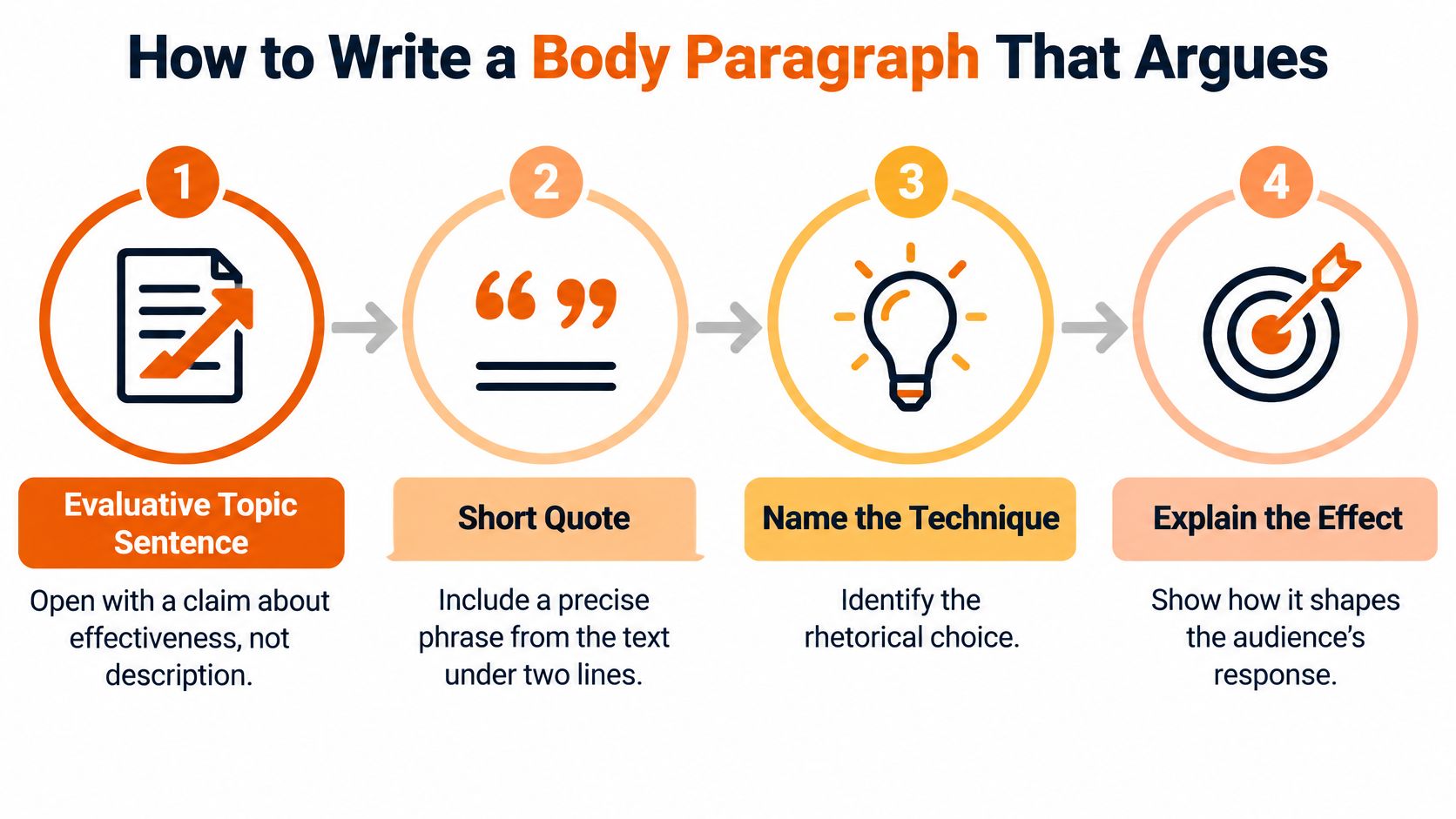
From observation to argument
A weak draft might say:
The superintendent uses statistics to support the levy.
That sentence identifies a category of evidence but doesn't explain its significance. Here's a stronger version using the hypothetical figure:
The 38 percent figure gives the levy an appearance of measurable need, but it omits the baseline year, so voters cannot tell whether the rise is large or routine. That gap matters because the vote depends on exactly that judgment. Parents already worried about cuts may accept the figure as confirmation that funding is urgent. Skeptical taxpayers, however, may see an incomplete comparison rather than sufficient justification for the levy. The numerical appeal therefore reinforces existing concern more convincingly than it answers financial objections.
Notice the distinction: the paragraph doesn't claim the number is false. It identifies what readers would need to evaluate it and explains why the omission matters to this decision.
Use qualified verbs such as suggests, reinforces, and may encourage when you're interpreting a likely response rather than reporting documented audience behavior. Our essay-writing vocabulary guide can help you choose precise language, but a more formal synonym won't repair a missing explanation.
If a paragraph feels thin, don't add another quotation immediately. First ask whether you've explained what the existing evidence enables the audience to think, feel, or decide.
Judging Ethos, Pathos and Logos Fairly
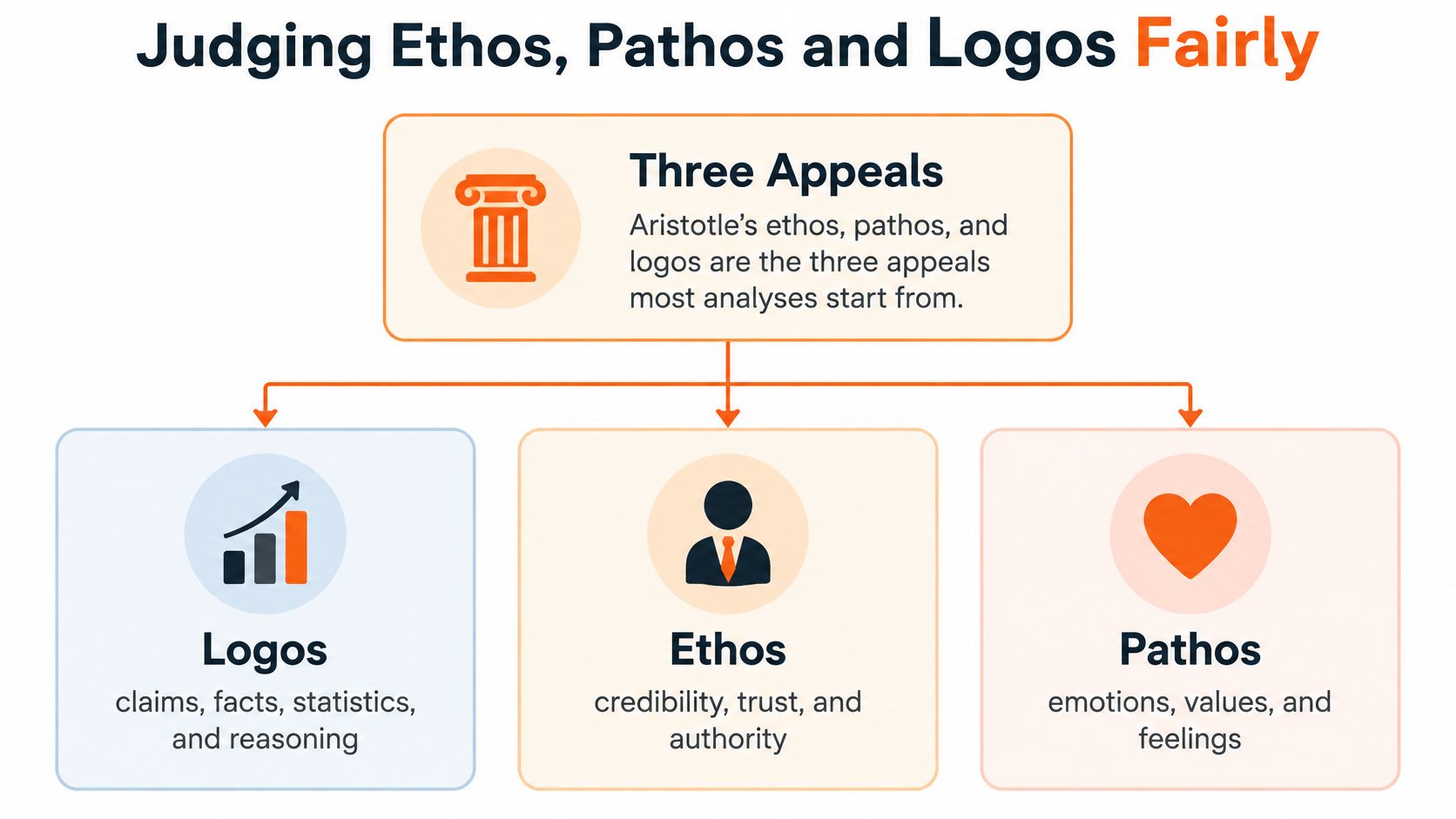
Aristotle's appeals remain a useful starting point: logos draws on reasoning and evidence, ethos builds credibility, and pathos engages emotion. The Kennesaw State University rhetorical analysis resource explains why those appeals must be understood in relation to particular audiences and purposes.
This diagram distinguishes the categories before you evaluate how they interact.
For logos, ask whether the evidence supports the conclusion. A statistic isn't valid merely because it's numerical; inspect its source, comparison, and relevance.
For ethos, ask what makes the speaker credible on this particular issue. A credential may establish relevant expertise without making every claim reliable.
For pathos, ask whether the emotion helps the audience understand the stakes or distracts from a necessary question. Emotional language isn't manipulative by default. A discussion of diction and word choice can help you identify the exact words creating that emotional effect.
Watch how appeals work together
Suppose a charity advertisement combines a beneficiary's personal story with an account of the organization's long record. The story supplies emotional stakes, while the record offers reasons to trust the organization. George Mason University's guide to rhetoric explains how personal stories and organizational credentials can serve these different appeals.
For donors who doubt the cause, the story may win attention without resolving their concerns. The organizational record must then answer a different question: whether this charity can use a donation effectively.
Naming that handoff is more useful than labeling both appeals. You can judge whether the advertisement moves from sympathy to relevant reassurance, or merely places a credibility claim beside an affecting story.
Fair evaluation: Don't assume credibility is deserved, reasoning is sound, or emotion is improper. Inspect what each appeal asks its audience to accept.
The Texas A&M University Writing Center's rhetorical analysis guide supports evaluating choices against audience and purpose. Without reception evidence, you generally can't prove what every reader felt; you can defend a likely effect by stating the audience assumption, showing the mechanism, and acknowledging its limits.
Analyzing Images, Ads and Digital Texts
Consider a hypothetical bus-shelter poster promoting active play: a large headline at the top, a photograph of a child in the center, and a small explanatory caption below. Begin by describing these visible features, not by declaring the design effective.
Use the campaign image to practice distinguishing observation from interpretation.

Record what the headline and caption say, which colors contrast, and where the photograph directs attention. Then compare the poster with a short social post carrying the same claim: a commuter who glances at the shelter for three seconds encounters a different argument from a follower who reads the full caption and follows a hyperlink.
Treat medium and timing as evidence
The hyperlink might provide qualifications that the poster leaves inaccessible. In video, a rapid cut might establish urgency while giving viewers little time to inspect supporting information. The San José State University rhetorical analysis handout includes kairos, the surrounding circumstances that make an argument relevant or timely.
For example, imagine a flu-vaccination campaign in a location where October precedes the expected season and March follows it. The same message would need different justification at those moments; that's a contextual judgment, not a universal calendar rule.
Apply the same questions about attention, sequence, and evidence when examining video.
Describe the feature, identify the audience, and explain the persuasive consequence.
Your analysis isn't a general review of whether a platform looks attractive. It should establish how the medium helps or constrains the particular response the author seeks.
Check Your Analysis Before You Submit
Revise your thesis after drafting the body. You may discover that the speech handles parental concern effectively but doesn't adequately answer questions about cost. Your thesis should reflect that mixed judgment rather than force every paragraph into a claim of complete success or failure.
Use these final questions to check the argument:
- Thesis: Does it judge how the text works on its audience, rather than merely naming its topic?
- Limitations: Does each major strategy include a credible counter-reading or boundary?
- Conclusion: Does it explain the overall effectiveness and its conditions, rather than repeat the introduction?
- Quotation balance: Are quotations brief enough that your interpretation carries the paragraphs?
The checklist below adds a useful final distinction: evidence must support your claim, and your explanation must show why.
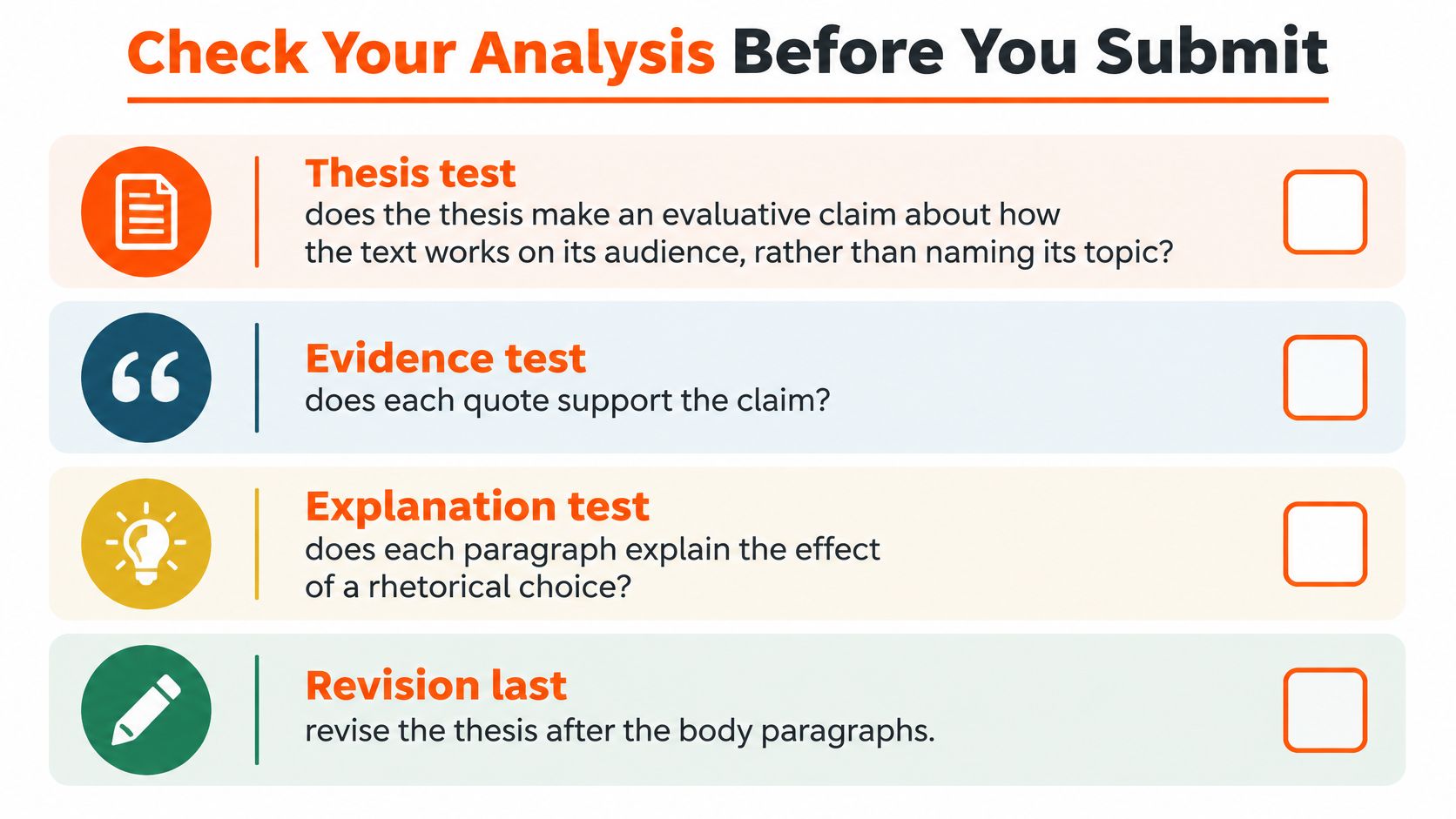
Revise the thesis to match the evidence
A weak thesis says that the speech uses emotional language. It identifies a feature but offers no judgment about what that feature accomplishes.
For a version of the hypothetical speech that directly addresses parents, a stronger thesis would argue that urgent second-person appeals make parents feel responsible for the vote, though the missing baseline year weakens the claim of need. That gives the essay a defensible distinction between emotional motivation and financial justification.
For the conclusion, explain the consequence of that distinction. The speech may be better equipped to mobilize supporters than to persuade undecided voters whose main concern is cost.
Once the thesis is stable, use the plagiarism checker to review originality if your instructor requires it. An originality review can't determine whether your reasoning holds; that responsibility stays with you.
Always review the final output before publishing or submitting it, including any tool-assisted edits. Read the essay aloud and check that each sentence says something specific about the text rather than about persuasion in general.
Rhetorical Analysis Questions Answered
How long should a rhetorical analysis be?
A student with a four-page limit often asks if each appeal needs its own page. The better measure is coverage. Give each major strategy room for a quotation, an explanation of its effect on the intended audience, and a qualified judgment about whether it worked. A short paper that tests two choices with counter-readings argues more strongly than a long paper that labels five devices.
Can I analyze a text I agree with?
Yes. Agreement does not prove effectiveness. You can support a school levy and still conclude that the speech mobilizes parents while leaving undecided voters unconvinced on cost. State the limitation plainly. The second-person appeals create responsibility. The missing financial detail weakens persuasion for a cost-focused listener.
Should I summarize the text first?
Keep summary to two or three sentences. Name the text, the speaker, the audience, and the situation. Spend the rest of the essay on specific choices. Explain what each choice leads that audience to notice, feel, or do next.
What if the text has no obvious appeals?
Look for quiet decisions. An unnamed source. A comparison left unexplained. A restrained tone where urgency was possible. An unusual order of information. Each can carry weight.
Ask what changes if a skeptical reader sees it differently. That counter-reading is often your strongest evidence.
Knowing how to write a rhetorical analysis means defending a judgment about effect, not collecting terms. Finish the reasoning first, then polish sentences for clarity and check that each paragraph ties evidence to that judgment.
Lumi Humanizer offers an AI Humanizer designed to improve clarity, voice, and flow while preserving a draft's main point. If AI-assisted wording sounds stiff, visit Lumi Humanizer to refine the prose, then review every change against your evidence and your instructor's rules.