You've got notes about what happened, a deadline approaching, and a blank page that keeps turning into a diary. That's the usual starting point when you're learning how to write a reflective essay. The fix isn't more story. It's a clear claim about what changed in your thinking, evidence for that change, and one specific thing you'll do differently next time.
Which Structure a Reflective Essay Should Follow
A reflective essay is an analytical argument built from one experience, not a diary entry. Most assignments still use an introduction, several body sections, and a conclusion. Inside that layout, the body moves through Describe, Interpret, Evaluate, and Plan, known as the DIEP model.
Your central claim shouldn't stop at "What happened?" It should answer what the experience revealed and how that insight will guide future decisions. The University of Hull reflective essay guidance sets out seven recurring tasks, from selecting an experience and preserving anonymity to connecting it with literature and explaining how future practice will change.
Reflective Essay Frameworks and When to Use Them
| Framework | Stages in order | Best used when |
|---|---|---|
| DIEP (Describe, Interpret, Evaluate, Plan) | Describe, Interpret, Evaluate, Plan | Formal analytical essays with several body sections |
| What? So what? Now what? | What happened, So what it means, Now what you will do | Shorter pieces and paragraph-level checks |
| Gibbs' Reflective Cycle | Description, feelings, evaluation, analysis, conclusion, action plan | Practice-based courses that ask for emotional response |
Use DIEP for a formal essay, What? So what? Now what? for a shorter piece or to check single paragraphs, and Gibbs when your course explicitly asks for feelings and practice-based learning. An expository essay outline can help you see how this differs from a purely explanatory structure.
Every draft claim must say what changed in your understanding, not only what took place.
How to Draft the Opening and Description
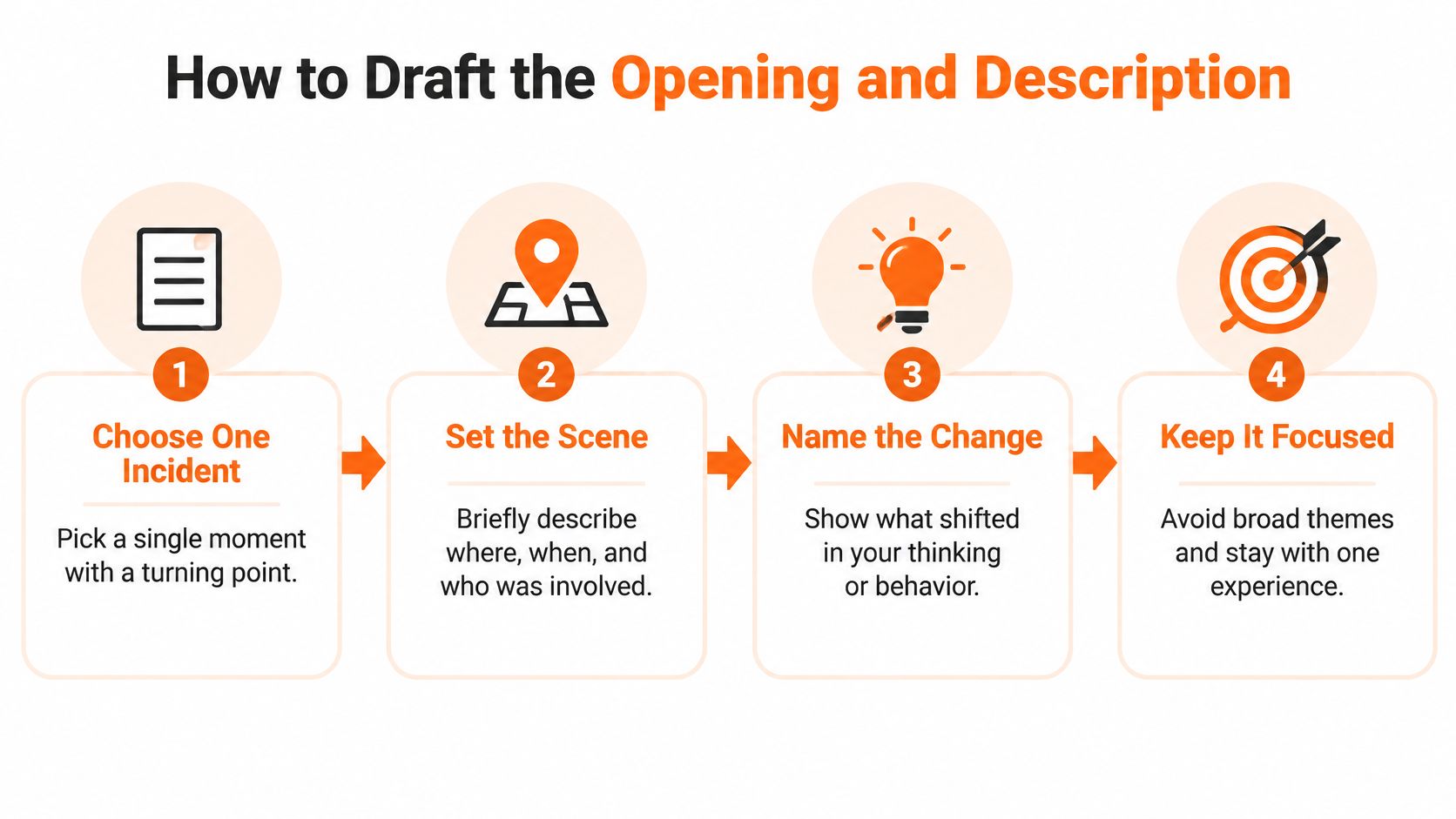
Pick one incident with a turning point, such as a failed group presentation or a placement moment that changed how you work. Avoid broad themes like "teamwork" or "communication." They're too wide to analyze well.
The visual below sums up the narrowing process before you start drafting.
Six Drafting Steps
- Choose one specific incident. Note the date, place, and people involved so your details stay observable, not vague.
- Check anonymity. Replace names and identifying details, and confirm your course's rule for writing about real people.
- Write a one-sentence thesis. Name the change, for example, "I learned that unclear task ownership, not low effort, caused our missed deadlines."
- Set a rough word budget. Try about 15 percent for context, 60 percent for analysis and learning, and 25 percent for future action, then adjust it to your assignment length.
- Draft the context paragraph. Include only details a reader needs to follow your analysis. Anything that doesn't support an insight can go.
- Outline the body by insight. Give each paragraph a specific example, an interpretation, a link to theory, and an implication for practice.
Writing in the first person is expected here, and these notes on first-person narration explain how to keep that voice controlled rather than chatty.
If you can't state your thesis in one sentence before drafting the body, your experience is too broad. Narrow it to a single moment and try again.
How to Analyze the Experience Instead of Retelling It
Compare two versions of the same presentation. The weak version says, "During the presentation I felt nervous and the slides were confusing, so it went badly." That reports a feeling and stops.
The stronger version explains a cause. Your slides followed your speaker notes instead of the questions your audience would ask, which exposed a planning gap. Now there's something to analyze.
Three Questions That Build the Stronger Version
- What assumption did I hold beforehand? You assumed clear slides were enough to carry the talk.
- What evidence changed that view? Audience members asked basic questions you couldn't answer from your slides.
- What alternative did I dismiss? Planning the talk from their likely questions, rather than from your own notes.
This follows the What? So what? Now what? movement in the BYU reflective writing guide for students, where "The group project was difficult" becomes an explanation that unclear task assignments caused duplicated work, linked to project planning and a shared responsibility chart next time.
Apply that same test to your incident. Unclear assignments, not low effort, caused the duplication. That challenges your first explanation and points to a concrete fix.
Label each body paragraph by the question it answers. If a paragraph only retells events, expand it or cut it. Include a feeling only when it explains a choice, such as nerves that led you to skip rehearsal.
How to Connect Your Reflection to Theory and Evidence
Theory earns its place when it changes how you interpret a moment. Start with one claim your experience tests, such as a course concept about feedback, then introduce it in a sentence or two and apply it directly to what happened.
This photo captures the working stage where notes, readings, and your own account have to be brought together.

State whether your experience supports, challenges, or extends the concept. Don't summarize the reading at length. Your marker wants to see what it does to your interpretation.
Evidence Most Courses Accept
- Participant or peer feedback: Comments that confirm or dispute your reading of events.
- An assessment result: A grade, rubric comment, or supervisor note tied to a specific moment.
- An observed change in practice: A log showing time saved, errors reduced, or a task handled differently afterward.
Say you're reflecting on a community tutoring project. You cite session records showing attendance rose after you changed the schedule, then link that result to a reading on community engagement. The records keep the claim honest, and the reading explains why the change worked.
Watch this short video before you finalize your citations, then check each one against the original source.
Avoid decorative citations, where a reference sits at the end of a paragraph and changes nothing. Add one counter-view too, a perspective that would explain the outcome differently, and weigh it briefly.
Working rule: Each theory should change at least one sentence of your interpretation, or it doesn't belong.
How to Write a Conclusion That Commits to Change
Your conclusion shouldn't repeat the experience. It should state a changed position and explain why it changed. Here's a model closing move.
"Before this placement, I assumed clients wanted facts first. Now I begin with what they are worried about, because two conversations showed that the worry was blocking understanding."
That works because it names the old belief, the new one, and the evidence in between. Precise wording matters here, and building your essay writing vocabulary helps you state the shift without vague filler.
Weak Plans Versus Strong Plans
Use the format "Next time, I will..." followed by one observable action and a way to check it. Compare the two versions below.
- Weak: "I will communicate better." Nothing can be observed or measured.
- Strong: "I will ask one open question in the first two minutes of every client call and note whether the client answers it in full."
Connect the plan to its future context, whether that's a study method, a workplace habit, or a professional practice. A plan floating free of any real setting won't convince a marker.
Three Closing Questions
- What changed in your thinking or behavior?
- Why did it change, based on which evidence?
- What will be different in the next similar situation?
Answer those three and your conclusion synthesizes the learning from the body. Don't introduce a new event at this stage. New material belongs earlier, where you have room to analyze it.
Where AI Help Ends and Your Reflection Begins
AI can help you organize a real experience. It can't supply the feelings, judgment, or learning your assessment is meant to measure. That boundary matters more as use becomes routine, since research indexed by ERIC reports HEPI survey data finding that 18% of students had included AI-generated text directly in assessed work, with common uses including explaining concepts and suggesting research ideas.
Low-Risk Support
Brainstorming questions is low risk. So is testing whether your paragraphs follow the What? So what? Now what? sequence, or asking where a transition is unclear. You're still supplying the experience and the thinking.
High-Risk Substitution
Inventing events, emotions, or sources crosses the line. So does rewriting a finished reflection so it merely sounds more human. Generic first-person prose can't stand in for your situated judgment, and markers read for exactly that.
Keep dated notes and drafts that show your own thinking. Verify every citation against the original, follow your course's disclosure policy, and rewrite any AI-suggested sentence from your own evidence.
If you want a rough view of AI signals in a draft, an AI detector gives an estimate only. It doesn't prove whether a reflection is genuine, and it can't tell whether you learned anything. That's your job to show.
Questions Students Ask About Reflective Essays
Can I write in the first person? Yes. Critical reflection uses "I," but each claim needs evidence such as a peer comment, a grade, a log, or a course concept. A feeling alone isn't enough.
How long should the story be? Keep context near 15 percent, analysis and learning near 60 percent, and the action plan near 25 percent. If your story runs longer, your analysis is probably thin.
Which tense fits? Use past tense for the incident and present tense for what you now believe and will do. That split shows the change clearly.
How many experiences should I cover? One incident with a turning point. A theme like teamwork is too broad for a one-sentence thesis.
Do I name real people? No. Replace names and identifying details, and follow your course rule on anonymity.
What if there's no rubric? Score your draft yourself using five checks rated 0 to 2, covered below. Submit only when your close names a changed belief and a measurable next step.
Score Your Draft Before You Submit
A tutor can spot a diary entry in ten seconds. It retells the week. An analysis proves a change in thinking. Use this final check to see which one you wrote.
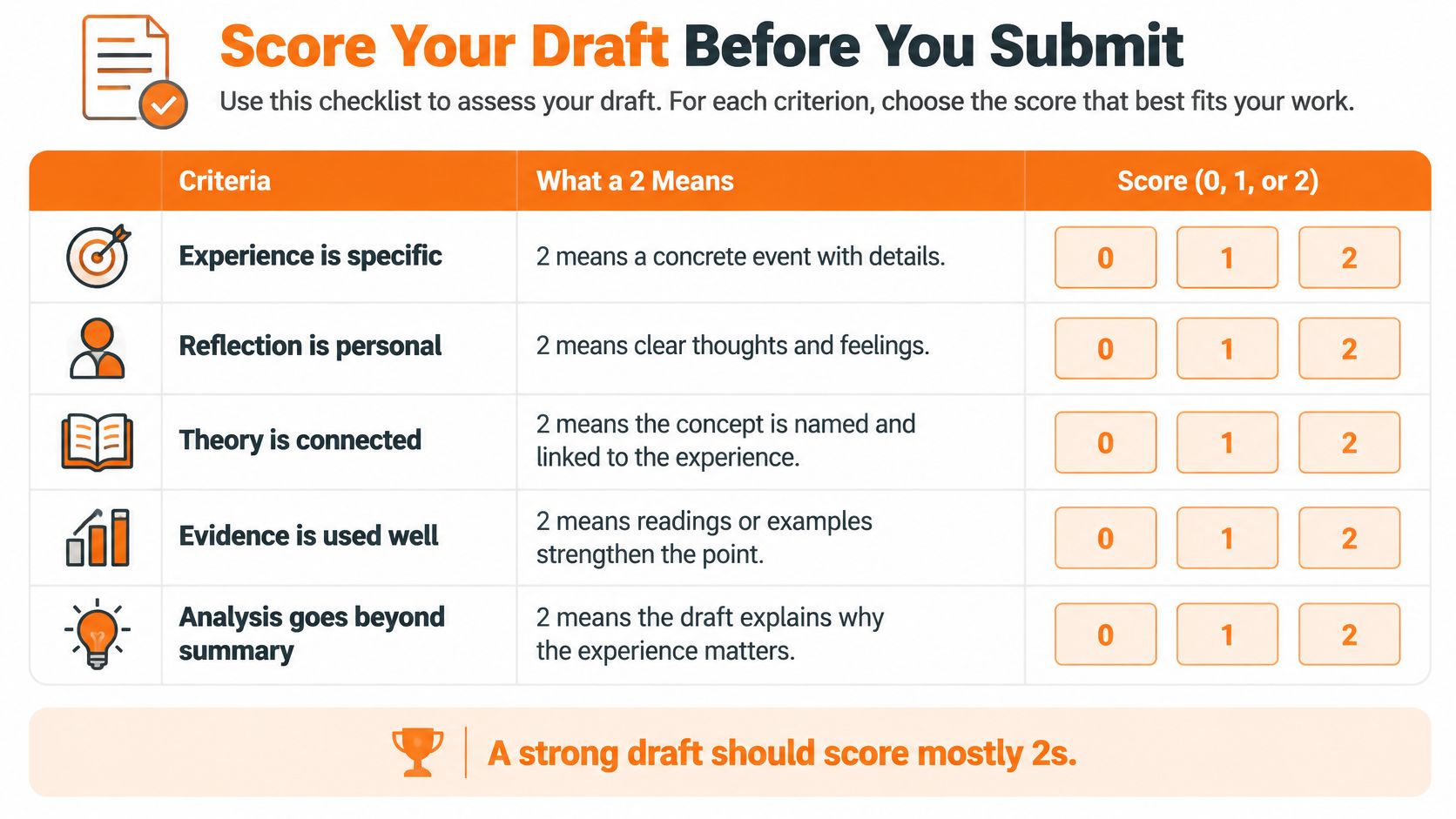
A simple way to check your draft is to score each criterion from 0 to 2, where 0 means absent, 1 means mentioned but shallow, and 2 means specific and analytically connected. Aim for no zeros. Most of your points should land at 2.
The checklist below gives you the five criteria at a glance before you work through the table.
Five-Criterion Reflective Essay Scoring Guide
| Criterion | Scores 2 when | Usually scores 1 when |
|---|---|---|
| Specificity of the incident | A named moment with observable details | A vague impression such as "it was hard" |
| Depth of analysis | The essay explains why it happened and tests an assumption | It says what happened and what was felt |
| Theory or literature | A concept tests the interpretation and changes it | A citation sits at the end of a paragraph without effect |
| Alternative perspectives | Another explanation is named and weighed | Only the writer's own view appears |
| Future action | A measurable next step tied to the lesson | "I will try harder" with no way to check |
The Revision Procedure
- Label each paragraph as What?, So what?, or Now what?
- Score the five criteria against the table.
- Revise until no core criterion scores 0 and most analytical criteria score 2.
- Hunt for common faults, including chronological fact reporting, unsupported self-praise, and emotional description without interpretation.
- Run an originality check with a plagiarism checker to catch passages reused from earlier papers or sources.
- Do a clarity pass with a grammar checker on sentences that hide the point of a paragraph.
Read a paragraph that scored 1 and ask what evidence would lift it. A vague incident needs time, place, and exact words spoken. Shallow analysis needs a reason the first interpretation was wrong. A loose plan needs a date, a frequency, and a way to tell if it worked.
Submit when your closing paragraph names a changed position and a measurable future action, and your scores back it up.
Once your reflection is yours, scored, and checked, a light final pass can smooth awkward phrasing without flattening your voice, and we built our tools for writers and students who want that clarity while keeping their meaning intact. Always review the final output before you submit it, then visit Lumi Humanizer to polish your draft in your own words.