You've drafted a paragraph, added evidence, and still can't tell whether its opening says enough. To learn how to write effective topic sentences, start by stating the paragraph's specific point, then check that the supporting details and neighboring paragraphs fit. The strongest sentence doesn't just introduce a subject; it helps readers understand why this paragraph belongs in your argument.
What a Topic Sentence Has to Do
A topic sentence gives readers a focus, connects that focus to the essay's thesis, and often carries an idea forward from the preceding paragraph. Think of it as a small promise about what readers will understand after reading the paragraph.
Purdue OWL's guidance on paragraphs explains that a topic sentence states the general subject or controlling idea, while the remaining sentences develop it. The important distinction is between naming a subject and making a point about it. Revision is a subject. Students struggle with revision because they edit sentences before checking their argument gives you something to explain.
Weak and stronger topic sentences side by side
The stronger openings below are sample claims, not established findings. In an actual essay, each would need appropriate evidence, especially the claims about learning, student scheduling, and tenant organizing.
| Weak opening | Why it fails | Stronger opening |
|---|---|---|
| Revision is important. | Names a subject with no point | Many students struggle with revision because they edit sentences before checking the argument. |
| There are many effects of technology. | Too broad to support or argue | Laptop note-taking shifts students toward verbatim transcription, which weakens recall of lecture content. |
| Online classes are interesting. | Offers an opinion, not a focus | Online classes demand stronger self-scheduling than in-person classes, especially for first-year students. |
| This issue is complicated. | Announces difficulty without a direction | Tenant unions gain bargaining power mainly when they can coordinate across several buildings at once. |
Notice what changes: each rewrite identifies a relationship the writer can develop. The revision example names a cause. The online-class example identifies a particular demand and a group of students.
Specificity also creates responsibility. If your sentence mentions first-year students, your paragraph needs evidence or reasoning about that group, not students in general.
Choose the paragraph's analytical purpose
A paragraph doesn't always need to add another supporting reason. Austin Peay State University's topic-sentence guide describes analytical roles that include supporting a central claim, answering a counterargument, acknowledging a limitation, and identifying an implication.
For an essay arguing that revision instruction should prioritize structure, a limitation might be:
Sentence-level editing still matters when grammatical errors prevent readers from understanding the argument.
That sentence qualifies the thesis without abandoning it. The paragraph should then explain when sentence-level problems interfere with meaning.
If you're unsure where that qualification belongs, map the argument using a multi-paragraph essay structure. Decide what each paragraph contributes before trying to make every opening sound polished.
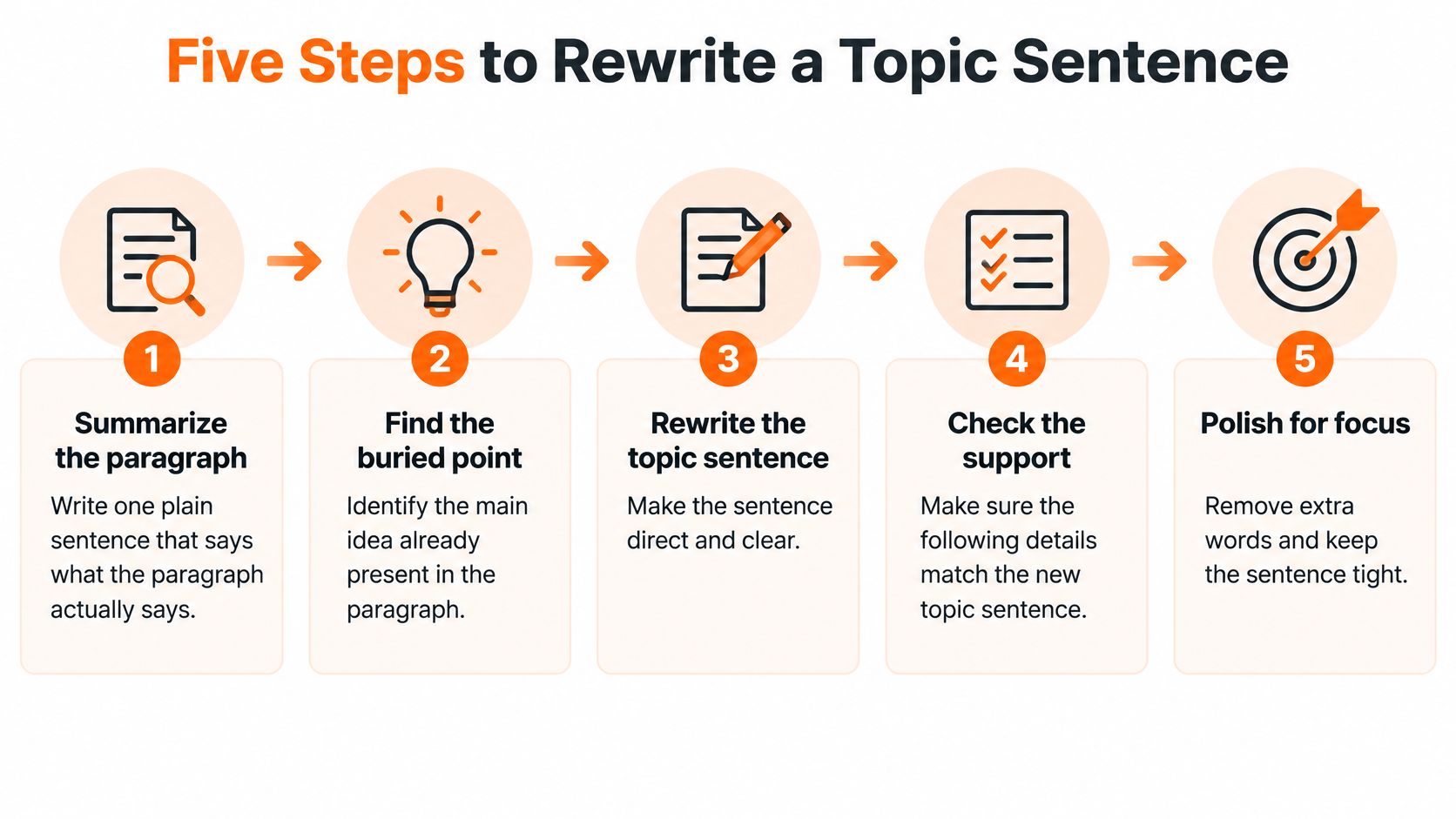
Five Steps to Rewrite a Topic Sentence
Choose a paragraph that feels unfocused, not necessarily the opening paragraph. Work with what you've written rather than what you intended to write.
How to write effective topic sentences during revision
-
Summarize the paragraph in plain language.
Suppose your paragraph describes students missing deadlines, forgetting weekly readings, and postponing assignments. Your working summary might be: Students need a routine for managing online coursework. Don't worry about elegance yet. You're identifying the point already present, even if it's buried halfway through. -
Keep one aspect of the subject.
If your summary says online courses require planning and reduce travel costs, separate those claims. Keep the paragraph about planning and move the cost discussion elsewhere. Related subjects don't automatically belong in the same paragraph. -
Turn the subject into a claim.
Online coursework and planning is a label, not a topic sentence. Try: A weekly study plan helps students manage deadlines in an online course. The reader can now anticipate an explanation of how the plan works. -
Connect the claim to your thesis.
Suppose your thesis argues that colleges should provide practical support for online learners. Revise the sentence to: Teaching students to build a weekly study plan would give them practical support for managing online deadlines. You've identified this paragraph's contribution without copying the entire thesis. -
Check the support, then tighten the wording.
Keep details about calendars, recurring study periods, and assignment reminders. Move the sentence about cheaper transportation. Finally, remove an opening such as It is important to recognize that, because it delays the claim without adding meaning.
Use this visual checklist while working through your paragraph.
Check the draft beyond the sentence
A common mistake is polishing the opening until it sounds impressive while leaving the paragraph unchanged. If the revised sentence promises an explanation of weekly planning, the paragraph can't consist mainly of complaints about online learning.
Revision rule: Change the sentence to fit the evidence, or change the paragraph to support the sentence. Don't leave them making different promises.
Finish with a quick reading pass through the draft's topic sentences. Mark any place where you can't explain why the next paragraph follows, and repair the order or connection before spending more time on word choice.
Where the Topic Sentence Goes and When to Move It
The opening position is a useful default, not a requirement. In an analytical paragraph, stating the claim early lets readers interpret the evidence with a clear purpose. But delaying the point can work when readers need context before they can understand it.
The University of New Hampshire's topic-sentence guidance recognizes that the main point can appear at the beginning, middle, or end, or remain implicit. Placement should serve the reader rather than satisfy a fixed template.
The same point in different positions
Consider a hypothetical lab report in which a calibration problem explains inconsistent readings.
- Opening claim: An incorrect calibration setting caused the inconsistent readings. The sensor registered different values for the same reference sample, and the readings stabilized after recalibration. This arrangement suits a direct explanation.
- Delayed claim: The sensor registered different values for the same reference sample. After recalibration, the readings stabilized. The original calibration setting therefore explains the inconsistency. Here, readers encounter the observations before the interpretation.
- Implicit point: The technician checked the reference sample, reset the calibration, and repeated the measurement. The readings stabilized. This version may work in a narrative account where the surrounding text already establishes the problem.
The difference is emphasis. The opening claim foregrounds the explanation; the closing claim foregrounds the process of reaching it.
When an opening needs context
A short transition can come before the controlling idea. For example: The second trial produced a different result. Unlike the first trial, it used a freshly calibrated sensor.
That opening works only if readers know which trial you mean and why the difference matters. Don't delay the point merely to create variety.
Move the topic sentence when the reader gains useful context, not when you're simply tired of starting with a claim.
Checking Unity, Length and Focus in Every Paragraph
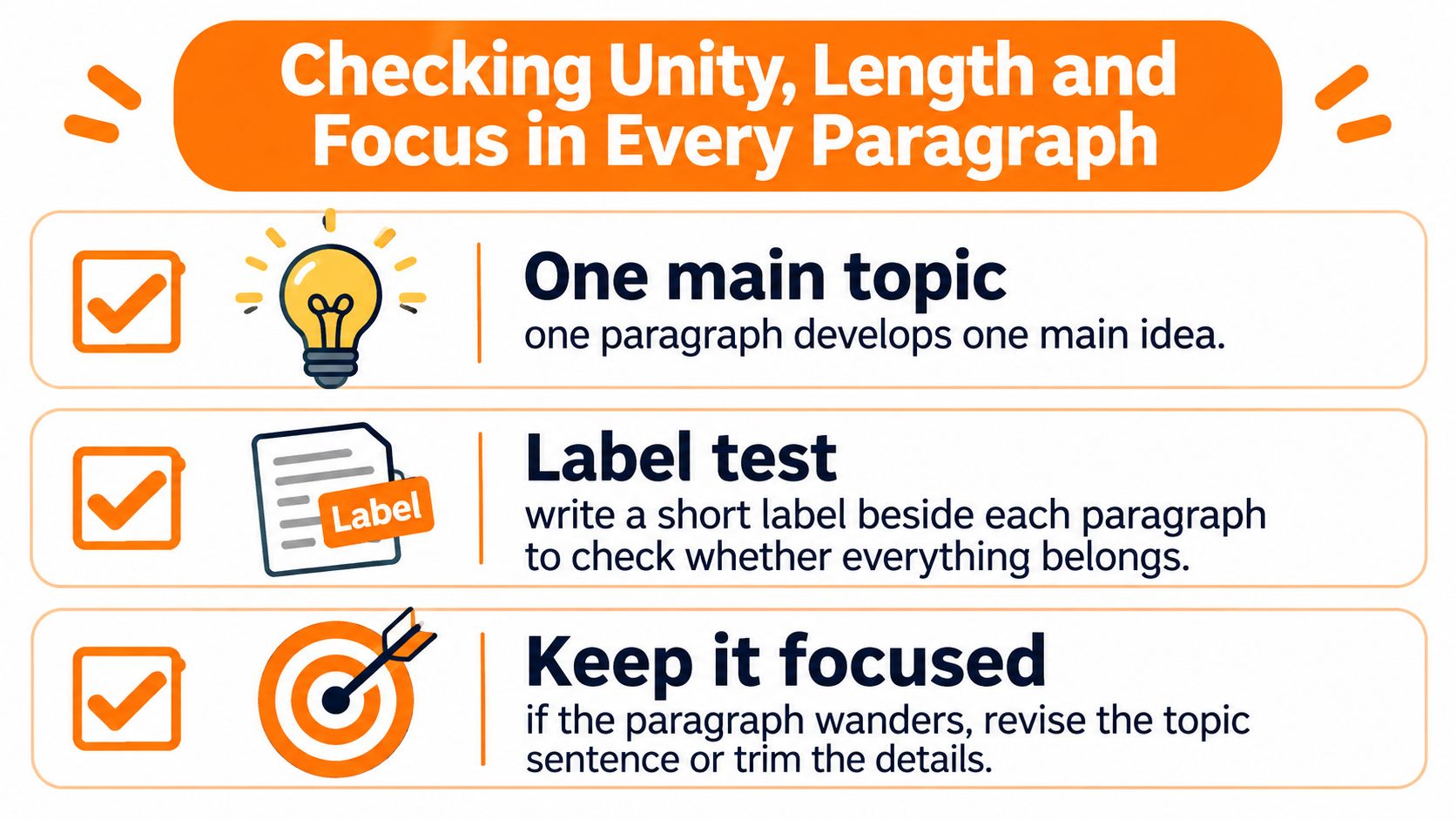
Paragraph unity means developing a main topic without drifting into a competing discussion. The Federal Plain Language Guidelines recommend covering one topic per paragraph and opening with a sentence that captures the essence of what follows.
Use the label test
Write a short label beside each supporting sentence. For a paragraph about managing online coursework, your labels might be calendar, deadlines, study routine, and tuition.
The tuition sentence is the mismatch. It may belong in the essay, but it doesn't help explain scheduling. Move it to a cost paragraph, or remove it if cost isn't relevant to your thesis.
Use this checklist to separate a focus problem from a wording problem.
Editing thresholds for sentences and paragraphs
Treat the following as editing signals, not grading rules. Plain-language guidance includes an average sentence-length target of 15 to 20 words attributed to the U.S. Office of Personnel Management; Washington State's guidelines suggest sentences below 20 words and paragraphs below six sentences.
| Check | Editing threshold | Source |
|---|---|---|
| Average sentence length | 15 to 20 words | U.S. Office of Personnel Management |
| Maximum sentence length | Below 20 words | Washington State guidance |
| Paragraph length | Below six sentences | Washington State guidance |
| Paragraph scope | One topic | Federal Plain Language Guidelines |
An academic explanation may need a longer sentence to express a necessary qualification. Don't remove a condition such as when students lack reliable internet access just to shorten the line.
Instead, look for avoidable bulk. Clear headings help readers locate information quickly gives readers a direct point. Adding heading design, audience research, and mobile layout to that opening would require them to sort through details before finding the claim.
Also check whether the supporting sentences develop the idea or merely repeat it. After a claim about weekly planning, explain how students assign study periods or track deadlines. If the paragraph still wanders, use a paragraph-level clarity revision rather than trimming isolated words.
How to Connect Each Paragraph to the Last
Read only your topic sentences in sequence. If they sound like unrelated observations, decide whether the paragraphs need a different order or a clearer logical connection.
Keep the preceding paragraph visible while checking the next opening.

Baruch College's guide to topic sentences and flow emphasizes connecting backward as well as introducing the paragraph ahead. A useful opening identifies the previous concept, adds a new claim, and makes their relationship clear.
Build a bridge with meaning
Suppose a hypothetical essay's preceding paragraph ends with this point:
Remote work saves employees commuting time.
The next paragraph could begin:
That time saving doesn't guarantee a less crowded workday if managers fill the available hours with additional meetings.
That time saving names the previous idea. The rest introduces a qualification: less commuting doesn't necessarily mean fewer demands during the workday. The paragraph would then need evidence about scheduling practices, rather than another explanation of commuting.
Compare that with However, remote work has disadvantages. The transition announces opposition but leaves readers guessing about the connection.
Keep the connection manageable
You don't have to fit the previous point, a new claim, and every qualification into a single sentence. Try: Employees may save commuting time. Whether they gain usable flexibility depends on how managers schedule meetings.
Choose essay transition vocabulary after identifying the relationship. Use because for a cause, although for a qualification, or similarly for a comparison, not just because the paragraph needs an opening word.
Use the following video alongside a practice pass through your own draft.
Frequently Asked Questions
Can a topic sentence be a question?
It can, but a direct claim is usually more useful in an analytical paragraph. Why do students postpone revision? introduces an inquiry; Students may postpone revision because they mistake it for proofreading gives the paragraph a position to explain. Use the question when the inquiry itself matters, and answer it clearly.
What if I can't summarize the paragraph?
Look for competing purposes. A paragraph discussing both library opening hours and textbook prices may need to become separate discussions, even if both concern student support.
If no clear point emerges, finish this sentence privately: I included these details because… Your answer may reveal the claim you haven't written yet.
Does every paragraph in a short essay need a topic sentence?
Not mechanically. A brief transitional paragraph or narrative passage may communicate its purpose without an explicit claim.
For academic analysis, make the point easy to identify and follow your assignment's expectations. A short essay gives you less room for readers to work out an unclear paragraph's purpose.
Should the topic sentence repeat the thesis?
No. If the thesis argues for better online-learning support, a paragraph can explain a specific measure, such as planning instruction. Repeating Colleges should support online learners doesn't explain what this paragraph adds.
Should I check grammar before revising the claim?
Settle the claim first, then check the wording. A grammar checker can help with spelling, awkward phrasing, and sentence clarity, but deciding how to write effective topic sentences still requires your judgment about evidence and the thesis.
Lumi Humanizer helps make AI-assisted text sound more natural by improving phrasing, rhythm, and flow while preserving its main point. Once you've checked your paragraph's claim and support, visit Lumi Humanizer to refine the wording, then review the result against your evidence and your own voice.