
The most popular advice is to rewrite your notes neatly. Don't. When you're deciding how to turn lecture notes into a study guide, the guide you need is a set of questions you answer from memory, not a tidier copy you reread until it feels familiar.
That difference matters. A clean summary can hide gaps for weeks. A diagnostic guide exposes them while you still have time to fix them.
Match the Study Format to Each Kind of Lecture Material
A study guide built from lecture notes is a retrieval system, not a summary. You turn each idea into a prompt, answer it with the notes hidden, then check what you missed.
Different material needs different prompts. A date doesn't test you the same way a causal explanation does, and a formula doesn't belong in a paragraph.
Study Format by Lecture Material Type
| Lecture material | Best guide format | Example cue question | How to check |
|---|---|---|---|
| Terms, names and dates | Compact fact table plus spaced flashcards | What does reinforcement mean, and where did it appear? | Recall the term before flipping the card |
| Formulas and procedures | Worked-example prompts | Solve a similar problem, then say which step changes when the inputs change | Redo the problem with the notes closed |
| Concepts and causes | Causal map or explain-why questions | Why does removing reinforcement weaken a behavior? | Write the cause-and-effect chain from memory |
| Comparisons between theories | Side-by-side comparison grid | How does approach A predict a different outcome from approach B? | Fill the grid blind, then compare |
| Applications and case discussions | Scenario questions | Given this new case, which principle applies and why? | Answer a case the lecture did not use |
Why Retrieval Beats a Nicer Summary
In the 2011 Karpicke and Blunt study in Science, students assigned to retrieval practice achieved a mean short-answer score of 0.67, compared with 0.45 for the concept-mapping group. That's a difference of 0.22 points, or about 49 percent higher.
The advantage wasn't limited to facts. It also held on questions requiring comprehension and inference, which is why your guide needs application and explain-why prompts alongside definition checks.
Practical rule: If you can't answer an item without opening the notes, it belongs in the guide. If you can already answer it reliably, drop it from the next review and spend that time elsewhere.
Don't sort material by lecture order alone. Sort it by the kind of thinking the exam will ask for, then build the format that forces that thinking.
How to Build the Guide from Your Lecture Notes
Start with one lecture, not the whole course. You're building something you can test yourself with this week.
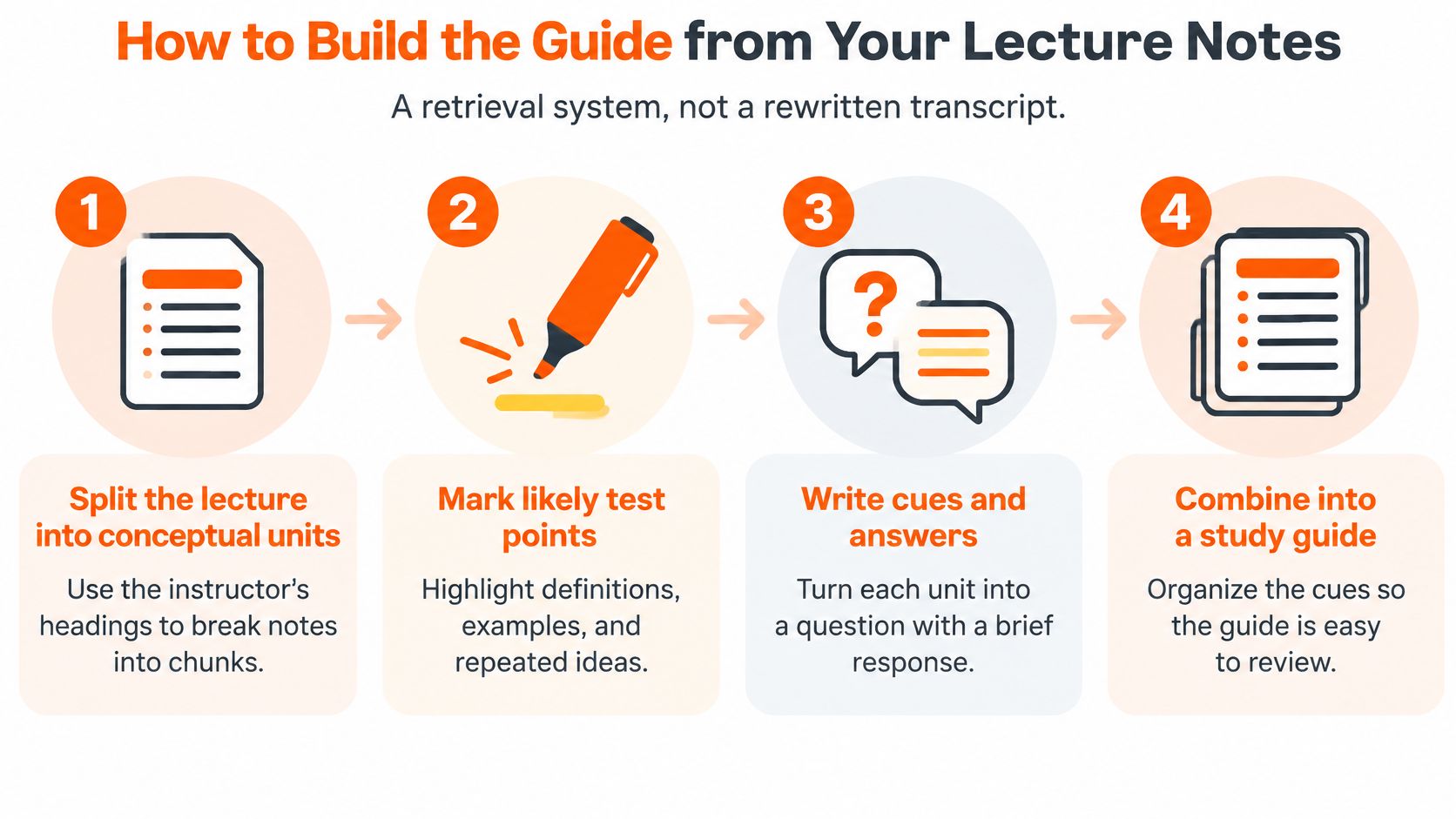
The Six Steps
- Split the lecture into conceptual units. Use the instructor's headings, learning objectives, diagrams, and transitions to break the notes into chunks. A unit should cover one idea you could explain on its own.
- Put the core explanation in a main-notes column. Keep the essential explanation and one or two examples here. This column is your answer key, not your study material.
- Turn each major idea into a cue question. Prefer why, how, compare, or predict questions over bare definitions. That's where understanding gets tested.
Here's the before-and-after. A raw note says, "operant conditioning uses reinforcement." A cue asks, "How does reinforcement change behavior, and what is one example?" The first line asks you to recognize a phrase. The second asks you to produce an explanation.
- Write a short synthesis paragraph for each unit. Cover relationships, mechanisms, or uses in your own words. If you can't write this paragraph, the unit isn't clear yet, and that's useful information.
- Hide the notes and answer the cues from memory. Then check and correct each answer against the main-notes column. Don't peek halfway through, or you're measuring recognition again.
- Label every item. Mark each cue as recall, explanation, comparison, calculation, or application, and confirm every lecture objective has at least one question. Gaps in coverage are easier to spot with labels than by scanning prose.
This workflow follows the Cornell sequence of record, question, recite, summarize, reflect, and review, as described in a review of retrieval-based note methods. The point isn't the page layout. It's that you generate answers instead of copying them.
What a Finished Unit Looks Like
Aim for one page per unit, five to eight cues, and one synthesis paragraph. If your notes have holes, fill them from slides and the reading before writing cues, and mark those filled items so you can tell source material from memory later.
For high-stakes cumulative exams, you'll see similar unit-by-unit organization in review strategies for Shelf exams from Ace Med Boards, where coverage checks matter as much as recall.
Do a final wording pass with the grammar checker so unclear cues don't waste review time. A cue you have to decode is a cue you'll skip.
How to Schedule Reviews Across the Week
One retrieval session the night before an exam measures very little. It shows what's in your head after a single pass, at a single hour, with no spacing and no chance to catch what faded. Spread the same guide across a week and it works as a diagnostic test: each session shows which items survived the gap and which ones slipped away.
The 2013 Dunlosky review of 10 learning techniques rated practice testing and distributed practice as the two techniques with the highest overall utility, and their benefits held across different materials, learners, and test types. The schedule below combines both.
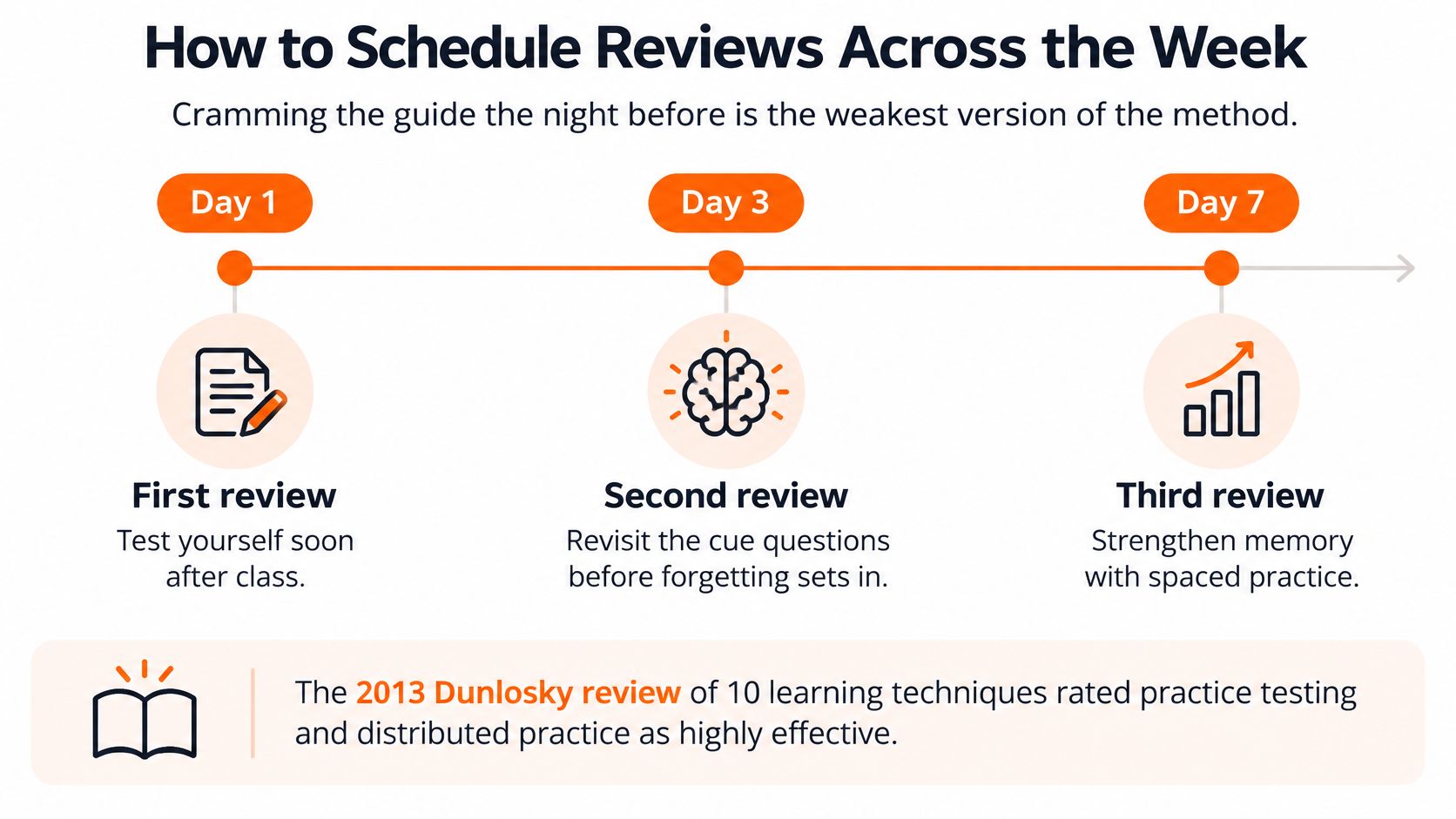
A Thursday Lecture With a Friday Exam
Say the lecture is Thursday and the exam is the following Friday. Build the guide within 24 hours. Run a closed-note session on Monday, about four days later. Run a mixed session the next Thursday, then revisit only weak items.
| Pass | When | Task | Output |
|---|---|---|---|
| Pass 1 | Within 24 hours of the lecture | Repair omissions and write cue questions | Cue list and one synthesis paragraph per unit |
| Pass 2 | Monday, about four days after a Thursday lecture | Closed-note retrieval, scoring each answer as correct, partial or incorrect | Error log of missed items |
| Pass 3 | Thursday, the day before a Friday exam | Mixed application questions, then revisit only weak items | List of items still not reliably recalled |
A gap of three or four days works like a filter. Items you can still retrieve after that delay are the ones likely to hold through exam week, and items that vanish are telling you something while there is still time to act. If the Monday session feels like reading the material for the first time, the gap was too wide. If every answer arrives without effort, the gap was too narrow to test anything.
The instinct here is to treat each session as another read-through of a tidy guide. The task column is what does the work. Pass 2 produces scored answers and an error log, and Pass 3 spends its time on items scored partial or incorrect.
Each later session should also mix new material with questions from earlier topics, so the guide stays cumulative rather than becoming a stack of separate sheets. Term-long writing work runs on the same logic, and the English Composition 2 course guide covers how those assignments build on each other.
Four things belong on the guide page: a dated review plan, a short must-know section, self-test questions, and an error log. The log pays off late in the week, because it names the concepts that need another spaced attempt rather than another reread. Write the review dates in before the first session. A plan that lives only in your intentions won't survive a busy week.
Mistakes That Turn a Guide into Passive Rereading
A guide can look organized while hiding what you can't recall. That's the central problem, and it's common.
A large survey of 584 students found that learners often created transcript-style notes and reviewed them passively at the last minute, even though they reported using organizational strategies. The notes looked like studying. The review didn't test anything.
The Mistakes and Their Fixes
- Copying slides verbatim: This produces recognition, not recall. Rebuild each copied item as a question you have to answer.
- Writing cues that are too broad: A cue like "memory" can't be answered or scored. Rewrite it as "What are the three stages of memory processing?" so a wrong answer is obvious.
- Mistaking familiarity for mastery: A page feels known because you've seen it five times. Test with the notes closed and let the score decide.
- Reviewing only in lecture order: Sequence becomes a crutch, and exams rarely follow it. Shuffle cues across units so each answer stands on its own.
- Skipping the error log: Misses that aren't written down get forgotten, then missed again. Log every miss and retest it after a delay.
The Mastery Rule
Score each retrieval attempt as correct, partially correct, or incorrect. Count an item as mastered only after repeated correct recall across separated sessions, not after one good answer on the day you wrote it.
A student who rereads a polished guide may feel ready, then miss most questions the first time the notes close. Scoring doesn't create that gap. It makes the gap visible while fixing it is still cheap.
Be careful with tools here too. Running your notes through a rewrite for cleaner wording, the kind of task covered in guidance on a paraphrase tool for students, can make a guide read better. It can't tell you whether you can recall anything on it.
Use timing from your review schedule, but let the scores drive the work. Partial answers are the most valuable items in the guide, because they show exactly which element is missing.
Using AI Drafts Without Outsourcing the Learning
A generated summary works like a friend's highlighted textbook. It gives you orientation, but the highlights show what your friend noticed, not what you can retrieve. AI can sort messy notes or a transcript, suggest concepts, and draft cue questions. The recall work stays with you. That division of labor is the point.
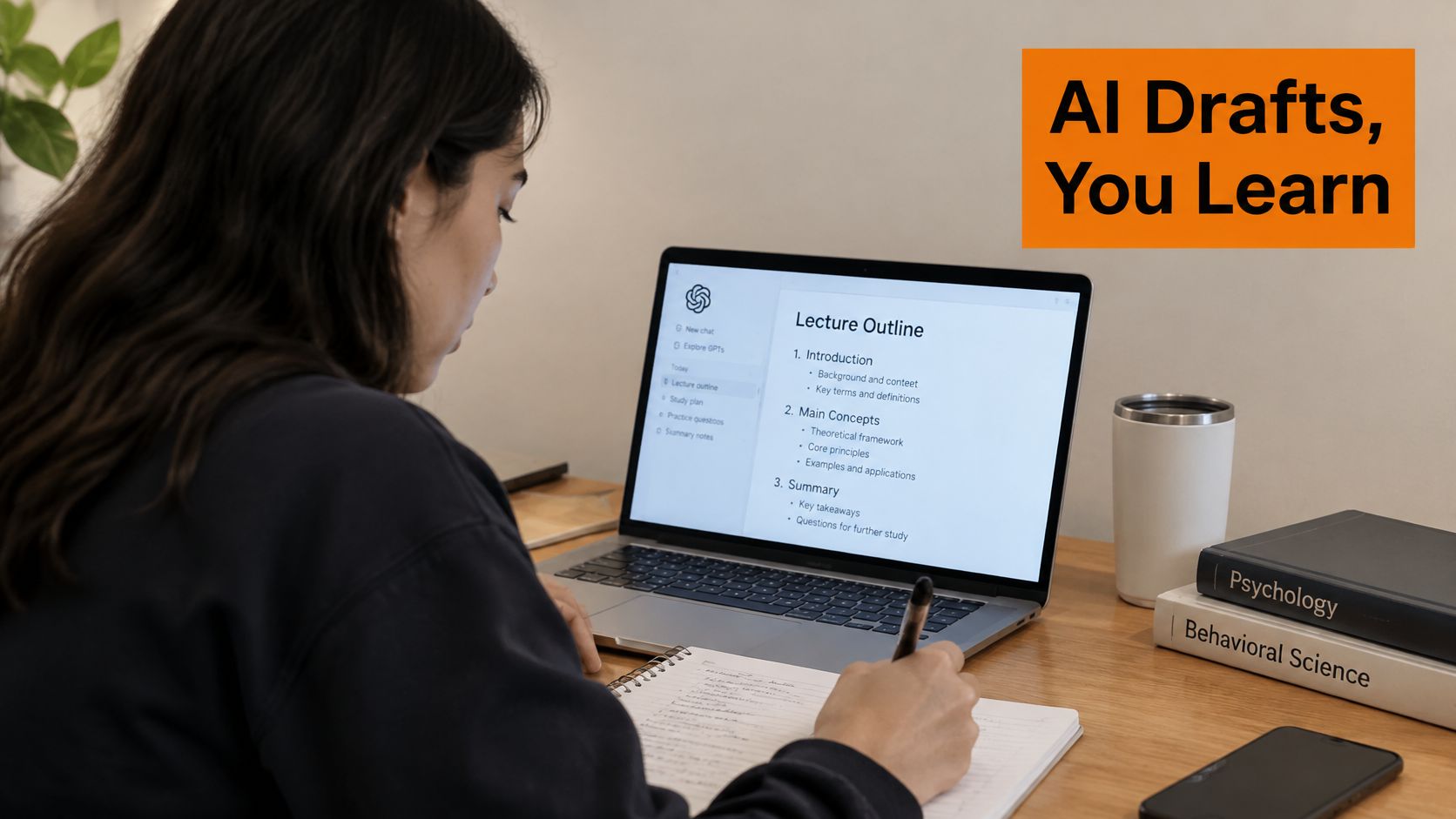
In experimental research with 30 participants, moderate AI assistance produced better learning outcomes than both high automation and transcript-only support. The highly automated system was preferred for ease of use but produced the lowest learning performance. The easiest draft to get was the worst one to learn from.
A Four-Step Routine That Keeps You in the Loop
- Let AI sort and draft. Use it to organize the notes and generate first-pass cues.
- Verify every claim. Check the draft against slides and readings, since generated summaries can state wrong things confidently.
- Add what's missing. Insert the instructor's emphasis and your own examples, which the draft can't know.
- Close the draft and answer from memory. Then compare your answers with the source material.
You may worry that editing AI output counts as learning. It can, when you check claims and rewrite questions. It stops being learning when the page gets cleaner but your recall does not. Treat the draft as a diagnostic test. It should expose what you cannot answer, not make the page look finished.
For disabled and neurodivergent learners, transcripts and generated quizzes can improve access when AI supports learning activities rather than replacing student work. Used that way, the tool lowers barriers to the effort instead of removing the effort.
This short video walkthrough shows the drafting side of the process in practice.
Keep paraphrasing separate from learning. A rewrite through the paraphrase tool changes wording without showing you can recall the idea. Roundups of AI writing tools for students are useful only if you assign each tool a narrow job. Review the draft manually and treat detector results as one editing signal, not a final verdict.
End with one test for every AI-drafted item. Could you answer it now, with the draft closed? If not, it's not learned yet, whatever the document looks like.
Frequently Asked Questions About Study Guides
How Long Should a Study Guide Be
One page per unit, with five to eight cues and one synthesis paragraph, is enough for most lectures. Length matters less than whether you can answer the cues with the notes closed. A short guide you test with beats a long one you skim.
Should I Still Reread My Notes
Rereading works as a first pass or to check an answer after an attempt. Retrieval practice tends to produce stronger recall, though it isn't universally superior to restudy under every condition. Use rereading to repair gaps, not as the main event.
Can I Build a Guide From a Recording Instead of Notes
Yes, but transcribe the recording into units and fill gaps from slides before writing cues. Recordings include tangents, announcements, and repetition that a guide should drop. The cue-writing step doesn't change.
What If the Instructor Provides a Guide
Treat it as a topic list and a source for cues, then write your own questions and check them against it. Writing the cue yourself is where you find out whether you understood the topic or only recognized its name.
Confirm the Guide Works Before the Exam
Run the diagnostic loop one final time: recall from memory, compare with the notes, mark the exact missing element, revise only that gap, then retest after a delay. Expect the first closed-note attempt to show gaps. That's the guide working, not failing.
The Pre-Exam Checklist
- Every lecture objective has at least one question.
- Every item carries a label: recall, explanation, comparison, calculation, or application.
- Every error-log item has been retested in a later session.
- No item counts as mastered after one correct answer.
If you want short retrieval drills to run between full sessions, quick quiz-based ways to reinforce learning from Million Whys offer a useful model for keeping attempts brief and frequent.
A clean summary isn't the goal when you're deciding how to turn lecture notes into a study guide. Reliable recall is. As Emily, a graduate researcher, puts it, "It helps our research notes read smoothly without overediting," and that restraint matters here too, since overediting a guide can polish away the prompts that make it work. If parts of an AI-assisted draft still read stiffly after the recall work is done, the AI Humanizer can smooth the wording.
Do this today. Open your most recent lecture, split it into units, write five cue questions, and start the error log with your first attempt.
Once your guide passes the closed-note test, you may still have AI-drafted sections that sound stiff or unlike you. Lumi Humanizer refines that wording into natural, human-sounding prose while keeping your content and meaning intact, so your study materials read the way you'd write them. Paste in a draft today and see the difference before your next review session.