You've reread your personal statement until every sentence sounds familiar, but you still can't tell whether it answers the admissions prompt. The most effective way to revise a personal statement is to check compliance and program fit first, strengthen the evidence next, and polish sentences last. That order stops you from perfecting material you'll eventually need to delete.
A strong revision doesn't just sound smoother. It makes your motivation, preparation, and next step easier to understand without asking the reader to fill in missing connections.
How to Revise a Personal Statement in Five Passes
- Compliance: Establish what the application requires.
- Fit: Test whether you're answering this program's questions.
- Substance: Check your central message and supporting evidence.
- Structure: Organize the argument and tighten the language.
- Proofreading: Correct errors in the finished draft.
Don't line-edit until the opening passes are complete. A beautifully phrased paragraph still needs to go if it answers the wrong question.
Purdue OWL's admissions essay guidance recommends outlining and checking thematic consistency, including whether paragraphs should be added or removed, before correcting word choice and mechanics. Apply that distinction deliberately: revision changes what the statement communicates; proofreading checks how accurately you've written it.
Five revision passes and their finish line
| Pass | What You Check | Done When |
|---|---|---|
| 1. Compliance | Word or character count, every prompt subpart, required format | Count is within the limit and every prompt is answered |
| 2. Fit | Reasons for this field and this specific program | Each paragraph serves a named purpose for the school |
| 3. Substance | Central message and the evidence behind each claim | You can state the main point in one sentence |
| 4. Structure | Paragraph order, transitions, tone, repeated points | Each paragraph moves the argument forward |
| 5. Proofreading | Grammar, spelling, punctuation, awkward syntax | Reading aloud and backward shows no errors |
Give Each Draft a Defined Job
Save a working copy before substantial changes. Name the program in the filename so you don't accidentally revise or upload another application's version.
For a professional pathway, check the broader application context before deciding which experiences deserve space. Medical School Programs' guidance on applying to medical school is a useful companion when you're considering how a medical-school statement fits the surrounding application.
Use the process graphic as a reminder to move from larger decisions toward smaller corrections.
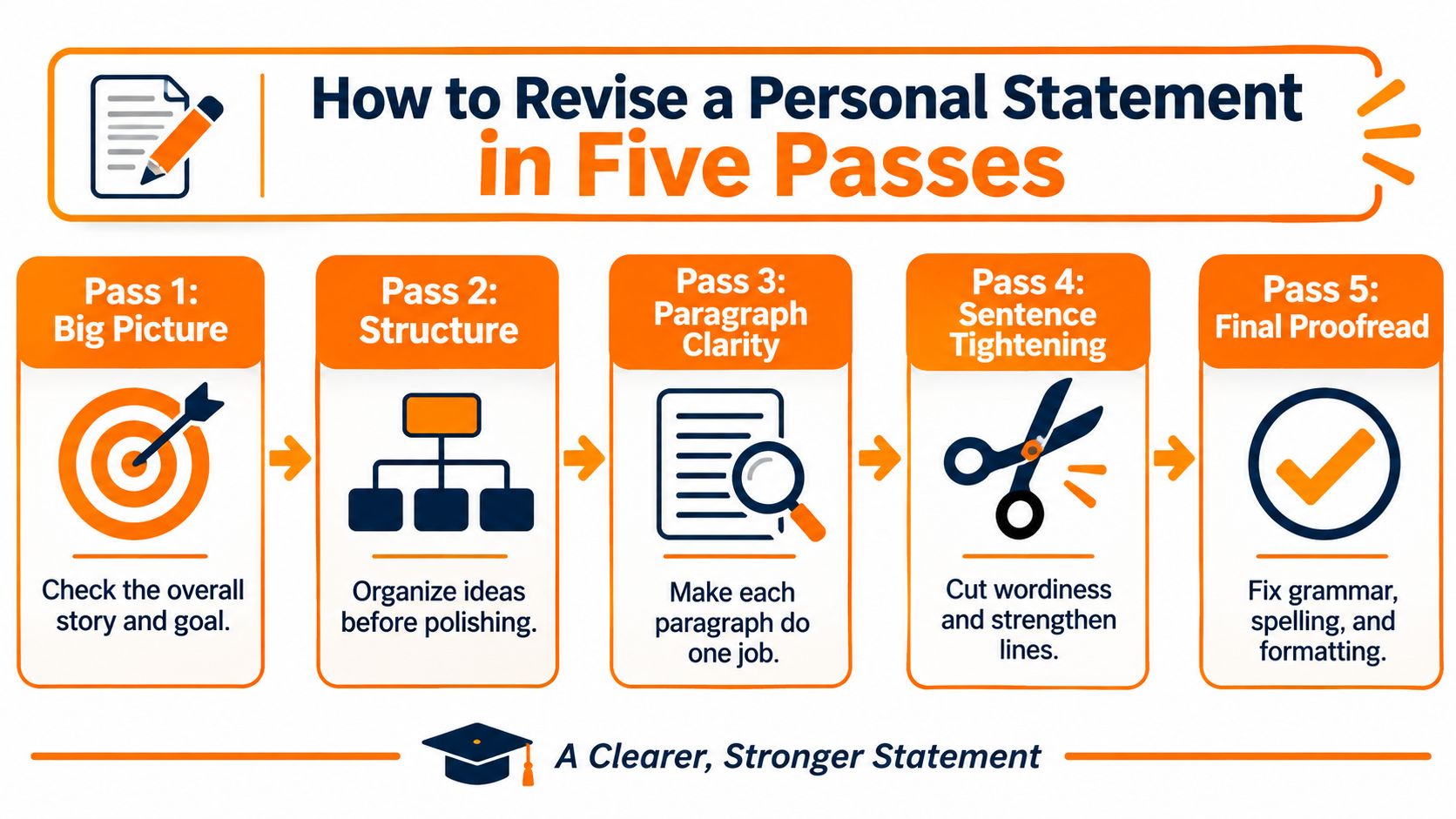
The graphic groups the editing work visually; keep compliance and fit as your entry checks before following its progression.
After the substance pass, close the document and summarize your main point in a sentence. If you can only list activities, you haven't yet identified what those activities explain about your direction.
Check the Limits Before You Touch a Sentence
A polished draft can fail before anyone reads it. A 620-word statement against Princeton's 250-word cap, or a paragraph that answers a question the prompt never asked, wastes your strongest sentence. Check the rules first, then edit.
Princeton Graduate School's personal-statement guidance sets a 250-word maximum, requires English, and accepts corrections only before the deadline. For UCAS applications from 2026 entry onward, the statement is three answers, each at least 350 characters, inside a 4,000-character limit including spaces. The mechanics differ. A word cap forces you to compress the argument. A character cap across three answers forces you to allocate space by question. Confirm the current program instructions before cutting, because formats change between cycles.
Statement limits by application system
| Institution or System | Limit | Format and Rules |
|---|---|---|
| Princeton Graduate School | 250 words maximum | English; corrections accepted only before the deadline |
| UCAS, 2026 entry | 4,000 characters total across three answers | Each answer at least 350 characters, spaces included |
The formats are not interchangeable. Don't shrink margins or font size to force a long statement onto a page limit. Don't assume a personal statement and a statement of purpose ask for the same material, even when a program requires both.
Cut by Prompt Coverage, Not by Sentence Length
Take a 620-word draft for Princeton's limit. Mark each paragraph by the question it answers: the personal experience, how it changed your decision to pursue graduate study, or what you would contribute to the scholarly community. A paragraph about unrelated awards may answer none of those questions. Remove it before you compress the paragraph that explains why the experience mattered.
Then identify what has to survive:
- Experience: What happened, and what did you do?
- Influence: How did it change your academic direction?
- Contribution: What will you bring to the scholarly community because of it?
Keep enough context to make the experience intelligible. Don't spend most of the available space setting the scene. Reflection needs room too. When a draft is substantially over length, remove unnecessary content before compressing necessary content. Cutting a whole paragraph is cleaner than shaving a clause from every sentence and flattening the voice.
For multipart applications, don't force equal lengths. The UCAS personal statement toolkit allows uneven allocation within the overall allowance as long as every answer meets its minimum. That freedom helps when one answer carries the evidence and another needs only a short transition.
Write the exact requirements at the top of your working document. Before drafting further, read your institution's academic integrity policy, including its rules on outside editing and AI assistance. In academic settings, you must comply with your institution's policies. A statement that breaks a limit or answers the wrong question is not rescued by better sentences.
Get Feedback That Tests Fit and Evidence
Ask for feedback while you can still change the argument, not just the punctuation. Give readers a clear job rather than asking whether they like the essay.
George Mason University's Writing Center recommends at least three readers with complementary perspectives: someone who knows you, a writing specialist, and an academic expert in your intended field.
| Reader | Main Job | Useful Question |
|---|---|---|
| Someone who knows you personally | Check factual accuracy and recognizable voice | Does this sound like me, and have I overstated anything? |
| Writing specialist | Examine organization, clarity, and readability | Where must you reread to understand the connection? |
| Academic in the intended field | Test motivation and program relevance | Do my proposed interests follow credibly from my preparation? |
Give everyone the prompt alongside the draft. Otherwise, a reviewer may recommend an engaging story that doesn't belong in this application.
Ask for Evidence Behind the Feedback
Use a 1–5 review scale as an editorial rubric, not as a prediction of admission. Ask readers to assess prompt coverage, specificity, credible motivation, reflection, coherent structure, authentic voice, and sentence-level correctness.
For every rating, request a sentence or paragraph that explains it. A low clarity rating without a location gives you little to revise.
Also ask readers to distinguish these reactions:
- Unclear: They can't work out what you mean.
- Unconvincing: They understand the claim but don't see enough support.
- Disagreement: They understand your position but would make a different choice.
Those reactions require different fixes. Clarify wording for the first, strengthen evidence for the second, and consider whether the third is relevant to the prompt at all.
Suppose an academic reviewer says your interest in public health appears abruptly. Adding another sentence about enthusiasm won't solve the problem. Explain which experience raised the question you now want to investigate.
Preserve a deliberate stylistic choice unless the prompt or a clear reader difficulty gives you a reason to change it.
Prioritize concerns raised independently by multiple readers, along with any requirement a reader correctly identifies as missing. Don't combine everyone's preferred wording into a statement that no longer sounds like you.
Finish with a blind read by someone outside the discipline. Ask them to summarize your central change or motivation without coaching. Their summary should make clear why you're pursuing the field, why the program fits, and what you intend to contribute or pursue next.
Fix Structure First, Then Tighten Each Line
Consider this hypothetical revision.
Before: I am a passionate and hardworking student who has always loved biology.
After: Redoing a failed PCR run in my school lab taught me to record every change before making it, a habit I now bring to research.
The second version gives the reader an experience, a lesson, and a connection to the field. Use that approach only with events that happened to you; a more impressive invented example is never a better revision.
Keep your draft and prompt visible together during this work.

Make the Reasoning Visible
Create a revision log with columns for problem, evidence, and change. Record the actual passage causing difficulty rather than a vague instruction to improve the flow.
| Problem | Evidence in the Draft | Change |
|---|---|---|
| Motivation is asserted | Opening relies on passion and hard work | Replace labels with a relevant experience |
| Reflection is missing | Placement paragraph describes duties only | Explain how a responsibility changed your thinking |
| Program connection is abrupt | Conclusion introduces a new interest | Establish that interest earlier and connect it to the program |
Give each working draft a defined objective. You might focus on adding reflection after major experiences, then use a later draft to replace résumé-style listing with a causal narrative.
For deeper help connecting an event to its significance, use this guide to writing a reflective essay. The useful distinction is between describing an event and explaining how it changed your understanding.
If you use video guidance alongside your draft, keep your application prompt open and test suggestions against it.
Edit Connections Before Vocabulary
Read only the opening sentence of each paragraph. Can you follow the progression from experience to developing interest to future direction? If not, move paragraphs or rewrite their openings before choosing more polished synonyms.
Use transitions that explain relationships. Instead of adding a simple connector, explain that a placement exposed a gap in your knowledge or that a project changed the question you wanted to study.
For multipart statements, label sentences by purpose: motivation, preparation, or relevant experience. UCAS's review checklist advises removing information already supplied elsewhere and avoiding repeated examples across answers.
Finally, tighten individual lines. Delete empty framing such as I would like to take this opportunity to explain. Prefer the direct statement.
A paraphrase tool can suggest alternatives for a stiff sentence, but compare each alternative with your original meaning. Reject changes that inflate your responsibility, alter chronology, or substitute vocabulary you wouldn't naturally use.
Mistakes That Weaken a Revised Statement
The most damaging mistake is treating smoother language as proof of stronger content. A polished assertion still needs evidence.
Use specific repairs rather than another general rewrite:
- Cliché opening: Replace a childhood-origin claim with the moment your interest became specific.
- Achievement list: Connect an accomplishment to a change in your thinking, not another accomplishment.
- Generic program paragraph: Replace interchangeable praise with a verified feature relevant to your goals.
- Inflated responsibility: Distinguish what you led, supported, observed, or learned.
- Over-editing: Restore straightforward wording where substitutions make you sound unlike yourself.
Keep Assistance Separate From Authorship
In a 2025 Association for Computing Machinery study, every applicant interviewed from the 2023–2024 application cycle reported using generative AI to help write or refine admissions essays and changing their essays based on AI feedback. That finding describes the interviewed applicants, not every applicant or every institution's policy.
Treat automated feedback as a source of questions. If a suggestion says your motivation is vague, identify the missing explanation yourself rather than accepting a fabricated personal connection.
A sentence-rewriting guide for essays can help you evaluate wording alternatives. The important distinction is between clarifying your account and replacing it with a more flattering account.
Your final statement should contain claims you can explain and defend without referring to an editing tool.
If you use an AI detector, treat the result as one editing signal, not a verdict. Results vary by draft quality, detector version, and the editing needed; a score doesn't establish whether an institution will accept your statement.
Review the final text manually before submitting it. You're responsible for any disclosures your institution requires.
Don't Confuse Document Requirements
If your application also needs a résumé, Eztrackr's guidance can help you avoid ATS formatting errors in that separate document. Don't transfer résumé conventions automatically to the statement.
An application résumé records experience efficiently. Your statement should explain the significance of selected experiences, using the format the program requests.
Confirm Your Statement Before You Submit
Stop revising when the draft meets clear acceptance criteria, not when you're tired of reading it. Open the version you intend to upload and check the document itself, including any conversion to PDF.
Run the Final Checks in Order
-
Read aloud, then backward sentence by sentence. Listen for awkward syntax, then inspect individual sentences for omitted words and punctuation without following the story.
-
Verify the final count. Use the required unit, whether that's words, characters including spaces, or pages with specified formatting.
-
Match the text to the prompt. Mark the sentence or passage answering each required part; an implied answer is a reason to inspect the draft again.
-
Confirm the submission details. Check the filename, file type, program name, upload location, and deadline before attaching the document.
-
Run a final grammar pass. Use the grammar checker, then reread each flagged sentence yourself rather than accepting every suggested change.
-
Make the submit-or-revise decision. If your outside reader's summary matched your intended message and no substantive issue remains, submit; otherwise return to the relevant revision pass.
For help distinguishing a genuine correction from an unnecessary change, consult this grammar-checker guide. A grammatically acceptable sentence may still be vague, and an unusual but clear sentence doesn't automatically need replacing.
Record What You're Accepting
Write a brief final note in your revision log: what changed, what you verified, and which editorial trade-off you accept. For example, you might omit a secondary experience to preserve a clearer explanation of your main motivation.
That's a legitimate trade-off. An unanswered prompt, unsupported claim, or prohibited format isn't.
Check the uploaded preview if the application provides one. Look for broken paragraph spacing, missing text, or a different file than the one you approved.
Knowing how to revise a personal statement means recognizing when substantive editing is finished; use the grammar-checker pass for final proofreading, not as a substitute for that decision.
Frequently Asked Questions
Can I Revise the Statement After I Submit It?
Only if the program permits it. Princeton allows a corrected essay before its deadline, while NYU GSAS does not accept post-submission revisions. Verify the policy before you rely on a later correction.
How Many Revisions Are Enough?
Start early enough to allow several rounds. I would plan backward from the deadline and treat readiness, not a revision count, as the signal to stop. The draft is ready when it passes every check and no substantive problem remains.
Can a Paraphrase Tool Revise My Statement for Me?
It can offer wording alternatives. It cannot determine which experiences are true, which lessons matter, or whether the response answers the prompt. Keep responsibility for claims, chronology, and voice.
Does an AI Detector Decide Whether My Statement Is Acceptable?
No. A detector estimates AI-generated signals without certainty. Institutional requirements, the prompt, and your own review matter more than a detector score. Treat the result as one editing signal.
How Do I Check UCAS Length?
Count characters including spaces across the complete statement, then check each answer against its own minimum. A total under the combined allowance does not guarantee that every answer qualifies.
Lumi Humanizer reviews writing patterns, sentence structure, and vocabulary to improve flow while keeping your meaning and intent. You can create a writing style from your own examples so the rewrite stays closer to your preferred tone and formality. Once the statement meets the prompt and every claim is one you can stand behind, use Lumi Humanizer for phrasing changes, then review each change before submitting.