You've found a passage that fits your essay, but after pasting it into the paragraph, it feels disconnected. To integrate quotations into an essay, introduce the source, reproduce its words accurately, add the required citation, and explain how the passage supports your claim. The harder question comes first: does your argument need the author's exact words, or would a paraphrase work better?
Deciding Whether to Quote, Paraphrase or Summarize
Would paraphrasing this passage weaken the evidence? If the answer is no, you probably don't need a direct quotation. Choose the form that helps your reader understand your argument, not the form that fills the page fastest.
A definition may need quoting because you're examining the author's precise terms. A controversial claim may also deserve quotation because readers need to see exactly what the author asserted. By contrast, a description of a study's procedures usually matters for its content rather than its phrasing.
The Pacific Lutheran University Writing Center's quotation guidance emphasizes selective quotation and explaining the significance of borrowed language. Your own reasoning should remain the main thread.
Quote, paraphrase or summarize: which to choose
| Situation | Best choice | Why |
|---|---|---|
| The exact wording is a definition or distinctive phrase | Quote | The author's words carry the meaning |
| A controversial or unusual claim you must attribute precisely | Quote | Changing the wording could change the claim |
| The idea matters more than the phrasing | Paraphrase | Your sentence can make the point in your own structure |
| A passage that is essential but clumsily written | Paraphrase | You can clarify it while keeping its meaning |
| Broad background across several sources | Summary | You need the gist, not the detail |
Keep your reasoning in charge
Say you're writing about social media and attention. A researcher's distinctive description of attention as a finite resource might deserve close analysis, so you quote the relevant phrase. You paraphrase the study's methods because your reader needs to understand what the researchers did, not examine their sentence structure.
If an essential passage is awkwardly written, don't preserve its awkwardness merely to sound authoritative. Reconstruct the idea clearly in your own words and keep the citation. This guide to paraphrasing an essay paragraph can help you distinguish a genuine rewrite from superficial word replacement.
As a drafting rule, give each paragraph a central piece of evidence rather than stacking quotations. Multiple excerpts can be useful for comparison, but each needs a distinct purpose and your interpretation.
Decision rule: Quote when the wording contributes something your paraphrase would lose. Otherwise, explain the idea in your own voice and credit its source.
Block and Inline Formats by Citation Style
MLA uses a line-based threshold, while APA uses a word-based threshold: Purdue's reference and citation guidance identifies four lines or fewer for inline MLA prose quotations and 40 words or more for APA block quotations.
That distinction matters because the same passage can require different layouts. In a hypothetical draft, a 45-word passage could stay inline in MLA if it occupies no more than the permitted lines, but it would require a block in APA.
MLA and APA quotation thresholds
| Style | Length | Format | Quotation marks | Citation placement |
|---|---|---|---|---|
| MLA | Four typed lines or fewer | Inline, in the paragraph | Yes | Author and page in parentheses before the period |
| MLA | More than four lines | Block, indented 0.5 inch | No | Parenthetical citation after the closing punctuation |
| APA | Fewer than 40 words | Inline, in the paragraph | Yes | Author, year and page in the same sentence |
| APA | 40 words or more | Block, new line, indented 0.5 inch, double-spaced | No | After the final punctuation, no period after the closing parenthesis |
The official APA quotation guide specifies the 40-word block threshold, 0.5-inch indentation, double-spacing, and citation placement shown above. For an unpaginated source, use an appropriate locator, such as a paragraph number, rather than inventing a page.
Apply the layout after choosing the passage
For a short APA quotation, the following instructional example shows how author, year, wording, and locator fit together:
Garcia (2022) argues that “revision changes the reader's understanding” (p. 18).
Treat Garcia as an example of citation structure, not as a source for your essay. Replace the example's details with information from the work you consulted.
For a block quotation, use your word processor's paragraph indentation settings rather than adding spaces manually. Preserve the document's required spacing, and don't add quotation marks around the block.
These are prose rules, not universal rules for every kind of source. Check your instructor's assignment requirements and the applicable style guide before finalizing the layout. A block's visual separation doesn't remove your responsibility to introduce it and interpret it.
How to Introduce, Quote and Explain a Passage
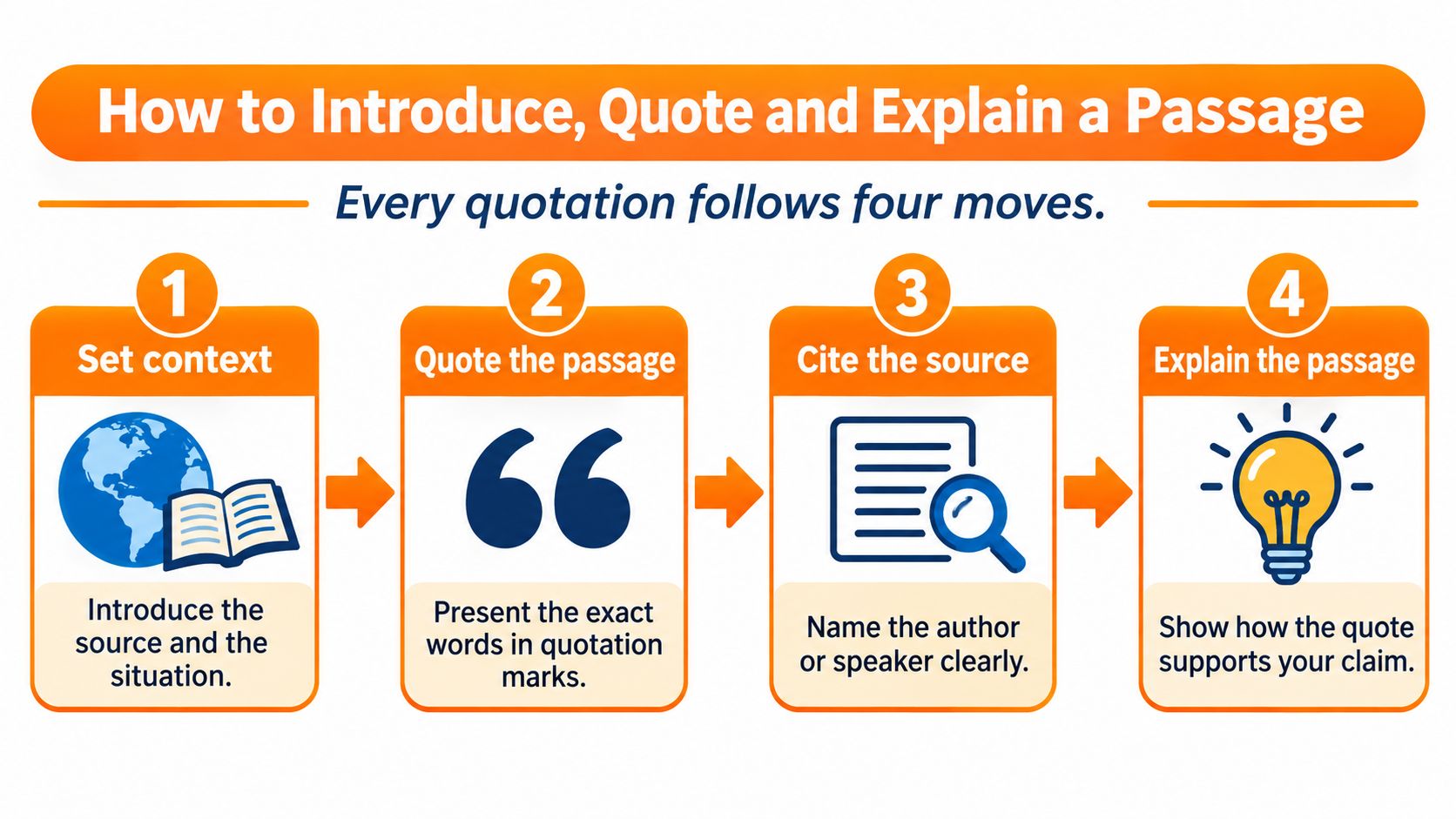
Every quotation follows four moves: introduce the source, present the exact words, cite the source, and explain the passage's significance. That's the practical answer to how to integrate quotations into an essay without letting borrowed language replace your argument.
Purdue's guidance on quoting, paraphrasing, and summarizing distinguishes direct quotation from other ways of using sources and stresses accurate wording and attribution. The MLA's quotation-integration model separates context, source material, citation, and commentary into distinct moves.
Use this sequence while drafting:
Build the sentence around a purpose
- Set context. Identify the author and the issue the passage addresses. Give the reader enough background to understand why this source belongs here.
- Quote selectively. Choose the clause or phrase you'll examine. Don't borrow a full paragraph when a brief passage supplies the evidence.
- Add the citation. Include the information and locator your citation style requires. Attribution in a signal phrase doesn't automatically supply the complete citation.
- Interpret the evidence. Explain a key term, implication, assumption, or tension. Connect that observation to your paragraph's claim.
Consider a paragraph arguing that revision improves essays by changing how readers understand the argument. Using the instructional Garcia example, compare these versions.
Weak integration
“Revision changes the reader's understanding” (Garcia, 2022, p. 18). Students should revise their essays.
The citation identifies the example source, but the writer hasn't established a connection between the quoted wording and the recommendation.
Stronger integration
Revision involves more than correcting surface errors. Garcia (2022) argues that “revision changes the reader's understanding” (p. 18). The emphasis on understanding suggests that writers should reconsider the order and explanation of their ideas, not just repair spelling.
The stronger version makes a claim before introducing the source. Afterward, it interprets the quoted term understanding and identifies a consequence for the writer.
Test the paragraph without the quotation
Temporarily remove the quoted material. Your claim should still be understandable because you've stated it yourself.
Then ask what disappears with the quotation. If you lose precise evidence or language worth examining, the quotation has a purpose. If nothing important disappears, it may be decoration; if the whole argument becomes unclear, strengthen your framing and analysis.
A quotation provides material for an argument. Your explanation tells the reader what to make of it.
Signal Phrases and Punctuation That Fit Your Sentence
Choose punctuation by reading the structure of your sentence, not by assuming every quotation needs a comma. The APA in-text citation checklist asks writers to check whether their quotation is incorporated into a sentence with an appropriate introduction.
Keep the surrounding sentence visible as you edit:

Match punctuation to grammar
The following instructional sentences isolate the punctuation pattern. A submitted essay would also need its source citation.
- Reporting verb with a comma. Lee observes, “The results changed after revision.”
- Complete introductory clause with a colon. The study reaches a clear conclusion: “The results changed after revision.”
- Integrated wording with no intervening punctuation. Lee observes that “the results changed after revision.”
The word that connects the quotation directly to the sentence. Adding a comma immediately after it would interrupt that connection.
Choose a verb that represents the source
Argues identifies a position, observes reports an observation, and qualifies signals a limitation. Says isn't automatically wrong, but it gives readers less information about the author's purpose.
If the source limits a finding to “in some cases,” retain that qualification. Replacing says with a more precise verb can help, but no signal verb can repair a quotation that has lost an essential limitation. Use this essay-writing vocabulary guide to choose accurate verbs rather than more elaborate ones.
For additional sentence practice, you can practice grammar with ChatPal. A grammar checker can help review your surrounding prose, but don't accept suggestions that rewrite quoted words without notice.
Use the video alongside your sentence-level practice:
Before: Lee observes that, “the results changed after revision.”
After: Lee observes that “the results changed after revision.”
Editing a Quote Without Changing Its Meaning
Brackets and ellipses must never change the author's claim. They make editorial intervention visible, but they don't give you permission to strengthen, simplify, or reverse what the source meant.
The University of Nevada, Reno's quote-integration guidance explains how to integrate and adjust quoted material while preserving its meaning. Start with the full passage in view, not just the fragment you copied into your notes.
Make every intervention traceable
- Square brackets identify inserted wording. If a source uses an unclear pronoun, a bracketed noun can clarify its referent. For instance, replacing a pronoun with [revision] is appropriate only when the surrounding passage establishes that revision is what the pronoun means.
- Ellipses indicate omitted material. Remove words only when the remaining passage still represents the source accurately. An omission must not hide a condition, exception, or disagreement.
- Grammar checks protect sentence fit. Review tense, pronouns, and capitalization against the original. Apply your style guide's rules for marking changes rather than correcting the source without notice.
Suppose an author reports that results changed “in some cases.” An unsafe edit removes that qualification and presents the finding as universal. An even more serious distortion replaces the qualified statement with an assertion that results always changed.
The safe version retains the limitation and explains its importance: the evidence supports a conditional conclusion, not a guaranteed outcome. If the qualification makes your sentence awkward, rewrite your own introduction or paraphrase the complete idea.
Fidelity check: Could the author reasonably object that your excerpt makes a different claim? Read the surrounding passage before deciding your edit is safe.
Keep translations distinguishable
When you translate a passage yourself, you're supplying English wording that wasn't present in the original. Identify it as your translation and cite the source version you used, following your required style.
If you quote a published translation, credit the version you consulted rather than implying that you translated it. Keep the original-language passage, translation details, and your draft translation separate in your notes.
That separation is especially useful when you move between languages while drafting. It helps you distinguish the author's wording from your own explanatory choices and prevents a provisional translation from becoming an unmarked direct quotation.
Common Questions About Quoting in Essays
Can I quote the same source more than once in a paragraph? Yes, provided each quotation adds distinct evidence and the reader can identify its source. Vary signal verbs when their meanings fit, not merely to avoid repetition, and explain why the separate passages belong together.
What if I found the quotation inside another source? Consult and cite the original whenever you can read it. If you can't, identify the indirect quotation using your style's convention, such as APA's “as cited in,” and cite the secondary source you consulted rather than pretending you read the original.
A citation should show the route you actually took to the evidence, not the route you wish you had taken.
How do I preserve line breaks when quoting poetry? In MLA, up to three lines of verse can run inline, with a slash surrounded by spaces marking each line break. Longer verse quotations use block formatting and preserve the poem's original line breaks rather than replacing them with slashes.
Do quotations count toward the word limit? Check the assignment brief or your institution's assessment rules instead of assuming they're excluded. If the policy distinguishes quotations, footnotes, and reference lists, follow those categories exactly; when the wording is unclear, ask your instructor before trimming your own analysis to make space for more quoted material.
Check Every Quotation Before You Submit
Finish with an audit of the source, the sentence, and the paragraph. Purdue's MLA quotation guidance explains quotation formatting, citation placement, and how to show changes to borrowed wording.
Use this checklist beside your draft:
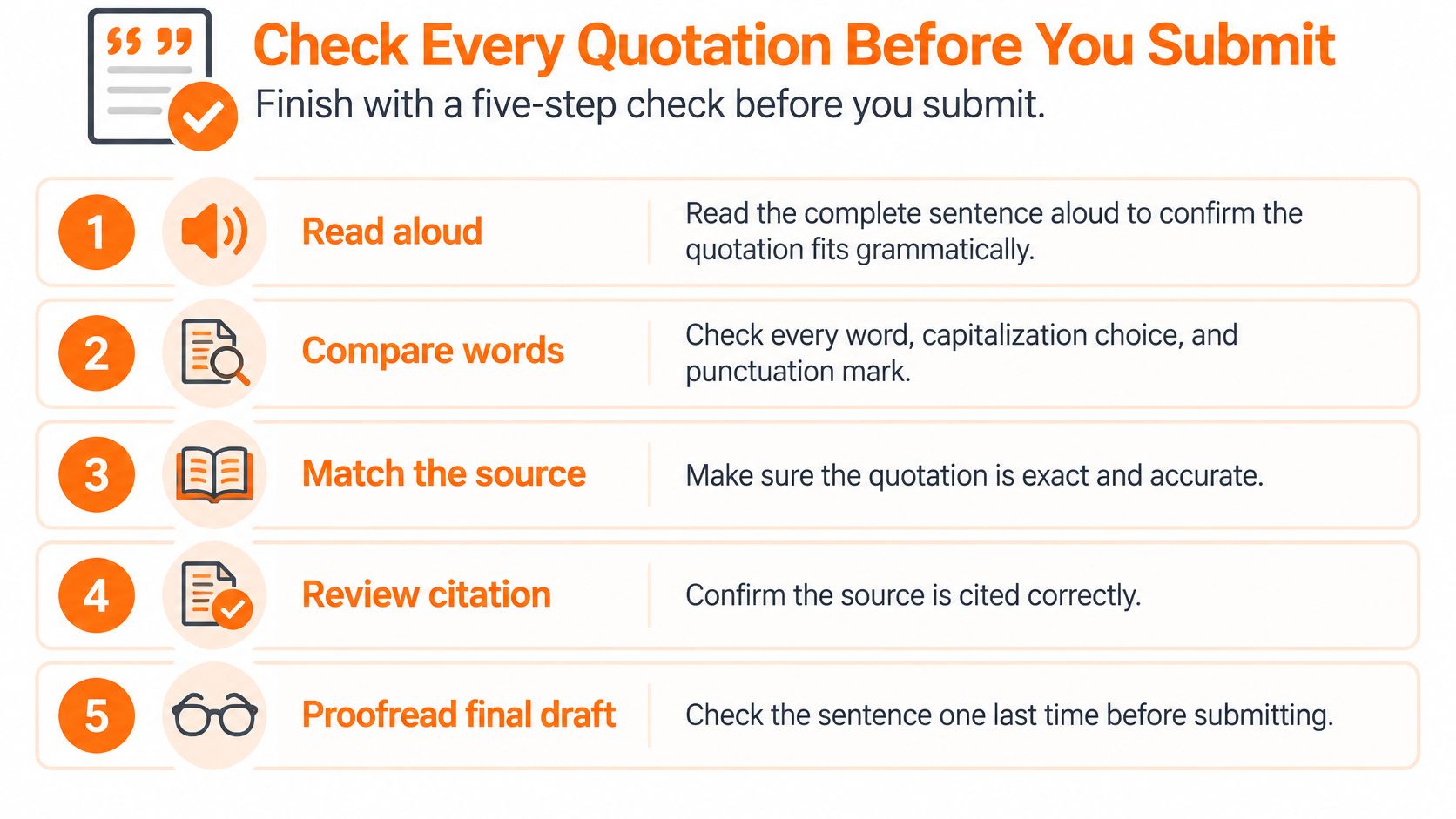
- Read the complete sentence aloud. Listen for a broken grammatical connection between your introduction and the quotation.
- Compare it with the original. Check words, capitalization, and punctuation. Confirm that any brackets or omissions preserve the meaning.
- Verify the citation. Check the author information and required locator against the source you used.
- Inspect the layout. Confirm that inline or block formatting matches the passage and the assigned citation style.
- Read the explanation afterward. Make sure you've interpreted the evidence rather than merely repeated it.
Make your notes easy to audit
Keep the exact wording in a dedicated quotation field, with its source location beside it. In a separate field, describe the quotation's intended function, such as defining a disputed term or supporting a contrast.
This arrangement prevents your paraphrases from becoming confused with copied wording. It also lets you check citations without searching through an entire document again.
A final originality review can help identify passages that deserve closer inspection; this guide to using a plagiarism checker explains that review process. A similarity result doesn't replace checking sources yourself or establish whether a passage is properly attributed.
Knowing how to integrate quotations into an essay means keeping both the evidence and your interpretation trustworthy. Before using any writing tool, check your institution's academic integrity policy, then resolve uncertain wording or citations before submitting.
Lumi Humanizer offers an AI humanizer designed to improve clarity, voice, and flow while preserving a draft's main point. If your institution permits this kind of assistance, visit Lumi Humanizer to refine your own explanatory prose, keeping direct quotations unchanged and checking every citation against the original.