A compound sentence with and joins two independent clauses with a comma before and, and each side must be able to stand as its own sentence. Adding and doesn't make a sentence compound.
The familiar advice to “put a comma before and” leaves out the most important decision: what exactly are you joining? Start with the clauses, not the punctuation. Then decide whether giving both ideas equal grammatical weight helps your reader.
What a Compound Sentence with And Is
A compound sentence with and connects complete statements through coordination. The MIT grammar guide identifies a comma plus a coordinating conjunction as a standard way to join independent clauses.
Consider this sentence:
The researcher analyzed the data, and the editor checked the citations.
The researcher analyzed the data can stand alone. So can the editor checked the citations. Each clause has a subject and a finite verb, meaning a verb that functions as the clause's main predicate and carries tense.
Now compare a sentence that looks similar:
The researcher analyzed the data and checked the citations.
Here, the researcher performs both actions. The words checked the citations don't have their own subject, so they aren't a separate independent clause. This is a simple sentence with a compound predicate, not a compound sentence.
Equal grammar doesn't mean identical importance
And presents connected ideas as grammatically equal. Neither clause depends on the other to form a complete statement.
Because and although create a different relationship. In “Because the researcher analyzed the data, the editor could check the conclusions,” the opening clause depends on the main clause to complete the sentence.
That distinction matters when you edit an essay, lab report, or proposal:
- Separate complete statements: Give the clause boundary appropriate punctuation.
- Shared subject: Don't insert a comma merely because another action follows.
- Unequal emphasis: Consider whether a dependent clause would express your meaning more precisely.
The goal isn't to make every sentence compound. It's to recognize the structure you've written, punctuate it accurately, and choose a connection that suits the point.
The Clause Test Before You Add a Comma
| Pattern | What each side is | Comma before and | Example |
|---|---|---|---|
| Two independent clauses | Each side has its own subject and verb | Yes | Maya finished the report, and she emailed it to her professor. |
| Compound predicate | One subject, two verbs | No | Maya finished the report and emailed it to her professor. |
| Words or phrases joined | Nouns, adjectives, or phrases only | No | Clear and concise notes help readers. |
| Three-item list | And before the last item in a series | List comma only, not a clause comma | She drafted, revised, and sent the file. |
| Comma splice | Two clauses joined by a comma alone | Wrong; add and, use a semicolon, or split | The notes were clear, readers still asked questions. |
| Fused sentence | Two clauses with no punctuation | Wrong; add comma plus and, or split | The notes were clear readers still asked questions. |
Read the structure, not just the word
In the opening row, Maya finished the report is complete. She emailed it to her professor is also complete. The pronoun she supplies the second clause's subject.
In the compound-predicate row, emailed it to her professor still describes what Maya did, but it can't stand alone as a statement in this context. Sharing the subject is normal English, not an error. The University of Wisconsin–Madison Writing Center uses this distinction to explain when coordinating conjunctions need commas.
The words-or-phrases row works differently again. Clear and concise are adjectives describing notes. You're connecting descriptions, not complete statements.
The list row can mislead readers because it contains a comma immediately before and. That comma separates items in a series. It doesn't turn drafted, revised, and sent into independent clauses.
Practical rule: Identify what and connects before deciding what punctuation belongs beside it.
The final rows show broken connections between complete statements. In a comma splice, the writer supplies a comma but no suitable joining word. In a fused sentence, the writer supplies neither punctuation nor a conjunction.
You can repair both without changing the facts. For example, “The notes were clear. Readers still asked questions” separates the statements cleanly. If you want to emphasize the unexpected outcome, “The notes were clear, but readers still asked questions” makes that relationship explicit.
Apply the test to your own sentence
Use this procedure while editing:
- Find and. Look at the material it connects, not merely the words immediately beside it.
- Cover the conjunction. Read the material on either side separately.
- Check for independence. Does each side have its own subject and a complete predicate? Does each express a complete thought?
- Choose the punctuation. If both sides are independent, use the comma before and. If the second part is only a phrase or another verb sharing the subject, leave out an otherwise unnecessary comma.
Don't confuse length with independence. A long phrase can still lack a subject, while a short clause such as she agreed can be complete.
Also check for dependency words. Although she agreed contains a subject and verb, but although makes the thought dependent. A subject–verb pair is necessary for these ordinary independent clauses, but it isn't the whole test.
Why the Comma Sits Before And
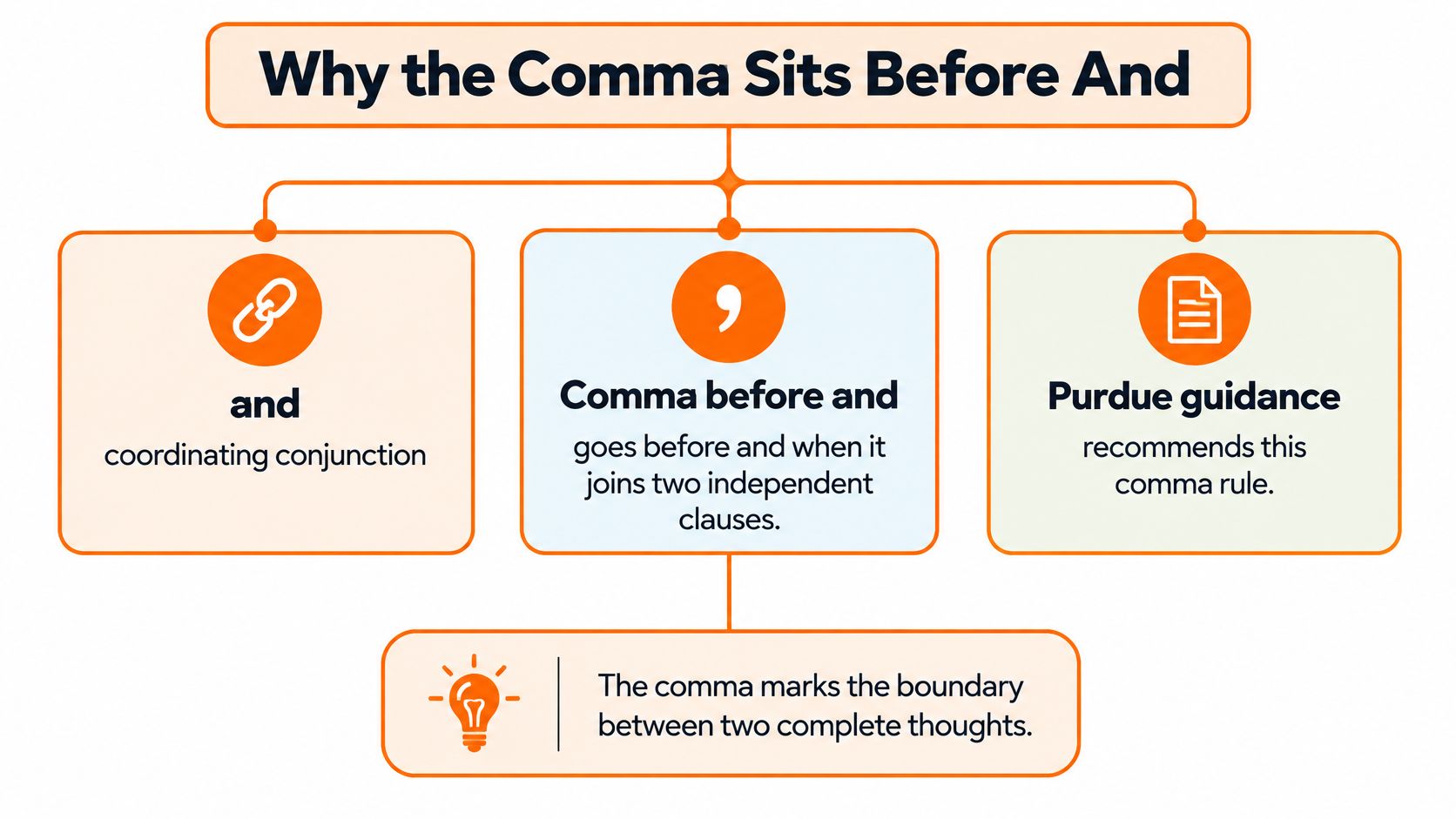
The comma marks a clause boundary, not the presence of and. Purdue OWL's punctuation guidance recommends a comma before a coordinating conjunction joining independent clauses.
The diagram shows how the conjunction and punctuation work together.
Compare these constructions:
- Separate clauses: The model generated a draft, and the editor revised it.
- Shared subject: The model generated and revised the draft.
In the first example, the comma marks where the first complete clause ends. In the second, generated and revised belong to the same subject, so there's no independent-clause boundary between them.
Choose the conjunction for its meaning
And belongs to the coordinating conjunctions remembered as FANBOYS: for, and, nor, but, or, yet, so. The University of Illinois Springfield sentence-pattern guide explains how these conjunctions connect independent clauses.
Compare the meaning of these sentences:
The data were incomplete, and the team repeated the experiment.
The data were incomplete, but the team published the results.
And adds a related action. But explicitly signals contrast. Correct punctuation won't compensate for choosing a conjunction that leaves the relationship unclear.
The subjects can also differ without changing the punctuation. “The students reviewed the sources, and they checked the citations” repeats the subject through a pronoun. “The students reviewed the sources, and their supervisor checked the citations” introduces someone else.
For an additional explanation of sentence joining, use this video.
You may encounter “I called and she answered” without a comma in casual writing. Some styles allow omission between very short, closely connected clauses. For formal coursework, “I called, and she answered” is the dependable default unless your style guidance says otherwise.
Graded Examples You Can Reuse
Beginner examples with visible subjects
Repeated subject
Maya finished the report, and she emailed it to her professor.
The pronoun she refers to Maya, but it still functions as an explicit subject. Repeating a person through a pronoun doesn't make the second clause dependent.
New subject
The students reviewed the sources, and their supervisor checked the citations.
The first action belongs to the students. The second belongs to their supervisor. This construction is useful when you want to describe related contributions without implying that the same person performed both.
Neither version is automatically better. Choose according to who did what.
Intermediate examples with meaning and omission
Sequence without an explicit cause
She saved the file, and the laptop crashed.
Readers will probably understand these events as occurring in that order. The sentence doesn't establish that saving the file caused the crash.
If timing is the point, “After she saved the file, the laptop crashed” states it more directly. Don't replace and with because unless the causal relationship is supported.
Shared subject versus repeated subject
Maria studied and passed the exam.
Maria studied, and she passed the exam.
Both sentences are grammatical. The first keeps the actions together under one subject; the second gives the outcome its own clause.
The shorter version may suit a quick summary. The compound version can give passing the exam more emphasis. You don't need to add she merely to make the sentence sound more refined.
Advanced examples with a series of clauses
Consider this sentence:
The lab closed, the samples warmed, and the team reran the test.
This can be read as a coordinated series of clauses with a final conjunction. It isn't automatically a comma splice, although a teacher or style guide may prefer a more explicit connection.
For a clear formal revision, separate the final action:
The lab closed, and the samples warmed. The team reran the test.
If the closure explains the warming, you could instead write:
After the lab closed, the samples warmed, and the team reran the test.
That version makes a temporal relationship explicit. Use it only if the sequence matches your intended meaning.
Practice with immediate answers
-
Prompt: Jordan drafted the email and sent it.
Answer: No comma is needed. Jordan is the subject of both verbs. -
Prompt: Jordan drafted the email and his manager sent it.
Answer: Jordan drafted the email, and his manager sent it. His manager introduces an independent clause. -
Prompt: The quote was wrong, the citation was missing.
Answer: This is a comma splice. Write “The quote was wrong, and the citation was missing,” or separate the statements with a period.
Read your answers aloud to assess rhythm, but don't use a pause as the grammar test. You can pause for emphasis inside a phrase, and you can speak through a clause boundary without pausing.
Errors That Make And a Run-On
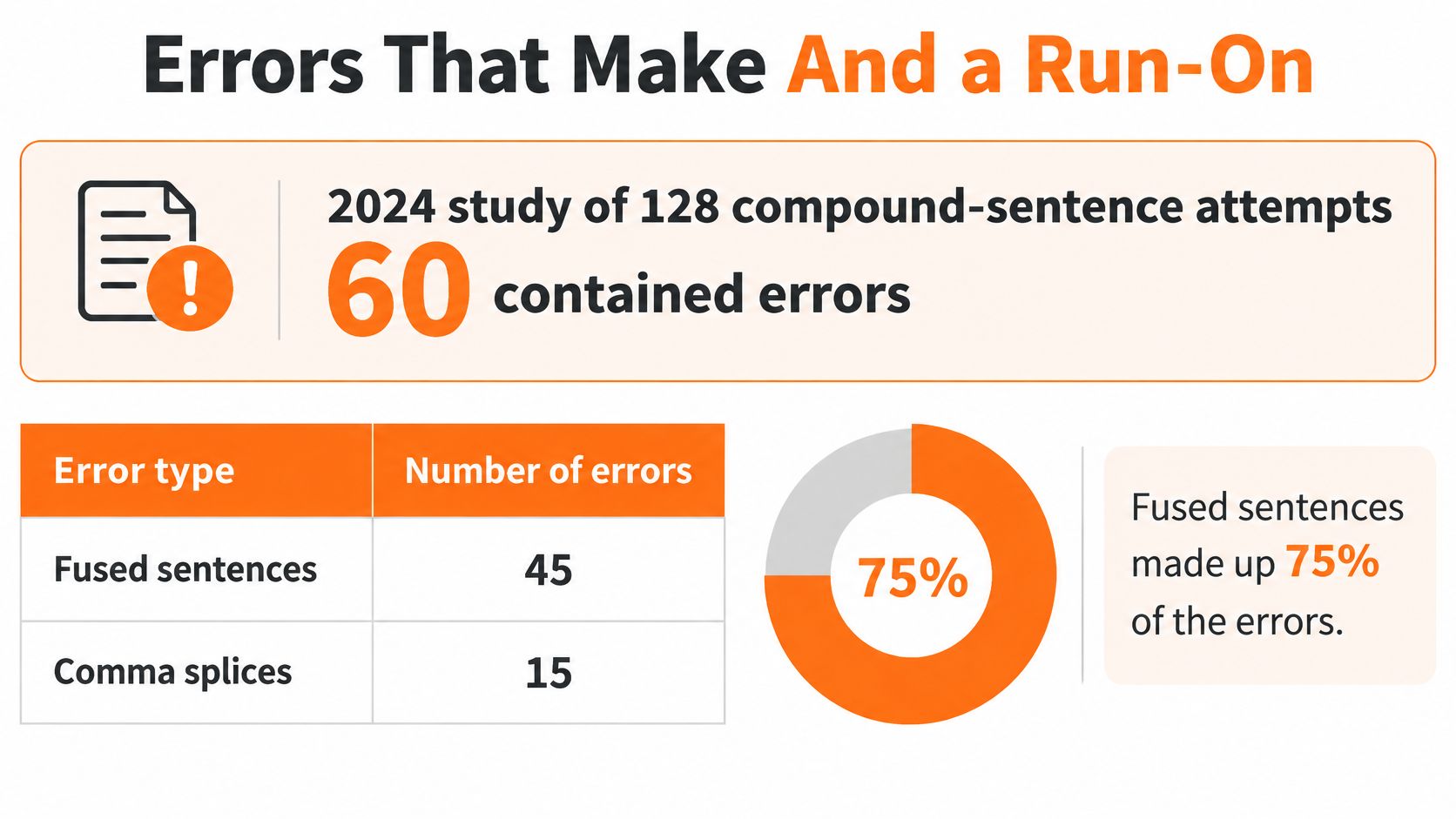
In a 2024 study of undergraduate compound-sentence attempts, 60 of 128 attempts contained errors; fused sentences accounted for 75% of those errors, while subject omission accounted for 18.33%.
The pattern behind those numbers is consistent. Each error below breaks the same rule: and works like a hinge, and a hinge can only swing between two clauses that each hang on their own frame.
Repair the actual error
Fused sentence
Before: The draft was late the editor revised it.
After: The draft was late, and the editor revised it.
Two independent clauses sit side by side with no join at all. A period also repairs it: “The draft was late. The editor revised it.” Choose the period when you want readers to weigh the revision as a separate point; choose comma plus and when the two actions belong in one breath.
Comma splice
Before: The draft was late, the editor revised it.
After: The draft was late; the editor revised it.
A comma alone cannot hold two independent clauses. The semicolon repairs the boundary without adding a conjunction. Comma plus and is another option, but add and only when both sides deserve equal billing. If you mean contrast or consequence, the connector should say so.
Missing subject after the comma
Before: The researcher analyzed the data, and checked the citations.
Here and links a clause to a bare verb phrase, so the comma advertises a join that does not exist. Repair it in either direction: drop the comma for a compound predicate (“The researcher analyzed the data and checked the citations”), or give the second clause its own subject (“and she checked the citations”). One subject, no comma. Two subjects, comma.
| Error type | Repair |
|---|---|
| Fused sentence | Add a comma plus and, a semicolon, or a period |
| Comma splice | Add a semicolon, a period, or a comma plus the conjunction that fits your meaning |
| Subject omission | Restore the subject, or drop the comma for a compound predicate |
Edit structure before surface details
These are sentence-structure problems, even when every word is spelled correctly. The distinction between grammar and spelling explains why a clean spell-check result tells you nothing about whether your clauses are joined properly.
For multilingual writers, an explicit subject check is especially useful when English sentence patterns differ from the patterns of another language. One caution: a shared subject in a compound predicate is perfectly acceptable, so do not “fix” it unless the punctuation or intended structure requires a change.
Finish with this editing pass:
- Mark every and: Identify the units it connects.
- Circle the subjects: Check whether each side can stand alone as a complete clause.
- Test the boundary: Keep the comma where both sides are complete and and states a relationship you intend, not merely where you hear a pause.
When And Weakens the Sentence
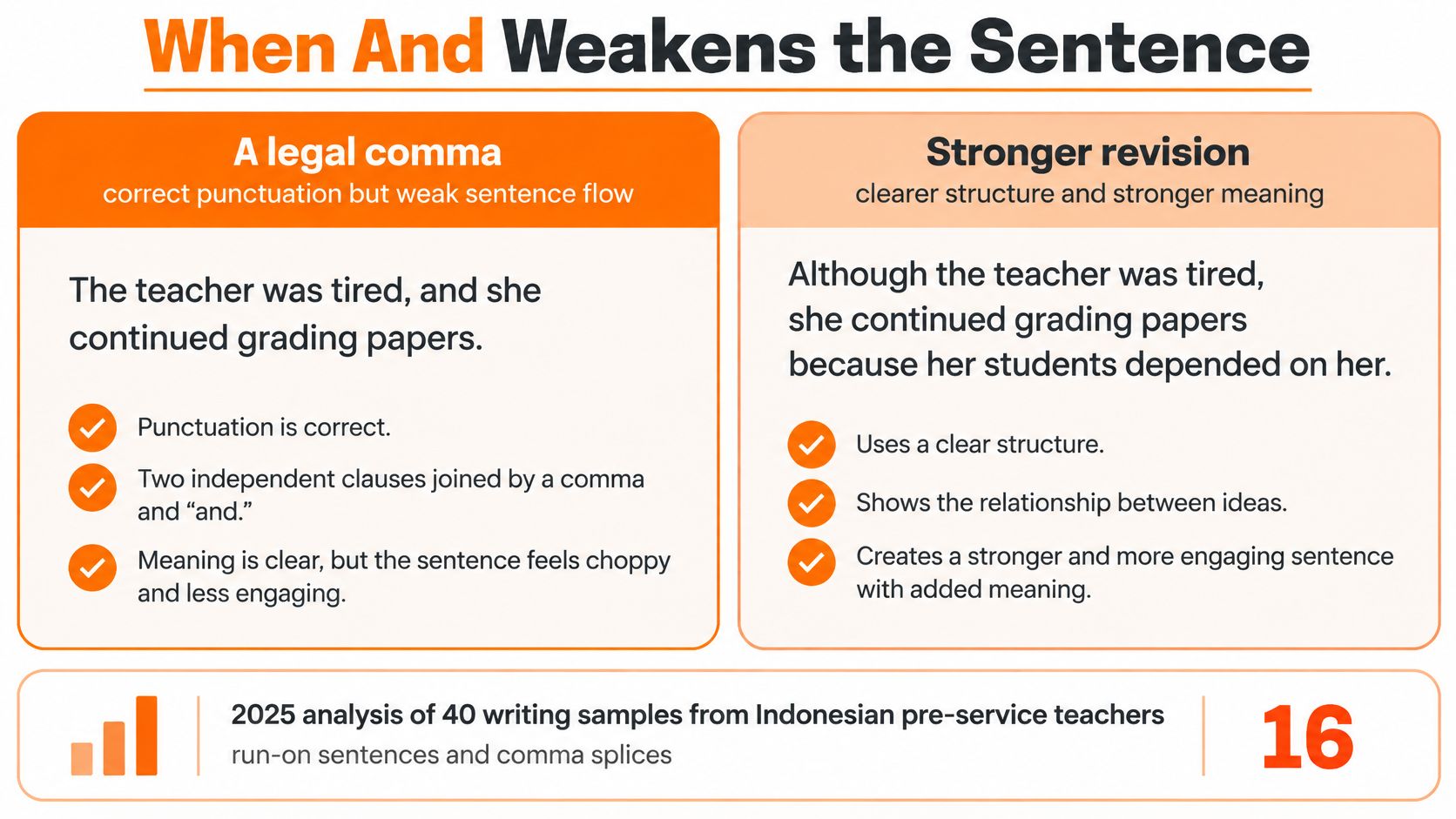
A legal comma doesn't make a strong sentence. And works like an equals sign between two clauses: it tells the reader both sides carry the same weight. Grammar can be perfectly equal while the rhetorical value is not, which is why adding and is a decision rather than a reflex.
Faulty joins are common in student writing. A 2025 analysis of Indonesian pre-service teachers' writing examined 40 writing samples and found run-on sentences or comma splices in 16 of them, or 40%. Repairing the punctuation fixes the join, but it does not settle whether and earned its place in the first place.
Compare three versions of the same actions.
Equal weight: The team reviewed the data, and it published the report.
Separate beats: The team reviewed the data. It published the report.
Time relationship in the foreground: After reviewing the data, the team published the report.
The first version puts both actions on the same level, so choose it when reviewing and publishing matter equally. The second gives each action its own moment. The third demotes the review to background, which fits when publishing the report is the main news. Same facts, three different emphases.
Vary the relationship, not just the wording
Use and for addition, a loose sequence, or related results that deserve similar emphasis. Reach for another construction when the second clause contains the main point, when nearby sentences repeat the same pattern, or when you need to express contrast, cause, or condition.
Before
The team opened the survey, and responses arrived. The researchers checked the entries, and the editor reviewed the summary. The team resolved the queries, and it released the report.
After
Responses arrived after the survey opened. The researchers checked the entries, and the editor reviewed the summary. After resolving the queries, the team released the report.
The revision mixes a simple sentence, a compound sentence, and a sentence with a subordinate opener. Every event survives; only the emphasis changes. A quick test: if removing and changes nothing about the meaning, the comma was doing all the work.
Don't replace every and. Keep the ones that make the relationship clear.
For essay revisions, these sentence-rewriting approaches can help you compare structures rather than swap isolated words. A tool that reviews sentence structure and vocabulary can also suggest alternatives, while you confirm the original meaning and intent stay intact.
Check the Join Before You Submit
Can a sentence start with And?
Yes. Beginning with And can create a deliberate continuation or emphasize an additional point.
For example, “And the citation was still wrong” can work after a sentence describing unsuccessful corrections. Avoid repeating that opening throughout a paragraph, and follow a course style sheet if it prohibits the construction.
An opening And doesn't automatically make the sentence compound. What matters is the clause structure within the sentence, not its connection to the previous sentence.
Is a semicolon the same as comma plus and?
No. A semicolon joins closely related independent clauses without a coordinating conjunction, while comma plus and explicitly adds a coordinating connection.
Compare “The interview ended; the recorder kept running” with “The interview ended, and the recorder kept running.” Both are grammatical, but the semicolon places the statements together more directly. Choose it when and contributes little and the relationship is easy to understand.
A period is equally legitimate when the ideas deserve separate attention. Longer punctuation isn't a sign of better writing.
Can a checker make the final decision?
A checker can flag possible problems, but you still need to evaluate the suggested revision. No detector or checker score proves that a sentence is correct, and a natural-sounding sentence can still contain a structural error.
For a compound sentence with and, use this final test: both clauses must stand alone, and the standard formal pattern places a comma before and. Then ask whether coordination expresses the relationship you intend.
When reviewing coursework, teachers can use Teacher Planner's tools for reviewing student writing to support a feedback workflow. Ask students to explain their joins, not merely accept a correction.
Make the final pass specific
Before submitting, check the actual sentences that carry your argument:
- Check completeness: Look for missing subjects and unfinished dependent clauses.
- Check connections: Repair splices and fused sentences without changing the intended relationship.
- Check emphasis: Give the main finding, decision, or conclusion enough space.
- Check suggestions: Accept automated edits only when you understand why they help.
A grammar-checker guide can help you plan that final review. Keep the clause test beside your draft so that punctuation decisions remain yours.
At Lumi Humanizer, we review writing patterns, sentence structure, and vocabulary to improve flow while keeping the original meaning and intent. Once you've checked your clause boundaries, visit Lumi Humanizer to revise repetitive sentence patterns and make a mechanically correct paragraph read more naturally.