The usual advice to start by correcting grammar gets literature-review editing backward. To learn how to edit a literature review effectively, start with the argument, organize the comparisons, verify the evidence, and polish sentences last. A fluent paragraph still needs rewriting if it lists studies without explaining what readers should conclude from them.
The key question isn't whether each sentence sounds academic. It's whether you've made a defensible claim about the literature and shown how the sources support, complicate, or limit it.
How to Edit a Literature Review in the Right Order
Edit in five passes, keeping structural decisions ahead of sentence-level work. Coventry University's literature-review guidance distinguishes editing, which can involve altering, reordering, or removing material, from proofreading for spelling, grammar, and formatting.
That distinction matters because editing changes what your review says and how it develops its argument. Proofreading makes the settled version cleaner.
Five editing passes in order
| Pass | What to check | Typical fix |
|---|---|---|
| 1. Argument and synthesis | Each paragraph makes a claim about the literature | Rewrite around a shared theme or cut |
| 2. Structure and transitions | Headings and paragraph jobs make sense in sequence | Reorder, merge or add transitions |
| 3. Evidence and citations | Each citation supports the exact claim beside it | Narrow the claim or correct the reference |
| 4. Search transparency | Search dates, terms and selection criteria are stated | Add a short method note |
| 5. Sentences and proofreading | Grammar, spelling and formatting | Correct after structure is settled |
Decide what belongs before improving its wording
Say your research question concerns how peer feedback affects revision. A paragraph summarizes studies about student satisfaction, classroom technology, and assessment preferences, but never connects them to revision.
Correcting its punctuation won't solve that problem. You need to decide whether the studies establish a shared theme, belong elsewhere as context, or don't contribute enough to stay.
A useful working annotation is: This paragraph explains why students accept or reject peer feedback. If the evidence doesn't support that purpose, change the paragraph's purpose or its contents.
Practical rule: Don't spend time perfecting a sentence until you know why its paragraph belongs.
During the structure pass, read headings and opening sentences together. They should show a recognizable progression, not a series of loosely related topics. Replace generic transitions such as Furthermore with connections that explain the relationship, such as These findings concern immediate responses rather than later revisions.
For search transparency, record what you did. A systematic review needs an account appropriate to its methodology; a course-based narrative review may need a shorter description of databases, search terms, dates, and selection boundaries. Don't imply that you followed a systematic procedure if you didn't.
Find the earliest pass your draft hasn't yet passed and start there. If the central argument remains unsettled, leave the commas alone for now.
Turning Study Summaries Into Synthesis
A source summary tells readers what a study did. Synthesis explains what becomes clearer when studies are considered together.
The University of Southampton's literature-review checklist recommends synthesizing sources throughout rather than treating them as separate islands. You can make that advice operational by testing the job of each paragraph and the relationship between its sources.
Use this process while annotating your draft.
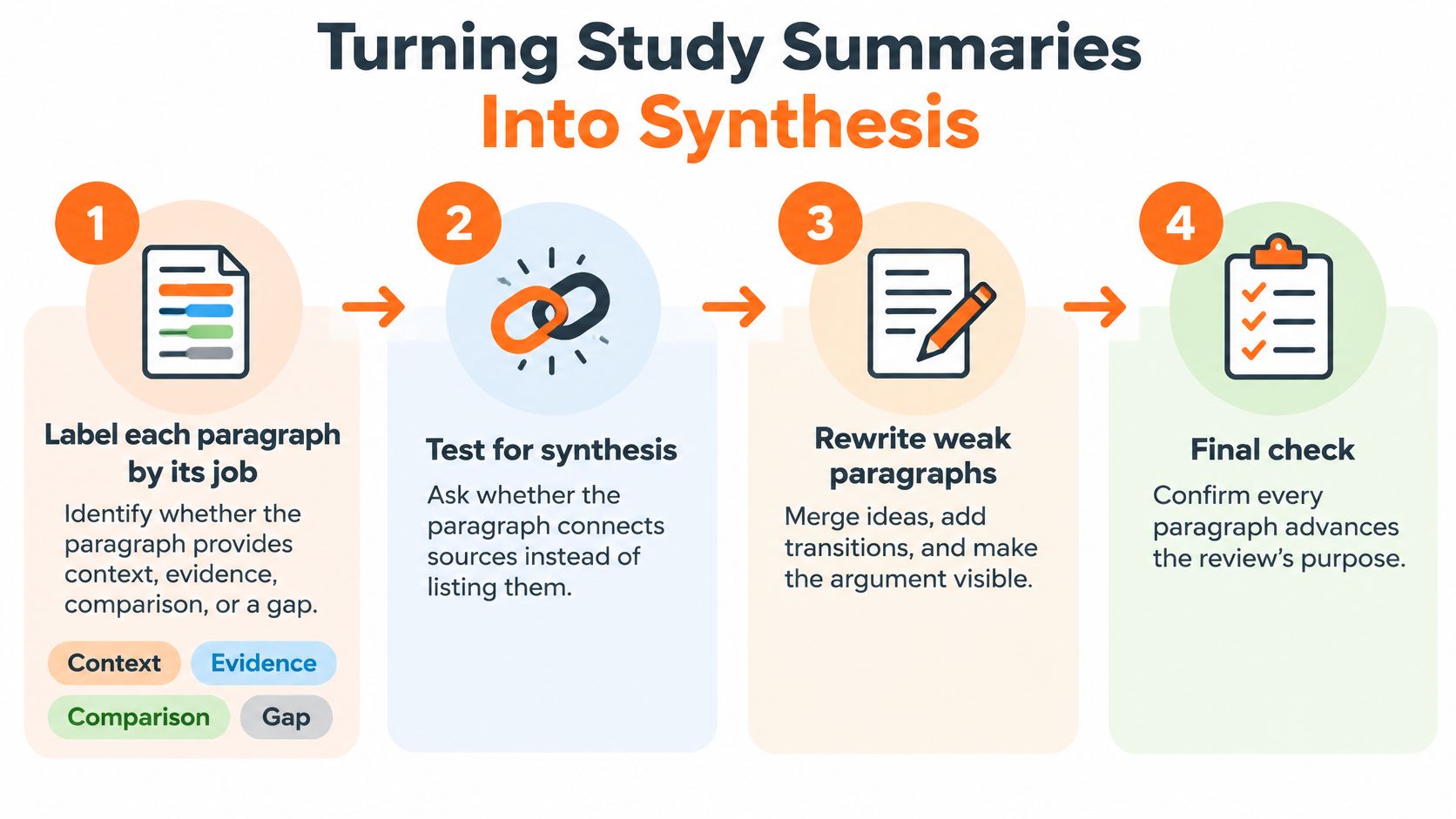
Give each paragraph a job
-
Label its main function. Use context, evidence, comparison, critique, or gap. Choose the dominant function rather than attaching every possible label.
-
Mark repetitive or unclear sequences. Consecutive context paragraphs may delay the actual argument, while paragraphs you can't label may need a clearer purpose. Reorder or merge them when doing so makes the reasoning easier to follow.
-
Test each source connection. After introducing a study, ask whether its finding agrees with, differs from, or qualifies another finding. Record relevant differences in research questions, samples, methods, outcomes, and limitations before deciding that the studies agree.
-
Rewrite lists as comparisons. In a hypothetical draft, the starting version might be: Smith found X. Jones found Y. Lee found Z. If the evidence supports it, revise to: Smith and Lee found X under similar conditions, whereas Jones reported Y using a different sample.
-
Remove sources that change nothing. Temporarily delete a source summary and reread the paragraph. If the claim remains equally supported and qualified, move the material to your notes or cut it.
Make the comparison do analytical work
The revised sentence isn't stronger merely because it combines author names. It identifies a pattern and a potentially important difference, giving readers something to evaluate.
Take the comparison further by explaining its consequence: The apparent disagreement may therefore reflect differences between novice and experienced participants. Keep that interpretation tentative unless the studies establish the explanation.
A paragraph needs more than several citations. It needs a relationship between the findings those citations represent.
Once you've decided on that relationship, the student guide to paraphrasing tools can help you approach wording changes separately from the analytical decision. Rephrasing a summary doesn't automatically turn it into synthesis.
A finished analytical paragraph has a stated job, a meaningful comparison, and a closing sentence that prepares the next step in the argument. Don't force comparisons into brief definitions or necessary background passages, but don't let those exceptions become the review's main structure.
Balancing Conflicting Studies Fairly
Equal space isn't the same as fair treatment. Balance requires you to assess what each study can support, rather than alternate between positive and negative findings.
The University of North Carolina Writing Center's literature-review guidance emphasizes synthesis, evaluation, and organization around ideas. When findings conflict, organize the paragraph around the disagreement and examine the evidence behind it.
What to compare when studies conflict
| Dimension | What to compare | Why it changes the claim |
|---|---|---|
| Study design | Experimental, cohort, survey or qualitative | Changes how strongly a finding can be stated |
| Population and setting | Age, discipline, country and sample size | Shows whether results transfer to your context |
| Publication date or data period | Year published and when data were collected | Older findings may reflect older practice |
| Stated limitations | What the authors say they could not control | Shows which part of the claim needs qualifying |
Weigh evidence against the question
Consider a hypothetical disagreement about whether peer feedback improves writing. One study surveys 40 students at a single college about their perceptions; another uses a multi-site trial with a comparison group to examine writing outcomes.
For a claim about improvement, a well-conducted trial offers stronger evidence than the perception survey. The survey still contributes context about students' experiences, but it doesn't measure the same thing.
A balanced synthesis might read: Students reported valuing peer feedback, but the trial did not establish an improvement in assessed writing. This difference may reflect the distinction between perceived usefulness and measured performance.
That sentence preserves the disagreement without pretending the studies are interchangeable. It also avoids treating study design as an automatic ranking: a trial with serious limitations still needs scrutiny, and qualitative evidence may be better suited to questions about experience.
Evidence check: Before calling findings contradictory, confirm that the researchers asked comparable questions and measured comparable outcomes.
Keep qualifiers such as may, associated with, and evidence remains limited when the evidence warrants them. Don't turn a possible explanation for disagreement into an established cause.
If design, population, timing, and stated limitations don't explain the conflict, leave it unresolved. A clearly bounded uncertainty is a useful finding, not an editorial failure.
Checking Citations Against the Original Sources
Citation mistakes aren't limited to reference formatting. A postgraduate citation-practices study published in the London Review of Education reported frequent citation errors and misrepresentations of original sources, making a deliberate accuracy check essential.
Keep the draft and original papers open together. Checking a reference manager's record confirms bibliographic details, but it doesn't establish that the paper supports your sentence.
Verify meaning before formatting
-
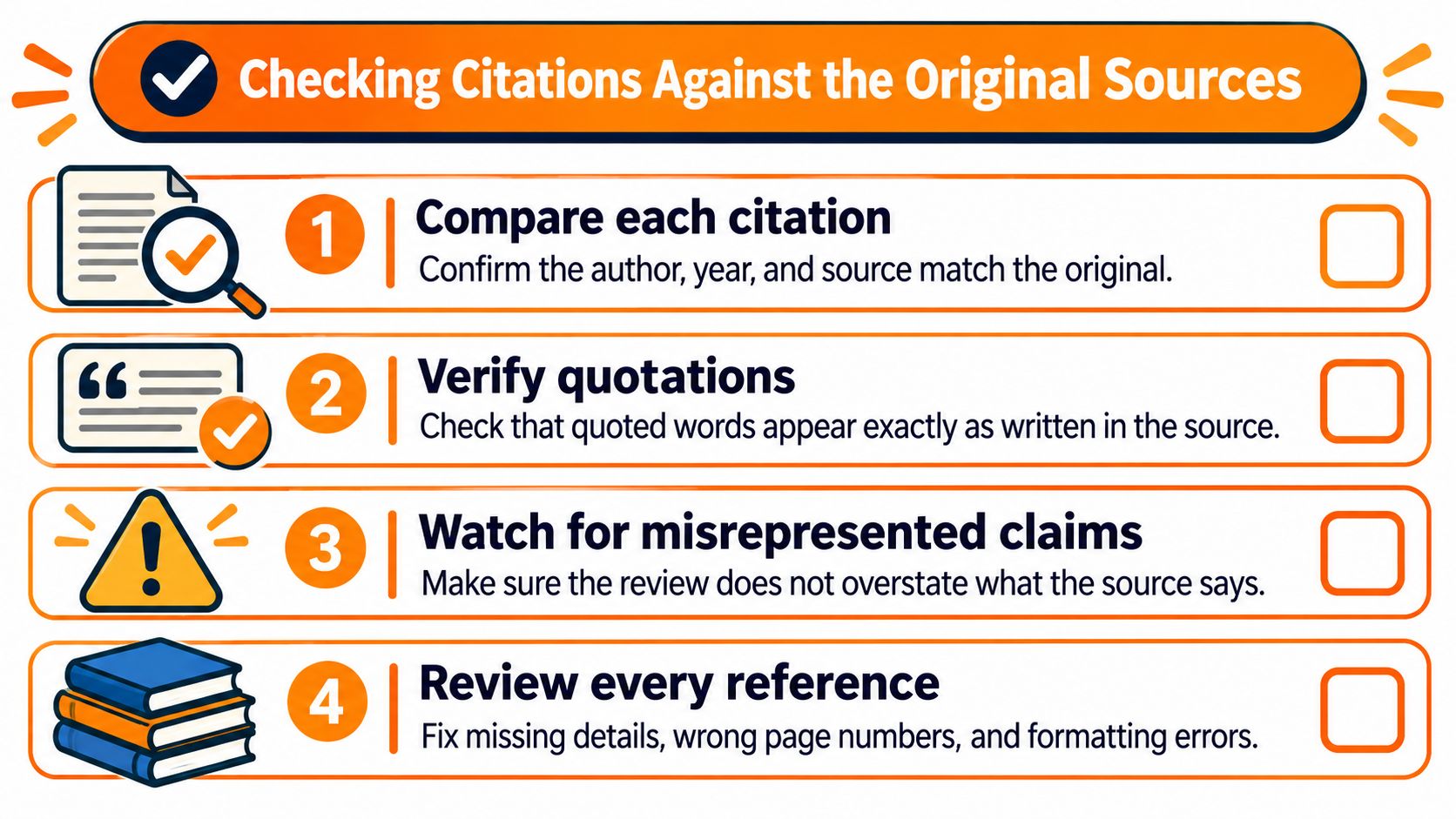
Compare each paraphrase with the original passage. Check the population, method, outcome, and qualifications. Read enough surrounding text to understand whether the authors are reporting a result or discussing a possibility.
-
Test the specific claim. A paper about remote learning doesn't necessarily support a claim that remote learning improves achievement. Locate the actual evidence for the wording you've used.
-
Check attribution and quotations. Verify author names, publication years, and the page numbers required by your citation style. Quoted wording must match the original exactly.
-
Match citations and references. Confirm that every in-text citation has the corresponding reference-list entry. Check uncited entries against your assignment or publication's requirements.
-
Look for omitted conflicting findings. Revisit results that complicate your interpretation, including limitations or null findings that disappeared during drafting.
For a hypothetical example, suppose the draft says:
Before: Remote learning improves outcomes (Lee, 2019).
After: In one university's blended course, Lee found improved exam scores (Lee, 2019).
The revision limits the claim to the setting and outcome examined. These are illustrative sentences, not references to a real Lee paper.
Use this checklist alongside your open sources.
Keep evidence traceable
Store supporting page numbers and passages in your notes. If your materials are scattered, Tintd's guide to Mac apps for notes and citations offers options for organizing that workflow.
After verifying citations, run a similarity check to flag potentially close wording. It can't confirm whether a citation supports a claim; the guide to plagiarism checking helps distinguish that separate originality task.
Finish with references you can trace back to the statements they support, not merely a bibliography that looks complete.
Editing AI-Assisted Drafts Without Losing Meaning
Smoother prose isn't automatically better academic prose. An AI revision can remove the uncertainty or limitation that makes a conclusion accurate, even while making the sentence easier to read.
Keep your evidence notes beside the draft while reviewing revisions.
The Illinois Institute of Technology library guide on AI-assisted academic work provides context for responsible use. Your editing priority is to preserve the author's meaning, the source's limitations, and a record of substantive changes.
Reject changes in evidentiary strength
Consider this hypothetical revision:
Original: The program may be associated with better outcomes, though evidence remains limited.
AI revision: The program causes better outcomes.
The revision replaces association with causation and deletes the limitation. Reject it, even if the shorter sentence seems more confident.
Use a controlled review routine:
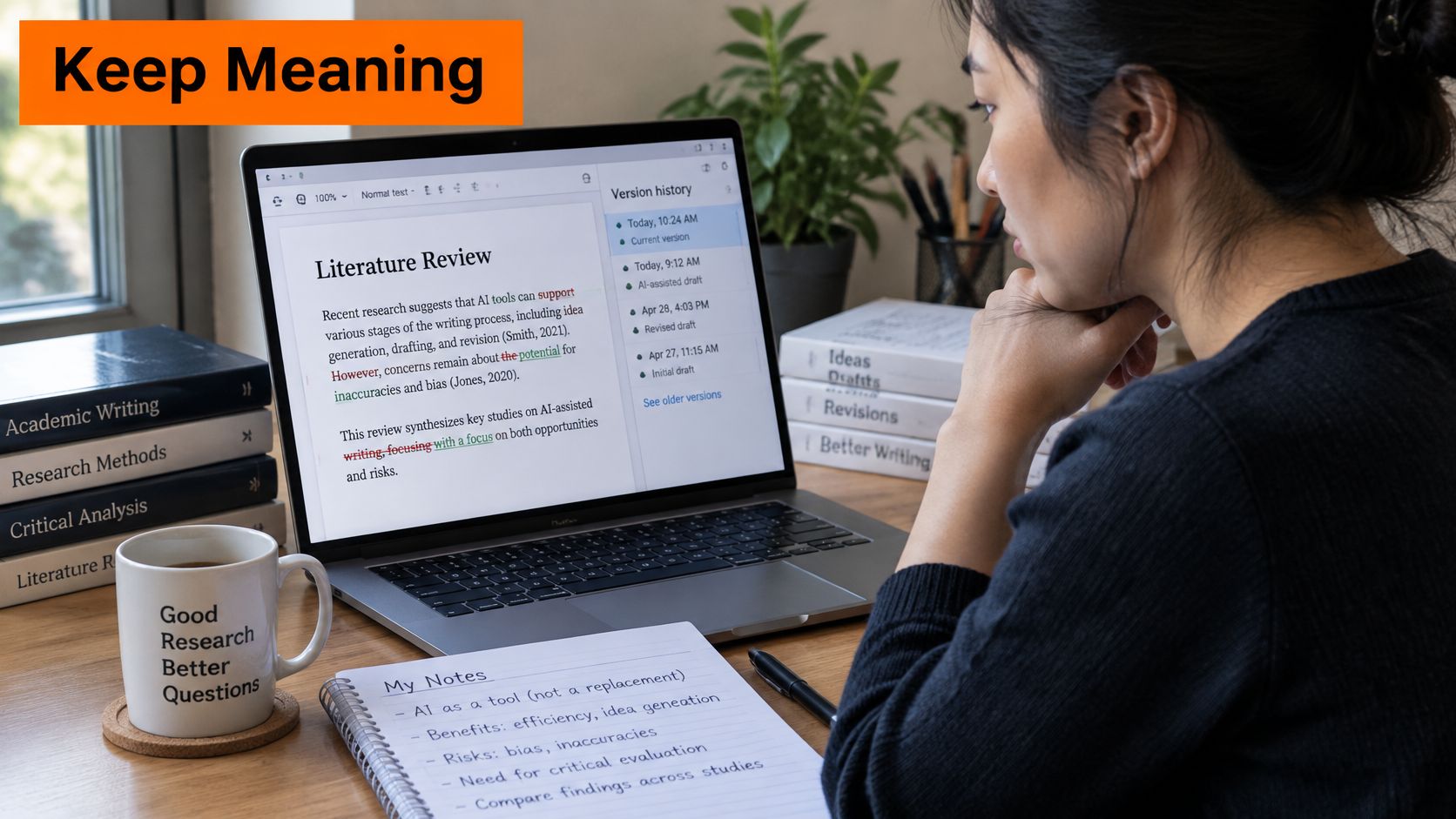
- Preserve version history. Keep an unchanged draft so you can identify and reverse alterations.
- Compare sentences directly. Look for changed populations, outcomes, technical terms, and conclusion strength.
- Reopen supporting sources. Verify factual additions and check that necessary hedges survived.
Language help, such as fixing awkward phrasing, differs from adding interpretations or claims. Check your discipline's, institution's, or journal's policy to determine what assistance is permitted and what needs disclosure.
This video offers an additional viewing resource for your revision session.
Review the draft manually and treat the AI detector as one editing signal, not a final verdict. Results vary with draft quality, detector version, and the extent of editing needed; a detector result doesn't establish factual accuracy.
Always read the final output before submitting or publishing. Any sentence where AI changed a conclusion gets rewritten by hand, using the original evidence rather than the revised sentence as your guide.
Answer Common Questions and Check Before You Submit
Should I cut a source I summarized well?
Yes, if removing it leaves the paragraph's claim adequately supported and unchanged. Good wording isn't a reason to retain material that contributes nothing distinct.
Should I fix grammar before structure?
No. Settle the argument and organization first, then proofread the text you'll keep. Editing sentences in a paragraph you later delete wastes effort.
Do I need to disclose AI editing?
Check the policy for your discipline, institution, assignment, or target journal. Keep a record of the tool and the assistance it provided so any required disclosure is accurate.
How do I know my review synthesizes rather than summarizes?
Check whether most analytical paragraphs have a clear job and make meaningful connections across sources. Author-by-author reporting without an explanation of those relationships is still summary.
For the submission check, rerun the original passes in order: argument, structure, evidence, search transparency, then proofreading. Confirm paragraph jobs, reference matches, the method note, and any qualifications affected by revision.
Knowing how to edit a literature review also means knowing which decisions remain yours. Use the academic grammar-checking guide to plan the final language pass, and the grammar checker for grammar and clarity suggestions, not decisions about evidence.
If a pass fails, return to that task before submitting. Don't hide an unresolved argument under cleaner prose.
Lumi Humanizer offers prose revision designed to improve clarity, voice, and flow while preserving your intended meaning. Once your comparisons and citations are settled, visit Lumi Humanizer to refine a passage's wording, then compare the result with your sources before keeping it.