Running a draft through an AI detector isn't a fact check. To understand how to fact check AI generated content, split the text into individual claims, trace each one to reliable evidence, and record what you can support. Treat questions about authorship separately from the decision to publish.
Ask Whether the Claim Is True, Not Who Wrote It
A fact check asks whether a statement is accurate, supported, and presented in context. Whether a machine drafted the sentence is a different question, and it rarely settles the first one.
A 2025 peer-reviewed study of fact-checking practices examined 136 verification articles published during 2023–2024 across Brazil, Germany, and the United Kingdom, supplemented by 13 expert interviews; synthetic media appeared in 77 cases, or 56.6% of the sample. Despite emerging detection tools, fact-checkers relied mainly on established methods: inspecting visual anomalies, tracing original sources, comparing material with official accounts, and evaluating context.
Separate accuracy from authorship
AI authorship alone doesn't make a statement false. Human-written content can contain errors, misleading quotations, or unsupported conclusions too. Understanding what counts as AI-generated content helps you distinguish fully generated material from drafts that someone edited, translated, or developed with assistance.
The study also discusses the liar's dividend: growing suspicion of synthetic media gives people an opportunity to dismiss authentic material as AI-made. An impression that something looks artificial isn't a sound reason to reject evidence, just as polished prose isn't a reason to trust it.
Editorial rule: Decide whether the evidence supports the sentence before deciding what its style suggests about its author.
Say a freelancer submits a blog post with plausible statistics and well-written quotations. Trace every statistic to its original table, and every quotation to a recording, transcript, or original document. Don't exempt elegant sentences or single out awkward ones.
Keep separate columns for accuracy and AI involvement. For factual publication decisions, the accuracy column controls what stays; authorship and disclosure requirements need their own review.
A Five-Step Workflow for Checking Claims
Build the check around a claim log, not a general impression of the draft. A spreadsheet is sufficient if each row holds one assertion, its evidence, and a decision.
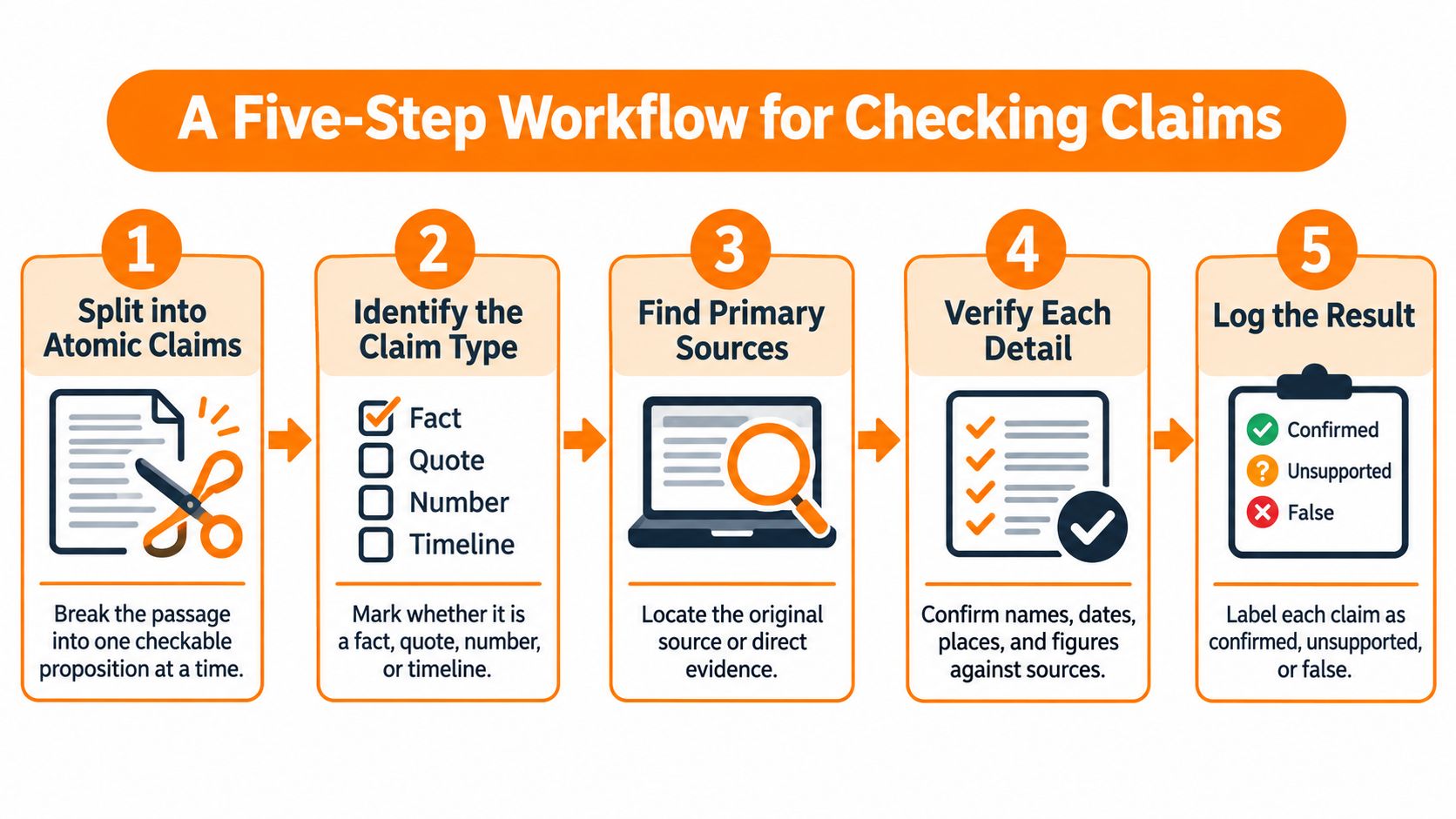
Use this workflow to move from a passage to an auditable publication decision.
-
Split the passage into atomic claims. Give each independently checkable proposition its own entry, and mark whether it's a fact, quotation, number, or timeline claim. A sentence about sales rising after a launch contains separate assertions about the change, the launch, and their timing.
-
Resolve ambiguous wording before searching. Replace pronouns with names, identify what relative dates refer to, and specify units, geography, and measurement periods. This prevents you from finding evidence for a similar statement rather than the statement you're publishing.
-
Retrieve primary evidence. Search government records, peer-reviewed papers, official statistics, company filings, or original datasets, using several query formulations. Search-result snippets help locate material, but you need to open the underlying document.
-
Compare every detail and assign a controlled label. Save the exact supporting or contradicting passage, the source's publication date, and your access date. A citation beside a sentence isn't enough unless its contents directly support the wording.
-
Recheck consequential claims independently. Ask another reviewer to inspect medical, legal, financial, academic, or reputational assertions, and record how many claims were checked and left unresolved. Prioritize harm and uncertainty rather than checking only the easiest statements.
Require evidence that actually supports the wording
The FEVER benchmark paper illustrates the importance of evidence retrieval: its best system achieved 50.91% verification accuracy when evidence correctness was ignored, but 31.87% when correct evidence was also required. A plausible verdict and a plausible citation aren't substitutes for finding the relevant passage.
Check completeness too. A document might establish that a product launched without establishing that sales subsequently increased. Flag changing facts and ambiguous terms, such as current availability or an undefined market leader.
A worked sales claim
Suppose a draft says that a fictional company, Cedar, increased sales 40% after its 2024 launch. Those are hypothetical details to investigate, not facts to accept.
Your record should show the full trail:
- Split: Create entries for the sales increase, the launch event, and the sequence of events.
- Normalize: Specify whether sales means revenue or units, which market is covered, and the comparison period.
- Retrieve: Locate the launch announcement and the relevant financial filing or original sales dataset.
- Compare: Save the passages and calculations, then label each assertion separately.
- Recheck: Have another reviewer confirm the baseline and timing before approving the sentence.
Even if the increase and sequence are supported, don't rewrite after as because of. Chronology doesn't establish that the launch caused the increase.
What Each Verification Label Means
| Label | What it means | Evidence needed before you use it |
|---|---|---|
| Supported | Evidence directly entails the claim | One primary source with its date and geographic scope confirmed |
| Contradicted | Reliable evidence directly refutes the claim | The exact contradicting passage, quoted and dated |
| Insufficient evidence | Sources exist but do not settle the claim | A note of what is missing; keep searching or soften the wording |
| Unverifiable | No reliable source exists, or the claim is undefined | Confirmation that a search was run; remove or qualify the claim |
| Outdated | An older source was correct but a newer one replaces it | The newer primary source and its publication date |
Insufficient evidence and unverifiable shouldn't become interchangeable bins for unfinished work. The first means you found relevant material but still lack something necessary, such as the right population, reporting period, or measurement definition.
Unverifiable means you can't establish the claim through reliable available evidence, or the wording isn't testable. An assertion that a product is universally loved has no useful verification boundary until the writer defines whose opinion counts and how it was measured.
Let the label determine the edit
Publish supported statements with their sources. Correct contradicted statements rather than attaching a vague caveat, and replace outdated evidence with the relevant newer source. Remove unresolved assertions when a qualifier would still leave readers with a misleading impression.
A source's existence isn't enough. For consequential or disputed material, the table's supported threshold is a starting point, not permission to stop after finding a convenient document.
An uncertainty label records a limit in the evidence. It doesn't accuse the writer of dishonesty.
Consider a hypothetical paragraph containing these claims: a service is available nationwide, it accepts online applications, and every applicant receives approval. Suppose official service documentation supports the availability and application method, while an eligibility dataset establishes that applications can be rejected.
The revised paragraph should retain nationwide availability and online applications, then explain that approval requires meeting eligibility criteria. Don't classify the entire paragraph as reliable and leave the approval promise intact.
Keep the source passage, publication date, access date, label, and reviewer initials beside each entry. When someone later challenges a sentence, that record shows what you checked and why the wording changed.
Checking Images, Video and Documents
Check the file and the claim attached to it separately. A genuine image can carry a false caption, and an edited image can accompany an accurate explanation.
Content Credentials offer a way to inspect recorded provenance rather than judge authenticity from appearance alone.
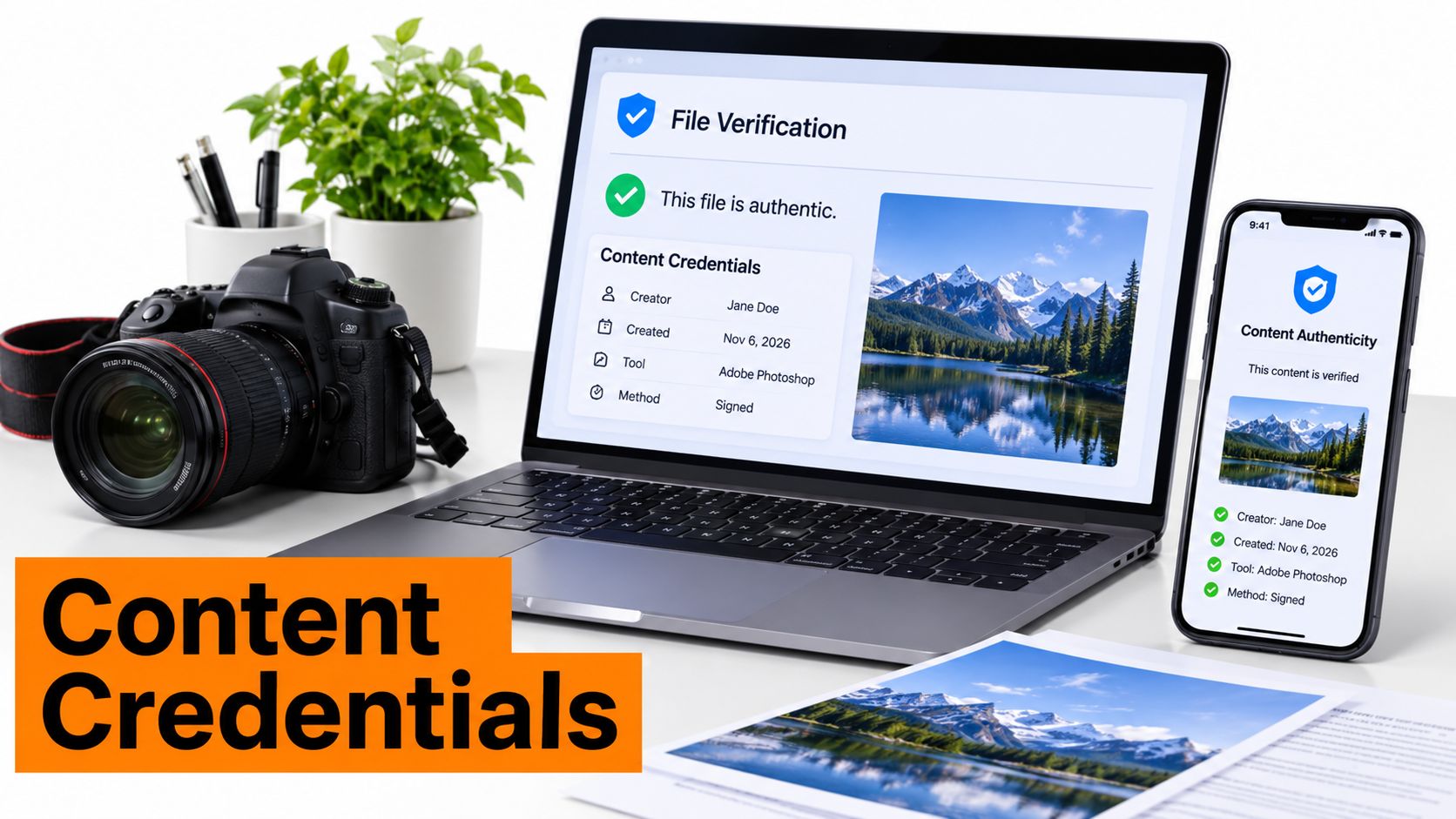
The C2PA explainer describes provenance assertions secured through digital signatures and cryptographic hashes. These records can describe an asset's origin, edits, tools, and AI involvement, while compatible applications can verify whether the file matches its recorded history.
Read the production history, then investigate the story
The Content Credentials technical specification explains how signed manifests bind provenance information to assets and record creation and editing actions. A photograph captured by a participating camera, cropped in compatible software, and exported can have those actions represented in its history; subsequent alteration can produce a validation mismatch.
That doesn't establish the truth of its caption. Say someone reposts an authentically signed photograph of a crowd but assigns it a false location and date. The provenance may validate while the post remains misleading.
Missing credentials don't establish fabrication either. Screenshots, re-encoding, and platform transfers can remove provenance information, so absence should prompt further checking rather than an accusation.
This video offers additional context for examining content provenance.
Preserve enough material to investigate
Use a repeatable sequence:
- Preserve the original: Keep the downloaded file, its source page, and the accompanying caption.
- Inspect credentials: Record what the provenance establishes and any validation warnings.
- Search earlier versions: Use Google Lens or TinEye for images, and search distinctive video frames.
- Check context: Compare publication dates, locations, publishers, and surrounding reporting.
- Corroborate the central assertion: Find a primary source or independent reporting that addresses the event itself.
For documents, verify quotations against the original text and inspect the surrounding paragraphs. An originality check addresses a separate question about copied wording and attribution risk; it doesn't establish whether a document's factual claims are accurate.
Where Detector Scores Fail on Length and Language
Detector accuracy by text length
| Text length | Reported accuracy | What to do with the score |
|---|---|---|
| Under 100 words | About 67% | Don't act on the score; check the claims instead |
| 100 to 1,000 words | Not specified in the cited assessment | Weigh the score lightly and verify sources |
| Over 1,000 words | About 96% | Use as one signal; it still isn't proof of authorship |
A 2025 assessment discussed in MultiLingual reported the table's about 67% accuracy for texts shorter than 100 words and roughly 96% for texts longer than 1,000 words. These are results from that assessment, not universal performance guarantees for every detector or draft.
The missing middle value matters. You can't interpolate a reliable accuracy estimate for your passage from the endpoints, especially when its domain, editing history, or generator differs from the evaluation material.
A flag starts a review, not an accusation
NIST's text-to-text pilot found substantial variation across generators and discriminators, with detector performance changing across testing rounds. NIST also cautions that aggregate metrics such as accuracy, AUROC, and F1 may not capture the consequences of falsely classifying human writing as synthetic.
A false positive can lead an editor or educator to challenge legitimate work. A false negative can let generated text pass without further examination. Neither outcome tells you whether its factual content is supported.
Suppose a detector flags a hypothetical 90-word introduction. Don't lengthen it merely to obtain a different score. Extract its factual assertions, locate their sources, and decide whether each assertion survives comparison with the evidence.
If authorship matters under an academic or workplace policy, inspect drafts, revision history, and the author's explanation of their process. Don't turn a writing-pattern estimate into a misconduct finding.
Practical boundary: A detector can suggest where to look. It can't supply the evidence needed to publish a claim or accuse its author.
Match the review to the language
A multilingual shared-task paper reported a macro-F1 of 0.7265 across languages, with differences in performance involving lower-resource languages. Macro-F1 isn't the same measure as accuracy, and it shouldn't be presented as a directly comparable percentage.
Check whether the detector supports the passage's language and whether its evaluation resembles your material. Translated, code-switched, and heavily edited writing needs particular care because a single language label may hide several production stages.
Keep the original-language source, the translated passage, and any human corrections together. Verify names, units, negation, and qualifications in the original before approving the English version. Fluent translation isn't evidence of deception, and awkward phrasing isn't evidence of AI use.
Our output quality is highest for English content, with effectiveness varying for other languages based on complexity. We recommend manual review and treating detector results as one editing signal, not a final verdict.
Keep summaries anchored to source passages
For financial and business drafts, Artul.ai's perspective on executive language analysis is a useful companion when reviewing earnings-call summaries. Check the underlying transcript for the speaker, qualifications, and surrounding question before approving an attributed conclusion.
Understanding how AI detectors work can help you interpret a result without confusing pattern detection with source verification. Our Check for AI feature checks text against GPTZero, Turnitin, Copyleaks, and others, but those results don't replace an evidence log.
For a consequential draft, report the unresolved claims and escalation decisions. A single document-wide score conceals the exact statements an editor still needs to fix.
Pre-Publish Checklist and Common Questions
Knowing how to fact check AI generated content is useful only if the checks change the publication decision. Don't approve a draft while its most consequential assertions remain unresolved.
Use this final checklist alongside your claim log.
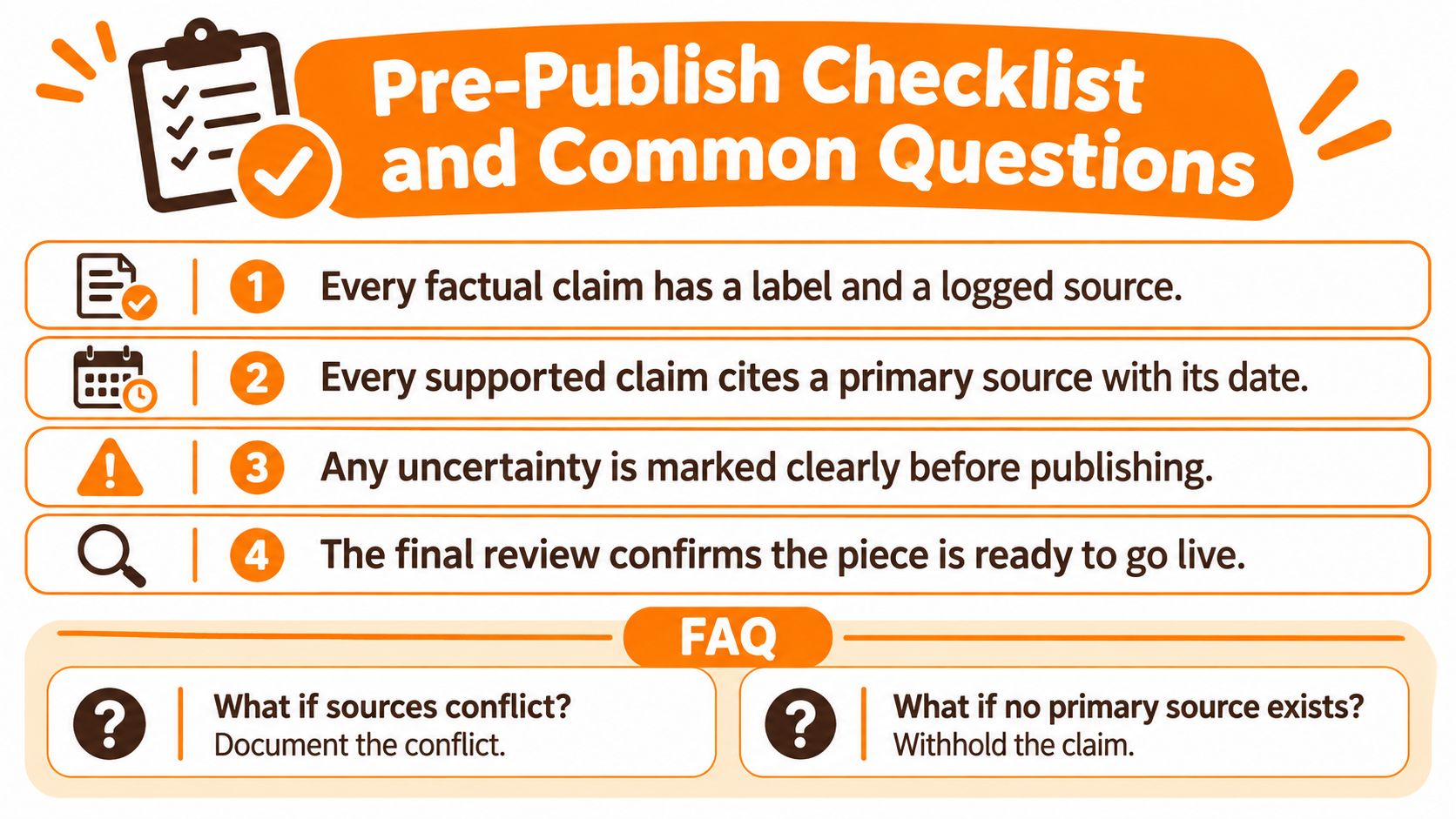
- Claim records: Every factual assertion has a label and a logged source, or a documented reason it couldn't be verified.
- Source quality: Supported claims cite primary evidence with its publication date and relevant scope.
- Corrections: Contradicted claims are fixed; unverifiable claims are removed or clearly qualified.
- Detector handling: Any score has been treated as triage, not a factual verdict.
- Human review: Consequential medical, legal, financial, or academic material has received an appropriate human check.
- Media preservation: Original files are saved, and available provenance has been inspected.
Common questions
Does a low AI score mean the text is safe?
No. It doesn't establish whether the claims are true, the citations support them, or the wording meets your disclosure obligations.
Can I skip checks on human-written text?
No. Apply the same evidence standard regardless of how the draft was produced.
What if a source is later updated?
Reassess the exact claim. Mark it outdated when newer primary evidence replaces the earlier basis, then update the citation and wording.
What if reliable sources conflict?
Document their definitions, dates, and scope. If you can't resolve a material disagreement, disclose it or withhold the claim rather than choosing the most convenient source.
For an optional triage pass, use the AI detector, then make the publish decision from your evidence record. Follow the responsible-use guidance, including the requirement to review the final output before publishing or submitting it.
Lumi Humanizer helps rewrite AI-assisted text for more natural phrasing, clarity, and flow while preserving its main point. Bring a fact-checked draft, refine the language, and compare the final version with your claim log before you publish.