AI-generated content is synthetic digital material produced by generative models, including text, images, audio, video, code, and 3D media. It exists on a spectrum of assistance, not a binary human-versus-AI label.
If you supply the facts, ask a model for a draft, and rewrite every sentence, what exactly did AI contribute? That question is more useful than asking whether the finished paragraph sounds human, because writing style alone tells you little about its accuracy or production history.
What AI-Generated Content Means in Practice
AI-generated content includes material that a system creates rather than a person writing, designing, recording, or editing it entirely themselves. The National Institute of Standards and Technology's explanation of generative AI describes models that emulate the structure and characteristics of input data to generate derived synthetic content, including text, images, video, audio, and 3D models.
The important word is generate. A spam filter classifies an existing message; a generative system writes a new reply. A photo classifier identifies a dog; an image generator creates a picture of one.
What is AI generated content in a mixed workflow?
Most practical workflows fall between entirely human production and fully synthetic output. A writer might supply all the reporting but ask a model to organize it, while another might publish a generated draft with minimal changes.
Spectrum of AI involvement
| Level | Who supplies the substance | What the system changes | Usual disclosure |
|---|---|---|---|
| Unused brainstorm | Person writes the published draft | Ideas or an outline that is not published | Usually none |
| Light edit | Person | Spelling, grammar, or a small clarity fix | Usually none |
| Human outline, model draft | Shared | Structure and first wording from the person's points | Often, if the draft remains |
| AI draft revised by a person | Shared | Most sentences, then human cuts and corrections | Yes when claims or structure came from the model |
| Translation or heavy rewrite | Person's source text | Wording and sometimes emphasis or meaning | Yes if meaning or structure shifted materially |
| Fully synthetic | Model | Nearly all wording and often the claims | Yes for public, client, or academic use |
These are practical disclosure expectations, not universal legal rules. Your course, client agreement, or publication policy can require a different level of detail.
An unused brainstorm leaves the published wording and substance with the person. Light editing usually preserves that arrangement, while drafting from an outline gives the model more influence over framing and emphasis.
Translation starts with a person's source text, but a system can soften a warning or strengthen a promise. Fully synthetic output gives the model the broadest role, even when a person chose the topic.
A spelling correction versus a new claim
Say a person writes a product blurb containing a misspelling: a cotton tote has an inside pokcet. Correcting pokcet to pocket leaves the idea and meaning intact.
Now suppose a model rewrites that blurb into an environmental pitch and invents a claim that the tote reduces shopping waste by 40 percent. That percentage is deliberately unsupported in this hypothetical example: it shows how a rewrite can introduce a new factual promise, not merely better wording.
Practical rule: Track what the system contributed to the substance, not how polished the final sentences look.
Keep separate checks for provenance, factual accuracy, originality, and audience fit. Knowing who produced a paragraph doesn't establish whether it's true, properly attributed, or suitable for its readers.
How a Model Turns a Prompt into Content
Say you ask a model for a 150-word explanation of a local museum, aimed at families visiting for the first time. That's a hypothetical writing assignment, but it makes the mechanism easier to follow.
Before you enter that prompt, the model has already undergone training. As described in NIST's Generative Artificial Intelligence Profile, foundation models typically learn through self-supervised training on broad datasets and may contain tens of billions of parameters.
Training happens before your request
Parameters are learned numerical settings that help the model represent patterns. Self-supervised learning uses relationships within the training material itself, rather than requiring someone to label every example manually.
The diagram summarizes the main components of generation and review. Training and parameter learning happen before a user submits a prompt, even though they appear alongside the other stages.
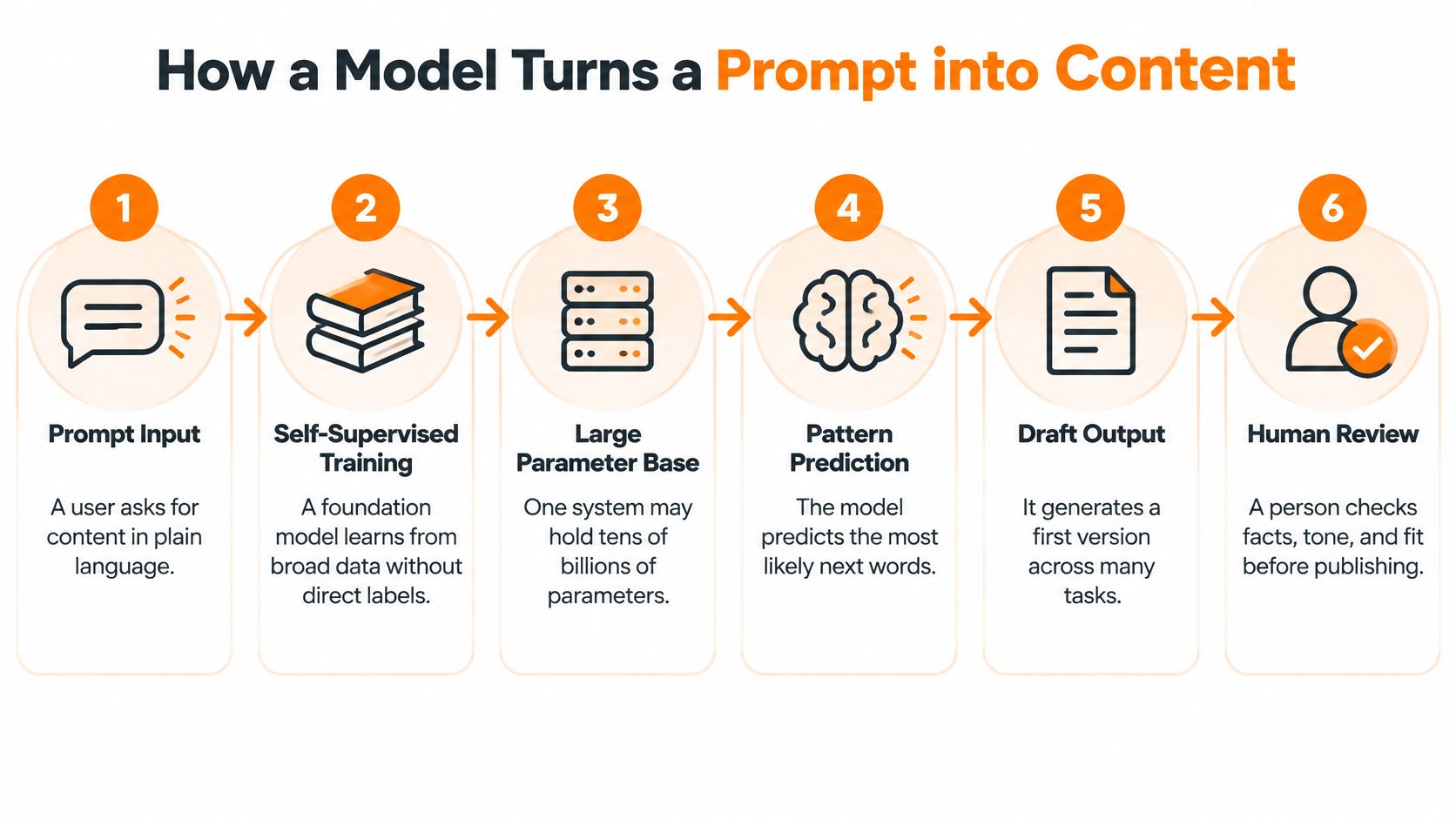
When generating text, the system estimates possible next tokens, which can be words or pieces of words. It selects or samples a token, adds it to the context, and repeats.
Think of very capable autocomplete that has absorbed patterns from a large library, not a researcher who checked each shelf. The system usually isn't retrieving a finished museum paragraph from storage.
What changes the museum draft?
The same request can produce different results because several controls affect generation:
- Prompting: Specifying families, plain language, and approved museum notes narrows the task.
- Temperature and top-p: These influence sampling choices, changing how predictable or varied the wording becomes.
- Retrieval: Supplying relevant source passages gives the model material to use, but doesn't guarantee faithful interpretation.
- Post-processing: Later editing can adjust the draft's tone, formatting, or phrasing.
With more varied sampling, the museum description might become livelier. It might also add an appealing but invented founding year; lower temperature doesn't guarantee that such details are correct.
The basic problem is that likely language and verified facts aren't the same objective. A sentence can fit the preceding words perfectly while describing something that never happened.
Image generation uses different technical methods but follows the broader pattern-learning principle. A model creates a picture from learned visual relationships rather than retrieving a stored image file.
Where Teams Use AI-Generated Content
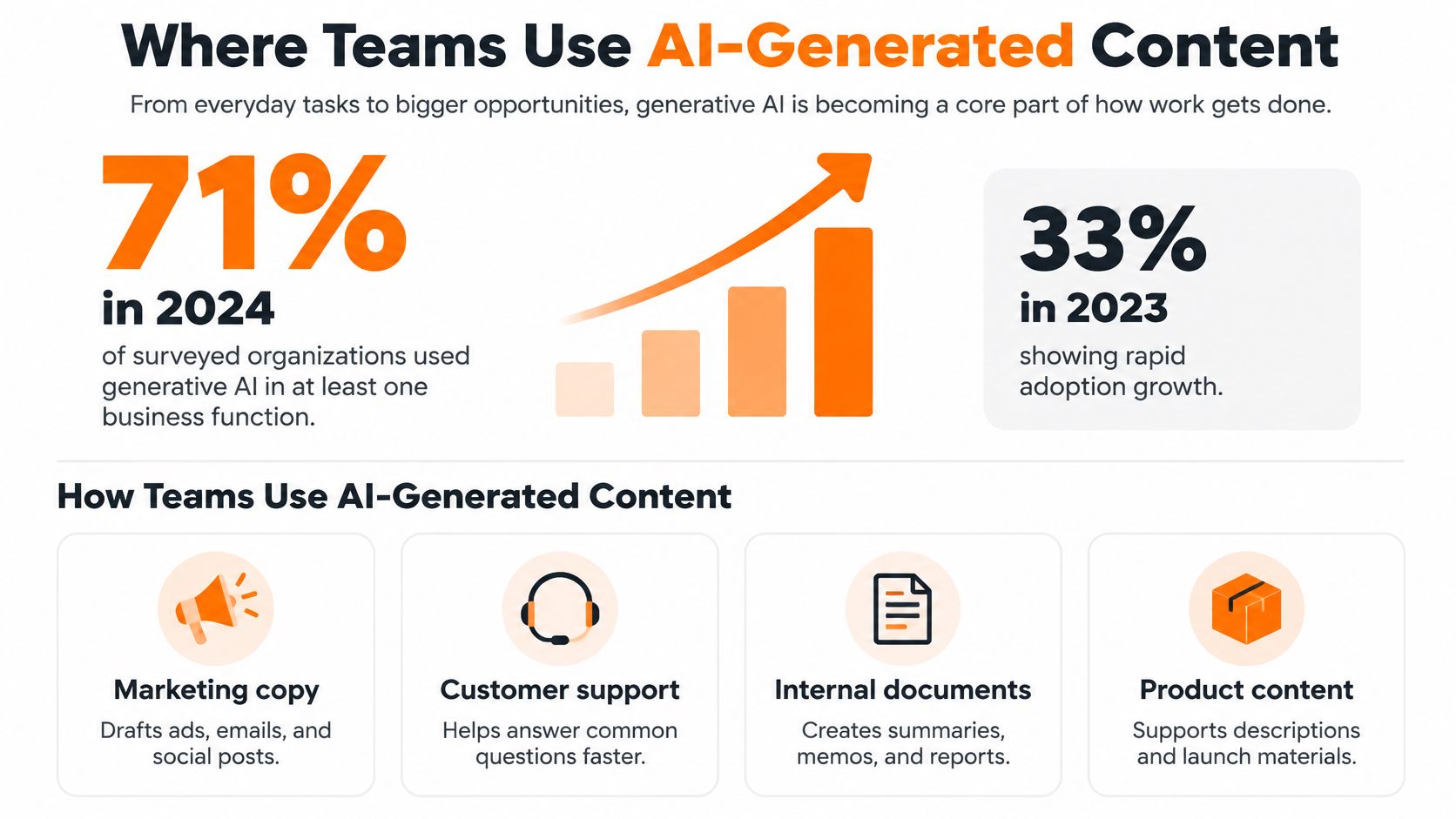
Many organizations now run generative AI in at least one business function, from marketing teams to customer service desks. Heavy use says nothing about review, though. A company can route almost every draft through a model while keeping people accountable for each sentence it publishes.
This graphic pairs that growth in adoption with the business applications behind it.
Where drafting assistance helps
The common thread across these uses is work that benefits from an editable starting point:
- Marketing and product copy: Article drafts, descriptions, email variations, and launch materials.
- Customer support: Suggested replies built on approved policies and documented customer issues.
- Internal work: Meeting summaries, briefing notes, and code suggestions.
- Creative development: Image concepts, voice drafts, and short video treatments.
A catalog team wants to start 20 product blurbs in one afternoon. The editor supplies approved specifications, and the model turns them into draft descriptions. The gain is less time assembling repetitive sentences. The editor still checks materials, prices, compatibility, and product promises before anything ships.
That split is the pattern worth noticing. AI involvement sits on a spectrum, from a grammar pass on a finished paragraph to a complete first draft, and the useful question is rarely "was a model involved?" The sharper questions are "who checked the facts?" and "who approved publication?"
Match the tool to the task
An AI writer creates new content from prompts, a different job from correcting a finished paragraph. This explanation of how an AI copywriter fits into content production can help a team define that drafting role before anyone opens a tool.
For narrower social publishing, ViralBrain offers a way to generate LinkedIn posts with AI. A sensible starting point is an approved announcement or argument, rather than an invitation to invent achievements or customer outcomes.
Non-native English writers can use models the same way, arranging their own facts into a clearer first structure. The value lies in reducing language friction without replacing the writer's knowledge or intended meaning.
Whatever the task, assign an owner before generating anything. Someone needs to decide which sources are authoritative, resolve contradictory specifications, and approve the final copy.
Faster drafting helps only when someone still owns the sources and the decision to publish.
When Fluent Wording Still Gets Facts Wrong
A model writes a smooth paragraph about a neighborhood festival. It places the festival's founding in the wrong decade and leaves out the community that organizes it.
Nothing in the sentence rhythm reveals either mistake. For local and contested subjects, unequal factual reliability can matter far more than whether a paragraph sounds robotic.
Checking the substance requires attention to the underlying documents, not just the prose.
Why local context needs extra care
Training material can contain outdated accounts, stereotypes, omissions, and deliberately misleading information. A model can reproduce those problems in the same confident style it uses for accurate information.
A review published in Dialogues on Digital Society discusses a geopolitical veracity gradient linked to the dominance of Global North contexts and limits in the generalizability of English-language data. That finding isn't a reason to dismiss every generated statement about another region; it's a reason not to assume equal reliability across contexts.
Local history, minority communities, non-English records, and contested political claims deserve checks that reflect their setting. A widely repeated English summary may omit information that community archives preserve.
Verify the festival, not its writing style
For the festival paragraph, source triangulation means comparing independent accounts rather than finding pages that repeat the same mistake.
- Start locally: Compare the organizer's archive with independent local reporting or a library collection.
- Inspect the claim: Find what the source establishes, including whether it describes the first event, a revival, or a renamed festival.
- Check representation: Look for the community's own description and notice whose role is missing.
- Ask for expertise: When important questions arise, consult a local historian, organizer, or relevant specialist.
- Preserve uncertainty: Attribute disputed dates or interpretations instead of smoothing disagreements into certainty.
For any number you retain, record the exact source passage and its context. Don't substitute a general overview for evidence supporting the specific claim.
Use the accompanying video as a discussion prompt about generated information, then apply the same source checks to any claims you encounter.
A second polish pass won't recover an omitted community or settle a disputed origin story. Human-like wording can make an unsupported claim easier to miss, so readability isn't evidence.
Why Detector Scores Are Only a Screen
AI detection is a classification task with two ways to fail. A detector can flag human writing as generated, and it can miss generated writing that has been edited, translated, or produced by a system it was not trained to recognize.
Independent evaluations have found that detectors can misclassify essays by non-native English writers at high rates, and that human or automated polishing can make authentic drafts look more machine-like. Those results do not set a universal error rate for every tool. They do show why a confident label cannot establish authorship by itself.
A score works more like a smoke alarm than a signature. It can tell you to inspect the draft, while the evidence about authorship still sits in prompts, notes, drafts, citations, and review history.
What detectors actually examine
A detector looks for patterns associated with generated output. Ordinary writing and editing can mimic or erase those patterns.
Detector signals and what weakens them
| Signal | What it suggests | What weakens it |
|---|---|---|
| Token predictability | The next words are unusually likely | Human edits and mixed sentences |
| Low sentence variation | Rhythm stays unusually even | A plain human style or later polish |
| Repetition | Phrasing looks template-like | Short factual copy that must repeat terms |
| Stylometry | Voice resembles a known model | Non-native English and heavy revision |
| Watermark | A mark was embedded at generation | Paraphrase, translation, or an unmarked model |
A watermark differs from a stylistic guess because a system adds a signal during generation. It can support provenance, but it isn't universal: unmarked systems avoid it, and later transformations can weaken or remove it.
An AI detector can estimate AI-like signals in a draft. For a fuller explanation of interpreting those estimates, consider how accurate AI detectors are.
What to do with a flag
For an academic submission, ask about the writing process before drawing a conclusion. For business copy, investigate whether the draft followed the approved workflow rather than treating a score as proof of misconduct.
Keep source notes, working drafts, citations, revision history, and the reviewer's approval. These records answer concrete questions about where claims came from and who checked them.
A detector flag starts an investigation into the process; authorship still needs evidence.
Don't ask someone to keep rewriting until a score drops. That turns an evidence question into a style exercise and may remove useful information about how the work was produced. Judge factual reliability and disclosure on their own terms; fluent wording can come from heavy human editing, and stiff wording can come from a cautious human writer.
Which Outputs Need a Mark or a Label
The practical disclosure question is whether a system substantially generated or altered the content, not whether software touched the file. Under European Commission guidance on AI transparency rules, ordinary assistive editing can fall outside the marking framework when it doesn't substantially alter the input or its meaning.
Technical marks and public disclosures serve different purposes
Article 50 of the EU AI Act requires covered providers to mark synthetic audio, images, video, and text in machine-readable form, with transparency obligations scheduled to apply from August 2, 2026; the marks must be effective, reliable, and interoperable as far as technically feasible.
The European Commission's guidance on AI-generated content disclosures distinguishes those technical marks from deployers' visible disclosures for deepfakes and public-interest text, with an exception for text subject to human review and editorial responsibility.
Marks and labels by output type
| Output | Machine-readable mark | Visible public label | Practical note |
|---|---|---|---|
| Synthetic image, audio, or video | Required from covered providers | Required for deepfakes that could seem real | A caption alone is not the technical mark |
| Public-interest text | Required for covered synthetic text | Required unless human review and editorial responsibility apply | An edited news explainer can differ from an unreviewed post |
| Ordinary spelling or minor edit | Generally outside synthetic marking | No under this minor-edit distinction | The edit must not substantially change meaning |
| Internal draft or client working copy | Record the tool as good practice; covered provider duties remain relevant | Not a public label by default | Keep drafts and the reviewer's name |
| Fully synthetic public post | Yes for covered provider outputs | Yes when it informs the public on a matter of public interest, unless the exception applies | Human accountability still sits with the publisher |
A machine-readable mark is intended for automated detection. A visible label tells the audience directly that content was generated or manipulated.
Deepfakes include synthetic or manipulated images, audio, and video that could falsely appear authentic. An internal news explanation checked by an editor therefore raises different publication questions from an unreviewed public-interest post.
Recording production history
The Content Credentials deployment guidance describes a compatible tool recording an asset as newly created, asserting AI generation, logging the tool and timestamp, and cryptographically signing the credential. This records production history and integrity information rather than merely adding a caption.
Correcting spelling is a different intervention from rebuilding an article's claims and structure. Keep copyright separate too: a new arrangement of words doesn't automatically establish originality or permission to reuse protected material.
How to Draft Review and Humanize Responsibly
Start with a source-led assignment, not an empty prompt. The following workflow keeps drafting, correction, and style editing distinct.
Keep the substance under human control
-
Write the factual foundation yourself. List the claims, names, approved terminology, and source passages before opening a model. For the museum example, include the verified opening information and collection details.
-
Ask for an outline or draft restricted to those points. Explicitly forbid new statistics, invented quotations, and unsupported historical details, while recognizing that instructions don't guarantee compliance.
-
Check the generated draft against the sources. Inspect every number, proper name, and local detail. Remove anything you can't support rather than asking the model to make it sound more convincing.
-
Use a paraphrase tool when a sentence needs clearer wording or a different construction. A crowded museum sentence might become separate statements about the collection and visitor facilities without changing either claim.
-
If grammar is the only problem, correct grammar. Don't regenerate an otherwise sound paragraph just to fix agreement or punctuation.
Edit style without changing the record
-
Humanize only after the facts are stable. This means adjusting cadence, word choice, and voice. Unlike paraphrasing a difficult sentence for clarity, a naturalness pass might vary sentence length or replace stiff phrasing while keeping the information fixed.
-
Save the prompt, generated draft, and edited version. Disclose model involvement when it materially shaped public, client, or academic claims, following the applicable policy.
For an editing-led publishing approach, VeloCMS explains how to edit AI drafts for your blog. Pair that workflow with the publisher's responsible-use guidance, especially when an assignment has authorship or disclosure conditions.
Before accepting a rewrite, compare factual verbs carefully. Changing may offer to offers, or planned to available, alters meaning even if every noun stays the same.
Paste the revised draft into a humanizer only after that review. Compare the versions side by side, and publish only if the sources, qualifications, and intended meaning survived.
Frequently Asked Questions About AI-Generated Content
Who owns AI-generated content?
Copyright treatment is fact-specific and jurisdiction-dependent. Human conception and substantial revision can matter, but neither fluency nor editing automatically clears copying risks.
Can a student submit it?
The institution's current policy controls. Check whether the assignment permits brainstorming, drafting, or editing, and retain prompts, sources, and revision history alongside any required disclosure.
Does translation count as AI involvement?
Yes. Translation changes wording and can shift emphasis, so ask a capable reader to check meaning, especially for technical terms and sensitive claims.
Is a grammar checker creating AI-generated content?
Not in the practical sense when it only corrects conventional grammar or spelling. Asking it to rebuild an argument, structure, or factual claims is a different intervention.
For questions about working across conversational systems, 1chat's answers about chatting with multiple LLMs address that separate workflow. Comparing model responses still doesn't establish which response is accurate.
The useful answer to what is AI generated content is about contribution, not appearance. Keep a human account of the facts, and apply a naturalness pass only after those facts are stable.
Lumi Humanizer offers a way to revise AI-generated text for more natural tone, cadence, and word choice. Visit Lumi Humanizer with a fact-checked draft, compare the revised wording with your original, and keep only changes that preserve your meaning and disclosure obligations.