You've finished the graph, but the caption still says little more than “Results.” To write clear figure captions, name what's shown, explain how to read the visual, and give enough context for someone from another field to understand it without searching the paper.
The difference is practical: a title identifies a figure; a caption lets a reader interpret it. Start with the subject, add the information needed to decode the graphic, and state the main takeaway without turning the caption into a discussion paragraph.
The Parts Every Figure Caption Needs
A clear caption tells readers what the figure shows, how its visual elements work, and what context matters. It shouldn't merely repeat the title or copy the axis labels into a sentence.
The American Statistical Association's style guidance requires a figure number and says the caption and main text together should provide a “clear and complete description” of everything shown. Its recommended sequence starts with what's graphed, then highlights important features and briefly explains their relevance.
Caption elements and what each one tells the reader
The examples below belong to a hypothetical reaction-time figure, not a reported experiment.
| Element | What it tells the reader | Example |
|---|---|---|
| Figure number and title | Identifies the figure in the text and the list of figures | Figure 3. Mean reaction time by trial type |
| Subject and variables | Says what is plotted against what | Reaction time (ms) by age group |
| Groups or conditions | Names each group, treatment or sample | Congruent and incongruent trials |
| Units | Removes guesswork about scale | ms, years |
| Sample size | Shows how much data sits behind each point | n = 24 per group |
| Symbols, colors and line styles | Explains what the encoding means | Filled markers = incongruent; open markers = congruent |
| Error bars and statistics | Defines the spread and any test used | Error bars show the standard error of the mean; name the statistical test if one is reported |
| Abbreviations | Defines terms the body text does not explain | SEM, standard error of the mean |
Be precise about what the sample size counts. Participants, specimens, independent experiments, and repeated measurements aren't interchangeable. If each point summarizes participants, say so rather than leaving readers to guess what n means.
Likewise, don't describe error bars as variability. State the actual quantity plotted. A standard deviation and a standard error answer different questions, so the caption must identify which one readers are seeing.
Practical rule: Include a detail when leaving it out would force the reader to guess.
Check every row against your figure. Keep applicable information, delete irrelevant checklist items, and never add a statistical test or sample description just because another caption includes one.
How to Order a Caption from Subject to Takeaway
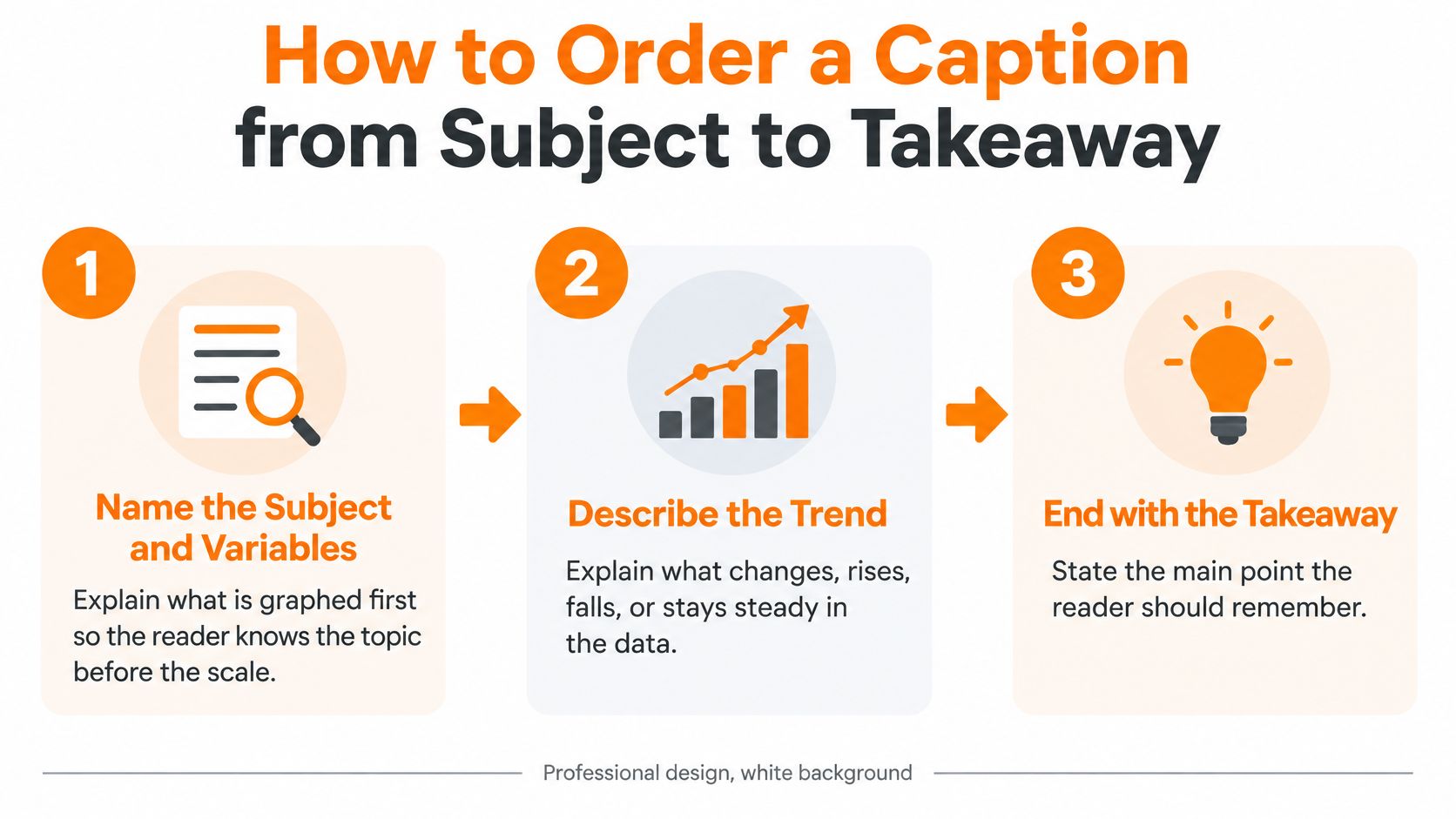
Write the caption in the order a new reader needs the information. Someone unfamiliar with your experiment needs to know what they're looking at before they can understand why a pattern matters.
The Council of Science Editors' guidance warns that labels such as “Analysis of data” are inadequate. A useful caption identifies the subject and explains the abbreviations, curves, symbols, and other elements needed to interpret the figure independently.
Build the explanation in a readable order
-
Name the subject and variables. Say what you measured and how you organized the comparison. “Mean reaction time by age group and trial type” gives readers a starting point that “Behavioral results” doesn't.
-
Explain the visual encoding next. Identify markers, line styles, colors, shaded regions, and error bars so readers can connect your words to the correct elements.
-
Describe the important feature. Point to a visible gap, peak, reversal, or steady pattern. Be specific about which groups differ rather than announcing that a difference exists.
-
Add a brief takeaway when it helps the argument. Keep it within what the figure supports, and don't turn an observed association into a causal explanation.
-
Finish with supporting definitions and statistical details. Define unfamiliar abbreviations and identify the sample size or tests where they fit naturally; the journal may prescribe a different placement.
The broad progression is subject, pattern, then takeaway. Definitions and statistical details make that progression interpretable.
A caption that names versus one that explains
For a hypothetical reaction-time experiment, compare these drafts.
Before
Figure 3. Results.
After
Figure 3. Mean reaction time for congruent and incongruent trials across age groups (n = 24 per group). Error bars show SEM. Incongruent trials are slower in every group, and the gap widens after age 60.
The stronger draft identifies the measurement, comparison, sample size, uncertainty notation, and visible pattern. To make it fully standalone, expand SEM to standard error of the mean, include the measurement units, and define the trial types if the audience won't recognize them.
Avoid starting with a conclusion such as evidence of age-related decline before naming the measurement. That forces readers to decode the figure backward and may imply more than the experiment establishes.
Direct sentences also help. The techniques in changing passive constructions to active voice can simplify awkward wording, but active voice isn't mandatory when the measurement is the natural subject. The goal is a caption that summarizes the evidence rather than argues the case.
Labeling Multi-Panel Figures Panel by Panel
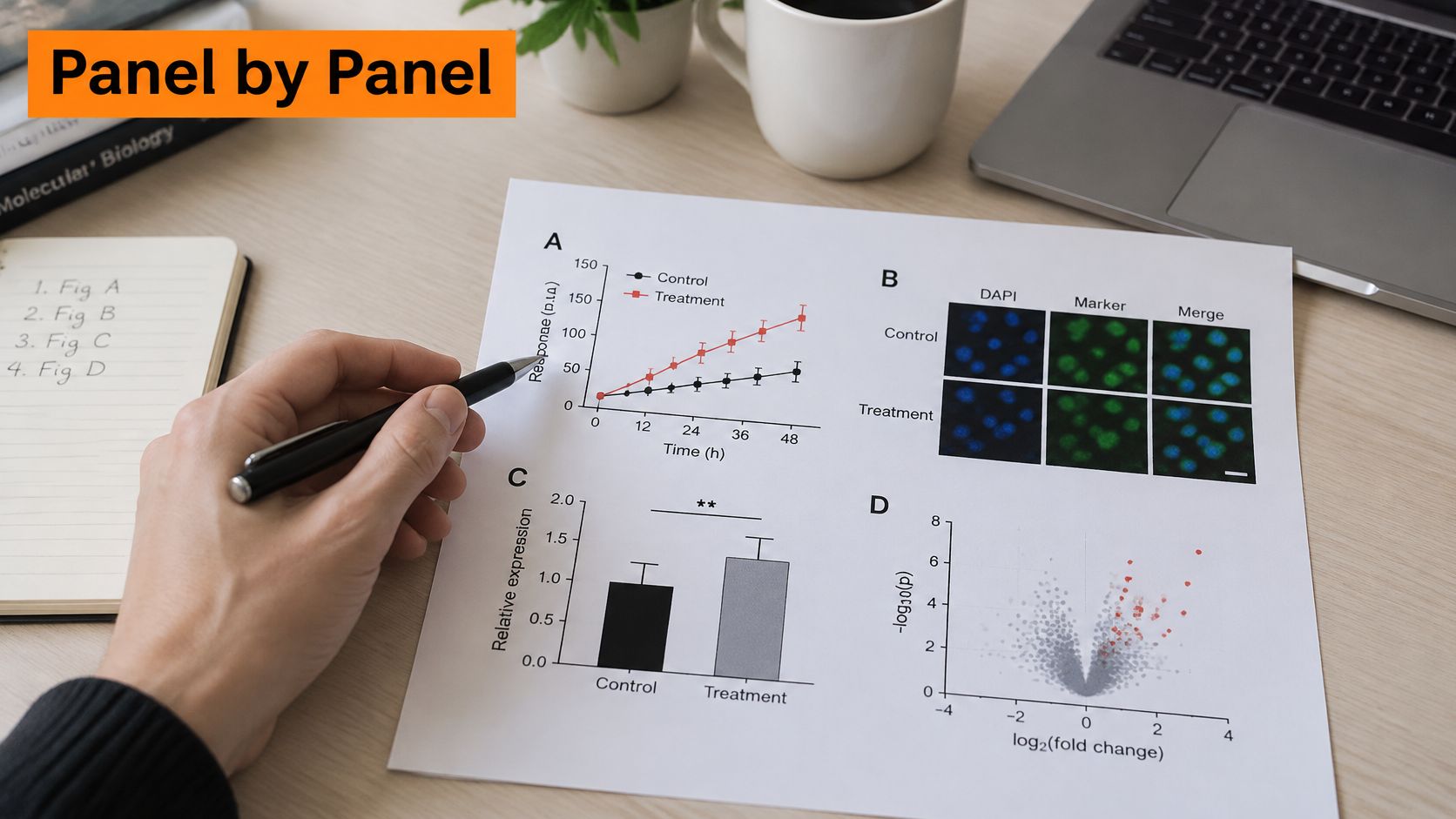
Describe panels in their reading order, using exactly the letters printed on the figure. Readers shouldn't have to infer whether a sentence refers to an image, a measurement, or a separate experimental condition.
Science's manuscript instructions require uppercase panel labels such as A, B, and C, with each panel described in sequence. They also require nomenclature, abbreviations, symbols, and units to match the main text.
Give each panel a clear job
Consider this hypothetical cell experiment:
Figure 4. Effect of compound on cell growth. (A) Untreated cells. (B) Cells exposed to 10 µM compound for 48 h. (C) Quantified fluorescence, mean ± SD, n = 3.
The panel letters connect each description to a specific location. Panel A establishes the untreated condition, panel B identifies exposure conditions, and panel C distinguishes the numerical summary from the images.
That's more useful than saying that the left, middle, and right panels show cells and quantification. Positional descriptions become confusing when a figure is rearranged, and they don't clearly assign each condition to its label.
The worked example still needs a scientific editing pass. Replace the generic compound name with its actual identifier, define SD as standard deviation, and explain what the sample size counts. Also confirm that fluorescence genuinely measures cell growth; if it measures another outcome, revise the title rather than implying an unsupported connection.
Handle shared information without repetition
When panels use the same visual key, state it once and identify its scope. For example, explain that filled markers represent treated samples in all plots, rather than repeating the same definition after every panel description.
Use panel-specific statements when the meaning changes:
- Shared symbols: Say which panels use the common key.
- Different scale bars: Give each panel's scale-bar value and unit.
- Different summaries: Identify which panels show means, individual observations, or another summary.
- Consistent terminology: Keep compound and group names identical to those in the results text.
Don't assume equal-looking image dimensions mean equal magnification. The caption must explain the scale shown, not what readers might infer from the layout.
For a quick labeling test, cover the figure and read the caption. If a reader can tell which letter corresponds to each condition or measurement, the panel descriptions are doing their job.
How Long a Caption Should Be
There's no universal correct length. A caption should be long enough to make the figure interpretable, but it must also fit the target journal's rules.
For research articles, Science advises about 200 words at most per caption and a short boldface title. Nature's author guidance requires fewer than 300 words per legend, beginning with a brief overall title and defining the panels, symbols, error bars, and statistics.
Published caption length limits and requirements
| Source | Length limit | Required content |
|---|---|---|
| Science research articles | About 200 words per caption | Short bold title; panel descriptions; units and symbols |
| Nature author guidance | Fewer than 300 words per legend | Brief overall title; panel descriptions; defined error bars and statistics |
| Medical-writing review | 40 words, excluding credits | Brief title; experimental and statistical details; symbol definitions; abbreviations |
| Other journals | Follow the journal's stated maximum | Check the target journal's author instructions first and use the stricter applicable limit when unsure |
The medical-writing review's tighter recommendation isn't a universal submission rule. Use your journal's instructions rather than importing a limit intended for another publication context.
Cut repetition before cutting definitions. Remove phrases such as the graph below illustrates or as can clearly be seen. Keep the subject, conditions, units, visual key, necessary statistics, and a supported takeaway.
A short caption isn't clear if the reader has to reconstruct the missing information.
Move extended procedural explanations into methods and broader interpretation into the discussion. Retain experimental details that distinguish what readers are seeing, such as the treatment condition or sampling point.
When instructions appear to conflict, check whether they apply to your article type. Until the journal clarifies an ambiguity, draft to the stricter applicable limit without sacrificing information needed to read the figure.
Caption Mistakes and How to Fix Them
A caption that merely names the figure is a common failure. “Analysis of data” tells readers that you performed an analysis, but not what was measured, which groups appear, or how to understand the result.
The useful editing question isn't whether the caption sounds academic. It's what the reader still has to work out.
Caption problems, causes and fixes
| Problem | Why it fails | Fix |
|---|---|---|
| Title-only caption, such as Results | Names the topic but not what is shown | State the subject, variables and groups |
| Restates axis labels only | Repeats what the reader already sees | Add what the trend or comparison means |
| Undefined abbreviations | Forces a search of the main text | Define each term at first use in the caption |
| Missing sample size or error bar definition | Reader cannot judge reliability | Add n and state what error bars represent |
| Panel letters do not match the text | Reader cannot link panel to result | Use the same letters and terms as the body |
| Caption repeats the results paragraph | Adds length without new information | Summarize the figure; keep interpretation in the text |
Missing information and awkward wording require different fixes. If a reader can't tell whether n means participants or measurements, shortening the sentence won't solve the problem. You need to check the experiment and supply the correct description.
Similarly, expanding an abbreviation isn't always enough. A reader from another field may understand the words congruent trial without knowing what participants did, so a brief task description may be necessary.
Repair facts before polishing sentences
Try a separate editing pass for each kind of problem:
- Completeness: Mark every term or symbol that requires outside explanation.
- Accuracy: Compare conditions, units, and panel labels with the actual figure.
- Wording: Remove repetition and simplify tangled sentences without changing technical meaning.
A paraphrase tool can rewrite text for clarity and variation, but rewording never supplies missing variables, units or sample sizes. Add those facts yourself before asking a tool to improve the prose.
For a dense draft, the approach in rewriting a paragraph for clarity can help separate the main statement from supporting details. Preserve technical terms where a simpler substitute would change the measurement.
Finish by reading as an outsider. Ask what the figure shows, what each visual element means, and which statement the plotted evidence supports. Every unanswered question identifies a concrete revision, not merely a sentence that needs to sound smoother.
Frequently Asked Questions
Should a caption repeat the title or axis labels?
Not by themselves. The title identifies the figure and the axes establish its scales; the caption should connect the measurement, groups, conditions, and relevant pattern. Repeating a variable name is fine when it helps form a complete explanation.
Can a caption state the conclusion?
Yes, a brief, supported takeaway can guide the reader. Describe what the figure establishes, but leave extended explanations, alternative interpretations, and broader implications to the discussion. Don't use causal language unless the study supports it.
Does a figure need a caption if the body explains it?
Yes. A reader should be able to approach the figure separately and understand its essential content. The caption doesn't need to reproduce the results paragraph, but it should supply the local definitions needed to interpret the visual.
Can a caption be shorter than the journal limit?
Yes. A maximum isn't a target, and adding sentences merely to approach it makes the caption harder to use. A shorter caption works when all applicable information remains, including the subject, groups, units, sample size, symbols, and statistical definitions.
Run a Final Check Before You Submit
Start with mechanical consistency. Match the figure number to its citation in the text, check every panel letter, and verify that the caption describes the final version of the graphic rather than an earlier draft.
Then read it cold. You should be able to identify what's plotted, decode the markers, and state the main point without consulting your notes.
Test the caption and accessibility text separately
Ask a colleague from a neighboring field to read the figure and caption together. Ask them to explain the measurement and comparison back to you; their hesitation can reveal an abbreviation or assumption you've stopped noticing.
- Check the submission rules: Confirm length, placement, and title formatting.
- Verify the science: Recheck sample counts, units, statistical summaries, and significance markers.
- Write separate alt text: Summarize the essential visual message rather than duplicating the full caption.
The Australian Government Style Manual recommends short alt text of fewer than about 100 characters for informative images. For the hypothetical reaction-time graph, an example is: Line graph showing reaction time rising with age in both trial types.
The caption supplies the fuller variables, panels, and conditions. Alt text serves a related accessibility purpose; it doesn't replace the caption.
Review the final wording yourself
Use the grammar-checking workflow for a final sentence-level pass, then check spelling, grammar, and clarity with the Lumi Grammar Checker. A grammar tool won't establish whether your units or sample size are correct, so always review the final output before publishing or submitting it.
Knowing how to write clear figure captions ultimately means checking both layers: the explanation must read naturally, and the scientific details must remain exact.
Lumi Humanizer offers an AI Humanizer designed to make AI-generated drafts sound more natural while preserving their main point. If your caption's facts are complete but its wording still feels stiff, visit Lumi Humanizer to refine the flow, then compare the revision against your figure before submitting.