You've read a classmate's draft, spotted a problem, and paused over the comment box because you don't want to sound harsh. Here's how to give constructive peer review feedback: identify the passage, explain its effect on the work, and suggest a feasible revision. Be direct about what needs changing, but distinguish what you can demonstrate from what you merely prefer.
Useful feedback doesn't require you to rewrite the draft or prove you know more than its author. It requires comments the author can evaluate and act on, including an honest account of the limits of your expertise.
The Three-Part Structure Behind Useful Comments
A constructive comment gives the author a location, an explanation, and a next action. Naming a weakness isn't enough. The author needs to understand where it occurs, why it matters, and what a workable correction would look like.
Use this sequence when drafting a comment.
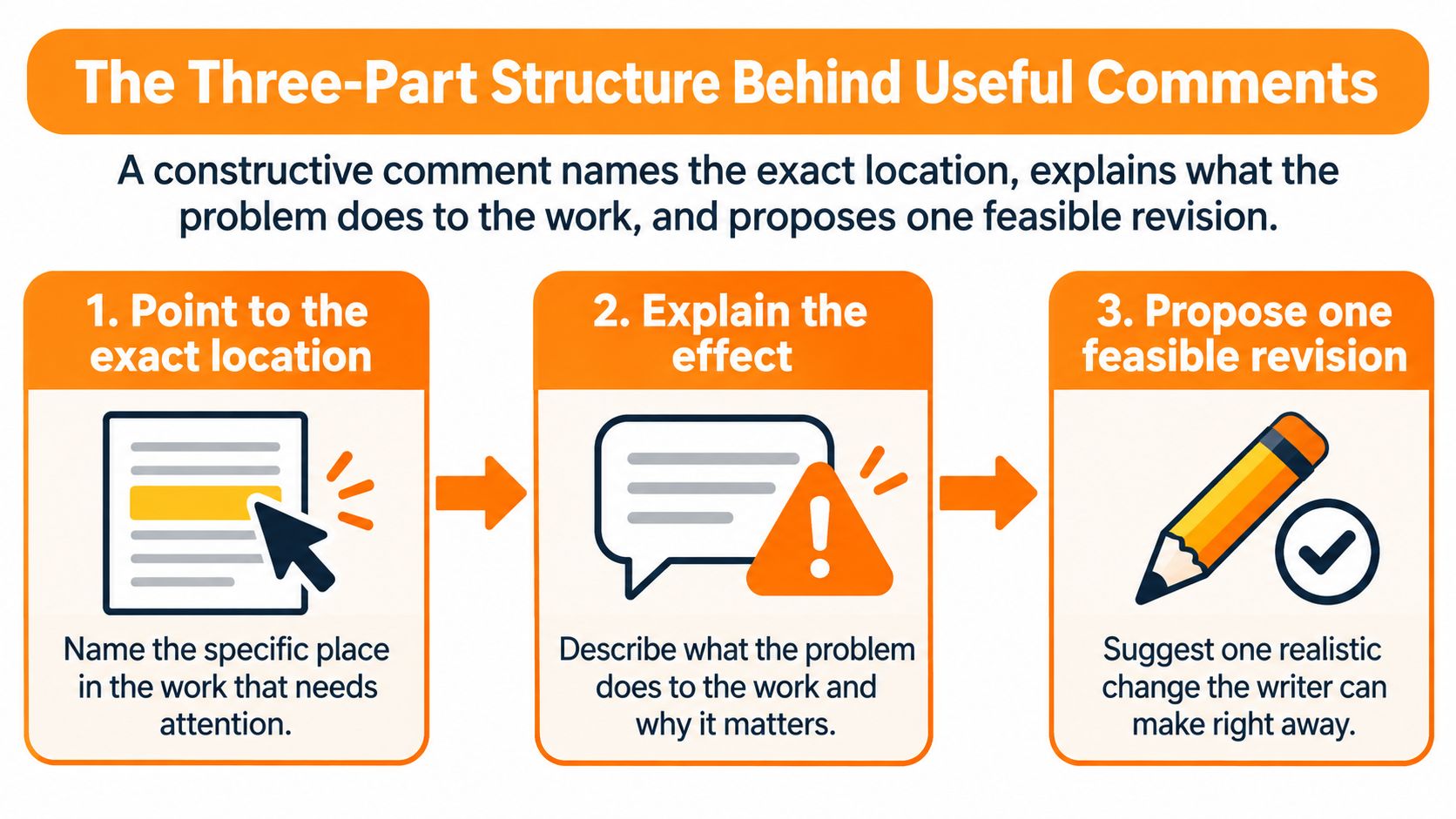
- Locate the issue. Name the paragraph, page, line, table, or section. Identify the observable problem rather than giving the whole draft a negative label.
- Explain the effect. Say whether the issue makes the argument harder to follow, leaves a claim unsupported, or prevents someone from understanding the method.
- Propose a manageable revision. Suggest a concrete action. If the underlying problem requires substantial work, identify the first decision the author needs to make.
Say you're reviewing an essay in a writing circle. Instead of saying that the thesis is buried, point to the second paragraph: the main claim appears only in its final sentence, so readers encounter the supporting details before knowing what they support. Suggest moving that claim to the opening and adding a sentence connecting the evidence to it.
Keep the judgment attached to the work
This approach reflects peer review's emphasis on informed evaluation rather than personal judgment. A historical account of editorial peer review describes how the Royal Society established a publication committee in 1752 and introduced a more formal process drawing on its Fellowship in 1831–1832.
For a modern reviewer, the practical lesson is to assess the claim, evidence, organization, and method, not the author's intelligence or effort. A missing explanation is observable; an accusation that the author didn't try isn't.
The accompanying video offers another way to approach the feedback process.
Before sending: Could the author act on this comment without asking what you mean?
A discussion may still be necessary for a difficult methodological issue. But the author shouldn't need a follow-up just to discover which passage you meant or what change you're proposing.
Rewriting Vague Comments Into Usable Feedback
Most vague feedback stops at a judgment. Useful feedback supplies the missing connection between the judgment and an editorial decision.
The following examples are illustrative, not quotations from actual reviews. Notice that each rewrite gives the author something more concrete than an instruction to improve.
Vague comments and constructive rewrites
| Vague comment | Constructive version | What the author can do next |
|---|---|---|
| This paragraph is unclear. | The main claim appears in the final sentence; move it to the opening and add one sentence on how the evidence supports it. | Restructure the paragraph around the claim |
| Good job overall. | The introduction states the problem well, but the second section jumps to results without describing the sample. Add one sentence on who was studied. | Add a sample description before the results |
| The argument is weak. | The claim in section 2 rests on one example; add a second case or qualify the claim as tentative. | Add evidence or narrow the claim |
| You didn't address the brief. | Criterion 2 of the brief is missing from the conclusion; connecting the conclusion to that criterion would close the gap. | Address criterion 2 in the conclusion |
The argument example offers alternatives because the right revision depends on the evidence available. Adding support strengthens a defensible claim; narrowing the wording is better when the author can't justify a broader conclusion. Don't demand more evidence automatically if a more accurate claim would solve the problem.
The positive example also needs care. If the missing sample description is your main concern, state it clearly rather than letting the compliment obscure it.
Fix the reasoning before polishing the wording
A study of peer feedback in academic writing found that 14 of 15 students improved their overall scores, and 13 students made at least one identifiable change attributable to peer feedback. Its discussion emphasizes clear assessment criteria, model comments, and a constructive mindset, a useful combination for preparing reviewers rather than asking them to improvise.
Before editing individual sentences in your comments, check for these problems:
- Unlocated commands. Replace requests to improve or clarify with the passage and the missing information.
- Personal accusations. Describe what the text does, not what you assume about the writer's intentions.
- Misplaced effort. Don't bury an unsupported conclusion beneath a long inventory of punctuation errors.
If your own explanation is tangled, the paraphrase tool guide can help you think through a clearer rewrite. Rewording is the last step, though. Smoother language won't rescue a comment that lacks a defensible reason.
Read the finished comment aloud. It should sound like practical editorial guidance, not a verdict delivered from a distance.
Praise Without Padding
Praise is useful when it identifies something the author should preserve. It's padding when it reassures without explaining what worked.
In a study of 186 student reviewers, lower-ability reviewers supplied more praise, while higher-ability reviewers identified more problems and proposed more solutions; the difference concerned feedback content rather than its overall amount. The accompanying peer-comment analysis illustrates the imbalance between generic encouragement and revision-oriented guidance.
Share of peer comments by type
| Comment type | Share of comments |
|---|---|
| Generic praise | 67.1% |
| Explicit feed-forward | about 13–14% |
| Explicit criticism | roughly 5–6% |
These figures describe the comments analyzed, not a target distribution for your review. Don't turn them into a quota for criticism. A strong draft may need little correction, while an early draft may need substantial structural guidance.
Tell the author what to protect
For a hypothetical report, useful praise could identify how the case study connects each figure to the central claim, then recommend preserving those connections when shortening the section. That tells the author what not to lose.
Generic praise offers no comparable direction. If you can't name the passage, choice, or effect you're praising, either make the compliment specific or cut it.
Praise should help the author make a revision decision, not merely make the reviewer sound friendly.
I would keep non-specific reassurance brief and spend the remaining space explaining strengths worth retaining. There's no need to place a compliment before and after every concern.
Delivery still matters. Understanding tone in writing helps you distinguish a firm assessment from a dismissive one. Keep the concern visible: excessive softening can make a necessary correction sound optional, while blunt labels can make a solvable problem sound like a judgment of the author.
Judging Within Your Expertise and Staying Fair
Confidence isn't a qualification, and hesitation isn't proof that you have nothing useful to contribute. Before making a comment, identify the kind of judgment it requires.
Some concerns need disciplinary expertise. Others need attentive reading and a clear understanding of the assignment.
| Type of concern | What you can responsibly assess |
|---|---|
| Statistical test or technical method | Whether it meets a named disciplinary standard, if you have the relevant expertise |
| Central claim and organization | Whether readers can identify the argument and follow its development |
| Technical citation | Whether it supports the specific claim, after checking it and understanding the subject |
| Conclusion | Whether its scope matches the evidence presented |
Stay with reader-level observations unless you can explain the specialist standard you're applying. If you suspect a technical problem but can't establish it, ask for clarification or recommend expert review instead of declaring the method wrong.
Use structure without surrendering judgment
Say a multilingual student reviews a lab report that calls a result significant but doesn't identify a statistical test. The student can flag the missing test name and ask the instructor whether further methodological review is needed. They don't need to decide whether an unfamiliar test was appropriate.
A lightweight review form can support that distinction. Record the criterion, the relevant passage, its effect, and a feasible response, while leaving room to explain uncertainty.
A 2025 study of 149 higher-education students found that scripted instructions produced longer, higher-quality feedback and more critical evaluation than a self-monitoring interface. Structure can therefore support judgment rather than replace it.
The trade-off is rigidity. A form becomes counterproductive when reviewers fill every box regardless of relevance or repeat stock phrases instead of examining the draft. Use prompts as checks, not as sentences you must reproduce.
For organizers assigning specialist responsibilities, Planstone's explanation of reviewer roles in scientific programs provides useful context for deciding who should assess which aspects of a submission.
Test whether your standard is fair
A criticism should connect to the work's purpose, not merely to your preferred academic voice. Unfamiliar phrasing, cultural conventions, or a different rhetorical structure aren't automatically defects.
Before submitting a potentially subjective comment, ask:
- What criterion applies? Identify the requirement the passage fails to meet.
- Would I apply it consistently? Consider whether you'd make the same objection to a familiar or higher-status writer.
- Can I demonstrate the effect? Name the ambiguity, missing connection, or unsupported inference.
- Is this preference rather than error? Label it accordingly, or remove it if it doesn't help.
Fairness also requires the willingness to intervene. In a 2025 NIH bias-mitigation initiative, more than 45,000 reviewers had completed training, and 91% said it substantially improved their ability to identify bias. That is a self-reported training outcome, not proof that bias disappeared.
Kind wording doesn't make an unfair standard legitimate.
When status differences are involved, describe the observable issue, explain its effect, and invite the writer's perspective before prescribing a solution. If you suspect discriminatory or inconsistent treatment, raise the concern through the appropriate instructor, editor, or chair rather than trying to settle it privately. Psychological safety should make rigorous discussion possible, not prevent it.
Frequently asked questions
How long should a peer review be?
Length matters less than coverage and priority. Lead with concerns that affect the argument, validity, or interpretation, then include minor notes the author can reasonably address during revision. Don't repeat the same diagnosis beside every occurrence; identify the pattern and provide representative locations.
Do I need to be an expert to comment?
No, you can assess clarity, organization, and whether the conclusion matches the evidence presented. Technical methods require more caution: ask what supports a choice if you can't independently assess it. Declaring your limits helps the author distinguish a reader's question from a specialist objection.
Should I rewrite sentences for the author?
Usually, suggest a direction rather than replacing whole passages. A short model sentence can demonstrate a grammatical repair or clarify the distinction you mean, but extensive rewriting takes over the author's decisions. Preserve their responsibility for the argument and their freedom to choose another effective solution.
Is a single review enough?
Not always, especially when reviewers are still learning. A systematic review of online peer feedback reports evidence that additional feedback rounds improved comment quality and quantity. Use another round to examine the revised work and learn whether your comments were understandable, rather than treating the original review as a fixed judgment.
Does a plagiarism check replace my review?
No. A plagiarism checker can help identify matching text for closer inspection, but it can't decide whether the argument is persuasive or your feedback is actionable. Inspect matches in context, distinguish legitimate quotation from possible attribution problems, and follow the relevant academic integrity process.
Checklist for Constructive Peer Review Feedback
Knowing how to give constructive peer review feedback matters most at the point of submission. Use this final pass to remove comments that sound useful but leave the author guessing.
- Check completeness. Confirm that each revision request identifies a passage, explains its consequence, and offers a workable next step. If the solution requires substantial work, distinguish the immediate action from the larger task.
- Make praise diagnostic. Keep comments that identify a strength the author should retain. Remove repeated reassurance that adds no editorial information.
- Check the standard. Connect criticism to the assignment, journal requirements, or disciplinary expectations. Replace statements about the writer with observations about the work.
- Separate preference from necessity. Mark optional stylistic suggestions clearly. Don't give a personal preference the same weight as a factual error.
- Verify your evidence. Recheck the passage before submitting. If you can't support an objection, turn it into a precise question or remove it.
- Prioritize the response. Put major concerns first and keep copyediting proportionate. A quick pass through the grammar checker guide can help you clean spelling and grammar from your own notes so the author can concentrate on their substance.
- Request a revision round. Ask the author to return the revised draft with a brief account of what changed. Check whether the underlying concern was resolved, not whether they copied your preferred wording.
Send a review that gives the author room to think. A well-reasoned alternative can resolve your concern just as effectively as the revision you proposed.
Lumi Humanizer helps make AI-assisted text sound more natural while preserving its main point, clarity, and intent. If your review notes read stiffly, visit Lumi Humanizer to refine their flow, then check every suggestion yourself and follow your institution's academic integrity rules.