Elegiac poetry definition has two meanings: the ancient elegiac couplet, a two-line unit of hexameter followed by pentameter, and the later English lyric of grief, memory, and optional consolation. The familiar advice that an elegy must mourn a death and finish with comfort is therefore too narrow.
A love poem by Ovid and a free-verse poem mourning a vanished shoreline can both be elegiac, but for different reasons. To understand the label, separate how a poem is built from what its speaker does with loss.
Elegiac Poetry Definition Across Meter and Mourning
In classical Greek and Latin poetry, elegiac identifies a metrical form. In modern English, elegy usually identifies a genre concerned with loss and remembrance.
Two meanings of elegiac poetry
| Label | What defines it | Typical subjects | Must it mourn |
|---|---|---|---|
| Classical elegiac verse | Elegiac couplet: hexameter then pentameter | War, politics, love, philosophy, myth, reflection, sometimes death | No |
| Modern English elegy | Sustained treatment of loss, memory, and often consolation | A person, community, culture, place, or way of life | Grief is central; consolation is optional |
| Elegiac tone in criticism | Melancholy, nostalgic, or reflective mood | Any reflective subject | No; tone alone is not enough |
The distinction isn't a minor technicality. A reader who expects every classical elegy to describe bereavement will misread love poetry, political exhortation, and personal reflection written in the same meter.
Encyclopaedia Britannica's account of elegy traces the English shift toward poems lamenting the dead from the sixteenth century onward. English writers increasingly used the term for the poem's subject and emotional purpose, rather than its ancient rhythmic construction.
Form, genre, and tone answer different questions
Form asks how the lines are organized. Genre asks what kind of literary work the poem undertakes. Tone asks what attitude or feeling the reader hears in the speaker's language.
These categories can overlap without becoming interchangeable. A poem might sound nostalgic without commemorating anything in a sustained way, just as a love elegy might use the classical meter without sounding mournful.
Practical rule: Check the meter for ancient verse; for modern English, identify who or what is lost and how the speaker responds.
Say a teacher calls Ovid elegiac because his poem uses the couplet. A student then calls an unrhymed funeral poem an elegy because it remembers a dead friend. Neither speaker is necessarily mistaken: each is identifying a different feature.
The confusion begins when the student assumes that Ovid must also be writing about a funeral. It also arises when the teacher insists that the student's funeral poem needs an ancient meter.
A useful comparison beyond poetry
Students encounter similar distinctions when learning about visual art. A movement, a technique, and a mood aren't the same kind of label; an approachable art guide for students offers a useful companion for practicing those distinctions across the arts.
With elegy, keep the categories separate before combining them. Historical context explains why the word changed, while attention to sound determines whether a poem uses the classical form.
From Greek Couplets to English Poems of Loss
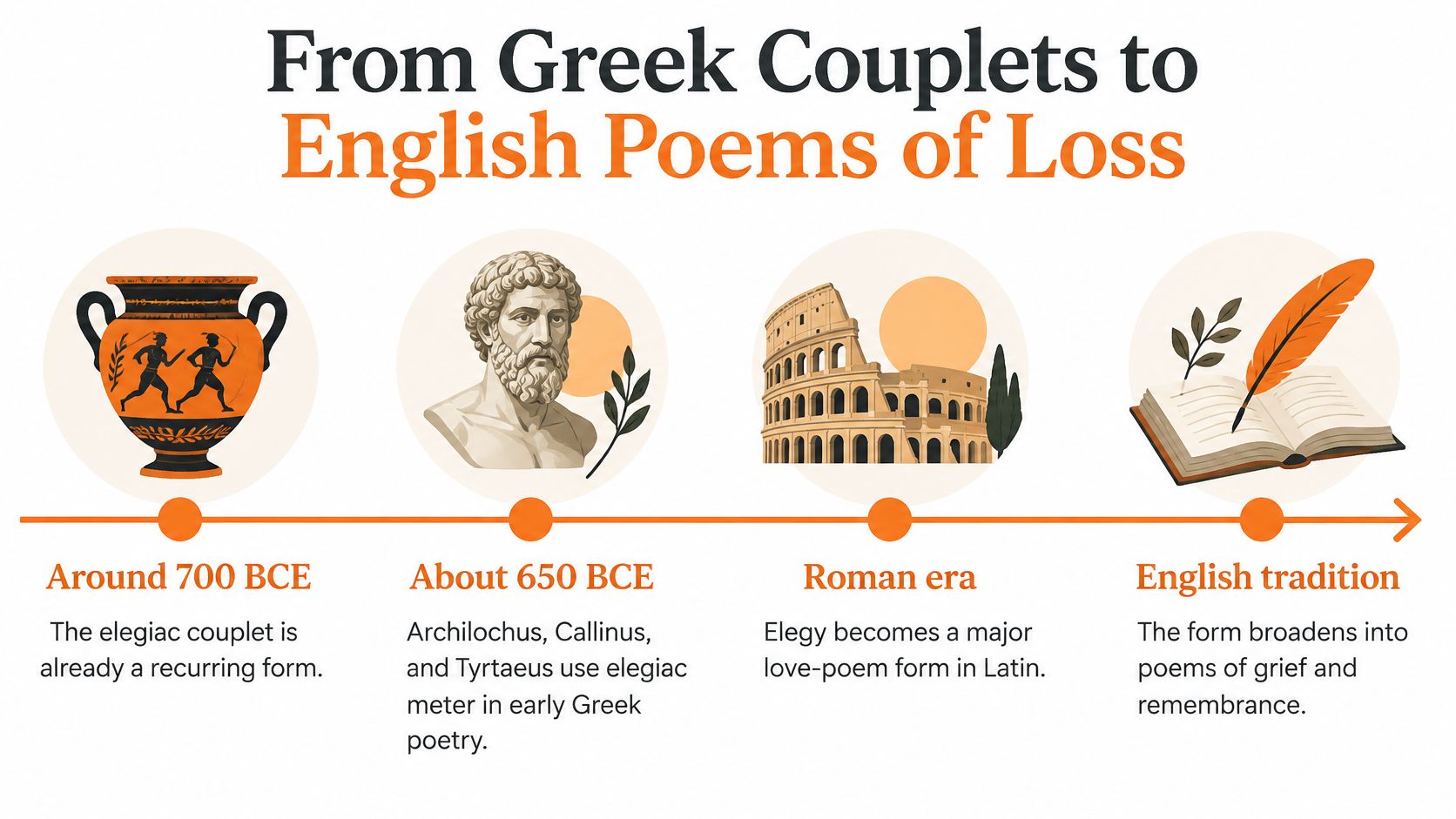
Think of the history as a change in what readers recognize first. An ancient listener could recognize a recurring rhythm before knowing the poem's subject; a modern English reader usually recognizes an elegy through its treatment of absence.
The timeline makes that change easier to follow.
Greek performance and inscription
The Oxford University Press chapter on elegiac poetry places recorded use of the couplet at roughly 700 BCE and describes Mimnermus of Colophon using elegiac verse for erotic poetry by the end of the seventh century BCE. Those uses make it difficult to treat the original form as exclusively funerary.
Early poets such as Archilochus, Callinus, and Tyrtaeus worked within a culture where elegiac verse could be delivered aloud in social settings. A listener might hear exhortation, reflection, or an argument about public life rather than private grief.
The meter also appeared in epigrams inscribed on objects, including tombstones and dedications. The same formal resource could therefore serve different situations: performance before living listeners or an inscription preserving someone's memory.
Mimnermus provides a particularly helpful example. Erotic longing belongs comfortably within ancient elegy because the defining feature is the verse pattern, not a requirement that someone has died.
From a literary form to a language of loss
By the Hellenistic period, scholars at the Library of Alexandria treated elegy as a developed literary kind. Roman poets including Catullus, Propertius, Tibullus, and Ovid then made the couplet a major Latin form, especially suited to love poetry.
Read a Roman love elegy with that background and the speaker's complaints become less puzzling. The poet can address desire, rejection, jealousy, or absence without needing to turn the poem into a memorial.
Old English poems later described as elegiac reveal another dimension of loss. Their speakers can mourn lost possessions, social standing, glory, or companionship, so the emotional world extends beyond an individual death.
A speaker can lose a place in the world without losing a particular person. Exile, separation, and the disappearance of a community can all become subjects of elegiac reflection.
Later English usage increasingly connected elegy with mourning the dead and contemplating mortality. English poets also developed an elegiac stanza, a quatrain in iambic pentameter with alternating rhyme.
The practical result is freedom of structure. A modern elegy may use blank verse, rhyme, or free verse because its claim to the genre rests on its treatment of loss, not its reproduction of a Greek or Latin pattern.
Couplet, Stanza and Modern Free Verse
The classical couplet pairs a longer line with a shorter one. The Academy of American Poets glossary describes a heroic or dactylic hexameter followed by a pentameter: a six-foot line followed by a five-foot line.
The University of Melbourne's shorthand, “six-five groove,” is a useful memory aid. But it isn't a complete guide to scansion: ancient Greek and Latin meters organize syllable quantity, not the strong and weak stresses familiar from English verse.
Forms readers confuse with elegy
| Form | Shape | What to listen for | What it counts as |
|---|---|---|---|
| Elegiac couplet | Two lines: dactylic hexameter then pentameter | A six-five groove and a shorter second line | Classical elegiac verse, including love and epigram |
| Epic hexameter | Consecutive six-foot lines | No alternating short line | Epic narrative, not elegy on metrical grounds |
| English elegiac stanza | Four iambic pentameter lines, rhyme ABAB | A steady quatrain, as in Gray | An English elegy form, not the Greek couplet |
| Modern elegy | Blank verse, rhyme, or free verse | Memory and mortality sustained across the poem | A thematic elegy, not necessarily strict classical meter |
Hear the alternation without mistaking it for scansion
Try this invented listening exercise aloud. Each beat group stands for a rhythmic unit; the exercise demonstrates relative length, not authentic ancient meter.
An even, epic-like run
DUM-da-da | DUM-da-da | DUM-da-da | DUM-da-da | DUM-da-da | DUM
DUM-da-da | DUM-da-da | DUM-da-da | DUM-da-da | DUM-da-da | DUM
A long-then-short illustration
DUM-da-da | DUM-da-da | DUM-da-da | DUM-da-da | DUM-da-da | DUM
DUM-da-da | DUM-da-da | DUM-da-da | DUM-da-da | DUM
The alternating example is the one to mark as illustrating the elegiac principle. Its shorter return interrupts the expectation of another equally long line.
Actual classical pentameter has a more particular internal arrangement than this exercise suggests. To identify a real ancient poem, scan its syllables rather than counting the apparent beats of an English translation.
English patterns serve different purposes
Gray's Elegy Written in a Country Churchyard uses the English elegiac stanza. Its alternating rhyme helps organize reflection into balanced units, but that doesn't make it an example of the Greek couplet.
Free verse offers another choice. A poet might use a short line to isolate a remembered name, then let a longer sentence carry the speaker's questions beyond the line break.
Neither approach is automatically more sincere. The useful question is whether the chosen rhythm supports the poem's attention, hesitation, insistence, or refusal to settle.
A poem about death in another meter can therefore qualify as a modern elegy while failing the strict classical form test. Its subject doesn't retroactively change its metrical construction.
Three Tests for a True Elegy
For a modern poem, ask what the speaker does with absence. Grief becomes recognizably elegiac when the poet develops it through memory, commemoration, questioning, or reflection on mortality.
The critical distinctions discussed in PMLA's Notes on the Elizabethan Elegie help explain why a melancholy atmosphere isn't enough. A persuasive reading needs an identifiable loss, meaningful rhetorical action, and attention to the ending.
Use the familiar emotional sequence as a guide, not a compulsory outline.
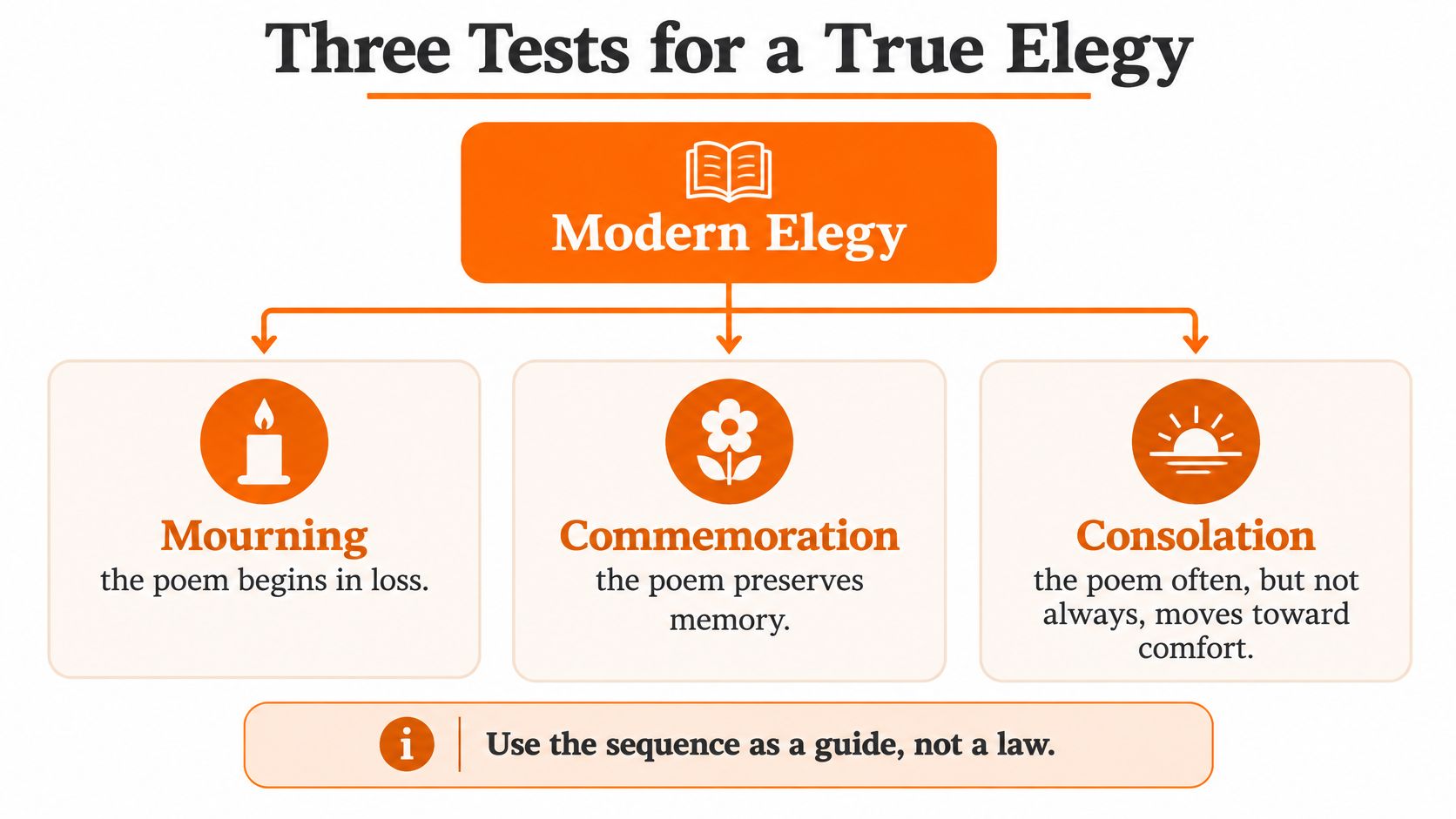
Despite the diagram's shorthand, consolation is a possible destination rather than an essential qualification. A poet may move from mourning to remembrance without offering reassurance.
Identify the object of loss
Name what is absent in a concrete phrase. In Milton's Lycidas, that starting point is Edward King; elsewhere it might be a public figure, a demolished neighborhood, a threatened language, or a destroyed habitat.
Avoid starting with an abstraction such as sadness. Sadness describes a feeling, but it doesn't explain what the poem asks the reader to remember.
Identify the speaker's action
Look for verbs you can use in your analysis: the speaker laments, praises, questions, accuses, protests, or consoles. These actions explain how the poem develops beyond an initial expression of pain.
A speaker who remembers a friend's habitual joke is doing something different from a speaker who challenges the institutions responsible for that friend's death. Both can be elegiac, but their purposes aren't identical.
For help separating attitude from action, consider how tone works in writing. A bitter tone, for example, might accompany either personal lament or public accusation.
Examine what the ending permits
Does the final movement offer reconciliation? Does the speaker remain uncertain, or reject comfort as dishonest?
Don't assume the last peaceful image resolves everything that came before. A quiet room can suggest acceptance, exhaustion, isolation, or the continued presence of an absence.
An ending can complete a poem without completing the speaker's grief.
Say a poem describes a closed factory. It names former workers, remembers the sound of their boots at the gate, asks who benefited from the closure, and ends with the gates still locked.
Its object of loss is a working community. Its actions include commemoration and protest, while its ending preserves unresolved harm rather than healing it.
Compare that with a wistful love lyric that merely describes a rainy evening. The mood may be elegiac, but without sustained attention to absence and memory, the stronger genre claim remains unproven.
Short Readings of Famous Elegies
Begin each reading with something you can point to in the poem: a named person, a pattern of address, a remembered scene, or a shift in the speaker's thinking. Then build the interpretation from that evidence.
Keep a notebook beside the text so your own observations remain distinct from quotations.
Ovid and Milton use the label differently
In Ovid's Amores, notice the verse form before assuming a funerary subject. Erotic absence, frustration, and complaint belong to the world of the lover, and the poems don't require a movement toward bereavement consolation.
For an essay, the useful opening observation is that Ovid is formally elegiac. You can then explain what the particular speaker desires or lacks without inventing a death to fit a modern definition.
Milton's Lycidas offers a different starting point: the death of Edward King. Lament and praise develop alongside questions about vocation and worth, while the ending moves toward religious consolation.
Notice first how Milton turns a particular death into a broader inquiry. Calling the poem sad is accurate but doesn't explain its intellectual or spiritual movement.
Tennyson and Gray widen the reflection
In Tennyson's In Memoriam, Arthur Hallam's death remains the central loss across changing moods. Repeated questioning matters because the speaker doesn't progress smoothly from pain to certainty.
Notice first the returns and reversals. A hopeful passage doesn't cancel earlier doubt, and a renewed expression of grief doesn't erase every possibility of comfort.
Gray begins with the unnamed rural dead and considers lives whose possibilities weren't publicly recognized. His meditation eventually includes the speaker's own mortality, widening the poem beyond a tribute to any single person.
Notice first whom Gray asks the reader to value. The reflective close matters, but so does his sustained attention to people who might otherwise remain unremembered.
For another way to approach the poems aloud, use the accompanying video alongside your own annotated text.
Four readings through the three variables
| Poem | Object of loss | Rhetorical action | Closure |
|---|---|---|---|
| Ovid or Propertius, love elegy | Erotic absence | Lament and complaint | No required movement toward consolation |
| Milton, Lycidas | Edward King | Lament, then praise | Moves toward consolation |
| Tennyson, In Memoriam | Arthur Hallam | Sustained lament and questioning | Late, uneven consolation |
| Gray, Elegy Written in a Country Churchyard | Unnamed rural dead, then the speaker's own mortality | Meditation | Reflective close |
| Contemporary elegy for a place | Landscape or ecosystem | Protest and witness | Refuses comfort |
The final row represents a possible contemporary poem rather than a named published work. Say its speaker remembers nesting birds at a drained wetland, identifies the destruction, and refuses to call replacement landscaping a recovery.
Notice first the specific world being mourned. Protest doesn't make the poem less elegiac when the protest grows from memory and irreversible loss.
In your essay, prefer a precise original paraphrase to a long borrowed passage. When exact wording matters, quote briefly, attribute it, and explain how the language supports your claim; paraphrased interpretations also need appropriate attribution.
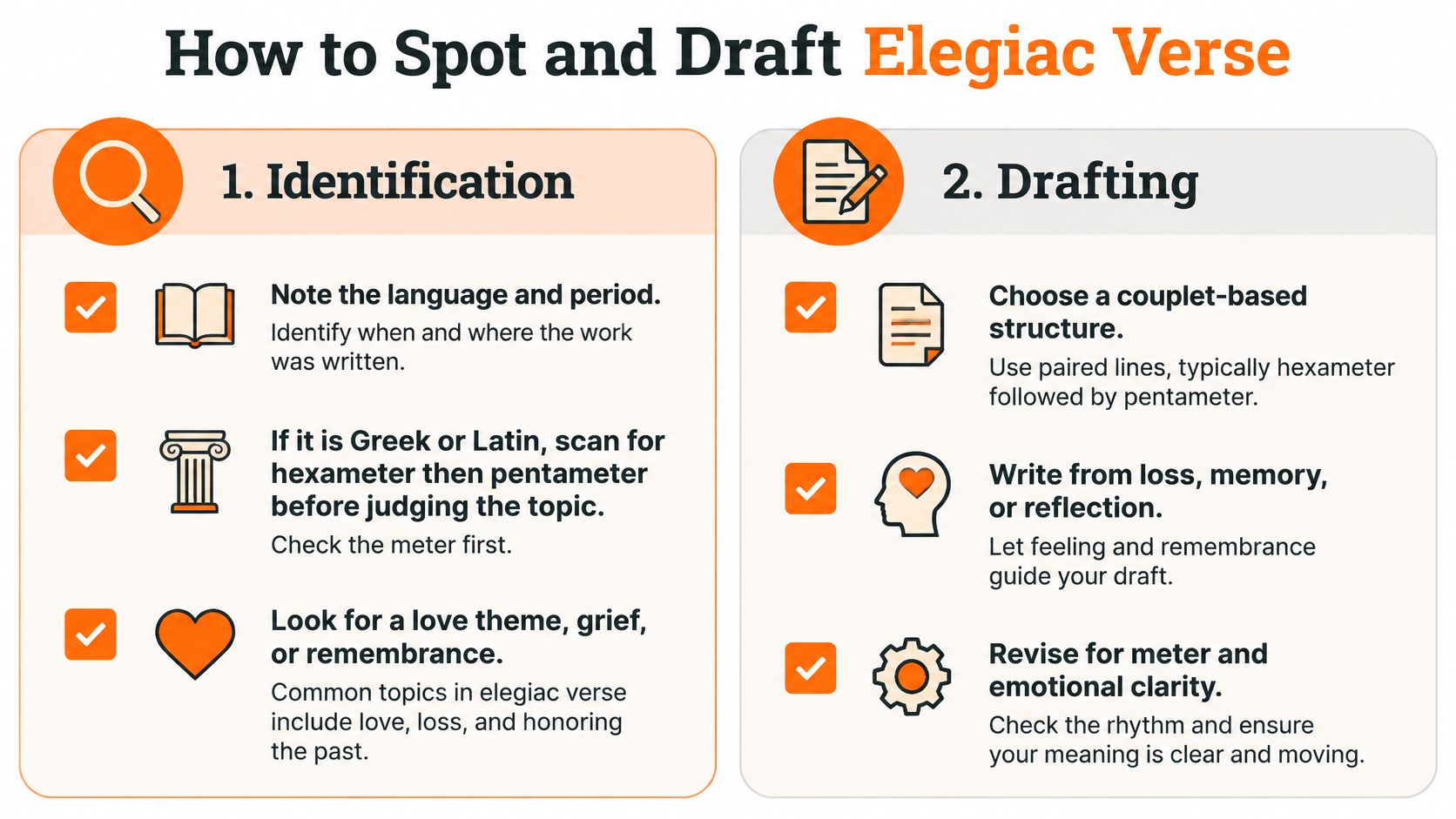
How to Spot and Draft Elegiac Verse
Identification and composition require different habits. As a reader, you gather evidence for a label; as a writer, you decide what deserves attention and what shape that attention should take.
Use this checklist as a starting aid rather than a demand that every modern elegy adopt a couplet.
Identify the poem's claim
- Establish context. Note the poem's language and period.
- Inspect ancient meter. For Greek or Latin verse, scan for hexameter followed by pentameter before judging the subject.
- Name the absence. For a modern poem, describe the object of loss in a short phrase.
- Mark the action. Find where the speaker laments, praises, questions, protests, or consoles.
- Classify the ending. Decide whether it reconciles, remains open, or refuses comfort.
- Challenge weak evidence. Reject a firm genre claim based only on a sad adjective without sustained remembrance.
Don't scan an English translation and assume you've established the original meter. Translators may preserve content while changing line length, rhythm, and rhyme.
Draft from particulars rather than declarations
- Choose a loss. Focus on a person, place, community, or other clearly defined absence.
- State what is gone. Write a plain account before trying to make it poetic.
- Record a visible memory. Select a detail a reader could picture.
- Give the speaker an action. Develop praise, questioning, or protest instead of accumulating grief words.
- Choose the ending. Allow uncertainty when certainty would falsify the experience.
- Select a form. Try a couplet imitation, an elegiac stanza, or free verse deliberately.
Before, the draft merely declares endless sorrow. After revision, the speaker sets a cup beside the empty chair and returns it, untouched, to the shelf.
The revised version gives the reader an action and an absence to interpret. A guide to examples of diction can help you evaluate whether words such as cup, chair, and untouched serve the poem better than abstract concepts.
For a prose commentary, a paraphrase tool can help test clearer sentence structures, followed by a grammar checker for grammar and spelling. Paraphrasing changes wording and structure; it doesn't automatically make a draft sound like your own voice.
If you later assemble a collection, the BarkerBooks guide to publishing poetry offers a practical publishing starting point. Revise the individual poems before deciding how to package them together.
Edge Cases and Frequent Questions
Can a poem be elegiac without being about death?
Yes. Ovid and Propertius wrote love elegies, while Tyrtaeus used elegiac verse for exhortation; the classical label doesn't require bereavement.
Modern elegies can also mourn a lost place, language, community, or possible future. What matters is whether the speaker gives sustained attention to the loss rather than merely mentioning disappointment.
Can a poem about death fail to be an elegy?
Yes. A verse report that records a death without developing remembrance or reflection doesn't automatically become an elegy.
A brief epitaph may overlap with elegiac writing, but its subject alone doesn't settle the classification. Read what the poem does instead of treating every mention of death as decisive evidence.
Can prose or free verse count?
Yes, within the modern genre. Prose elegies and free-verse elegies can organize grief through memory and reflection without reproducing classical meter.
The discussion of consolation in this Ca' Foscari University thesis also supports a broader understanding of elegiac writing that includes unresolved grief, collective losses, and nonhuman worlds. Comfort is a convention a writer can use, question, or refuse.
Refusing consolation isn't the same as failing to finish. A poet may deliberately end by preserving the reader's discomfort.
A useful elegiac poetry definition therefore keeps both axes available: historical form and the work of mourning. When you open the next poem, make a claim you can support with its meter, its remembered particulars, or its speaker's response to absence.
Lumi Humanizer helps make AI-generated prose sound more natural while preserving its meaning. After writing your close reading, visit Lumi Humanizer to refine awkward phrasing, then check that poets' names, technical terms, citations, and your interpretation remain intact.