
Unified content workflows can speed up campaign delivery, but faster drafting alone doesn't establish whether a page deserves to exist. Scale depends on whether each page serves a distinct purpose, has a named owner, and receives review matched to its risk.
More drafts won't resolve the hard decisions: which topics to refuse, who checks the facts, and when AI assistance needs disclosure. Set those rules before the publishing queue fills, so teams can stop weak pages rather than just produce more.
What Content at Scale Means for a Team
Content at scale means a team can brief, draft, review, adapt, publish, and maintain useful content without reinventing the process for every asset. Raw volume is the wrong goal. The test is whether each page has a distinct job and someone accountable for keeping it useful.
Consider contrasting teams. Team A keeps doubling assignments, but writers still deliver late. Editors discover overlapping explainers during review because nobody checked the existing site before commissioning them.
Team B approves a single brief for each page, assigns an owner to every stage, and refuses topics that an existing URL already serves. It publishes fewer pages, but spends less effort untangling duplicate work and rewriting drafts whose purpose was never clear.
Define the operating rules
Three terms make this system concrete:
- Brief: The shared document that fixes the primary keyword, search intent, unique angle, and supporting sources.
- Stage owner: The named person authorized to approve the work or stop it from advancing.
- Stop condition: A specific unresolved problem that blocks progress, such as an unsupported claim or an existing page serving the same intent.
These aren't administrative details. A writer needs to know which question to answer, an editor needs authority to reject weak work, and a channel owner needs an unambiguous publication decision.
For teams formalizing these responsibilities, MyMentions' guide to AI content governance for marketing teams is a useful companion when documenting ownership and approval rules.
Scale the responsibility, not just the draft
Demand extends across websites, search, social platforms, courses, and commerce, as reflected in the sectors covered by Polaris Market Research's digital content creation market analysis. Getting faster at writing doesn't remove the work of adapting, checking, and maintaining those assets.
Operating principle: Nobody commissions a page until someone can explain what readers will accomplish with it.
AI drafting can fit inside this operation. It belongs after a person has accepted responsibility for the facts and established why the page should exist.
The Weekly Pipeline From Brief to Publish
Run the pipeline in your existing project board or spreadsheet before buying another platform. Every handoff should carry an output, an owner, and a visible reason to stop.
Weekly content pipeline
| Stage | Owner | Required output | Do not advance if |
|---|---|---|---|
| Brief | Managing editor | One keyword, intent, angle, and sources | Another URL already owns that intent |
| Draft | Writer, optional AI first pass | Complete draft that follows the brief | A claim has no source or the angle is generic |
| Edit | Editor | Structure, accuracy, and useful internal links | The page overlaps another URL or title |
| Voice | Writer | Natural cadence with brand terms locked | Meaning, names, or claims were changed |
| Originality and clarity | Reviewer | Grammar pass and plagiarism review | Uncited copying or unclear sentences remain |
| Publish | Channel owner | Live page with a unique accurate title | Title or intent duplicates a live URL |
| Measure | Editor or analyst | Query coverage note and defect log | No query map and no update owner |
Make each handoff executable
-
Commission the brief. The managing editor records one primary keyword and tightly related secondary terms, then checks the inventory. Another URL owning the same query, modifier, and intent is a stop condition, not an invitation to find a slightly different title.
-
Draft against evidence. The writer can use an AI writer for a first pass, but must connect factual claims to supporting material. An unsupported sentence gets verified, rewritten as a clearly identified recommendation, or removed.
-
Edit the substance. The editor checks structure, accuracy, and useful internal links with varied anchors. For an ordinary guide, two to four contextual links can be a sensible working target, provided each destination helps the reader. Overlapping scope sends the draft back for consolidation.
-
Run the voice pass. Lock product names and approved terms before refining cadence. Use a humanizer when the task is making AI-assisted prose sound natural; use a paraphrase tool when the task is clarity or wording variation. Stop if either process changes meaning, names, or claims.
-
Review originality and clarity. Check grammar, spelling, and ambiguous sentences with a grammar checker, then review potential copying with a plagiarism checker. A flagged passage needs human inspection. Uncited copying blocks publication.
-
Publish the approved version. The channel owner checks the unique, accurate title, links, formatting, and final approval. An approved document isn't permission to publish a different revision.
-
Record the result. The editor or analyst adds the live URL to the query map and opens an update record. Missing maintenance ownership blocks closure of the production task.
Measure handoffs rather than typing speed
Keep comments, source decisions, and approvals attached to the same document. Practical document version control helps reviewers identify what changed instead of rereading disconnected copies.
Magic Genie's guidance on how to turn ad-hoc tasks into repeatable processes can help convert informal handoffs into explicit acceptance rules.
Optimizely reports that organizations unifying content workflows increased campaign velocity by 57%, while compliance reviews rose 137% and review turnaround declined 73%. Those findings support coordinated review, not bypassing reviewers.
For a four-week pilot, record brief-to-draft time, draft-to-approval time, approval-to-publication time, review-cycle count, and defect rate. Treat the pilot length as a practical starting point, not a benchmark. Fix the longest avoidable queue before increasing assignments.
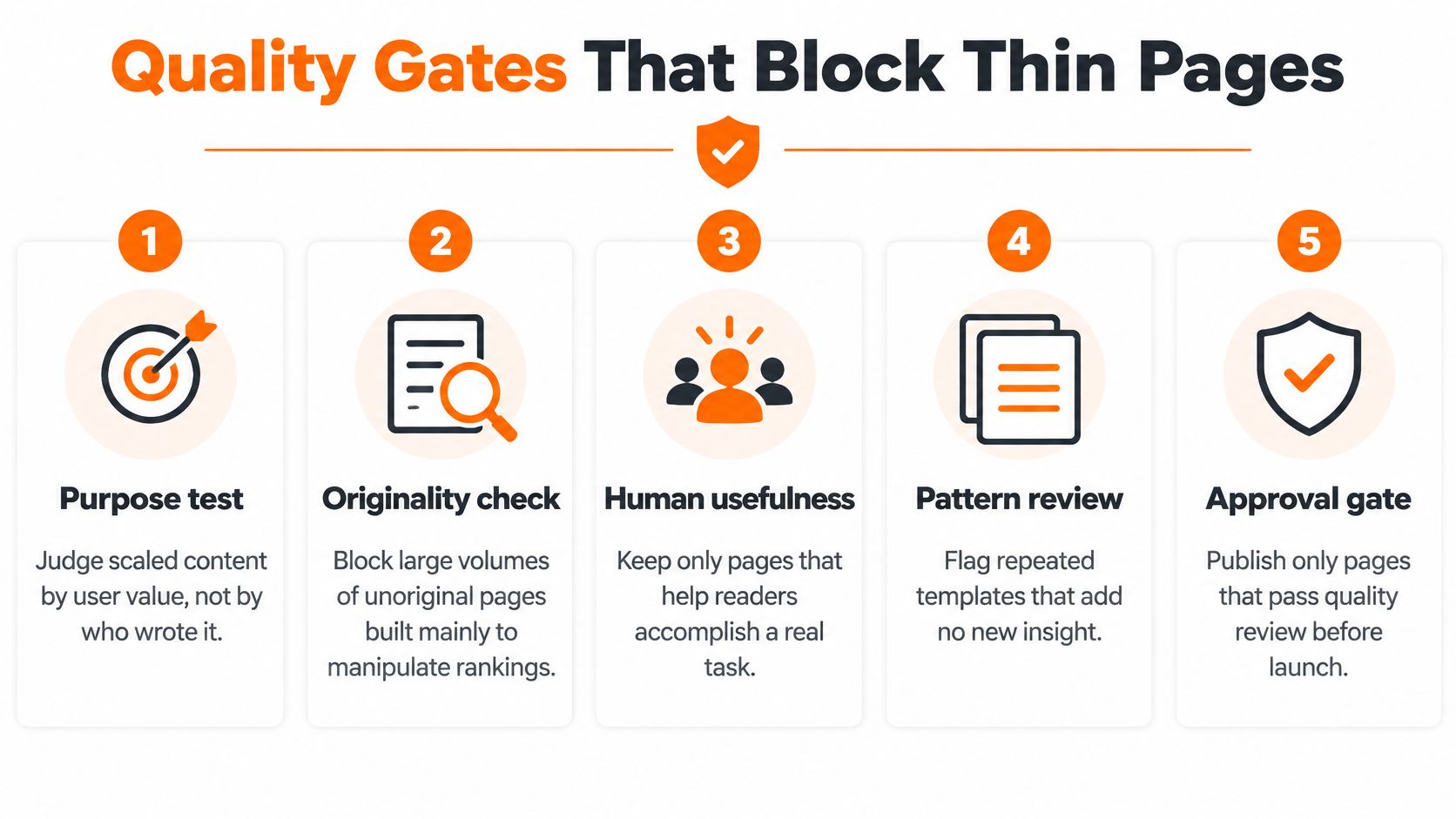
Quality Gates That Block Thin Pages
Google evaluates scaled content abuse by purpose and user value, not by whether a person or software wrote the text. Its spam policies cover large volumes of unoriginal content created primarily to manipulate rankings, including AI-generated, scraped, and stitched-together pages with little added value.
That makes page selection an editorial responsibility. Every proposed URL needs a substantive reason to exist: a distinct question, a specific audience, original analysis, firsthand evidence, or useful synthesis.
Use these gates before a page enters the publishing queue.
Replace wording variants with useful coverage
Before: An editor commissions separate pages for AI writing humanizer, humanizer for AI writing, and AI text humanizer. Each draft explains the same process using different phrasing.
After: The editor commissions a single guide that answers the shared need. Supporting sections explain editing options, meaning preservation, and review requirements without forcing readers through repetitive pages.
Google's generative-AI optimization guidance cautions against creating separate content for every possible query variation when the purpose is search visibility rather than additional user value.
A student-focused page and an agency workflow page may justify separate URLs. The student page would need substantive guidance on authorship and institutional permission; the agency page would need client approvals, terminology controls, and handoffs. Changing the audience label while recycling the advice doesn't establish a distinct purpose.
Make commissioning refusals routine
Before approving a brief, the editor fills an inventory row:
| Inventory field | Editorial question |
|---|---|
| Primary keyword | What main query does this page serve? |
| Search intent | What does the reader need to accomplish? |
| Title | Can readers distinguish this page from existing results? |
| Unique angle | What useful material won't another live page provide? |
Google's SEO Starter Guide recommends unique, clear, concise, accurate titles. Treat the title as a final distinction check, not a cosmetic fix for duplicate scope.
When a proposal matches an existing row, refuse the new URL. If the existing page is weak, improve or merge it rather than publishing a competing replacement without a consolidation plan.
A new title doesn't create a new reader need.
For implementation details, use an editorial checklist grounded in SEO content writing practices, rather than a keyword quota.
Topic clusters provide structure, not an exemption from these checks. Following the architecture described in HubSpot's topic-cluster guide, connect a broad pillar to focused supporting pages with descriptive links. Add cross-links only when they offer a genuine next step, not merely because the pages share a category.
How Much Human Review Each Asset Needs
Review depth should follow the consequences of an error, not the asset's length or the team's publishing target. Use the policy below as a starting point, then apply any legal, institutional, or client requirements that are stricter.
Review depth by content risk
| Content risk | Typical assets | Minimum review | Disclosure stance |
|---|---|---|---|
| Low | Blurbs and internal enablement | Editor spot-check and voice pass | Follow the company AI policy |
| Medium | Guides, product pages, landing pages | Source check, named editor, voice pass | Disclose when the audience would reasonably want to know |
| High | Regulated, news, academic, or reputation-sensitive | Named owner, source check, policy or permission | Disclose AI help and get required permission |
| Any factual claim | Statistics, quotes, and how-to steps | Verify against the original source | A detector score does not establish accuracy |
A short internal announcement may need only a light edit. A product page that describes compatibility needs a reviewer to check the actual specification, even if the page is shorter. Assign a human owner who can verify the claims and approve the final version; an AI tool cannot take responsibility for that handoff.
The same asset can move into deeper review if its use changes. A mistake that could materially mislead a reader warrants more scrutiny, regardless of word count. The publishing record should make clear who checked the work and what they were responsible for.
Trust requires more than fluent sentences
The Content Marketing Institute's technology marketing research reports that, in its 2025 survey of technology marketers, 13% rated AI-generated content excellent or very good, 38% rated it fair, and 7% poor. 67% reported medium trust and 4% high trust, while 45% said their organizations disclose AI-generated content.
Many readers want to know whether AI helped create content, and readers can be cautious about AI involvement in factual material. These concerns do not call for identical wording on every asset. They do make disclosure a deliberate editorial decision, matched to the content's risk and audience, rather than a choice left to the writer at publication time.
Record what AI did, who reviewed the result, and whether readers need that context. Describe the assistance accurately. Human review is a meaningful control, not a guarantee that every claim is correct.
Keep verification separate from voice
Natural prose isn't evidence of accuracy. An AI detector estimates signals associated with generated text. Its score does not establish factual reliability, originality, authorship, or policy compliance.
After factual approval, a humanizer can refine cadence and word choice. The reviewer must compare the revision with the approved text, paying particular attention to qualifications, product limitations, quotations, and named entities. If the rewrite changes a claim or removes a caveat, return it for substantive review instead of publishing it as a voice edit.
Students and researchers need an additional boundary:
- Authorship: A smoother voice does not change who developed the argument.
- Permission: Check the institution's or instructor's rules before substantive AI-assisted rewriting.
- Evidence: Retain notes, source records, prompts, drafts, and revision history.
- Attribution: Verify citations and disclose assistance where required.
For high-risk work, finish substantive review before the voice pass. Stop publication if the owner cannot verify the claims, permissions, or required attribution.
One Publishing Week Before and After
A higher draft count does not make a content operation more useful. Consider a hypothetical eight-person B2B content team asked to produce 12 posts a month. The figures below are illustrative operating assumptions, not reported results or expected performance. Each page needs a distinct reader task and a named owner; the shared queue makes both visible.

Before the inventory check
Writers maintain a shared document with 40 draft ideas. In a typical month, they publish 12 posts, including three targeting slight variants of the same workflow query. Those pages compete for the same intent, while other ideas move ahead without checking what already exists.
Review waits in inboxes for 11 days. Two posts ship with an unsourced statistic, and nobody owns updates after the publication task closes.
The bottleneck is the gap between commissioning and review capacity. Editors also spend time figuring out each draft's purpose instead of assessing whether it deserves a page.
Sample team before and after the pipeline, hypothetical
| Measure | Before | After |
|---|---|---|
| Posts published | 12 in the month | 8 in the month |
| Overlapping variant posts | 3 of the monthly posts | None among the new pages |
| Review wait before publish | 11 days | 4 days |
| Unsourced statistics shipped | 2 posts | None in the sample week |
| Drafts stopped at brief stage | No inventory check | 1 killed by inventory check |
| Owner for page updates | Nobody | One named owner per page |
The measures compare monthly publishing volume where available, while the defect measure refers to the sample week. The lower after count reflects a deliberate choice to stop duplicating pages, not a target to publish less.
After the commissioning rules change
After six weeks using the pipeline, the team publishes eight posts in the month, each with a distinct intent recorded before drafting. In the sample week, it ships two pages: a pillar explaining the operating system and a cluster page explaining review rules.
The editor rejects another proposal at briefing because the inventory already contains its intended answer. That decision prevents a new URL from competing with the existing page. The editor also assigns a person to own each published page, so updates have a clear handoff rather than ending when publication closes.
Review wait falls to four days in this scenario because sources arrive with the brief and the editor no longer has to reconstruct the angle. The writer runs the voice pass after factual sign-off, and the defect log records zero unsourced statistics that week. The operating trade-off is explicit: fewer overlapping pages, with review time spent on work that has a distinct job.
Use the video as a separate discussion prompt when reviewing your team's production habits.
What to copy on Monday is straightforward:
- Freeze the idea list: Don't turn every suggestion into an assignment.
- Kill duplicates: Compare proposed reader tasks with live URLs.
- Name the owner: Put a person, not a department, on the next brief.
Metrics That Prove the System Works
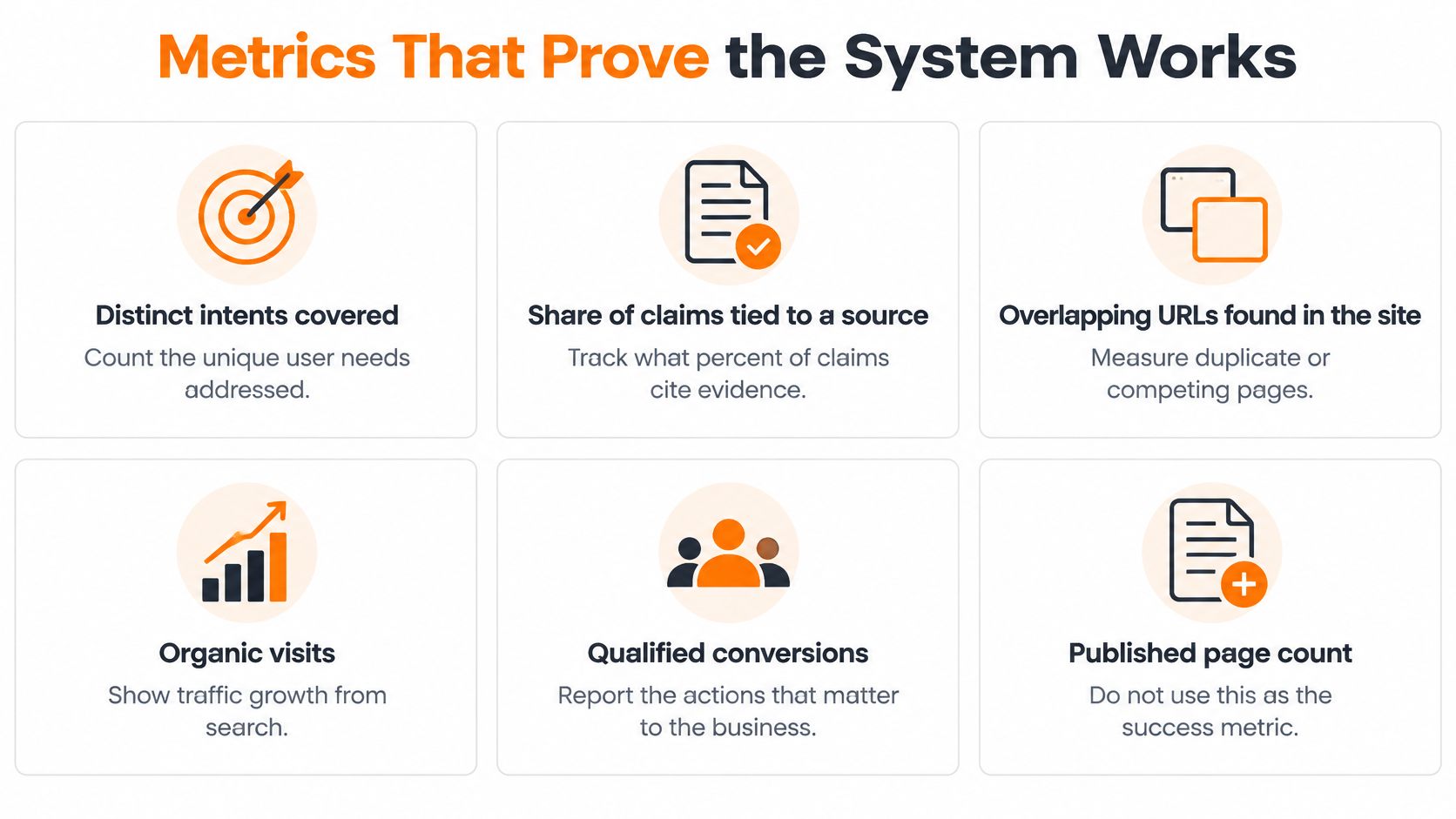
Stop treating published page count as the success metric. Use a scorecard that reveals whether the team covered useful ground, preserved evidence, and removed avoidable delays.
Six-field scorecard for a content team
| Metric | What to record | Action on a bad value |
|---|---|---|
| Distinct intents covered | Count of unique intents across live URLs | Commission only intents missing from the inventory |
| Share of claims tied to a source | Sourced claims divided by total claims | Hold publication until every claim has a source |
| Overlapping URLs | Pairs found in the inventory | Merge the overlapping URLs into one stronger page |
| Median days, brief to publish | Median across the period | Find the stage that holds the most days |
| Defect rate per URL | Logged defects divided by published URLs | Fix the stage that let the defect through |
| Source update status | Whether a source that serves many queries is current | Update that source before new pages in its cluster |
For the source-coverage field, count externally verifiable factual claims. Label recommendations and hypothetical examples clearly instead of pretending they have documentary evidence.
Keep operational measures alongside audience outcomes, not in place of them.
Map queries to sources
The academic CC-GSEO-Bench contains 1,030 source articles paired with 5,353 query–article relationships. Its one-to-many structure offers a useful mental model, although a content team doesn't need to adopt the benchmark itself.
A strong page may support several closely related queries. Counting URLs alone can't tell an editor whether those pages contribute defensible information or merely repeat each other.
For the hypothetical team, a compact monthly row could record eight URLs, eight distinct primary intents, and zero known overlaps. Record the sample week's zero unsourced-statistic defects separately. Its four-day review wait isn't automatically a four-day median brief-to-publish cycle; measure the complete cycle before entering that value.
Turn a bad row into an assignment
If the inventory shows overlap, merge the competing material and resolve the old URLs before commissioning another page in that cluster. If an important source becomes outdated, assign its update before producing more derivatives.
Maintenance rule: The page that supports several reader tasks deserves attention before another marginal topic enters the queue.
Performance monitoring can help identify where that work matters. Teams wanting to track content decline with Month17 can use declining visibility as an investigation prompt, then check relevance, evidence, and intent rather than assuming every decline requires a rewrite.
Choose AI content optimization software only after deciding which decision it should support. A spreadsheet is sufficient to begin; unclear ownership remains unclear in an expensive dashboard.
Common Questions About Scaling Content
Is AI required to run content at scale?
No. Human-written drafts can move through the same briefs, approvals, publication checks, and maintenance records. AI is optional production assistance, not the operating system.
It may shorten a first pass, but that doesn't justify assigning more drafts than editors can verify. Set capacity according to the review work the team can complete responsibly.
Does publishing more pages help search?
Only when the additional pages serve useful, distinguishable needs. More wording variants of an existing answer don't create meaningful coverage.
When a proposed page repeats a live page's purpose, strengthen the existing asset instead. Separate pages should earn their place through a different task, audience requirement, or substantive contribution.
How do several writers maintain a consistent brand voice?
Keep a short glossary of product names, approved terminology, and phrases the team avoids. Pair it with approved writing samples that show how the brand explains limits, gives instructions, and addresses readers.
Editors should approve substance before anyone refines the voice. Humanizing aims to make prose sound more natural; paraphrasing aims to change wording for clarity or variation. Neither process should change a verified claim.
Should a team check a detector score before publishing?
A detector can provide an estimate of AI-generated signals if that information is useful to the workflow. Don't turn its score into the publication gate.
A factual error can appear in natural prose, and legitimate human writing can attract an AI signal. The accountable editor still decides whether the page is accurate, useful, original, and compliant with the applicable rules.
For content at scale, the final approval should mean something specific: the facts are checked, the page serves a distinct need, and a named person owns what happens after publication.
Lumi Humanizer offers a voice-refinement option for making AI-assisted drafts sound more natural after factual review. Visit Lumi Humanizer with an approved draft, refine its cadence, and compare the result against your signed-off version before publishing.