Breaking the mold is a structural revision, not a vocabulary swap. The phrase means abandoning a standard pattern and doing something in a completely new way, not just doing the same thing better. In a draft, that means changing how ideas are arranged and connected while keeping facts and meaning intact.
That distinction matters because readers can feel when a brand sounds like every other brand. Authenticity shapes trust and purchase decisions, but the writer's practical question is narrower: does this revision change the reader's experience, or does it merely replace familiar words? A synonym swap leaves the same skeleton in place. A mold-breaking revision changes the skeleton, then checks that every fact still stands.
Where the Phrase Comes From and What It Means
“Break the mold” means abandoning a standard pattern and doing something in a completely new way, not just doing the same thing better. The phrase comes from casting and manufacturing, where a mold gives objects a repeated shape. Break the mold, and it can't produce another identical copy.
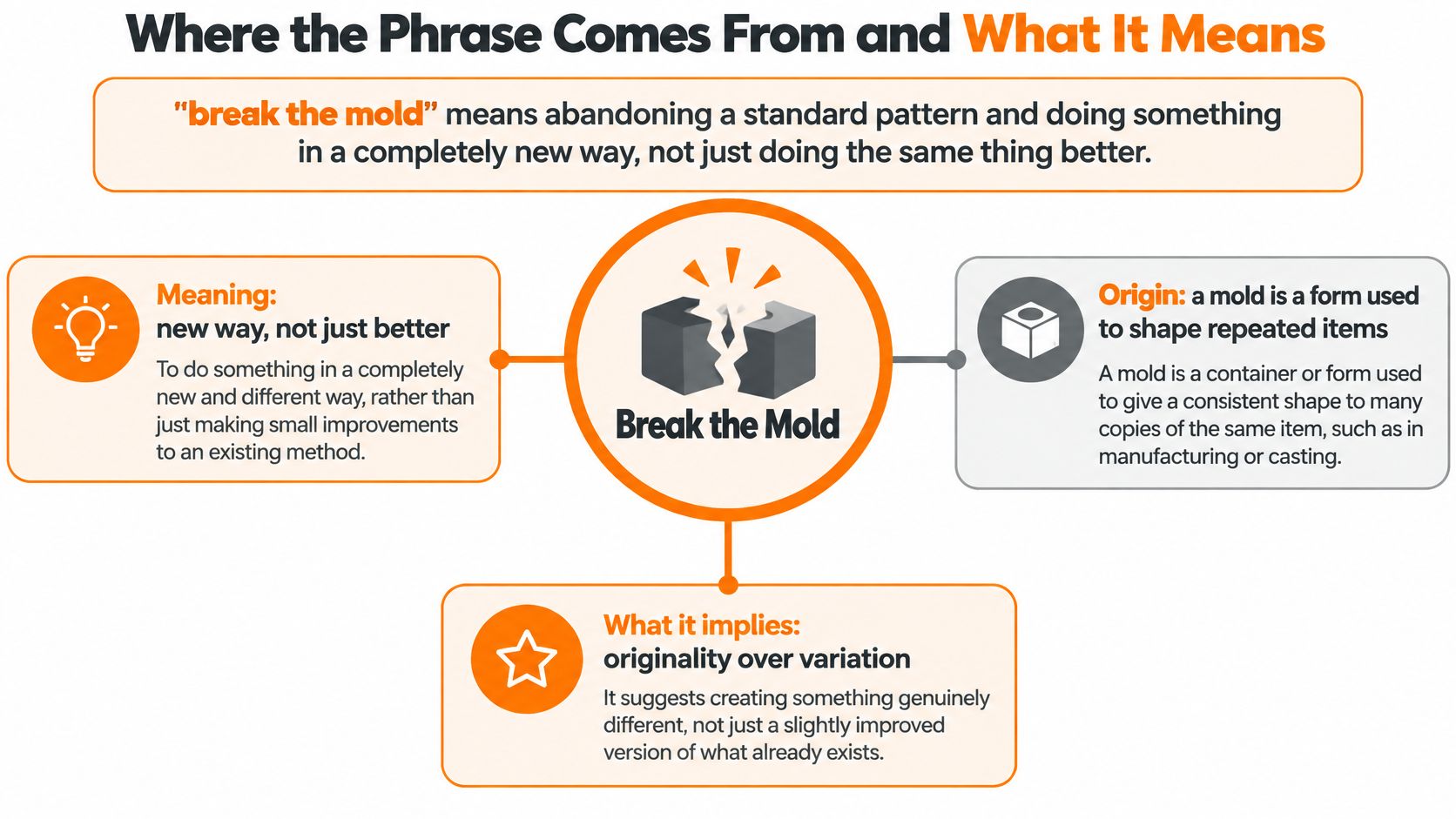
That physical image helps explain the figurative meaning. A product, practice, or piece of writing can break the mold when it departs from the usual pattern. The phrase can also describe a person so distinctive that people say the mold was broken after making them. Merriam-Webster gives both senses, defining the expression as doing something “in a completely new way” and applying it to an unusual or admired person in its dictionary entry for “break the mold”.
The expression is old: historical evidence places its figurative use at least as far back as the 1560s. It became more widely prominent much later, including in political language. In 1980, Roy Jenkins spoke of breaking an “out-of-date mould,” an idea associated with the newly formed British Social Democratic Party. The phrase also appeared in the 1953 film-related text Shane and in a 1991 U.S. presidential education message about schools that “broke the mold,” according to Grammarist's account of the phrase's history.
A simple bakery example makes the distinction clear. If a baker keeps trimming the edges of a standard cookie cutter, the cookies may look a little different, but the production pattern remains. Design a new cutter, and the shape itself changes. In a draft, the equivalent test is this: does the revision alter the pattern, or only the surface?
Mold-Breaking Versus Polishing a Draft
Most rewrites change the surface while leaving the structure alone. That's the difference between polishing a draft and breaking its mold: one adjusts wording, while the other changes how the writing guides a reader through its ideas.
| Dimension | Surface polish | Mold-breaking revision |
|---|---|---|
| Word choice | Swaps synonyms one by one | Rebuilds the sentence around its point |
| Sentence rhythm | Left as it was | Varies length and opening pattern |
| Transitions | Adds filler connectors | Shows how each idea leads to the next |
| Argument order | Unchanged | Reordered when the reader needs a different sequence |
| Meaning | May drift with synonym swaps | Checked against the original claims |
| Result | Looks different, reads the same | Reads as if a different writer made it |
A polished paragraph can look new at a glance while giving the reader the same experience. A mold-breaking revision is easier to recognize in the order of its ideas, its rhythm, and the way one claim leads to another. The table is a checklist, not a score. Every row assumes the original facts remain intact.
Two-minute test: Read the first paragraph of each version. Does the revision make a different point, or does it make the same point with different words?
If the answer is “same point, different words,” the revision may still be useful for clarity, but it hasn't changed the draft's underlying pattern. Writers looking to develop a more distinctive style can also find practical prompts in this guide to writing LinkedIn posts that sound like you. For another perspective on how different styles work on the page, see examples of writing styles.
The test isn't whether every sentence looks unfamiliar. It's whether the reader gets a clearer or more compelling route through the same material. The worked example below shows what that can look like in practice.
Why the Mold Matters for Writing and Branding
A reader can tell when a paragraph sounds as if it could belong to any company. That's a problem for content creators and SEO writers competing with similar posts, for marketing teams trying to keep proposals and brand copy consistent, and for non-native speakers whose fluent but generic English may obscure the knowledge they want to share.
Clutch's 2025 survey on brand authenticity found that 97% of surveyed consumers said authenticity influences their purchasing decisions, while 70% said they were willing to pay more for brands they perceive as real. Those figures don't mean every sentence must be clever or unusual. They do underline a practical risk: when a paragraph says nothing specific, readers may come away thinking the brand has nothing specific to say.
Specificity does more than novelty
A distinct voice often comes from details that a generic template would leave out: a named customer, a measured result, a clear position, or phrasing the team would use. A bakery could say its service is convenient, for example, or explain that customers can place an order for a cake and confirm the design before pickup. The second version gives the reader something concrete to picture.
Polishing can help a team communicate consistently, but consistency isn't the same as sameness. One useful exercise is to ask whether the sentence could be pasted into a competitor's website without anyone noticing. If so, replace broad claims with details the business can stand behind. For help identifying the attitude and relationship a piece of writing should convey, explore this guide to tone in writing.
Make the opening and ending count
Authenticity is judged by readers, so calling a paragraph “human” doesn't make it credible. The aim is writing that sounds like a real person or team and supports its claims with relevant detail. Start with the lead, the claims, and the closing paragraph. Those are the places where a vague opening, an unsupported promise, or a generic invitation can make a draft feel interchangeable.
A distinct style doesn't require bold vocabulary for its own sake. It requires the writer to decide what the reader needs to know and to say it in a way that fits the subject and the speaker. That may mean a precise example, a direct opinion, or a familiar phrase the team uses.
A Before-and-After Example from a Software Blog
A generic software introduction often opens with a broad observation about the pace of modern life, lines up three benefits in matching sentences, then ends with a vague invitation. Here's a fictional example for a software company called RelayDesk.
Before
In today's fast-paced world, teams need tools that help them work smarter. RelayDesk helps teams save time, improve collaboration, and stay organized. With a user-friendly platform and powerful features, it's easier than ever to manage your work. Discover how RelayDesk can help your business today.
After
Approvals stall when nobody knows whose turn it is. A request sits in the queue, the person who needs to review it is busy, and the team has to chase updates instead of moving work forward. RelayDesk puts approvals, reminders, and an audit trail in one place, so a team can see what needs attention and what's already been decided. See whether that process fits the way your team handles approvals.
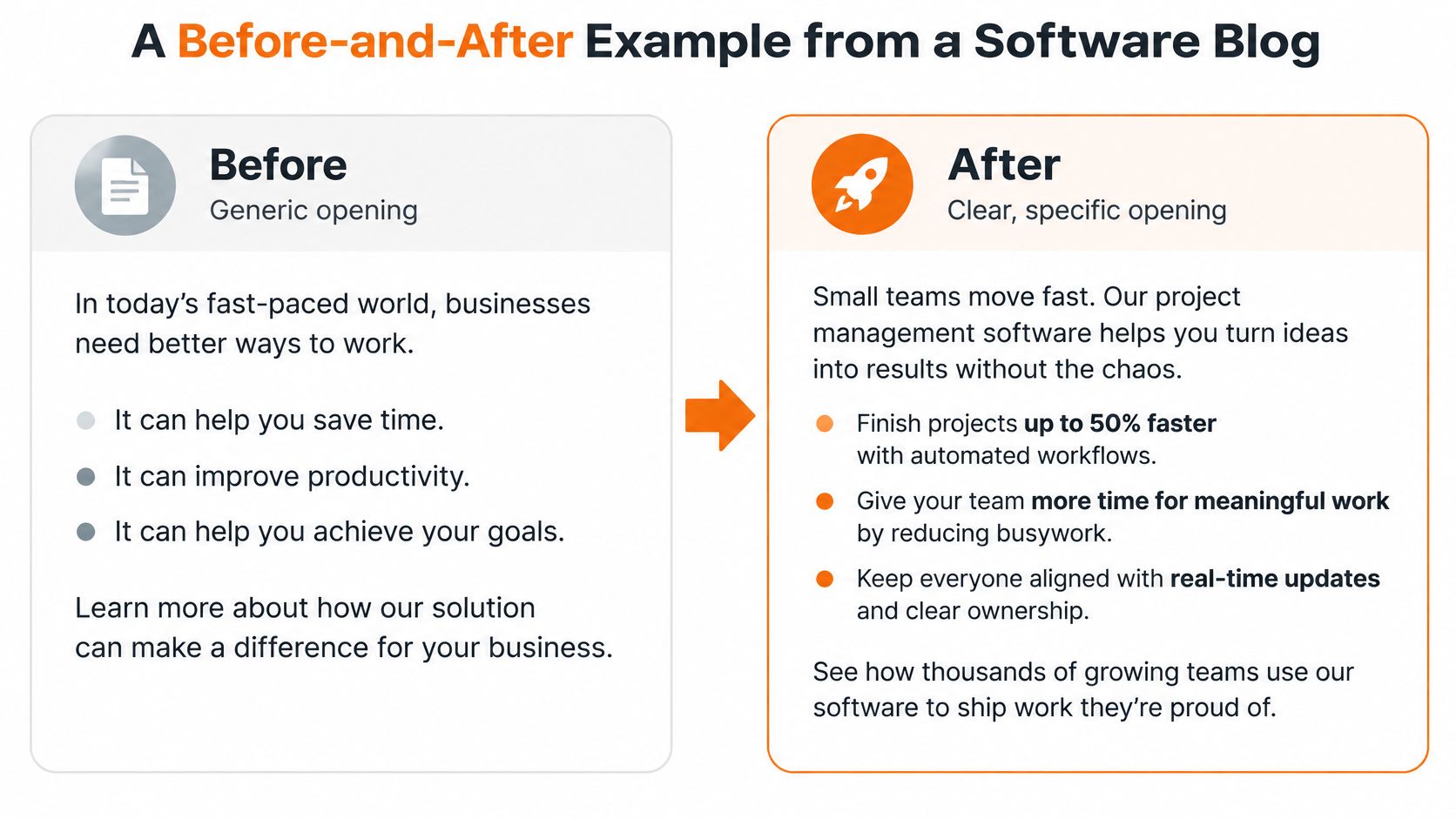
The product name, feature names, and core promise remain fixed. The revision changes the order and emphasis: it starts with the customer's problem, names a concrete situation, and introduces the product as a way to address that situation. It doesn't invent a customer, a performance result, or a numerical claim.
What changed and what stayed
The opening moves from a broad statement about the world to a specific frustration: an approval is waiting, and no one knows who should act. The image of a team chasing updates gives the reader a scene to recognize. The sentence rhythm changes, too. The short first sentence sets up the issue, while the next sentence fills in the situation.
The transitions don't rely on a string of connectors such as “in addition.” Instead, each sentence advances the explanation: a request stalls, that stall creates extra work, and the product's features make the process visible. The strongest claim, that RelayDesk helps the team see what needs attention, appears before the invitation.
That's different from paraphrasing for clarity and variation, which focuses on rewriting wording. A mold-breaking revision changes the order, emphasis, and shape of the argument. The same test applies: does the new version change only the surface, or does it give the reader a different route through the point?
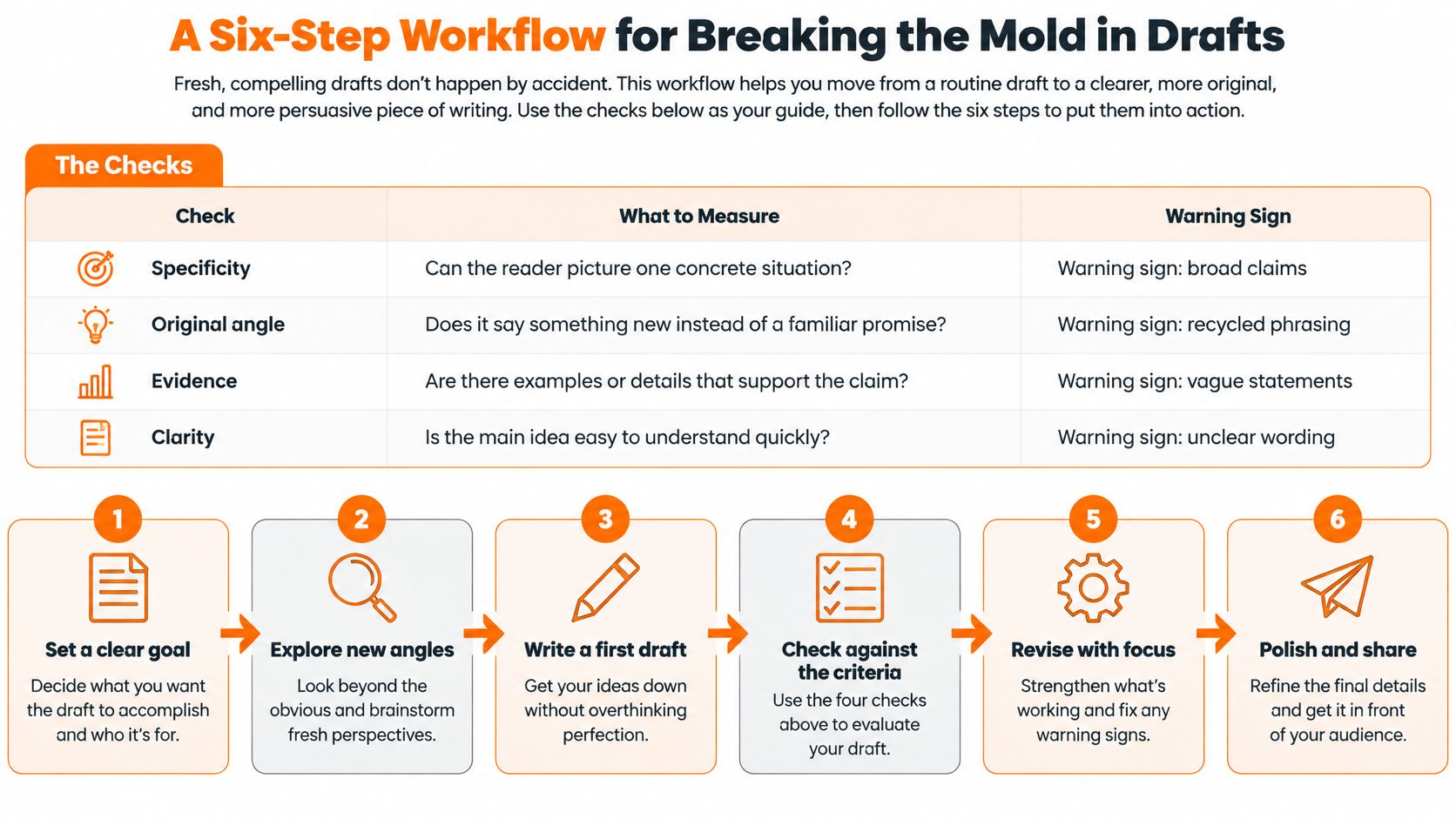
A Six-Step Workflow for Breaking the Mold in Drafts
Before revising, decide what must stay fixed and what you're free to change. Use the checks below to compare the versions, not to chase a mechanical score.
| Check | What to Measure | Warning Sign |
|---|---|---|
| Sentence length | Spread between short and long sentences | Most sentences are the same length |
| Repeated words | Words and phrases repeated across sections | The same phrase in every section |
| Passive voice | Share of passive sentences | Passive used to avoid taking a position |
| Transitions | Connecting words between paragraphs | Every paragraph opens with the same connector |
| Named facts | Names, numbers and citations | Any change from the original |
Step 1: Lock what must not change
Make a list of the names, numbers, citations, product terms, and claims in the draft. Treat that list as the boundary for revision, especially if several people will handle the text.
Step 2: Mark the mold
Underline the default opener, paragraphs with similar shapes, and stacked transitions such as “in conclusion.” Marking these habits shows where a revision can change the pattern instead of merely replacing individual words.
Step 3: Make a first pass
Run the draft through the Lumi AI Humanizer for a first pass, then compare the result against your locked list. If the request exceeds the word limit, break the text into smaller chunks before submitting it.
Step 4: Compare the versions
Use the checks table to look at sentence-length spread, repeated phrases, passive voice, transitions, and named facts. Don't force every measure to change; check whether the differences help the intended reader follow the same claims.
Step 5: Reject factual drift
Reject any edit that changes a claim, even if it sounds smoother. Keep the changes that reorganize the argument, clarify its connections, or give an important point the emphasis it deserves.
Step 6: Read the draft aloud
Reading aloud can reveal awkward rhythm or transitions that look fine on screen. Then run the revision through a grammar and clarity check for spelling and readability. For further guidance on planning and refining search-focused drafts, consult these SEO content writing best practices.
A successful revision keeps the same facts in a different shape. If the draft now flows better but the central point has shifted, return to the locked list and revise again.
Where Mold-Breaking Goes Wrong and How to Prevent It
A draft can become less effective when a writer confuses originality with being unusual. Three failure modes are common: novelty for its own sake, replacing the author's thinking, and sanding away a distinctive voice.
Novelty can bury the meaning
If unusual words or forced informality make a paragraph harder to follow, the revision has missed its purpose. Keep a phrase when it expresses the point precisely; change it when the familiar wording hides what the reader needs to know. A clear sentence doesn't need an unexpected adjective to feel distinctive.
Assistance shouldn't replace authorship
Academic writing raises a different question from style editing: who formed the argument and interpreted the evidence? A 2025 survey of 277 U.S. university students found that most respondents viewed fully AI-generated essays as serious misconduct, while views on brainstorming, editing, and partial assistance were more ambiguous. Authors should keep the argument, evidence interpretation, and reflection their own, and follow their institution's disclosure rules.
Polish can flatten a voice
Over-editing may remove regional phrasing, cultural references, useful domain language, or a writer's natural cadence. Those features aren't automatically flaws. Preserve them when they make the writing more accurate or more recognizably the author's, while revising wording that gets in the way of understanding.
An AI signal check can estimate AI-like patterns, but it can't guarantee how a reader, institution, or detector will judge a draft. An originality review can help examine plagiarism risk, but it can't establish who did the thinking.
Before publishing, check that the draft still contains your argument, your examples, your terms, and your voice markers.
Frequently Asked Questions About Breaking the Mold
How much of a draft should I restructure at once?
Start with the lead, central claims, and closing paragraph. Those parts often carry the most sameness, and revising them first makes it easier to see what else needs attention.
Does this work for short pieces?
Yes, but a short caption offers fewer structural choices. Focus on its opening line and call to action.
Should I disclose that I revised a draft with a tool?
Follow the rules of your publisher, client, or institution. Disclosure expectations differ by setting, so check the rules that apply to your work.
Is the checks table enough to judge a draft?
No. It flags patterns that need a closer look; your final judgment comes from reading the draft aloud and checking it against your locked list of facts.
Test the Method on One Draft This Week
Choose a published post or proposal that feels generic, then run the six-step workflow on a single section. Compare the original and revised versions with the checks table, and note which structural changes improve the reading experience without changing the facts.
Start a first pass with the Lumi Humanizer, where the humanizer lives at /. For regular work, review the available plan options and choose one that fits how you write. One blogger describes the effect this way: “Our first drafts sound less generic and need fewer manual edits.”, Maya, Tech Blogger

A mold-breaking revision changes the shape of a draft, not its facts. Before publishing, ask whether a reader who saw the old version would notice the difference and whether the meaning still holds.
Use Lumi Humanizer to make a draft sound more natural while preserving its original meaning. Try it on one section, then review the revision for voice, clarity, and factual accuracy before you publish.